The Beetle Larva That Smells Like a Female Bee
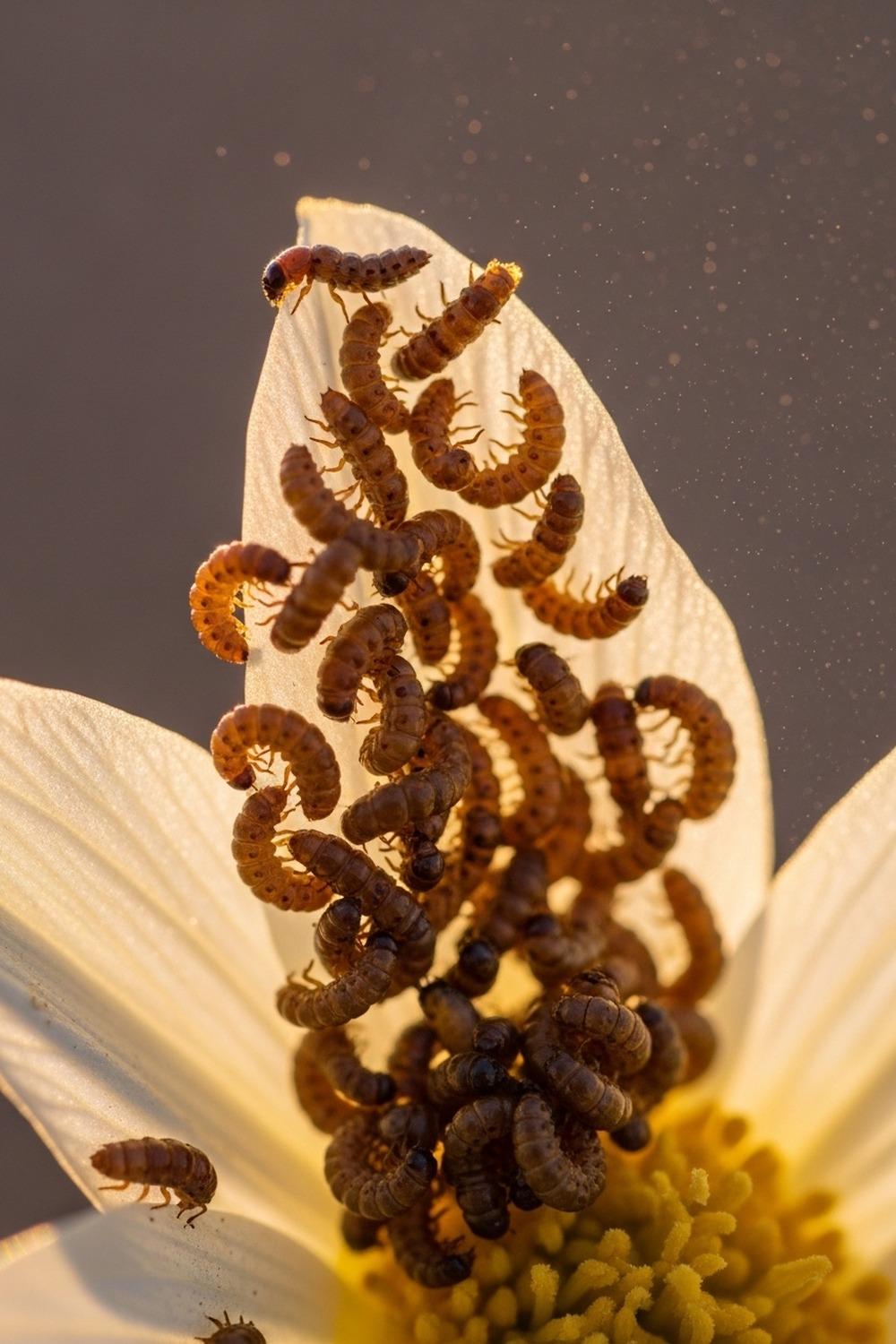
Hundreds of tiny larvae, each barely a millimeter long, pile together on a desert flower and release a chemical signal so perfectly calibrated to a bee’s sexual drive that the male never hesitates — never doubts — never survives the encounter unchanged. They are newborn Meloe franciscanus, the oil beetle, and they’ve already mastered something most predators spend lifetimes chasing: how to make a larger, faster creature volunteer to carry them to their own destruction. Blister beetle chemical mimicry doesn’t use force. It uses desire.
Deep in California’s Mojave Desert, a spring wildflower holds something stranger than anything you’d expect to find on a petal. The larvae don’t chase. They don’t hunt. They simply wait, reeking of desire, and let the world come to them. These are triungulins — the first larval stage of Meloe franciscanus — and they’ve already solved a problem that most animals never figure out: how to make a larger, faster creature do exactly what you need it to do without any physical force whatsoever.
The mechanism they use is chemical. And it’s almost flawlessly executed.
Key Facts
- Meloe franciscanus larvae release a chemical blend matching the sex pheromones of female Habropoda pallida digger bees in California’s Mojave Desert
- Leslie Saul-Gershenz and Jocelyn Millar at UC Riverside published definitive proof of the mimicry in PNAS in 2006
- Triungulins hatch in clusters of up to 700 individuals from a single egg mass
- Blister beetles as a family date back at least 40 million years in the fossil record
- Adult blister beetles secrete cantharidin, the toxin behind historically misused ‘Spanish fly’
In short: Blister beetle chemical mimicry lets newborn Meloe franciscanus larvae broadcast a chemical blend matching female Habropoda pallida bee pheromones. Male bees, fooled into attempting copulation, carry the larvae to a female and ultimately to her nest, where the larvae consume her pollen stores and egg. Saul-Gershenz and Millar verified the deception in 2006.
The Science Behind the Signal
Entomologist Leslie Saul-Gershenz and Jocelyn Millar at the University of California, Riverside, first documented blister beetle chemical mimicry in rigorous scientific detail, with their landmark findings published in 2006 in the Proceedings of the National Academy of Sciences. What they described wasn’t just a curiosity — it was a masterclass in evolutionary deception. The larvae aggregate in tight clusters on the tips of flowers favored by their target host: Habropoda pallida, the digger bee native to the Mojave. Together, the cluster releases a volatile chemical blend that replicates the sex pheromones of a virgin female digger bee with remarkable fidelity.
This is chemical mimicry in its most aggressive, calculated form — not a passive resemblance, but an active, cooperative chemical broadcast designed to trigger a specific behavioral response in a specific species. The larvae produce compounds including mono- and sesquiterpenes that overlap almost precisely with those found in the glands of unmated female Habropoda pallida. The male bee’s nervous system has no reason to doubt what it’s detecting.
What Saul-Gershenz and Millar recorded bordered on the obsessive: males approaching larval clusters with all the urgency of genuine courtship — antennating, grasping, attempting copulation. It’s not a mild attraction. That credulity is the exploit.
Individual triungulins hook their curved forelegs into the bee’s body hair — a grip evolved specifically for this moment. By the time the bee lifts off, it’s carrying dozens of passengers it can’t feel and can’t see.
From Deception to Hijacking
Getting onto the male bee is only phase one. The larvae still need to reach a female’s nest, and the route runs through exactly the kind of biological moment you’d rather not interrupt. When the now-infested male eventually encounters a real female Habropoda pallida and mates with her, the triungulins perform a swift, precise transfer — crawling from his body onto hers during the brief physical contact of copulation.
It’s a strategy so specialized that it mirrors, in strange ways, the opportunistic behavior seen in other deceptive animals across the insect world. If you’ve ever read about how crows deliberately expose themselves to formic acid from ant colonies, using other species’ chemistry for their own biological ends, you begin to see a pattern: insects exploit chemical signals with a sophistication we’re still only beginning to map. Here’s the thing — what separates Meloe from those other parasites is the precision. Not luck. Not approximation. Exact molecular matching.
Once the female bee carries the larvae back to her underground burrow, everything clicks into place.
Her nest is a sealed cell packed with pollen and nectar — precisely the nutritional cache she’s laid down to feed her own eggs. The triungulins eat it all. They consume the bee’s provisions, sometimes the egg itself, and develop through a complex series of larval stages called hypermetamorphosis, passing through at least five distinct forms before pupation. This developmental pathway, documented across the family Meloidae, involves a first-instar triungulin, then a grub-like second instar, then a quiescent “pseudopupa” stage before the final larval form and eventual adult beetle emerges. The female bee never knows. She seals the cell, flies off to provision the next one, and leaves behind a nest that will produce beetles, not her own offspring.
The cost to local bee populations, in years when beetle numbers are high, can be measurable. One infested female may produce zero surviving bees.
Evolution’s Obsessive Refinement
Why does a parasite evolve chemical precision instead of brute force? Because precision works.
Aggressive chemical mimicry of this precision — where a predator or parasite replicates the sexual pheromone of its host to gain access — is extraordinarily rare in the animal kingdom. The Meloidae family represents one of the clearest examples ever documented, but the evolutionary pressures that produced it took millions of years to align. Blister beetles as a family are ancient, with fossil records suggesting the group has been around for at least 40 million years. The chemical arms race between Meloe species and their host bees is thought to have co-evolved over a long period of reciprocal pressure — as bees became better at detecting impostors, larvae became better mimics.
According to a detailed review published in Smithsonian Magazine, the specificity of the relationship between particular Meloe species and their bee hosts suggests these pairings aren’t accidental — they’re the result of highly targeted co-evolution. What makes blister beetle chemical mimicry especially striking is how it upends the expected direction of evolutionary sophistication. We tend to assume that the parasite is always one step behind — that the host evolves defenses first, and the exploiter scrambles to keep up.
But the pheromone match documented by Saul-Gershenz and Millar is so close that it suggests the larvae may actually be ahead of the game, at least for now. The male bees have no reliable way to distinguish the cluster’s signal from a real female. No learned avoidance. No visible cue to override the chemical message. Watching a system this perfectly tuned slowly collapse from climate drift, you stop calling it an adaptation — you call it fragility wearing a disguise.
M. franciscanus is entirely dependent on a single bee species in a single fragile desert ecosystem. If Habropoda pallida declines — and desert bee populations are under mounting pressure from habitat loss and climate disruption — the beetle has nowhere else to go. That chemical dominance has a cost built in, though, one the species can’t negotiate its way out of.
The Timing Problem
The Mojave Desert’s spring wildflower bloom is the pivot point for this entire system. Habropoda pallida times its emergence to match the flowering of specific plants, particularly desert species in the families Onagraceae and Hydrophyllaceae. In turn, the larvae of Meloe franciscanus have evolved to hatch in synchrony with early bee flight. Research from the University of California system and field surveys conducted in the late 1990s and 2000s established that this synchrony is tight — triungulins that miss the early bee flights by even a few days are unlikely to find a host. They don’t survive long unattached. The window is narrow, and the stakes are absolute.
Climate change is already disrupting the timing of desert blooms across the American Southwest. A study published in 2019 tracking phenological shifts in Mojave plant communities found that some flower species are blooming earlier by as much as two to three weeks compared to records from the 1970s. Whether bee emergence and larval hatching are tracking those shifts at the same rate is an open and urgent question. Phenological mismatch — when predator, prey, or mutualist partners fall out of sync — has been documented as a destabilizing force in ecosystems from Arctic tundra to coral reefs. For a system as finely tuned as M. franciscanus and its host, even a modest mismatch could collapse the beetle’s reproductive cycle entirely within a single season.
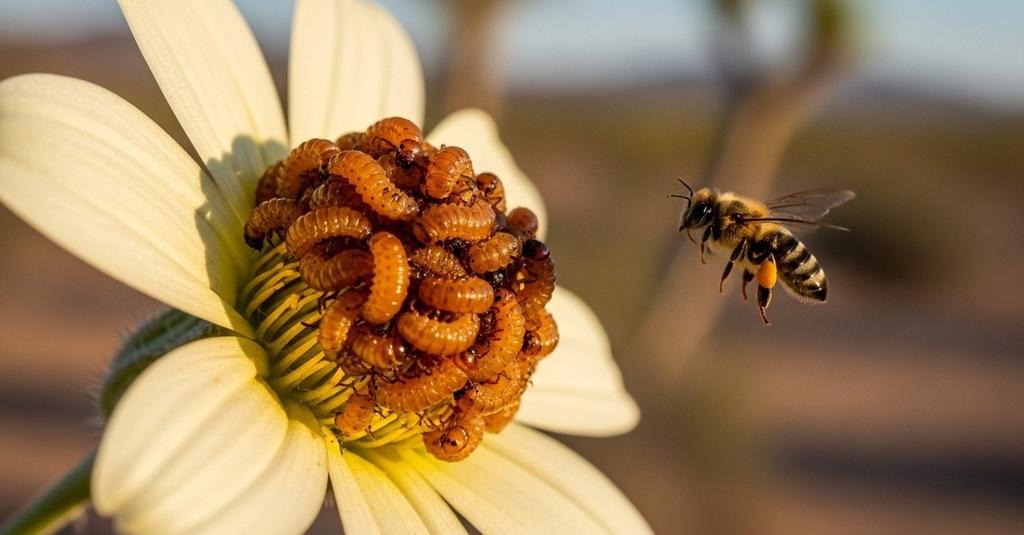
Researchers at the Mojave Desert Land Trust and affiliated university programs have been documenting Habropoda population trends with increasing urgency. The beetle’s fate is inseparable from the bee’s. Protect the pollinator, and you inadvertently protect the parasite. It’s a strange, uncomfortable conservation equation — but nature rarely offers clean ones.
How It Unfolded
- 1800s: Naturalists in Europe first described the triungulin larval stage in Old World Meloe species, noting their unusual aggregation behavior without understanding the mechanism behind it.
- 1983: Entomologist J. N. Tumilson and colleagues began characterizing the chemical ecology of blister beetle larvae, establishing that pheromone-like compounds were involved in host attraction.
- 2006: Leslie Saul-Gershenz and Jocelyn Millar at UC Riverside published definitive evidence in PNAS that Meloe franciscanus triungulins use precise chemical mimicry of Habropoda pallida sex pheromones — the first rigorous proof of the mechanism in a North American species.
- 2019–present: Ongoing phenological monitoring in the Mojave has raised alarms about climate-driven timing mismatches that could sever the beetle-bee relationship within decades.
By the Numbers
- Triungulins hatch in clusters of up to 700 individuals from a single egg mass — only a vanishingly small fraction will successfully transfer to a host bee (Saul-Gershenz & Millar, 2006).
- The pheromone blend produced by M. franciscanus larvae contains compounds matching female Habropoda pallida secretions to within chemically detectable fractions of a percent.
- A single female Habropoda pallida provisions approximately 4–8 nest cells per season; infestation of even one cell eliminates all beetle or bee offspring within it.
- Mojave Desert wildflower bloom windows have shifted by as much as 2–3 weeks earlier since the 1970s, according to phenological tracking studies published between 2015 and 2019.
- Meloe franciscanus adults are capable of secreting cantharidin, the defensive toxin that gives the entire blister beetle family its name — potent enough to raise fluid-filled blisters on human skin within hours of contact.
Field Notes
- In 2006, Saul-Gershenz and Millar confirmed the mimicry by synthesizing the larval chemical blend and applying it to glass beads — male Habropoda pallida bees attempted to mate with the beads, demonstrating conclusively that the larvae’s shape and movement were irrelevant to the deception. Chemistry alone was sufficient.
- Triungulins that fail to transfer to a female bee during the male’s mating encounter don’t get a second chance — they’re highly mobile in their first instar but have no ability to locate host nests independently. Their entire survival strategy is based on a single, borrowed moment of intimacy.
- The cantharidin produced by adult blister beetles has a surprisingly long history of human use — it was an ingredient in so-called “Spanish fly,” historically and dangerously misused as an aphrodisiac, which adds an uncomfortable irony to a beetle whose larvae exploit the sex drive of another species.
- Researchers still can’t fully explain how larval hatching is synchronized so precisely with peak male bee flight — whether the trigger is temperature, photoperiod, or a chemical cue from the host plant remains unresolved, and the answer matters enormously for predicting how the system responds to climate change.
Frequently Asked Questions
Q: What exactly is blister beetle chemical mimicry, and how does it work in Meloe franciscanus?
Blister beetle chemical mimicry is the process by which newborn Meloe franciscanus larvae collectively produce a chemical blend that matches the sex pheromones of female Habropoda pallida digger bees. The larvae aggregate on flowers in clusters of dozens to hundreds, and their combined chemical output is strong enough to attract male bees from a distance. The male bees, unable to distinguish the signal from a real female, approach and attempt to mate — allowing the larvae to grab onto them. The deception was chemically verified by Saul-Gershenz and Millar in 2006.
Q: Does this parasitic strategy harm the bee population in any lasting way?
It can, particularly in years when beetle populations are high relative to bee numbers. Each infested female bee carries larvae back to her nest, where they consume the pollen stores and often the egg she’s laid — producing zero bee offspring from that cell. Because Habropoda pallida is a solitary bee with a short annual flight season and limited nesting capacity, repeated high-intensity parasitism can suppress local bee reproduction measurably. However, in stable ecosystems, the relationship appears to be in long-term balance — the beetle can’t afford to drive its host to extinction.
Q: Are blister beetle larvae dangerous to humans who might encounter them?
The larvae themselves are unlikely to cause direct harm in the way adults can. It’s the adult blister beetles that produce cantharidin, a potent defensive chemical that causes painful fluid-filled blisters on contact with skin. Triungulins in the field are tiny — under two millimeters — and wouldn’t typically be noticed by a casual observer. That said, anyone handling adult Meloe beetles should avoid crushing them against skin. The cantharidin they release is fast-acting and causes tissue damage; historically, it has caused deaths in livestock that consumed hay containing crushed beetles.
Editor’s Take — Alex Morgan
What stops me cold about this story isn’t the cleverness of the larvae — it’s the specificity. Not just any pheromone. Not a rough approximation. The exact compound profile of one species of bee, in one desert, tuned over millions of years to exploit a single behavioral moment. That’s not an adaptation. That’s a lock pick carved for one lock. And the fact that a shifting climate could uncouple the whole system in a single bad spring — not gradually, but all at once — is the kind of fragility that doesn’t show up in any conservation headline until it’s already too late.
The Mojave doesn’t look like a place where high-stakes chemical warfare is underway. It looks still. Sun-baked. Quietly beautiful in the brief weeks when the wildflowers open. But on those flower tips, something is broadcasting a signal calibrated to the deepest instincts of a creature that never asked to be a vehicle. Blister beetle chemical mimicry is a reminder that the most sophisticated strategies in nature leave no visible trace — no fangs, no venom sacs, no armor. Just chemistry, patience, and a male bee who never stood a chance. What else are we walking past without knowing?
“
Illustrations are AI-generated. Article fact-checked and human-edited. Our editorial standards.