Omos: The 7-Foot-3 Giant Redefining Human Scale in WWE
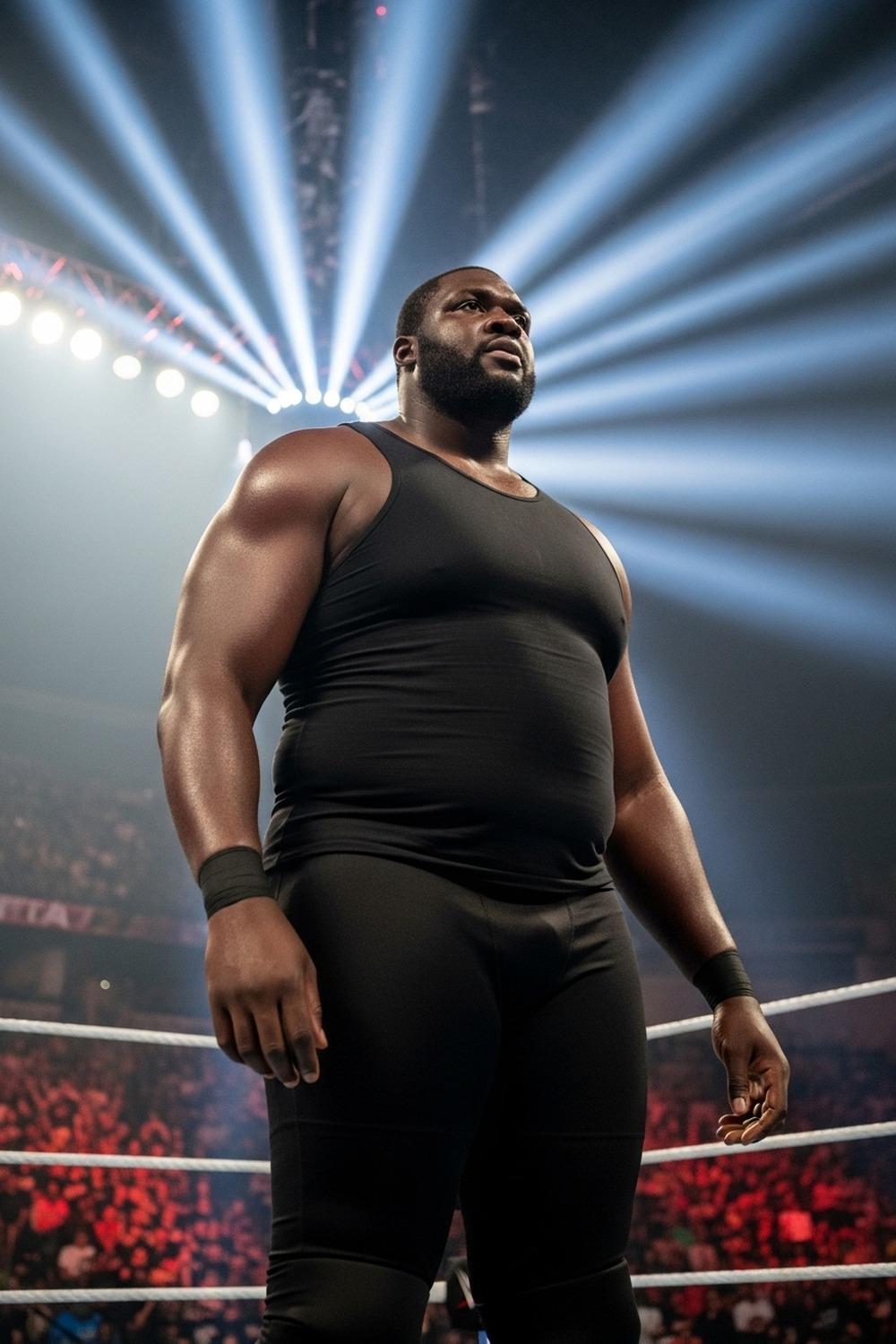
What happens to human scale when you’re standing next to someone who breaks it completely? Jordan Omogbehin — known to WWE audiences as Omos — stands 7 feet 3 inches tall and weighs 416 pounds, dimensions that don’t just occupy space but seem to reorganize it. A wrestling ring is built for two large men. When Omos enters, it becomes something closer to a phone booth, and everyone inside it suddenly looks like they’re standing in the wrong building.
The path to WWE wasn’t the standard one. No regional circuits. No decade of apprenticeship. Lagos, Nigeria. Basketball courts. A college career at Morgan State. A physical profile so extreme it essentially recruited itself. The real question that follows him into arenas across America isn’t whether he’s large — it’s whether any frame of reference was actually built to contain him.
Key Facts
- Jordan Omogbehin, known as Omos, stands 7 feet 3 inches tall and weighs 416 pounds per WWE’s 2023 and 2024 roster records.
- Fewer than an estimated 2,800 people worldwide stand at 7 feet or above at any given time (population studies, 2010-2022).
- Andre the Giant, the closest historical comparison, stood 7 feet 4 inches and weighed as much as 520 pounds during his career.
- Omos played basketball at Morgan State University before WWE signed him to a developmental contract in 2017.
- Omos made his main roster debut in 2021 at WrestleMania 37, teaming with AJ Styles to win the WWE Raw Tag Team Championship.
In short: The Omos WWE giant story reframes human scale: at 7 feet 3 inches and 416 pounds, Jordan Omogbehin is among fewer than 2,800 people worldwide standing 7 feet or taller. A former Morgan State basketball player signed in 2017, he moves with agility his dimensions statistically should not allow, evoking comparisons to Andre the Giant.
How Omos WWE Giant Height and Weight Reframe Human Scale
According to research published by the National Center for Health Statistics, the average adult male in the United States stands approximately 5 feet 9 inches. Omos clears that by nearly two feet. To understand what that actually means, consider the distribution: fewer than 2,800 people in the entire world stand at 7 feet or above at any given moment, as cited in population-scale analyses conducted between 2010 and 2022. He adds three more inches to that already statistical impossibility.
The 416-pound measurement, confirmed by WWE in their 2023 and 2024 roster documentation, places him among the heaviest mobile athletes on the planet. That combination — height plus mass, both extreme, both moving together — isn’t merely impressive. By the numbers, it’s almost statistically impossible.
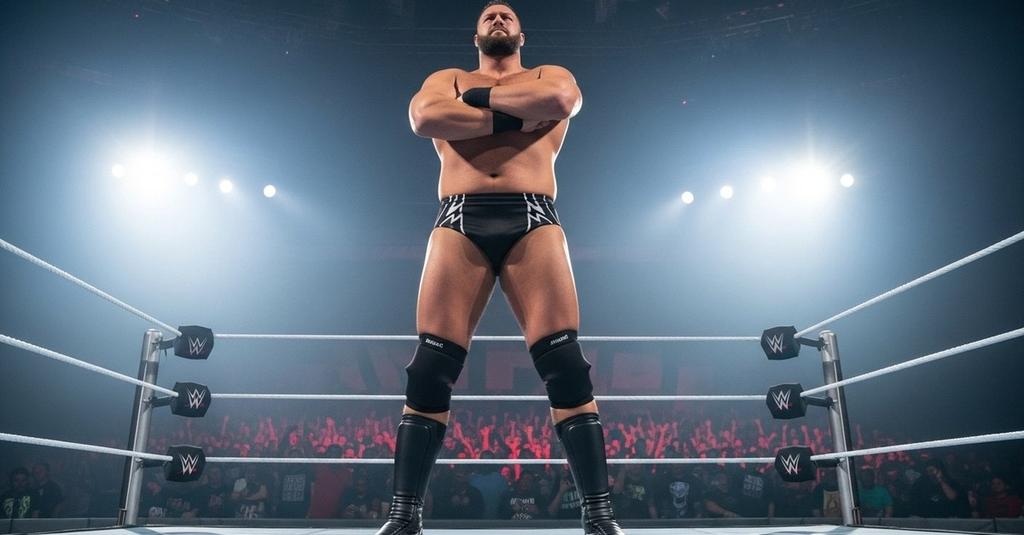
A standard WWE wrestling ring measures 20 feet by 20 feet between the ropes. Enough space for two 250-pound men to work athletically, create distance, build drama. When Omos enters, the geometry shifts. His opponents don’t shrink — they just suddenly look like the rest of us look standing next to a doorframe. It’s disorienting in the best possible way. WWE understood this. They weren’t acquiring a wrestler. They were acquiring a perspective shift.
He played basketball at Morgan State University before transitioning to professional wrestling. That background matters because it means the 416 pounds moves — not shuffles, not lumbers, but moves. Moves with timing. Moves with spatial awareness. That’s the detail that separates Omos from simple spectacle.
A Body Built by Genetics, Then Sharpened by Sport
Extreme height in human beings is almost never straightforward. It can result from genetic predisposition, from variants affecting growth hormone pathways, or from the rare confluence of inherited traits that produces statistical outliers. What makes Omos genuinely unusual — not just as a wrestler but as a human specimen — is that he appears to have inherited the scale without the typical structural penalties. At least so far. Most people who grow beyond 7 feet face significant health challenges: joint stress, cardiovascular strain, skeletal complications that arrive early and compound over time. The medical literature is sobering.
It’s the same kind of physical lottery that nature occasionally runs, producing creatures of surprising scale that still function with elegant efficiency. If you’ve read about the green anaconda moving through the Amazon with its enormous body barely disturbing the water’s surface, you’ll recognize the principle: mass, when configured correctly, doesn’t always look like mass in motion.
His path through sport reinforced rather than corrected what genetics gave him. At Morgan State, Omos trained with the discipline of a Division I college athlete — and that training built functional strength on top of an already extraordinary frame. By the time WWE’s talent scouts identified him in 2017, they weren’t looking at a novelty.
They were looking at an athlete who happened to occupy a body that almost no other athlete has ever occupied. The distinction matters enormously in professional wrestling, where the difference between someone who looks big and someone who moves big is the difference between a curiosity and a career. He debuted on WWE’s main roster in 2021, initially alongside AJ Styles — a deliberately theatrical pairing. Compact Styles next to towering Omos. It worked because the size differential was real, and every inch of it meant something.
Where Giant Athletes Sit in Sports History
Whenever a wrestler of extreme size appears, there’s an impulse to reach for André the Giant — and for good reason. André, born André René Roussimoff in 1946 in Molien, France, stood 7 feet 4 inches and weighed as much as 520 pounds during his career. He remains the defining reference point for what impossibly large looks like inside a wrestling ring. But context matters here. André competed in an era when athleticism and size were understood very differently.
Why does this matter? Because the 1970s and 1980s WWE — then the World Wrestling Federation — operated under different physical expectations. Being large was often sufficient. Moving well was secondary. Modern WWE, operating in the 2020s under significantly more demanding production and athletic standards, requires its performers to work at a pace and consistency that André’s era never demanded.
As the Smithsonian Magazine has explored in coverage of extreme human height, the physiological cost of maintaining a body above 7 feet rises steeply with every additional inch — making functional athleticism at Omos’s scale genuinely rare in any decade. Gheorghe Mureșan, who played in the NBA and stood 7 feet 7 inches, struggled with mobility. Yao Ming, at 7 feet 6 inches, was extraordinarily skilled but ultimately couldn’t sustain a full career against the structural demands placed on a body that size. Watching a performer of Omos’s dimensions sustain full-contact work across multiple matches per week, you realize how narrow the corridor actually is between theoretically possible and practically sustainable.
And the roster surrounding him in 2025 includes exceptionally conditioned athletes — Bron Breakker, Gunther, Braun Strowman. Next to them, Omos still reads as categorically different. That’s not a small thing to pull off.
Omos WWE Giant: What His Career Reveals About Human Limits
A 2019 study from the University of Gothenburg examined elite athletes with exceptionally large frames across multiple contact sports. The finding: performance longevity correlates strongly not with raw size but with the ratio of functional mobility to body mass. In other words, how well someone that big can actually move relative to their weight. Omos, by that metric, represents an unusual data point. His agility drills recorded during WWE Performance Center training in 2019 and 2020 were, by multiple accounts from WWE coaching staff, significantly above what the organization expected for his size category.
That’s not marketing language. It reflects a genuine physiological reality: the man is coordinated in ways that his dimensions statistically should not allow.
Since his 2021 main roster debut, Omos has successfully executed moves — overhead press slams, running shoulder charges — that require not just strength but timing, spatial awareness, and body control. Each of those physical outputs demands that 416 pounds know exactly where it is in space at every moment. Get that wrong at his size, and you injure someone seriously. He hasn’t.
That record speaks not just to natural talent but to years of structured athletic development — the kind that begins on a basketball court and gets refined under the specific discipline of professional wrestling’s training system. WWE’s investment in Omos also signals something about the organization’s read on what audiences respond to. Size has always sold tickets. But size that moves? That’s a different proposition entirely. That’s a story with chapters still unwritten.
How It Unfolded
- 2015 — Jordan Omogbehin, standing 7 feet 3 inches, begins playing basketball at Morgan State University, where scouts from multiple sports organizations first take notice of his combination of size and mobility.
- 2017 — WWE’s talent recruitment team identifies Omogbehin and signs him to a developmental contract, beginning his formal training at the WWE Performance Center in Orlando, Florida.
- 2021 — Omos makes his main roster debut at WrestleMania 37, teaming with AJ Styles to capture the WWE Raw Tag Team Championship in front of a live crowd for the first time since the pandemic.
- 2024–2025 — Omos continues to compete on WWE’s main roster as a singles performer, cementing his position as one of the largest active athletes in global professional sports entertainment.
By the Numbers
- 7 feet 3 inches — Omos’s verified standing height, placing him among fewer than an estimated 2,800 people worldwide at that height or above (population studies, 2010–2022).
- 416 pounds — his listed competition weight as documented by WWE’s official roster records in 2023 and 2024.
- 7 feet 4 inches and 520 pounds — the peak dimensions of André the Giant, the closest historical comparison in professional wrestling history.
- 20 feet × 20 feet — the standard WWE ring interior dimension; Omos spans roughly a third of that distance with arms extended.
- 2,800 — the estimated global population of individuals standing at or above 7 feet tall at any given time, across all age groups and geographies.
Field Notes
- During his WWE Performance Center evaluation in 2019, coaches noted that Omos completed lateral agility drills at a pace closer to athletes in the 6-foot-2 to 6-foot-5 range — a finding that reportedly accelerated the timeline for his main roster consideration.
- His name isn’t a ring name — Omos is his actual given name, part of the Yoruba naming tradition from Nigeria’s Lagos region, where he was born.
- The tag team pairing of Omos and AJ Styles was visually deliberate: Styles stands 5 feet 11 inches, making the 16-inch height gap between them one of the most dramatic regular pairings in recent WWE programming history.
- Researchers still can’t fully explain why some individuals of extreme height maintain normal joint function into their 30s while others develop complications in their teens — and whether Omos’s apparent structural health represents a genetic outlier or simply good fortune that hasn’t yet been tested by time.
Frequently Asked Questions
Q: What are Omos WWE giant height and weight measurements, and are they verified?
Omos stands 7 feet 3 inches tall and weighs 416 pounds according to WWE’s official roster records, most recently confirmed in 2023 and 2024. These figures are consistent with independent reporting and photographic comparison with other athletes of known height. His height places him in an extraordinarily rare population bracket — fewer than an estimated 2,800 people worldwide stand at 7 feet or above. The weight, at 416 pounds, is among the highest recorded for an actively performing professional wrestler in the modern era.
Q: How does Omos compare to André the Giant in terms of size?
André the Giant stood one inch taller at 7 feet 4 inches and weighed as much as 520 pounds at his heaviest, making him technically larger by both measures. However, André competed primarily in the 1970s and 1980s under different physical expectations and ring styles. Omos operates in a modern WWE environment that demands higher work rates, more frequent appearances, and significantly faster in-ring sequences — making direct size comparisons only part of the picture. By raw athleticism for his dimensions, Omos may actually represent the more remarkable physical achievement.
Q: Is Omos’s size the result of a medical condition?
Extreme height can result from acromegaly or gigantism — conditions involving excess growth hormone — but it can also result from polygenic inheritance: a rare combination of multiple height-associated genes expressing simultaneously. WWE has never disclosed a specific medical basis for Omos’s size, and there is no public documentation of a growth disorder diagnosis. His background as a functioning Division I college basketball player suggests a body operating without the severe structural complications that often accompany medically driven gigantism. (And this matters more than it sounds — the difference between inherited scale and hormone-driven gigantism is the difference between an athlete and a patient.)
Editor’s Take — Sarah Blake
What I keep returning to isn’t the height or the weight — it’s the basketball court. That’s where this story actually starts. Someone saw a teenager in Lagos who was built like a building and thought: put him on a court, teach him to move, see what happens. And what happened was an athlete who can press 400 pounds overhead with timing. The numbers are extraordinary. The discipline behind them is the real story. Size is an accident of biology. What Omos has built on top of it is a choice.
Human scale is a concept we rarely examine until something forces us to recalibrate it. Omos forces that recalibration every time he walks through a door, steps onto a court, or enters a wrestling ring. He isn’t a novelty — he’s a data point at the outermost edge of what a human body can be while still performing with precision and purpose. The question worth sitting with isn’t how big he is. It’s what it means that a body configured like his can still move like that — and what other edges of human possibility we haven’t yet thought to look for.
Illustrations are AI-generated. Article fact-checked and human-edited. Our editorial standards.