Jaguar Bite Force: The Skull-Crushing Kill No Cat Can Match
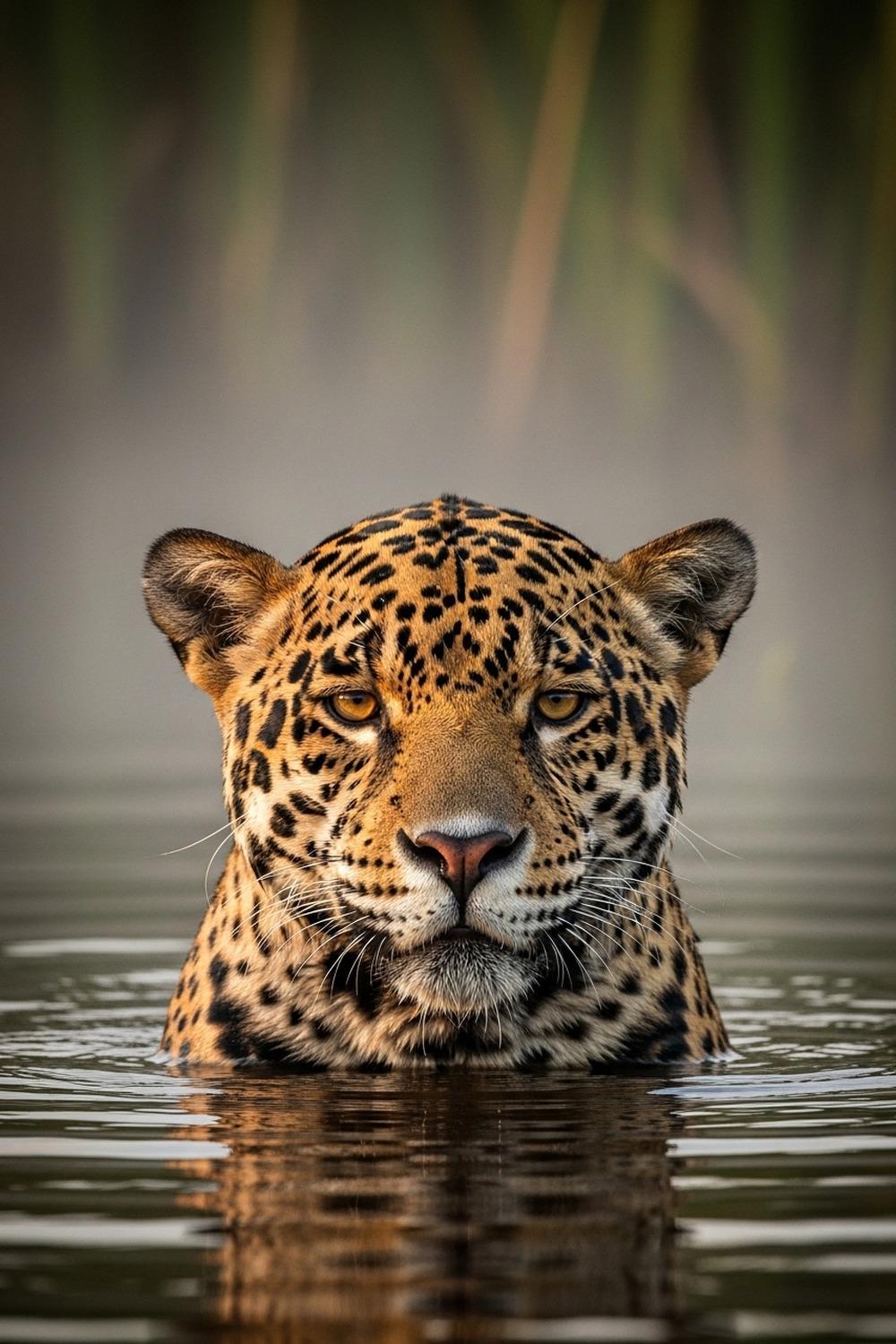
One strike. That’s all it takes. A jaguar moving through the Pantanal shallows locks its jaws around a caiman’s skull — not the throat, not the soft underside — and the prey is gone. No thrashing. No prolonged struggle. What makes this jaguar bite force so lethal is that no other big cat on Earth hunts this way, and none could execute it with this precision, because none evolved in a wetland packed with armor-plated prey that made suffocation obsolete millions of years ago.
Deep in the world’s largest tropical wetland spreading across Brazil, Bolivia, and Paraguay, jaguars developed a killing technique so specialized that biologists are still reverse-engineering exactly how it works. Up to 1,500 pounds per square inch. A jaw built like no other felid’s. A hunting strategy carved by millions of years of encounters with creatures that refused to die easy. The real question: what does this tell us about the limits of animal engineering when evolution has to solve one problem perfectly?
Key Facts
- Jaguars deliver an estimated peak bite force of roughly 1,500 psi, about double a lion’s approximately 650 psi
- A 2005 study by Stephen Wroe and colleagues gave the jaguar a bite force quotient of 137, highest in the Panthera genus
- Jaguars kill prey across at least 85 recorded species, the widest prey spectrum of any American big cat (Panthera, 2018)
- Jaguar canine teeth are about 2 inches (5 cm) long, proportionally thicker than any comparable big cat
- Wild jaguar population is estimated at 64,000 to 173,000 individuals (IUCN Red List, 2018)
In short: Jaguar bite force reaches an estimated 1,500 psi, roughly double a lion’s, and earns the highest bite force quotient (137) among big cats. Evolved in the Pantanal among armored caimans and turtles, jaguars use a skull-puncturing kill that bypasses armor and ends struggles in seconds, making the bite a precision risk-management tool rather than brute force.
The Most Powerful Bite Among Big Cats
Adam Hartstone-Rose and colleagues published a 2007 study using dry skull specimens from major felids to calculate something called the bite force quotient — a metric that strips away body mass and measures jaw power per kilogram in a way that actually means something. The jaguar ranked highest. Absolute bite force estimates place the jaguar at roughly 1,500 psi (pounds per square inch). Lions? Around 650 psi. Leopards? 300–400 psi. The jaguar’s skull is rounder and shorter than those of other big cats — a design that concentrates mechanical leverage at the back molars with almost frightening efficiency.
Shorter rostrum. Wider zygomatic arches. Temporalis muscles developed to an almost grotesque degree. All of it points to the same conclusion: a biological vice. What makes this more remarkable is that the jaguar is the third-largest cat on Earth, not the largest.
Lions and tigers are heavier. But neither generates proportionally more jaw force. The jaguar gets more crushing power per kilogram of body weight than either. That’s not an accident.
In the Pantanal, prey doesn’t wait patiently to be suffocated. A caiman can thrash and roll. A giant river turtle offers no soft tissue target at all. The jaguar solved this with geometry — shorter skull, bigger muscles, and a bite that lands with mathematical precision. It’s the signature of an animal that evolved in a specific ecological theater where the old playbook simply stopped working.
Armor-Piercing Evolution in the Wetlands
The prey community that shaped the jaguar’s jaw is unlike anything lions or leopards face on the African savanna. Across the Amazon basin and the Pantanal, heavily armored animals dominate — giant river turtles with shells thick enough to deflect most predators, yacare caimans running osteoderms their full length like a biological tank, and armadillos encased in keratin and bone. Evolution doesn’t hand out crushing jaws for free. They’re metabolically expensive and mechanically demanding on the skull itself. Every ounce of jaw muscle is a trade-off in speed or maneuverability elsewhere.
The jaguar’s jaw architecture is a direct response to an arms race running for millions of years. It’s a parallel, in its own way, to what happens when other apex predators meet armored prey — think of how green anacondas in the same Amazon system evolved extreme constriction force to neutralize prey that would tear apart a less specialized hunter.
Rather than targeting the throat or the neck’s soft tissue — the standard felid method — jaguars drive their canines directly into the skull or the cervical vertebrae of their prey. Why does this matter? Because it bypasses the entire defense that works on everything else.
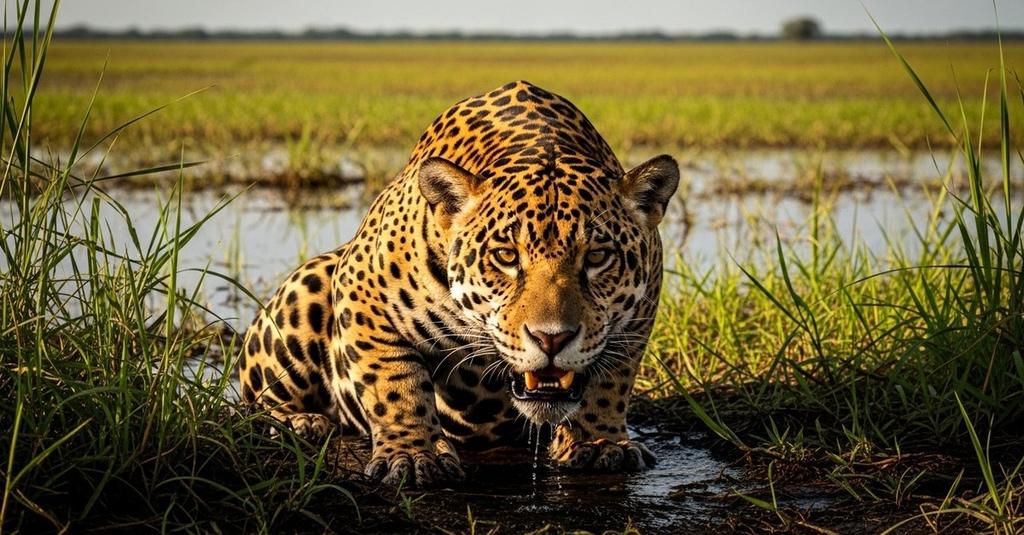
Researchers at the Wildlife Conservation Society documented this behavior in detail across multiple Pantanal field seasons in the 2010s, noting that jaguar kills on caimans consistently showed puncture wounds at the back of the skull, between the brain and the first vertebra. The bite severs or crushes the brainstem. Death is effectively instantaneous. Think about what that requires: the jaguar has to precisely place a strike on a thrashing, armored reptile in shallow water, often in low light. Accuracy matters as much as force. The jaw delivers the power; the brain delivers the aim.
What the Data Actually Reveals
Jaguar predation has attracted serious academic attention in recent decades. A landmark analysis from the Panthera organization — the global wild cat conservation science group — confirmed that jaguars kill more species of prey than any other big cat in the Americas, with recorded kills across at least 85 species. That dietary breadth isn’t possible without the jaw flexibility and force to handle prey at both extremes: a small peccary and a full-grown caiman require completely different mechanical approaches. The jaguar’s bite force accommodates both. And this is where it gets interesting: that jaw power isn’t primarily about killing large prey at all.
Panthera’s field teams, working across Central and South America through the 2010s and into the 2020s, built some of the most comprehensive jaguar predation datasets ever assembled. Here’s the counterintuitive finding that keeps emerging from that data: jaguar bite force is about reliability. A jaguar in the wild can’t afford a failed kill — a wounded caiman that escapes into deeper water, a partially crushed turtle that retreats into its shell. Those failures have real consequences. Lions can afford to spend eight to ten minutes suffocating a wildebeest on open grassland, where backup options exist. A jaguar in reed-choked water cannot.
The kill has to work the first time.
That reliability imperative explains something else: why jaguars so rarely show the bone injuries that accumulate on lions and leopards over a lifetime. Fewer struggles mean fewer counterattacks. Watching a species solve this particular equation — where the weapon itself becomes a risk-management system — you realize evolution rewarded something other than raw power. It rewarded precision under pressure, and the absence of second chances.
Jaguar Bite Force Compared: The Numbers in Context
Raw psi comparisons between species can mislead. Jaw force scales with body mass in complex ways. But the bite force quotient (BFQ) framework cuts through the noise. A 2005 study by Stephen Wroe and colleagues at the University of New South Wales, published in the Proceedings of the Royal Society B, calculated BFQs for 39 carnivore species. Results:
- Jaguar: BFQ of 137
- Lion: 112
- Tiger: 94
- Clouded leopard: 137 (only felid competitor — smaller, tree-dwelling, with disproportionately elongated canines)
- Spotted hyena: 119
In absolute terms, a Nile crocodile generates more raw bite force than any mammal — estimated at over 3,700 psi in adult males — but kilogram for kilogram, among warm-blooded predators, the jaguar holds a position that’s genuinely exceptional. The skull geometry that produces this BFQ has one engineering cost: speed. A shorter, rounder skull with massive jaw muscles is slightly less capable of the wide gape that lions use to suffocate large prey at the throat.
The jaguar’s bite is a precision instrument, not a blunt one. Canine teeth are proportionally the longest and thickest of any big cat — thick enough to transmit enormous force without snapping, wide enough to wedge between vertebrae and lever them apart (and researchers actually call this the “puncture-crushing” strategy, which is distinct from both pure crushing and pure puncture). CT scans of jaguar skulls conducted at the American Museum of Natural History show internal bone density markedly higher than in comparably sized leopards. The trabecular architecture — the internal scaffolding — is built for impact absorption.
Conservation biologists have started using jaw morphology data as a proxy for population health. A jaguar whose teeth show heavy wear or whose jaw muscles have atrophied — signs visible on camera trap footage and confirmed in necropsies — is a jaguar that’s struggling to hunt effectively. Panthera’s monitoring teams now include dental health assessments in jaguar capture-and-release programs across Belize, Brazil, and Colombia.
Where to See This
- The Pantanal in Mato Grosso do Sul, Brazil, particularly the Porto Jofre region along the Cuiabá River, offers the highest jaguar sighting density on Earth — dry season runs from June to October, when caimans concentrate in shallow water and jaguars hunt openly along riverbanks.
- Panthera’s Jaguar Corridor Initiative (panthera.org) works across 18 range countries and offers the most current science on jaguar distribution and prey ecology — their published field data is publicly accessible.
- For the clearest documentation of jaguar hunting technique on film, the BBC Natural History Unit’s footage from the 2019 Dynasties II production includes slow-motion capture sequences that show the skull-strike kill method in real time.
By the Numbers
- Up to 1,500 psi — estimated peak jaguar bite force, roughly double that of a lion at approximately 650 psi (Hartstone-Rose et al., 2007)
- Bite force quotient of 137 — the jaguar’s BFQ in Wroe et al.’s 2005 Royal Society B study, highest among the Panthera genus
- At least 85 recorded prey species across the jaguar’s range, the widest prey spectrum of any American big cat (Panthera, 2018)
- Jaguar canine teeth are approximately 2 inches (5 cm) long — proportionally thicker than any other big cat of comparable size
- Current wild jaguar population estimated at 64,000–173,000 individuals (IUCN Red List, 2018), down from historic highs before European colonization
Field Notes
- In 2015, a camera trap study in Belize’s Cockscomb Basin Wildlife Sanctuary — the world’s first jaguar preserve, established in 1986 — captured a jaguar killing a fully armored armadillo with a single bite to the back of the head, bypassing the shell entirely; researchers noted the animal showed no hesitation or repositioning before striking.
- Jaguars are the only big cat regularly documented killing prey larger than themselves — adult male caimans can exceed 2.5 meters and outweigh a jaguar by 30–40 kilograms, yet successful kills are routine in the Pantanal.
- The jaguar’s killing bite is so efficient that indigenous Tupí hunters historically interpreted it as a form of supernatural precision — the word “jaguar” itself derives from the Tupí-Guaraní word yaguara, meaning “he who kills with one leap.”
- Researchers still can’t fully explain how a jaguar avoids tooth fracture when striking caiman osteoderms at full force — the mechanical stress should, by conventional models, exceed safe loading limits for felid enamel, but documented fractures remain rare in wild populations.
Frequently Asked Questions
Q: How does jaguar bite force compare to other big cats?
Using the bite force quotient framework — which accounts for body size — jaguars score approximately 137. Lions score 112. Tigers come in at 94. In raw psi terms, the jaguar reaches an estimated 1,500 psi versus a lion’s roughly 650 psi. Only the much smaller clouded leopard scores comparably on a weight-adjusted basis. No other big cat in the Americas comes close.
Q: Why does the jaguar kill differently from lions and leopards?
Lions and leopards evolved on open terrain with prey whose weak point is the windpipe — suffocation works when you have time and space. The jaguar evolved in dense wetland and forest environments packed with armored prey that a suffocation grip simply can’t penetrate. The skull-puncture kill bypasses armor entirely, targets the central nervous system, and ends the struggle in seconds rather than minutes. The jaw architecture — short, round skull, massive temporalis muscles — is the hardware that makes this possible.
Q: Is the jaguar actually the strongest-biting animal on Earth?
Not in absolute terms. That distinction belongs to large crocodilians, with Nile and saltwater crocodiles generating over 3,700 psi. Among warm-blooded predators, the spotted hyena and some sharks exceed the jaguar in raw bite force. What makes the jaguar remarkable is its bite force relative to body size among big cats specifically, combined with the precision of its application. Raw force isn’t the story. The engineering — how that force is generated, aimed, and delivered — is what sets the jaguar apart.
Editor’s Take — Alex Morgan
What gets me about jaguar bite force isn’t the psi number — it’s the risk calculation embedded in every strike. The skull-puncture kill isn’t just more powerful than suffocation; it’s specifically designed to minimize the window in which something can go wrong. A jaguar that misses a caiman’s braincase goes into the water with a thrashing, armored reptile that outweighs it. Nature didn’t reward brute force here — it rewarded precision under pressure. That’s a different kind of evolutionary story, and a more interesting one.
The jaguar’s jaw is one of the most precisely engineered killing tools in the vertebrate world — not because it’s the biggest or the fastest, but because it solves a specific problem with a specific solution, and it does so without margin for error. Every time a jaguar walks into the Pantanal shallows, it’s running a calculation that took millions of years to develop. What other solutions are out there in the world’s wild places, still waiting to be properly measured and understood? Somewhere in the reed beds tonight, a caiman surfaces. The math is already in motion.
Illustrations are AI-generated. Article fact-checked and human-edited. Our editorial standards.