A Fungus Is Quietly Eating the Great Pacific Garbage Patch
There’s a fungus in the middle of the Pacific Ocean that shouldn’t exist yet. It’s eating plastic — and it’s been doing it while we weren’t looking.
Between California and Hawaii, roughly 80,000 metric tons of plastic drift in slow circles. Scientists went out to catalog what was living on the surface of that floating garbage. They found something that changes how we think about plastic’s permanence in the ocean. Not because it solves the problem. Because it suggests the problem is solving itself in ways we never expected.
Key Facts
- The marine fungus Parengyodontium album was found degrading polyethylene in the North Pacific by researchers from the Royal Netherlands Institute for Sea Research
- The fungus degrades roughly 0.05% of polyethylene mass per day, about 35 times faster than photodegradation by UV light alone
- The Great Pacific Garbage Patch holds about 80,000 metric tons of plastic across 1.6 million square kilometers
- Polyethylene accounts for roughly 34% of all plastic produced globally each year
- Over 400 microbial species had been identified living on floating plastic debris, the ‘plastisphere,’ by 2023
In short: A plastic-eating fungus ocean discovery centers on Parengyodontium album, a marine fungus pulled from polyethylene debris in the North Pacific. It degrades about 0.05% of plastic mass per day, roughly 35 times faster than UV light alone, but only after sunlight pre-weakens the plastic. The find challenges assumptions about how long ocean plastic persists.
The Fungus Nobody Was Hunting For
The organism is Parengyodontium album. Marine fungus. Pulled directly from polyethylene debris in the North Pacific during routine sampling by researchers from the Royal Netherlands Institute for Sea Research. They weren’t looking for plastic-eaters specifically. They were documenting what lived on floating trash. And then this showed up.
What made it stick around in their data — what actually kept me reading for another hour — was the specificity of what it does. The fungus degrades roughly 0.05% of plastic mass per day under observed conditions. That’s roughly 35 times faster than UV light alone can break down polyethylene. On a patch holding 80,000 metric tons, “small percentages” start to add up.
Here’s the thing about Parengyodontium album: it can’t work without help.
Sunlight Does the First Cut
UV radiation cracks polyethylene’s chemical bonds. Photodegradation is the technical term. It happens passively to every piece of plastic floating in the ocean sun. Happens for decades. What this fungus figured out is how to use the result — it moves in after the sun has already started breaking things apart, exploiting weakened surfaces the way a scavenger works a picked-over kill.
That dependency explains why it’s thriving specifically in the garbage patch. Plastic floats near the surface. Gets baked. Gets pre-weakened. Perfect conditions.
It also means the fungus is less of a revolutionary discovery and more of a partnership. The ocean already breaks down plastic slowly. This organism is just the middleman, collecting what UV leaves behind.
But here’s where it gets strange: this fungus didn’t evolve to eat plastic. Polyethylene is only about 70 years old in any volume that matters. Evolution works on geological timescales. Yet Parengyodontium album has already adapted — or is actively adapting — to an entirely new food source.
Polyethylene Was Supposed to Be Forever
The old scientific consensus was clean and simple. Polyethylene — your bottles, your bags, your packaging — persists in seawater for hundreds of years. Some estimates approached a thousand.
The logic tracked.
Seawater isn’t acidic enough to chemically attack it. Microbial life had no appetite for it. Nobody designed plastic to be eaten. The plastic-eating fungus ocean research now challenges that directly. If organisms like Parengyodontium album have been working on floating debris in the open ocean, our degradation timelines might be wrong. Not catastrophically. But meaningfully.
And that uncertainty spirals. If this fungus exists here, what else exists out there? What other plastics are being metabolized? What other organisms have made the same adaptation? Is every garbage patch on Earth running its own accidental laboratory?
The Great Pacific Garbage Patch might be an experiment we didn’t know we were running.
It’s Not Working Alone
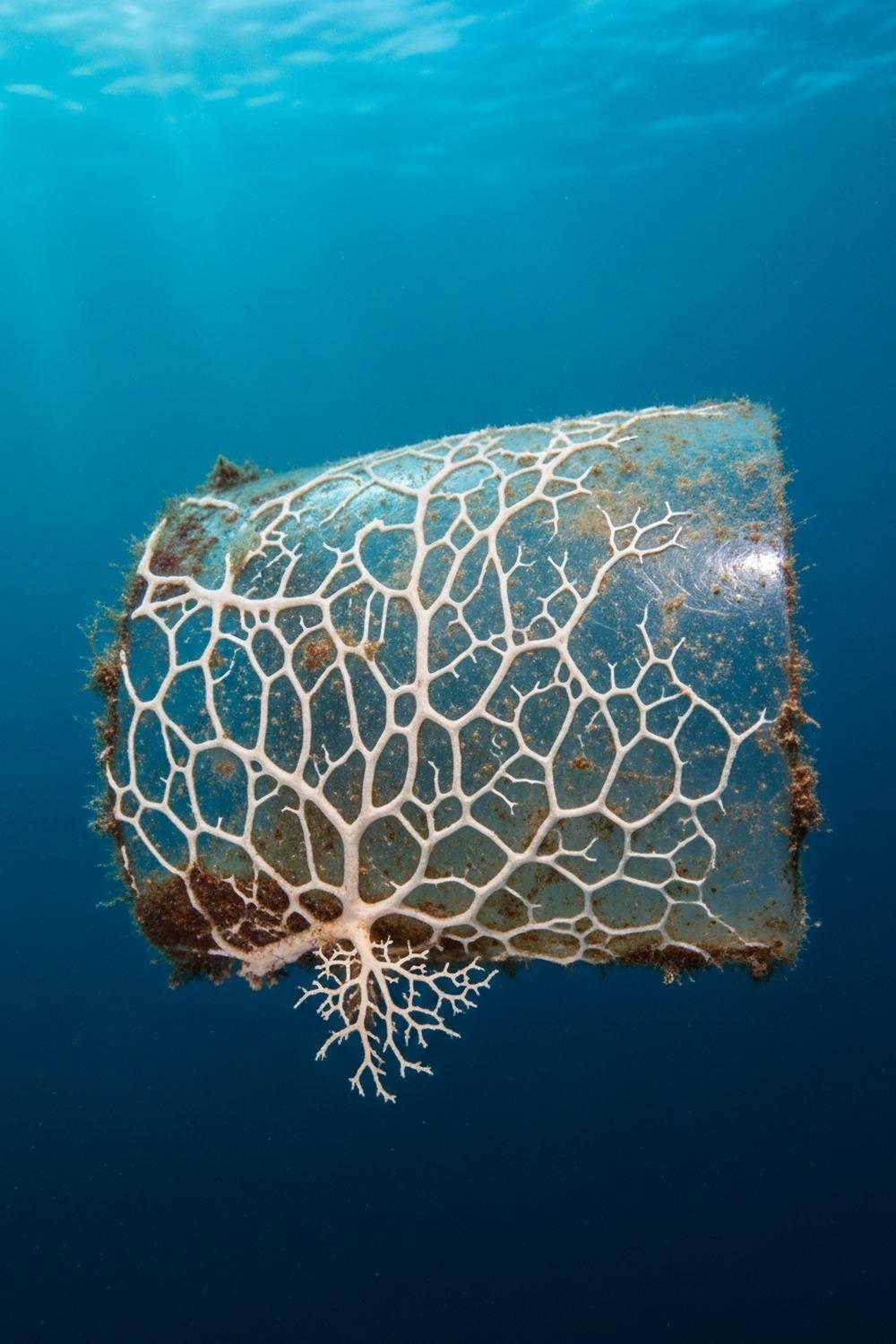
Scientists now describe a “plastisphere” — a thriving microbial ecosystem colonizing floating plastic across global oceans. Bacteria, fungi, algae. Some are just hitchhikers. Others actively metabolize their substrate. The distinction matters enormously for understanding plastic fate in marine systems over centuries.
The other side of this is darker. Microbes living on plastic can travel. The plastisphere moves with ocean currents, carrying organisms across ecosystems. A fungus eating plastic in the North Pacific could theoretically hitchhike across entire ocean basins. We don’t know what that does to native microbial communities yet.
We’re starting to ask, though.
The Numbers
- 80,000 metric tons of plastic drifts across 1.6 million square kilometers in the Great Pacific Garbage Patch — roughly equivalent to 500 jumbo jets by weight, according to a 2018 Scientific Reports study.
- Parengyodontium album degrades approximately 0.05% of polyethylene mass per day. That’s 35 times faster than photodegradation alone.
- Polyethylene accounts for roughly 34% of all plastic produced globally each year. It’s now a confirmed food source for at least one marine fungus.
- Over 400 microbial species have been identified living on floating plastic debris across every major ocean by 2023 — the plastisphere is everywhere.
How It Actually Works
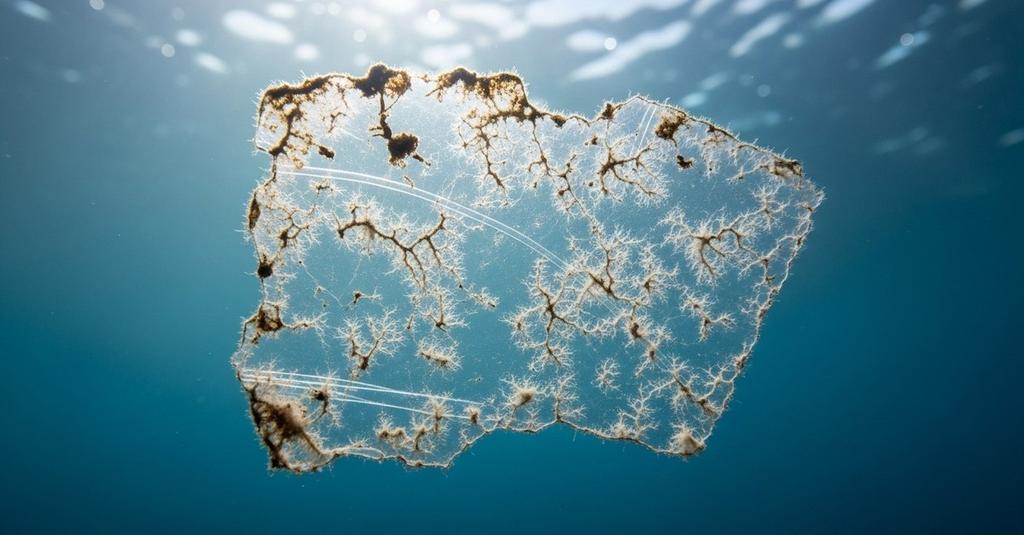
- Parengyodontium album produces enzymes that break polyethylene into smaller carbon compounds it can absorb as nutrients. Think digestion, not dissolution. The end products are carbon dioxide and water — which raises uncomfortable questions about whether we’re trading one ocean problem for another.
- Most plastic-degrading microbes move too slowly to matter at current pollution scales. This fungus operates among the fastest recorded for marine polyethylene degradation in open-water conditions.
- The garbage patch isn’t solid. It’s a dispersed soup of microplastics and larger debris spread across millions of square kilometers. Fungi living on it constantly separate, isolate, and reconnect as currents shift. Distribution is chaotic.
Why This Actually Shifts The Conversation
The search for biological plastic degradation has been a quiet priority in marine science for years. Not because anyone expected a silver bullet. Because even partial degradation would reshape our understanding of plastic’s long-term marine fate.
This discovery confirms something strange: nature isn’t standing still in the face of our pollution. Evolution is slow. It’s not indifferent. Organisms are finding ways into new niches. Niches made entirely of human industrial waste.
That doesn’t mean we can stop worrying.
It means we should look harder at what else is out there. It means the real question isn’t whether Parengyodontium album can clean up the garbage patch — it can’t, not on any timescale humans care about. The question is what we can learn from how it works. Whether that chemistry can be replicated. Accelerated. Applied at scale.
That frontier is opening now.
A fungus nobody was looking for is quietly breaking down some of the most durable material humans ever made, floating in one of the most remote places on Earth. It doesn’t need our help. It’s already figured out what to do. Nature does that sometimes. The research into the plastic-eating fungus ocean discovery is just getting started — and the next weird thing we find might be stranger than this one. More stories like this at this-amazing-world.com.
“
Frequently Asked Questions
Q: What is the plastic-eating fungus found in the ocean?
The organism is Parengyodontium album, a marine fungus pulled directly from polyethylene debris in the North Pacific during sampling by researchers from the Royal Netherlands Institute for Sea Research. They were documenting what lived on floating trash when they found it actively breaking down plastic. The fungus produces enzymes that break polyethylene into smaller carbon compounds it absorbs as nutrients, leaving carbon dioxide and water as end products.
Q: How fast does Parengyodontium album break down plastic?
The fungus degrades roughly 0.05% of polyethylene mass per day under observed conditions. That rate is about 35 times faster than photodegradation by UV light alone. However, the fungus cannot work without help: sunlight must first crack the polyethylene’s chemical bonds through photodegradation, weakening surfaces the fungus then exploits. This dependency explains why it thrives in the sun-baked surface plastic of the Great Pacific Garbage Patch.
Q: Can this fungus clean up the Great Pacific Garbage Patch?
No, not on any timescale humans care about. The patch holds about 80,000 metric tons of plastic across 1.6 million square kilometers, and even at 0.05% mass loss per day the fungus cannot meaningfully reduce that volume soon. Scientists see its value differently: understanding how its enzymes work, whether that chemistry can be replicated, accelerated, and applied at scale in controlled settings, rather than relying on the ocean.
Q: What is the plastisphere?
The plastisphere is a thriving microbial ecosystem that colonizes floating plastic across the world’s oceans, including bacteria, fungi, and algae. By 2023, over 400 microbial species had been identified living on floating plastic debris in every major ocean. Some are hitchhikers; others actively metabolize the plastic. Because the plastisphere moves with ocean currents, these organisms can travel across entire ocean basins, raising questions about effects on native microbial communities.
Illustrations are AI-generated. Article fact-checked and human-edited. Our editorial standards.