White Sands Footprints Rewrite Human Arrival in America
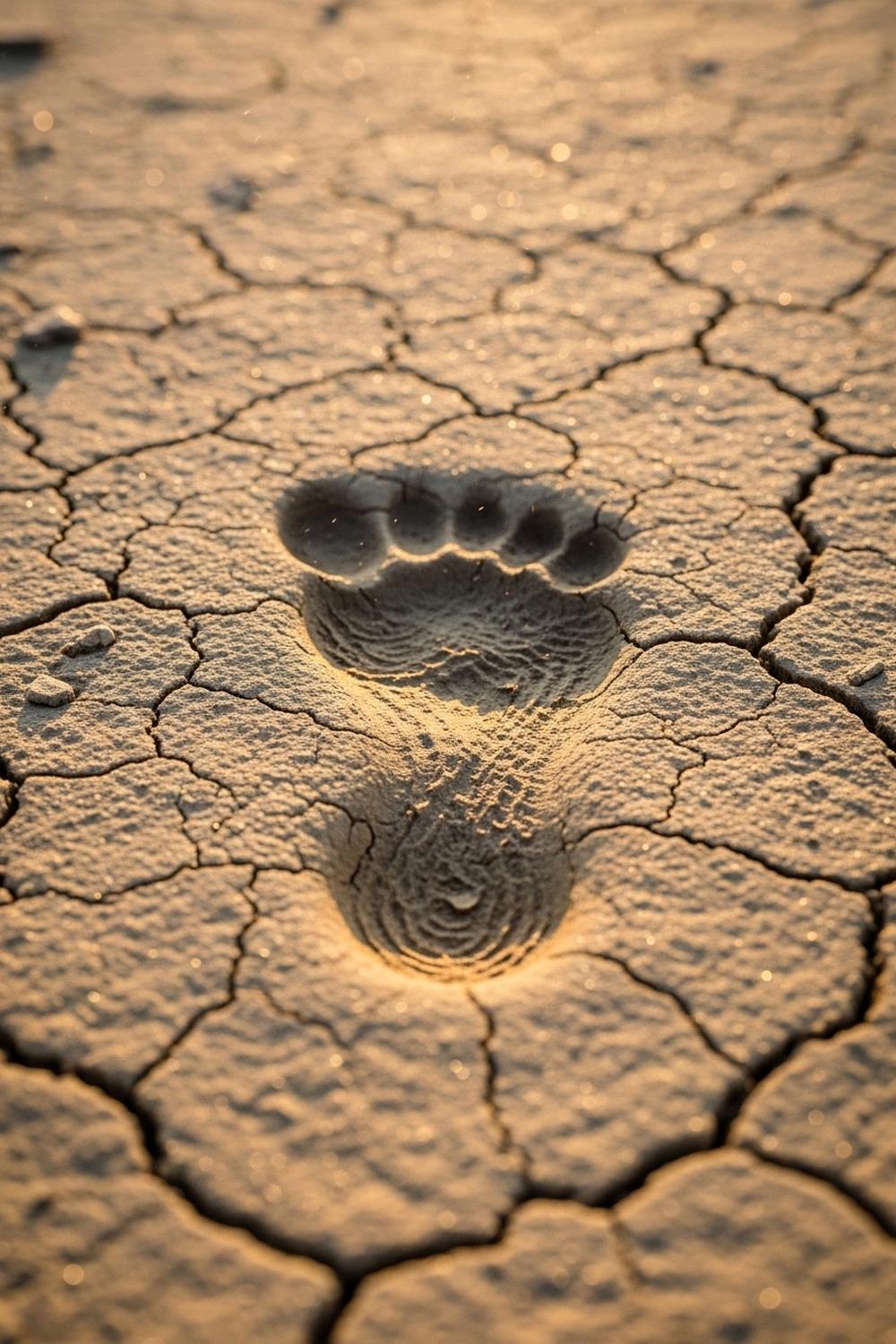
Most of what we knew about the first Americans was wrong. At White Sands National Park in New Mexico, researchers discovered fossilized human footprints pressed into lakeside sediment dating to more than 23,000 years ago—during the Last Glacial Maximum, when ice sheets covered a third of Earth’s land surface. Small toes. Soft sediment. A child walked here when the continent was supposed to be empty. The White Sands footprints first Americans now study have fractured the foundational model of North American settlement and forced an entire field to rebuild from evidence it never expected to find.
For decades, the Clovis-first consensus held: humans arrived in North America around 13,000 years ago, after ice sheets retreated and opened a southbound corridor. These tracks predate that window by ten millennia. They belong to real people—children, adolescents, adults—living beside ancient Lake Otero during a period when most models said the continent was impassable.
The question that follows isn’t peripheral. If they were here, how did they arrive?
Key Facts
- Fossilized human footprints at White Sands National Park, New Mexico, date to between 21,000 and 23,000 years ago, during the Last Glacial Maximum
- David Bustos began documenting unusual impressions in the gypsum sediment in 2009
- In 2021, Dr. Matthew Bennett’s Bournemouth University team published dating results in Science, dating Ruppia cirrhosa seeds
- A 2023 USGS follow-up study used pollen grains and conifer needles to independently confirm the same age range
- The dates predate the long-accepted Clovis-first arrival of about 13,000 years ago by roughly 10,000 years
In short: The White Sands footprints first Americans evidence comes from fossilized human tracks at White Sands National Park, New Mexico, dated to 21,000 to 23,000 years ago, during the Last Glacial Maximum. Confirmed by three independent dating methods, the prints predate the Clovis-first arrival model by roughly 10,000 years and have reshaped theories of North American settlement.
Ancient Tracks That Shattered the Clovis-First Consensus
David Bustos, resource program manager at White Sands National Park, began noticing impressions in the pale gypsum sediment in 2009 that didn’t match animal tracks. Years passed before the site attracted scientific attention. In 2021, Dr. Matthew Bennett of Bournemouth University led a team that published findings in Science, presenting the first robust radiometric dating of the prints. They dated seeds of the aquatic plant Ruppia cirrhosa—found embedded in the track layers—and established an age range of 21,000 to 23,000 years before present. This placed the tracks squarely within the Last Glacial Maximum, when glaciers covered roughly a third of Earth’s land surface and sea levels were dramatically lower than today.
The Clovis-first model, which had dominated North American archaeology since the 1930s, had no room for these people. They existed anyway.
Across the site, researchers identified at least 61 individual track surfaces representing multiple episodes of activity over what appears to be thousands of years. The size distribution proved telling: many prints were small, consistent with children and teenagers. Adults appeared too, but younger tracks dominated—a pattern some researchers interpret as evidence that adolescents were sent ahead of hunting parties to scout or drive prey. Others see something simpler and more powerful: families, moving together, doing what families do. The sediment preserved everything. Toe splay. Pressure ridges at the heel. The slight deepening of a step suggesting someone was carrying weight. These aren’t symbolic artifacts or stone tools open to interpretation.
They are the actual shape of a human foot, frozen in geological time—measurable, readable, almost audible in the space between the toes and the compressed earth.
How a Lake Became the World’s Most Remarkable Archive
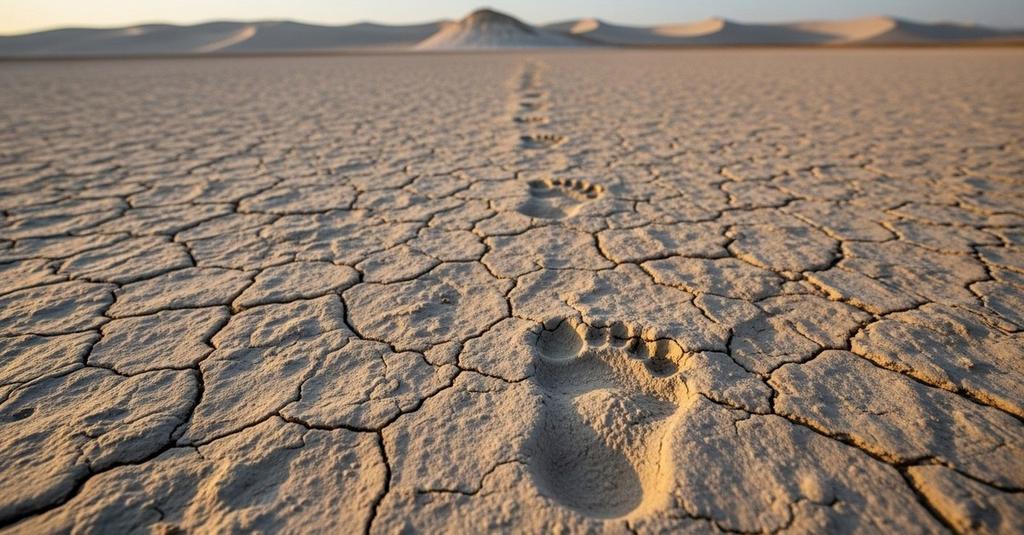
Ancient Lake Otero no longer exists. At its peak during the Pleistocene, it covered roughly 1,600 square kilometers of the Tularosa Basin, and what it left behind ranks among the most remarkable paleoanthropological archives on Earth. As water levels fluctuated—rising after storms, retreating in dry seasons—the exposed mudflats around its edges became natural recording surfaces. Every creature that crossed left an impression. Mammoths. Giant ground sloths. Dire wolves. Camels. And, unexpectedly, humans.
The tracks weren’t isolated. Researchers documented human prints alongside mammoth trails, and in several cases the paths appeared to intersect—not accidentally. This kind of deep-time evidence for human-megafauna interaction resonates with other prehistoric puzzles being untangled around the world, connecting to questions about extinction, migration, and ecological memory that researchers studying everything from trilobite behavior to early predator dynamics are now asking in parallel. If you’ve followed the story of ancient creatures gathering in groups 500 million years ago, the logic of reading movement from preserved evidence will feel familiar: geology doesn’t lie, but it requires patience to read.
White Sands sits in an enclosed basin with no drainage outlet. The gypsum—calcium sulfate—that gives the park its name is softer than quartz sand and compacts differently under pressure. When lake sediment dried slowly under the right conditions, impressions hardened without crumbling. Later layers sealed them.
The result is a stratigraphic record with human footprints sandwiched between datable organic material—seeds, pollen, plant fragments that gave Bennett’s team their chronology. The site isn’t just a collection of prints. It’s a time-stamped diary of a shoreline.
Bustos, who spent years walking this terrain before the wider scientific community arrived, describes the experience of finding a new trackway as violently disorienting. You’re looking at gypsum flats, seemingly featureless under flat light. The angle shifts. Shadows fall right. Suddenly you’re seeing feet—human feet—and the scale recalibrates instantly, violently. The data left no room for interpretation: people had stood in this mud, and the earth had remembered.
Dating the Undatable—and What the Critics Said
Science doesn’t change its mind easily, and the White Sands findings faced immediate scrutiny. Why does the dating methodology matter so much? Because radiocarbon dating of aquatic plant seeds carries a known risk called the reservoir effect, where plants absorb ancient dissolved carbon from groundwater and return dates that are artificially old. Critics, including some prominent archaeologists, argued that the seed dates might be inflated by thousands of years—which could theoretically push the tracks back into the accepted Clovis-era window. It was a legitimate concern.
The research team addressed it directly. In 2023, a follow-up study published in Science employed two independent dating methods—pollen grains extracted from the same layers, and conifer needles found in the sediment above and below the prints—neither susceptible to the reservoir effect. All three methods converged on the same age range. The tracks are old.
The dates hold.
What makes the White Sands footprints first Americans evidence so compelling isn’t any single data point—it’s the convergence. Multiple labs. Multiple organic materials. Multiple dating techniques. Results don’t just agree; they reinforce each other with a precision unusual in Pleistocene-era archaeology. Dr. Kathleen Springer of the USGS, co-author on the 2023 study, noted that consilience of evidence was the strongest argument against the reservoir effect hypothesis. When your critics point to a potential flaw and you return with three independent confirmations, the conversation shifts.
The field has shifted accordingly. Not unanimously—archaeology rarely moves that cleanly—but the Clovis-first model no longer holds the authority it once did. What’s replacing it is messier, more human, and infinitely more interesting: a picture of multiple migrations, coastal routes, and populations adapting to a continent in flux over tens of thousands of years.
White Sands Footprints and the New Map of First Americans
If people were living in the interior of North America during the Last Glacial Maximum—when the Laurentide Ice Sheet covered Canada and extended deep into the northern United States—then conventional migration routes need rethinking. The implications stretch far beyond one site in New Mexico. The ice-free corridor between the Laurentide and Cordilleran ice sheets, long favored as the highway south for the first Americans, didn’t open until after 14,000 years ago. The people who left prints at White Sands couldn’t have used it. They must have arrived by another path.
The leading alternative is a coastal route: small boat-capable or walking populations moving along the Pacific shoreline, hugging the kelp forest ecosystem that would have provided food even during glacial periods. But genetic studies published by the Ancient DNA Laboratory at Harvard Medical School between 2018 and 2022 independently suggested something complementary. Indigenous American populations carry signatures consistent with a coastal entry point and an early divergence—predating the Clovis window. The White Sands evidence and the genetic data are now pointing in the same direction.
The site raises unresolved questions about population size and continuity. Were these people ancestors of later Indigenous populations? Did their lineage persist, or did they represent an earlier wave eventually absorbed or replaced? The footprints can’t answer that. What they can tell us is that the continent was not empty, not waiting, not a blank slate. People were raising children beside this lake when woolly mammoths still walked the Northern Hemisphere and Europe’s oldest cities were still 15,000 years in the future.
Tribal nations in the region, including the Puebloan communities with deep roots in the Southwest, have noted that their oral traditions have never described the Americas as uninhabited before a sudden arrival.
The science is now catching up to what those traditions have long maintained.
How It Unfolded
- 2009 — David Bustos, resource manager at White Sands National Park, begins systematically documenting unusual impressions in the gypsum sediment of the ancient Lake Otero basin.
- 2021 — Dr. Matthew Bennett and colleagues at Bournemouth University publish dating results in Science, placing the prints at 21,000–23,000 years old and triggering immediate international debate over the reservoir effect.
- 2023 — A USGS-led follow-up study by Dr. Jeff Pigati and Dr. Kathleen Springer uses pollen and conifer needle dating to independently confirm the original age range, effectively answering the strongest methodological objection.
- 2024 — Ongoing excavation and ground-penetrating radar surveys reveal additional trackway surfaces beneath the currently visible layers, suggesting the archive extends deeper than previously mapped.
By the Numbers
- 23,000 years — the upper age estimate for the White Sands footprints first Americans researchers studied, based on three independent radiometric dating methods (USGS, 2023)
- 61+ individual track surfaces identified across the White Sands site as of 2023, representing multiple species and multiple episodes of human activity
- 10,000 years — the minimum gap between the White Sands prints and the previously accepted Clovis-first arrival date of ~13,000 years ago
- 1,600 km² — approximate surface area of ancient Lake Otero at its Pleistocene maximum, providing the mudflat conditions necessary for print preservation
- 3 independent dating methods (aquatic seeds, pollen grains, conifer needles) all confirmed the same age range in the 2023 USGS confirmation study
Field Notes
- Several trackways at White Sands show a human path running parallel to mammoth tracks before converging—a spatial pattern that some researchers at the U.S. National Park Service interpret as deliberate following behavior, possibly related to hunting strategy, though direct evidence of a kill remains absent from the site.
- The prints of children are disproportionately common at White Sands compared to most other Pleistocene hominin track sites globally—a fact that complicates simple interpretations of the site as a hunting ground and suggests it may have been a routine domestic corridor near a water source.
- White Sands isn’t the only site challenging the Clovis-first model: the Cerutti Mastodon site in California and the Bluefish Caves in Yukon have each produced contested pre-Clovis evidence, meaning White Sands is the strongest but not the only data point in a growing pattern.
- Researchers still can’t determine whether the populations at White Sands were genetically continuous with later Indigenous North Americans or represent an earlier, distinct migration wave—the footprints preserve behavior and biology but not DNA, and no skeletal remains have been found at the site.
Frequently Asked Questions
Q: What exactly are the White Sands footprints, and why do they matter for understanding the first Americans?
Fossilized human tracks pressed into the sediment of ancient Lake Otero in what is now New Mexico, dating to between 21,000 and 23,000 years ago—that’s what we’re looking at. The White Sands footprints first Americans now study predate the previously accepted arrival window of around 13,000 years ago by a full decade of millennia. They don’t just suggest earlier arrival; they prove it with physical, datable evidence that can be measured and analyzed.
Q: How do scientists date footprints that are tens of thousands of years old?
The prints themselves can’t be directly dated—they’re impressions in sediment, not organic material. Instead, researchers date the organic matter found in the sediment layers immediately above and below the tracks. At White Sands, this included seeds of the aquatic plant Ruppia cirrhosa, pollen grains, and conifer needles. Each contains carbon that was fixed at a known point in time. Radiocarbon dating establishes a bracket: the prints are older than the layer above and younger than the layer below.
Q: Doesn’t the reservoir effect mean the White Sands dates could be wrong?
And here’s the thing: this was the primary criticism when the 2021 study appeared. Aquatic plants can absorb dissolved ancient carbon from groundwater, making their radiocarbon dates appear artificially old—sometimes by thousands of years. The 2023 USGS follow-up study specifically addressed this by dating pollen grains and conifer needles from the same sediment layers (neither susceptible to the reservoir effect). All three materials returned the same age range. The convergence of independent methods is the strongest possible answer to the concern.
Editor’s Take — Dr. James Carter
What strikes me most about White Sands isn’t the age of the prints—it’s the children. Archaeology tends to reconstruct the past through its most dramatic moments: kills, migrations, extinctions. But here’s a child, walking beside a lake, small toes in soft mud, 23,000 years ago. That’s not a migration event. That’s a Tuesday. And history has a way of treating the people who ignored this kind of evidence unkindly.
The White Sands footprints first Americans researchers continue to study don’t just push a date backward on a timeline. They reintroduce us to people who had already mastered a continent while the rest of the world was buried under ice—people who made decisions, raised families, and walked along shorelines in ways we’re only now learning to read. Every excavation season reveals new surfaces, new tracks, new moments frozen in gypsum. The archive isn’t exhausted. And somewhere beneath the pale flats of the Tularosa Basin, there are almost certainly more feet waiting—pressed into the earth by someone who had no idea, and no reason to imagine, that we would one day be looking for them.
Illustrations are AI-generated. Article fact-checked and human-edited. Our editorial standards.