She Rode 60 Miles to Let a Surgeon Do the Impossible
“`html
A woman rode 60 miles on horseback through December snow with a 22-pound tumor inside her. She was going to let a surgeon open her abdomen without anesthesia. Nobody had ever survived this before.
This was Christmas morning, 1809. Rural Kentucky. The surgeon’s name was Ephraim McDowell. The patient was Jane Todd Crawford, 47 years old, and the local doctors had been completely wrong about what was happening to her body.
Her name was Jane Todd Crawford. The year was 1809. She was 47 years old, living in rural Kentucky, and she’d been told by her local doctors that she was simply pregnant and overdue. She wasn’t. What was growing inside her was a tumor the size of a small child — and it was killing her slowly. So she got on a horse and rode to the one man who might be willing to try the impossible.
The First Abdominal Surgery Nobody Thought Was Possible
Before December 25th, 1809, opening a human abdomen was considered a death sentence. Surgeons didn’t do it. The infection risk alone was enough to stop them, and that’s before you account for the shock, the blood loss, or the complete absence of pain management. Medical historian Ira Rutkow has written extensively about how the first abdominal surgery was essentially considered off-limits in early 19th-century medicine — a boundary nobody had successfully crossed.
So what made Ephraim McDowell think he could do it?
He didn’t. That’s the honest answer. He was well-trained for his time, having studied in Edinburgh, but he had no precedent to follow. No textbook. No mentor who’d done it. He looked at Jane Crawford, understood what was wrong, and decided the attempt was better than certain death.
She Rode 60 Miles With a Tumor Inside Her
Let that sit for a second.
Jane Crawford didn’t take a carriage. She rode on horseback — 60 miles through the Kentucky wilderness in December — with a 22-pound ovarian tumor pressing against her organs. The journey alone could have killed her. The tumor had grown so large that her abdomen was visibly distended, which is exactly why her local physicians had assumed she was carrying a child. When McDowell examined her, he knew immediately that wasn’t the case.
And he told her the truth about what came next.
She listened to everything. The surgery had never been done before. The odds were genuinely unknown. She could die on the table. Her answer was: yes. Let’s do it. There’s something almost disarming about a woman in 1809, facing an experimental surgery in a frontier home, and just… agreeing to it. You can read about other remarkable acts of human endurance throughout history at this-amazing-world.com, but few of them start quite like this.
Christmas Morning, No Anesthesia, 25 Minutes
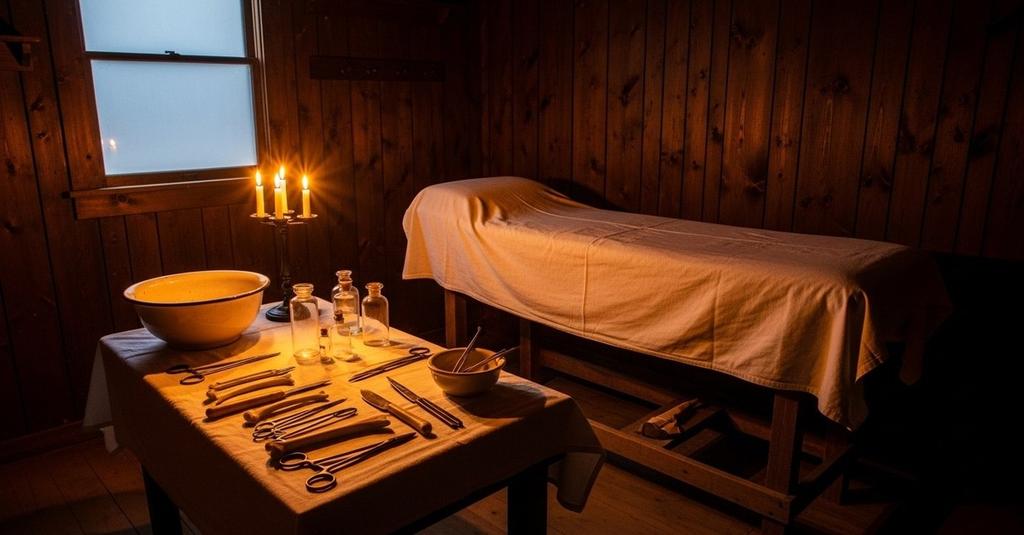
McDowell scheduled the first abdominal surgery for December 25th. Whether that was deliberate — perhaps hoping the holiday would keep away hostile crowds — or simply the day things came together, nobody knows for certain. A small group gathered outside his home in Danville, Kentucky. Some reportedly hostile. Inside, there were no specialists. No sterile field. No anesthesia beyond whatever prayer and willpower Crawford could summon.
Crawford lay on a table.
McDowell made his incision. And then — this is the part that genuinely stops you cold — she began reciting psalms aloud. Out loud, the entire time, as a surgeon she’d met only recently opened her abdomen without anything to dull the pain. The whole operation took 25 minutes.
What They Actually Found Inside Her
The tumor wasn’t just large. It was extraordinarily complex. The growth — now understood to have been a massive ovarian cyst — weighed 22.5 pounds once removed, and contained what contemporary accounts described as gelatinous matter, along with significant fluid. McDowell drained the fluid first, then removed the mass entirely, ligated the blood vessels, and closed the incision. The whole time, Crawford stayed conscious. Stayed calm. Kept reciting.
Twenty-five days after the first abdominal surgery, Jane Todd Crawford rode home on horseback.
She went on to live another 32 years, dying in 1842 at the age of 78. The woman who had the first successful elective abdominal surgery in history outlived the surgeon who performed it — McDowell died in 1830. She outlived her own procedure’s discoverer by over a decade. (That last fact kept me reading for another hour.)
By the Numbers
- 22.5 pounds — the exact weight of the ovarian tumor removed on December 25, 1809, as recorded in McDowell’s own surgical notes published in the Eclectic Repertory and Analytical Review in 1817. Most surgeons at the time didn’t believe the weight was real.
- 60 miles on horseback through winter Kentucky
- 25 minutes — the total duration of the first abdominal surgery, remarkably short even by modern standards for a procedure of this complexity, performed without anesthesia or sterile technique
- McDowell performed 13 similar ovariotomies in his lifetime, losing only one patient. A survival rate that stunned the European medical establishment when his results were finally published.
Field Notes
- When McDowell first published his results in 1817, the British medical community largely refused to believe him. The first abdominal surgery couldn’t have really happened on the American frontier.
- Crawford reportedly walked around McDowell’s yard within days of her surgery. Movement that modern surgeons now recognize as genuinely beneficial to post-operative recovery, though nobody in 1809 understood why it helped.
- McDowell never received a formal medical degree — he studied under a mentor in Edinburgh but left before completing his course, making his surgical achievement even more striking to the establishment figures who had dismissed frontier American medicine as backward and reckless.
Why This Moment Changed Medicine Forever
The first abdominal surgery wasn’t just a single brave act on a cold Christmas morning. It cracked open an entirely new category of what medicine could attempt. Before McDowell, the abdomen was essentially forbidden territory. Surgeons genuinely believed it couldn’t be entered and closed without killing the patient. After Crawford survived, that belief couldn’t hold.
Slowly, over the following decades, other surgeons began to push further into the body cavity. The path toward appendectomies, cesarean sections, and eventually organ transplants runs directly through that room in Danville, Kentucky.
But here’s what matters: the person who made it possible wasn’t just McDowell. It was Crawford. She had to say yes. She had to make that 60-mile journey. She had to lie still on that table, conscious and in pain, and trust a man who was honest enough to tell her he wasn’t certain she’d survive.
Without her willingness, there’s no first abdominal surgery. There’s no precedent. There’s no proof it could be done.
Jane Todd Crawford rode into a surgeon’s home and changed the history of medicine. Most people have never heard her name. That’s the part that lingers. The breakthroughs that reshaped how we live and die often happened quietly, in small rooms, by ordinary people deciding to try something that had never been tried. If this kind of story keeps you up at night, there’s more at this-amazing-world.com.
“`