He Told Norway: No Commoner Wife, No King
It’s 1959. A crown prince walks into a party in Oslo and sees a woman studying dressmaking in Switzerland — and nine years later, Norway’s entire constitutional order is still shaking.
Nobody planned for this. That’s the part that makes it strange.
In the late 1950s, Harald — heir to one of Europe’s oldest thrones — fell in love with Sonja Haraldsen. She was a textile merchant’s daughter from Oslo. No bloodline. No title. No diplomatic value whatsoever. What happened next wasn’t a scandal, exactly. It was quieter than that. Which somehow made it more stubborn.
Key Facts
- Crown Prince Harald and Sonja Haraldsen courted for 9 years before the Norwegian parliament approved their marriage.
- Norway’s constitutional monarchy was re-established in 1905, making the line barely 60 years old at the time.
- Harald and Sonja married in Oslo Cathedral on March 29, 1968.
- The couple has now been married more than 55 years, one of Europe’s longest-running active royal marriages.
- Harald privately stated that if he could not marry Sonja, he would not marry at all, threatening the entire succession.
In short: The Harald Sonja commoner marriage shook Norwegian politics: Crown Prince Harald fell for a textile merchant’s daughter in 1959 and waited 9 years, refusing any other match, until parliament approved their union. They married on March 29, 1968, and have stayed together more than 55 years.
How a Future King Falls for the Wrong Person
They met at a party. She was finishing a degree in dressmaking and tailoring — practical, unpretentious, the kind of detail that tells you everything about who she was. Harald was 30. He looked at her and apparently decided, right then, that this was the person he was going to marry.
Nobody told him the world wasn’t built for that decision.
The Norwegian constitution required parliamentary approval for a royal marriage. And a commoner queen? That wasn’t what the system had planned for. Historian Tor Bomann-Larsen, who’s written extensively on the Norwegian royal family, describes what happened next as the palace catching entirely off guard. But here’s the thing — Harald didn’t panic. He didn’t look for alternatives. He just… waited.
And refused.
The Ultimatum That Shook Norwegian Politics
He didn’t storm into parliament. Didn’t make demands. Didn’t do anything dramatic at all. Instead, the pressure built through private conversations, quiet diplomatic back-channels, and a prince who simply wouldn’t consider any other option. According to the Wikipedia entry on Harald V, his position was clear: if he could not marry Sonja, he would not marry at all.
The throne would pass to someone else. Full stop.
For a monarchy that’d only been re-established in 1905, that wasn’t small talk. Norway’s royal line was young. Harald was the only son. The idea of losing the entire succession because a king refused a “suitable” wife — that was the kind of thing that kept palace advisors awake at 3 a.m., running through contingency plans that didn’t exist yet.
Nine Years
Think about what nine years actually means.
It’s not a passionate summer standoff. It’s nearly a decade of state dinners where the subject hangs in the air like cigarette smoke. Separate appearances at public events. A relationship kept deliberately low-profile while the political machinery ground slowly around it. Harald and Sonja didn’t go public. They just… persisted. Quietly. Without drama.
That last fact kept me reading for another hour. Nine years of a relationship most people would’ve abandoned by year three. No guarantees. No promise that parliament would ever say yes. Just two people who’d decided, and held.
People who knew them during those years described a couple who were simply steady. No theatrical gestures. No public pressure campaigns. Just present. Waiting.
What Changed in 1967
Harald was approaching thirty. By now, he’d turned down every suitable match, every diplomatic solution, every way out the system offered him. King Olav V — Harald’s father — had watched this play out for nearly a decade. He was a pragmatic man. He understood something parliament didn’t: forcing a king into a loveless marriage for protocol was a recipe for catastrophe far worse than a commoner queen.
The Norwegian government gave its approval.
Quietly. No fanfare. No grand gesture. Just a slow yielding to the fact that sometimes a person refuses to budge, and the world has to adjust.
What Happened on March 29, 1968
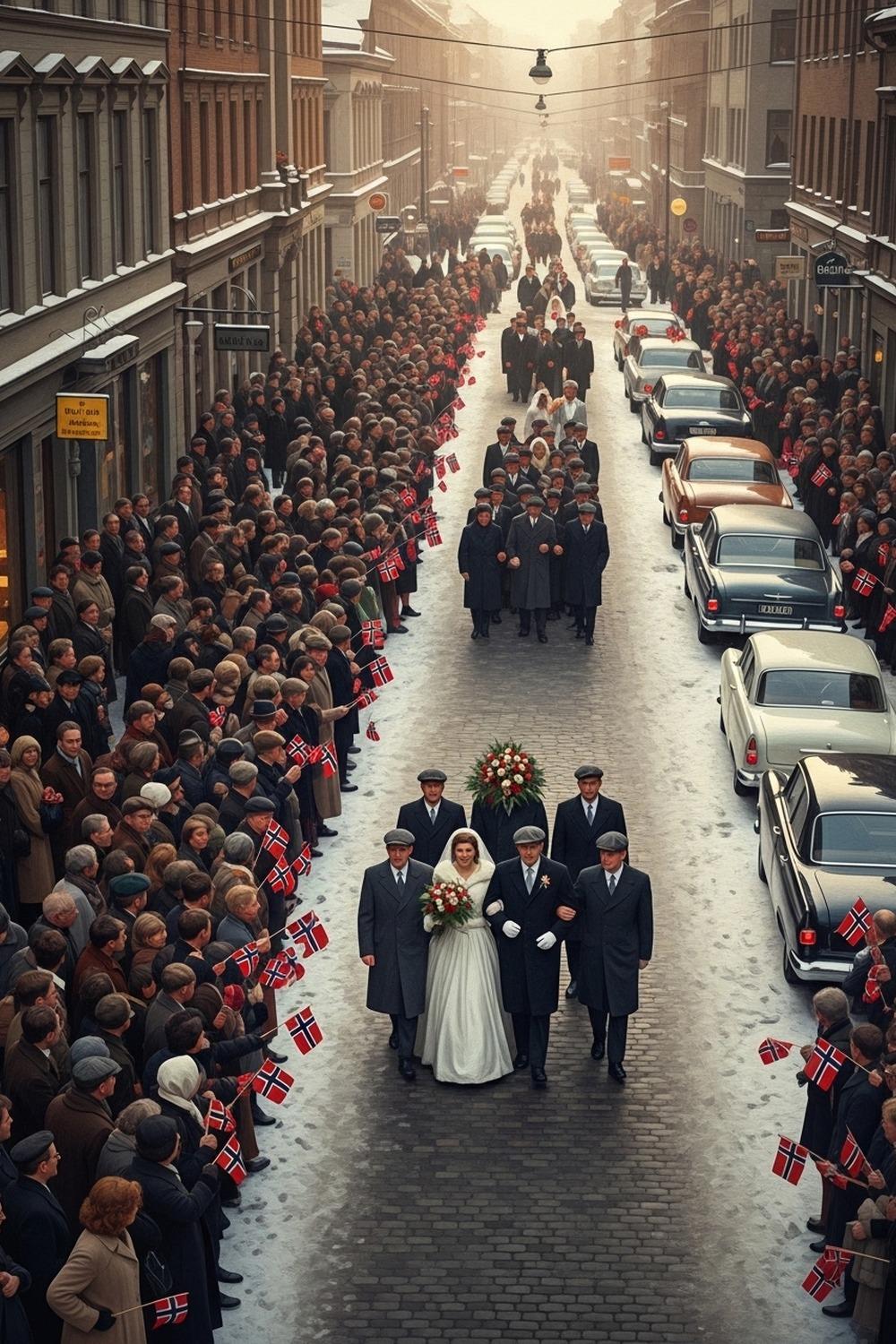
Here’s the thing — when Harald and Sonja married in Oslo Cathedral, something unexpected happened. The public showed up. Not in the polite, obligatory way crowds appear for royal events they feel they should attend. They came because they actually cared. Thousands lined the streets of Oslo, and contemporary accounts describe people visibly moved. Not by the ceremony. By the story.
A man who’d staked his future on one person. A woman who’d waited, without any guarantee of a yes, for nine years.
That’s not pageantry.
And Norway recognized it.
By the Numbers
- 9 years — Harald and Sonja’s courtship before parliament approved their marriage, one of the longest waiting periods in modern European royal history.
- 1905: The year Norway’s constitutional monarchy was re-established, making Harald’s potential abdication threat genuinely destabilizing for an institution barely 60 years old.
- 55+ years of marriage now, making their union one of the longest-running royal marriages currently active in Europe — and the personal approval ratings? Still high.
- Norway’s ranked #1 in UN World Happiness Reports multiple times. The monarchy that almost imploded over this love story is consistently one of Europe’s most popular.
Field Notes
- Sonja was the first commoner to marry a Norwegian crown prince in modern times — unprecedented, with no playbook for what came next.
- Harald’s ultimatum was never formal, never public. It was communicated through private channels, which made it harder to dismiss and harder to dramatize. A deliberate strategy.
- Queen Sonja became a passionate advocate for the arts and Norwegian literature — establishing herself as one of the most culturally active consorts in Scandinavian royal history. A textile merchant’s daughter who studied dressmaking. Nobody predicted that trajectory.
The Ripple Effect
The marriage of Harald and Sonja didn’t just survive. It quietly changed what European monarchy could look like. Before 1968, marrying outside the aristocracy was treated as a constitutional crisis waiting to happen. After Harald and Sonja? It became something closer to a template.
The Danish crown prince married an Australian woman. The Swedish crown princess married her personal trainer. The Dutch king married an Argentine. One by one, the old walls came down.
Norway was first.
That matters. Not in a grand, civilization-altering way. But in the specific, human way that one person’s refusal to accept a bad answer shifts what’s possible for everyone who comes after.
Harald didn’t make speeches about love versus tradition. He just declined to choose tradition. Then he waited — nine years — for the world to catch up with a decision he’d already made.
There’s something quiet about a story with no villain and no dramatic breakdown. Just two people who decided, and held. They’ve been married over 55 years now. Norway’s monarchy is thriving. And the commoner queen the palace once feared became one of the most beloved figures in the country’s modern history. If this kind of story keeps you reading past midnight, there’s more at this-amazing-world.com — and the next one is even stranger.
Frequently Asked Questions
Q: How long did Harald and Sonja wait before they could marry?
Crown Prince Harald and Sonja Haraldsen courted for nine years before Norway’s parliament approved their marriage, one of the longest waiting periods in modern European royal history. They met around 1959, kept the relationship deliberately low-profile, and persisted without any guarantee parliament would say yes. The government finally gave approval in 1967, and they married in Oslo Cathedral on March 29, 1968.
Q: Why was a commoner queen such a constitutional problem in Norway?
The Norwegian constitution required parliamentary approval for a royal marriage, and the monarchy itself had only been re-established in 1905, making the royal line barely 60 years old. Harald was the only son and heir, so his private ultimatum, that he would marry Sonja or not marry at all, threatened to end the entire succession. Losing the royal line over a commoner wife alarmed palace advisors throughout the nine-year standoff.
Q: What impact did the Harald and Sonja marriage have on European royalty?
Before 1968, marrying outside the aristocracy was treated as a constitutional crisis, but Norway’s example made it a template. Afterward, the Danish crown prince married an Australian, the Swedish crown princess married her personal trainer, and the Dutch king married an Argentine. One by one the old walls fell, with Norway first. The couple have now been married more than 55 years, among Europe’s longest-running active royal unions.
Illustrations are AI-generated. Article fact-checked and human-edited. Our editorial standards.