The Holiday Waste Crisis Nobody Talks About
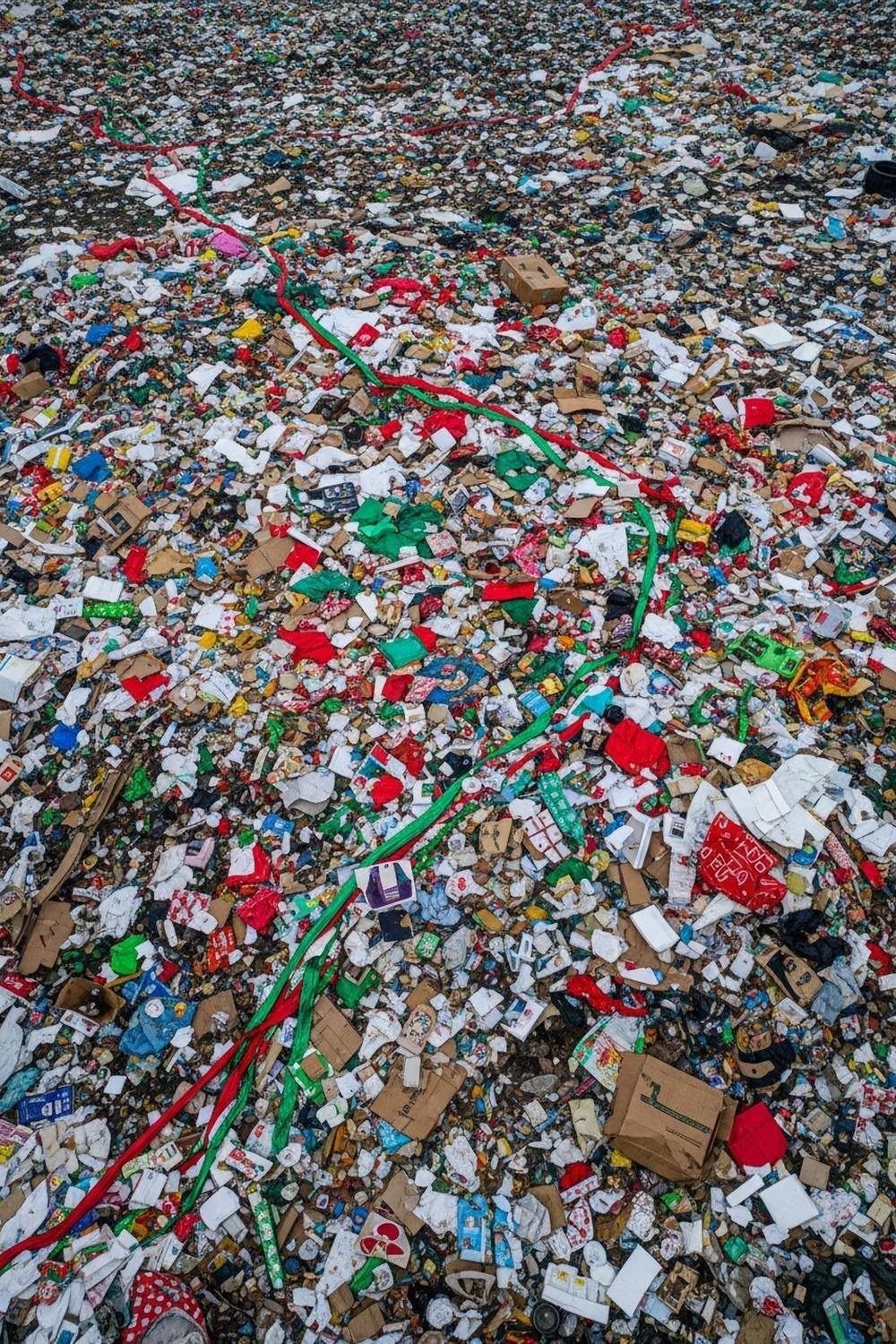
Every year between Thanksgiving and New Year’s, America’s landfills get absolutely buried under 25% more trash than normal. Nobody really talks about it. We just… generate it, and then it vanishes from our minds the moment January hits.
The wrapping paper alone — just the wrapping paper — could cover 9,000 football fields. And here’s the part that kept me reading for another hour: most of it can’t actually be recycled.
Between Thanksgiving and New Year’s Day, Americans generate millions of extra tons of waste on top of an already staggering baseline. It’s a seasonal avalanche. Predictable. Preventable. Almost entirely ignored in the conversations we have about environmental responsibility.
Key Facts
- Americans generate an estimated 25 million extra tons of garbage between Thanksgiving and New Year’s Day each year, roughly a 25% spike above baseline (EPA waste data).
- Wrapping paper and shopping bags account for approximately 4 million tons of waste annually during the U.S. holiday season, most non-recyclable.
- American households throw away roughly 25% more food during the holiday season than at any other time of year.
- Roughly 1.6 billion holiday cards are exchanged annually in the U.S., most unrecyclable due to glitter, plastic windows, or mixed materials.
- Reusing wrapping on just three gifts per American family would save enough paper to cover 45,000 football fields (Stanford Recycling Center).
In short: The holiday waste crisis sees Americans generate an estimated 25 million extra tons of garbage between Thanksgiving and New Year’s — a 25% spike. Wrapping paper, tinsel, and 25% more food waste overwhelm recycling systems, with much of the roughly 4 million tons of seasonal wrapping paper non-recyclable and headed straight to landfills.
The Holiday Waste Crisis Hidden in Plain Sight
Researchers at the University of California, Davis have studied seasonal consumption patterns for decades. The numbers are genuinely hard to sit with. Americans produce roughly 25 million extra tons of garbage during the holiday season each year — that’s above and beyond normal waste levels. Dr. Timothy Gutowski at MIT has called the holiday consumption cycle “one of the most compressed episodes of material waste in the modern calendar.”
So why does almost no one treat it that way?
Part of it is timing. The waste happens in fragments — one gift here, one dinner there — spread across millions of households. It never looks catastrophic at the individual level. But zoom out, and the picture flips entirely. It’s death by a thousand ribbons.
Wrapping Paper Is Worse Than You Think
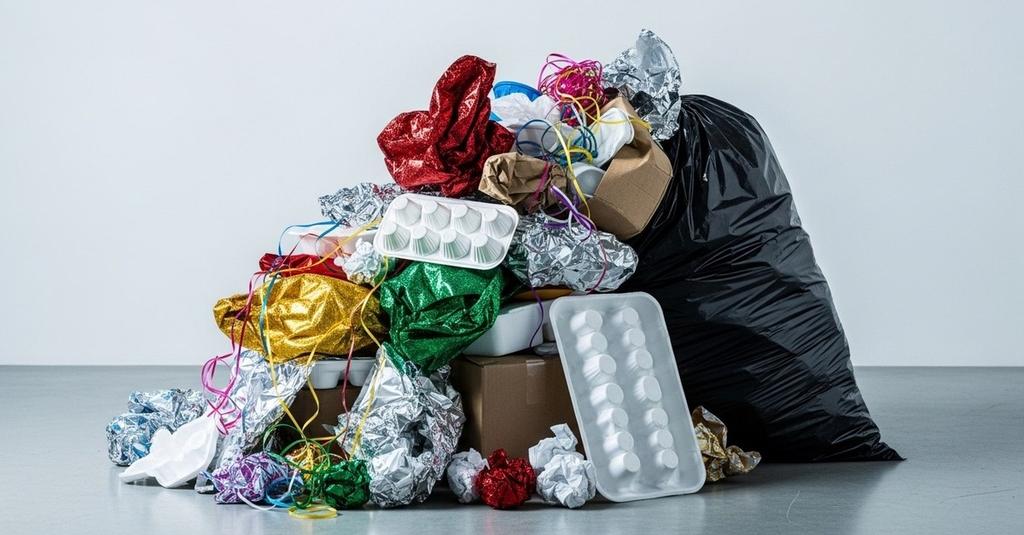
Let’s start with the obvious culprit: the wrapping paper. An estimated 4.6 million pounds of it ends up in American landfills each year. Not recyclable — the metallic stuff, the glitter-coated rolls, the foil-laminated sheets. Standard recycling facilities can’t process mixed materials. Add the tape, the bows, the tissue paper, and you’ve got a disposal nightmare dressed up in a festive bow.
And it’s not like the gifts inside fare much better.
- Plastic clamshell packaging that requires an engineering degree to open
- Foam inserts designed to protect goods and outlive human civilization
- Those impenetrable wire ties nobody asked for
- Twist-ties, plastic sheeting, protective film wrapped around protective film
The gift is a small island inside an ocean of single-use material. We engineered all of this ourselves. We can undo it too — but that requires admitting the scale of the problem first.
Food Waste Doesn’t Get the Attention It Deserves
During the holiday season, American households throw away roughly 25% more food than at any other time of year. Billions of dollars of uneaten turkey. Untouched casseroles. Forgotten leftovers heading straight to landfills, where organic matter decomposes anaerobically and produces methane — a greenhouse gas far more potent than CO₂ in the short term.
The irony is almost painful.
We spend weeks planning the perfect meal. We shop days in advance, overfill the table, and then toss half of it by December 28th. If you want to explore how food systems connect to environmental cost, there’s more at this-amazing-world.com — the numbers are genuinely surprising once you start digging.
The Recycling System Is Already Struggling to Cope
Here’s where the holiday waste crisis gets even more tangled: the seasonal surge doesn’t just overwhelm landfills. It actively breaks the systems designed to keep trash out of them.
Tinsel. That shiny, stringy decoration draped across millions of Christmas trees — it’s one of the most destructive items that enters the recycling stream. It wraps around conveyor belts and sorting machinery, jamming equipment and forcing facilities to shut down entirely. Workers have to untangle it by hand. Every January. Like clockwork. At facilities across the country.
Battery waste spikes. Styrofoam packaging floods donation centers that don’t want it and landfills that have to take it. Single-use plastic from toys, electronics, and novelty items accumulates faster than sorting systems can process.
And the whole thing repeats itself in twelve months. Every year. No pause. No adjustment.
Some cities have tried to fight back.
Cities That Pushed Back and What Happened Next
Turns out, the holiday waste problem isn’t unsolvable — it’s just undertreated. San Francisco’s zero-waste holiday programs have demonstrated that aggressive composting infrastructure, paired with public education campaigns, can meaningfully reduce seasonal waste. Germany offers an even sharper example: its strict packaging laws require manufacturers to take responsibility for the end-of-life of their materials. Complete incentive shift. Suddenly, manufacturers have reasons to use less packaging in the first place, rather than creating waste and letting someone else handle the consequences.
These aren’t utopian experiments. They’re functional policy decisions. The infrastructure gap in most American cities isn’t a mystery. It’s a choice.
And choices can be revisited.
By the Numbers
- Americans generate an estimated 25 million extra tons of garbage between Thanksgiving and New Year’s Day each year — roughly a 25% spike above baseline levels, according to EPA waste characterization data.
- Wrapping paper and shopping bags alone account for approximately 4 million tons of waste annually during the holiday season in the U.S., most of which is non-recyclable due to mixed-material coatings and adhesive contamination.
- A single large holiday dinner for eight people generates over 100 pounds of food and packaging waste — the equivalent of a full week of normal household trash compressed into one evening.
- If every American family wrapped just three gifts in reused materials, it would save enough paper to cover 45,000 football fields. That’s Stanford Recycling Center math, not mine.
Field Notes
- Tinsel is identified by recycling facility managers as the single most operationally disruptive item in the post-holiday waste stream — not because of volume, but because it physically disables sorting machinery.
- The “recycling” symbol on wrapping paper packaging doesn’t guarantee it’s accepted curbside. Facilities use the scrunch test: if it holds its shape, it’s too contaminated with foil or laminate to recycle through standard programs.
- Holiday cards. Roughly 1.6 billion of them exchanged annually in the U.S. Most contain mixed materials, glitter, or plastic windows that make them unrecyclable. Almost nobody tracks this category of waste.
Why the Holiday Waste Crisis Actually Matters Year-Round
The holiday waste crisis doesn’t end when the decorations come down. The material consequences persist for decades. Wrapping paper in a landfill doesn’t biodegrade in any meaningful timeframe. Microplastics from holiday packaging leach into soil and groundwater. The methane from decomposing food waste contributes to atmospheric warming that affects every season, every year.
What feels like a contained, cheerful burst of excess is actually a slow-moving ecological event with a very long tail.
And the cultural cost is real too. We’ve built a version of celebration that is structurally dependent on disposal. That’s worth naming clearly. The holiday season isn’t inherently wasteful — the way we’ve designed it is. Design can change.
The numbers are jarring. The solutions exist. The gap between the two is mostly a matter of attention and political will. Every piece of tinsel that jams a sorting machine, every bag of uneaten food, every roll of foil wrapping paper headed straight to a landfill — it all adds up to a holiday waste crisis that runs on autopilot because we look away after New Year’s. There’s more on this at this-amazing-world.com, and the next story’s even stranger.
Frequently Asked Questions
Q: How much extra waste do Americans produce during the holidays?
According to EPA waste characterization data, Americans generate an estimated 25 million extra tons of garbage between Thanksgiving and New Year’s Day each year, roughly a 25% spike above baseline levels. This includes wrapping paper, packaging, food, and decorations. The waste happens in fragments across millions of households, so it never looks catastrophic individually, but the cumulative seasonal total represents one of the most compressed episodes of material waste in the modern calendar.
Q: Is holiday wrapping paper recyclable?
Much of it is not. Wrapping paper and shopping bags account for roughly 4 million tons of holiday waste annually in the U.S., and most cannot be recycled because of metallic coatings, glitter, foil lamination, and adhesive tape contamination. Standard recycling facilities can’t process these mixed materials. A useful test is the scrunch test: if the paper holds its shape when crumpled, it’s too contaminated with foil or laminate to recycle through standard curbside programs.
Q: Why is tinsel a problem for recycling facilities?
Tinsel is identified by recycling facility managers as the single most operationally disruptive item in the post-holiday waste stream — not because of its volume, but because it physically disables machinery. The shiny, stringy material wraps around conveyor belts and sorting equipment, jamming it and forcing facilities to shut down. Workers must untangle it by hand, a problem that recurs at facilities across the country every January like clockwork.
Q: How much extra food do Americans waste during the holidays?
During the holiday season, American households throw away roughly 25% more food than at any other time of year — billions of dollars of uneaten turkey, untouched casseroles, and forgotten leftovers. Much of it heads to landfills, where organic matter decomposes anaerobically and produces methane, a greenhouse gas far more potent than carbon dioxide in the short term. The waste typically peaks in the days right after major holiday meals.
Illustrations are AI-generated. Article fact-checked and human-edited. Our editorial standards.