The Dog Who Growled at the Babysitter — And Saved a Baby
In 2013, a rescue dog in Charleston did something nobody asked him to do — he refused to stop protecting an infant from someone the parents thought they could trust. No hidden camera. No smart home system. Just a growl that wouldn’t quit.
Here’s what’s wild about this: Benjamin and Hope Jordan had hired a babysitter named Alexis Khan, and their dog Killian responded by positioning himself between her and their baby every single time she arrived. Growling. Hackles up. Not budging. The parents couldn’t figure out why their rescue dog was acting so aggressively toward someone they’d vetted, someone who seemed perfectly normal. So they did something that would either look paranoid or brilliant, depending on how it turned out — they slid an iPhone under the couch cushions and hit record.
When they played back that audio that evening, they heard Khan cursing at the infant. Slapping sounds. The unmistakable noise of someone shaking a baby out of pure frustration.
Key Facts
- In 2013 in Charleston, the Jordan family’s rescue dog Killian repeatedly placed himself between their baby and a babysitter, Alexis Khan.
- An iPhone hidden under couch cushions recorded the abuse, and Khan was sentenced to one to three years in prison.
- Dogs have roughly 300 million olfactory receptors, compared with about 6 million in humans.
- A 2004 BMJ study found trained dogs could identify certain cancers with up to 97% accuracy.
- The ASPCA estimates roughly 3.1 million dogs enter U.S. shelters every year.
In short: In 2013, a Charleston rescue dog named Killian growled and positioned himself between the family’s baby and a new babysitter. A hidden iPhone caught the babysitter abusing the infant, and she was sentenced to one to three years. The case highlights how dogs, with about 300 million olfactory receptors, detect danger humans miss.
How a Dog Detects Danger Before Humans Do
Dogs have been living next to humans for something like 15,000 years. In that time, they’ve picked up on things we’re still trying to explain with science. A dog detects danger through a combination of scent, body language, and micro-expressions — the tiny shifts in someone’s face that happen in milliseconds, below the level of conscious awareness.
Dr. Alexandra Horowitz at Barnard College has spent years documenting how sophisticated this actually is. Dogs can read elevated cortisol levels in sweat. They pick up on tension in how someone holds their shoulders. They notice when a person’s breathing changes. It’s not magic.
It’s detection.
Killian wasn’t operating on instinct in that vague, hand-wavy sense we use the word. He was processing data — constant, real-time information about whether someone was safe to be around his family. His nervous system, honed over thousands of years, was doing exactly what it evolved to do. The problem wasn’t Killian. The problem was that nobody was listening to him.
The Morning Everything Changed
The audio evidence led to Khan’s arrest. A judge sentenced her to one to three years in prison for child abuse. The case made national news, but not because of the technology — because of the complete absence of it. No nanny cam. No smartwatch alerting them. No neighbor who happened to stop by. A dog detects danger in ways that don’t show up on any dashboard or notification. He just shows up. He growls. He refuses to move.
And if nobody listens, the abuse continues.
But the Jordans listened.
Think about what that means. The only barrier between that baby and ongoing harm was a mixed-breed rescue dog with no training certification, no special title, and absolutely no way to say in words what he knew. He had to keep showing up. Keep positioning himself. Keep refusing to stand down until someone finally asked the question: why?
Dogs Have Been Doing This Forever
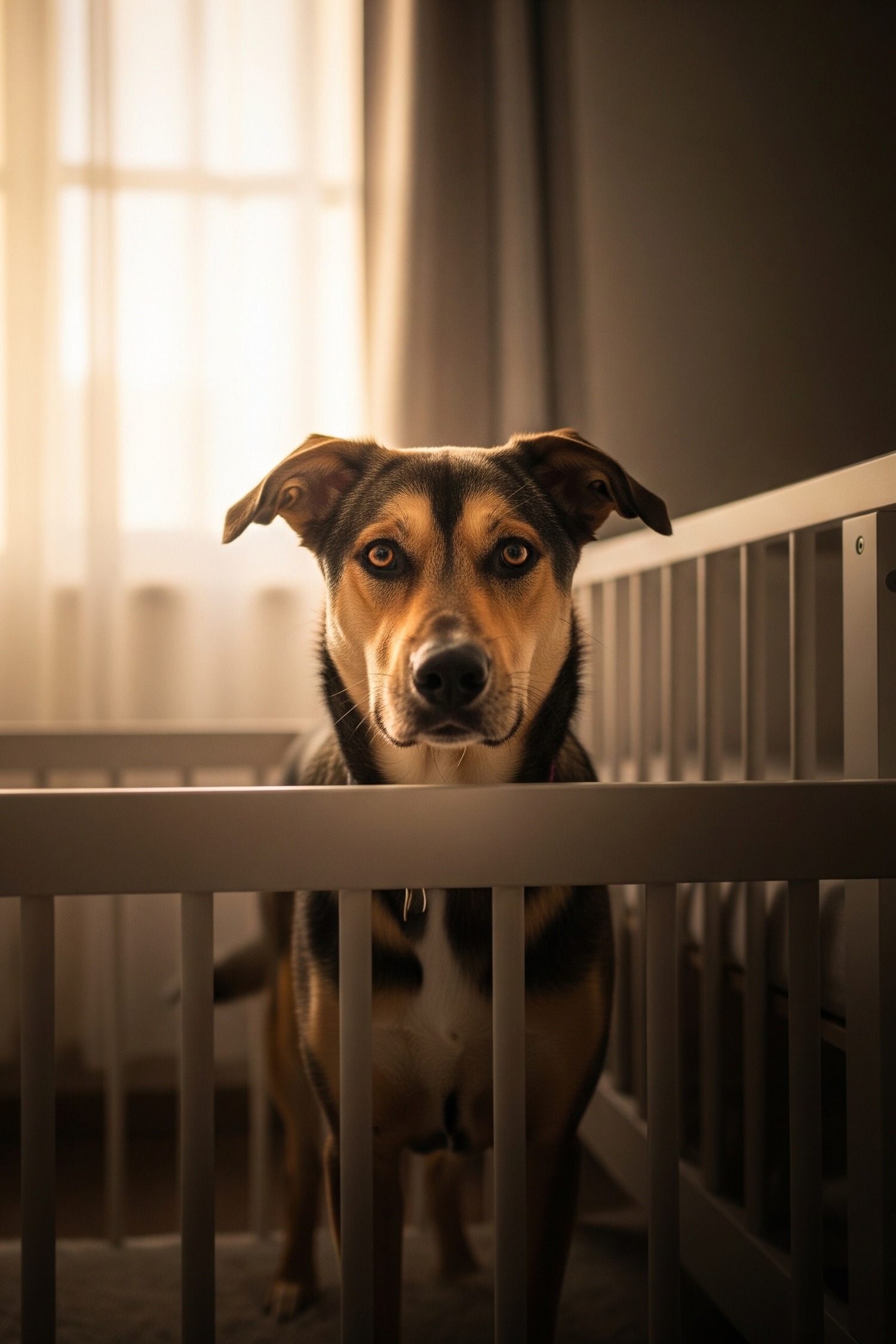
Killian wasn’t an outlier. He wasn’t specially trained or genetically gifted. He was just a dog who noticed something dangerous about a person and reacted accordingly — which turns out to be something dogs have documented records of doing for centuries. They’ve alerted families to gas leaks before anyone smelled it. They’ve detected seizures happening minutes before they occur. They’ve identified certain cancers with accuracy rates as high as 97%, according to studies in the BMJ. Medical researchers take this seriously now, which is wild to think about, because it means they’re finally catching up to what dogs have been telling us all along.
Here’s what kept me reading about this for hours: if dogs are constantly picking up on these signals — stress levels, illness, intention — and we’re missing them because we’re distracted by our phones or because we’ve decided a behavior is “just quirky,” what else are we not seeing? How many times has a dog tried to tell you something was wrong and you petted them and moved on?
By the Numbers
- Dogs have roughly 300 million olfactory receptors in their noses. Humans? About 6 million. Do the math.
- Domesticated for an estimated 15,000 years — longer than any other animal species — and they’ve spent that entire time learning to read human behavior (Nature Communications, 2020 review of archaeological evidence).
- A 2004 study in the BMJ found that trained medical alert dogs could identify certain cancers with up to 97% accuracy compared to some standard screening methods.
- Dogs can distinguish between a person who is stressed and the same person when calm by scent alone, suggesting they’re reading our internal states in real time without any visual information at all.
- The American Society for the Prevention of Cruelty to Animals estimates that roughly 3.1 million dogs enter U.S. shelters every year — thousands of animals with Killian’s potential waiting for someone to bring them home and actually trust them.

Field Notes
- A 2019 study found that dogs could identify the scent of malaria infection with 81% sensitivity — accurate enough that researchers think they could serve as a screening tool at international ports.
- The Killian case became a catalyst for public discussion about pets as informal household monitors, a concept animal behaviorists had been quietly exploring for years before this case went mainstream and suddenly everyone was interested.
- Researchers have documented cases of dogs predicting epileptic seizures with enough consistency that it’s no longer considered anecdotal — it’s measurable.
Why This Matters in an Age of Surveillance
We’re surrounded by smart doorbells and nanny cams and location-tracking apps. We’ve built an entire infrastructure around the idea that technology can protect us. And yet the thing that stopped an abuser in Charleston wasn’t any of that. A dog detects danger the way no algorithm ever could — not by processing a dataset, but by being present. By caring enough to position himself over and over between a threat and the thing he was protecting, until someone finally asked what he was trying to say.
That’s not sentimental.
That’s the most important thing we’ve been missing about the animals we live with.
Killian wasn’t specially trained. He didn’t have credentials. He just paid attention in a way that mattered, and he didn’t stop even when everyone else wanted to move on with their day. That baby is safe now because a rescue dog refused to be dismissed.
Next time your dog acts strange around someone, maybe don’t explain it away immediately. Maybe ask yourself what he’s actually seeing — or smelling, or sensing in some way we haven’t fully mapped yet. There’s more at this-amazing-world.com, and honestly, the next story is even stranger than this one.
Frequently Asked Questions
Q: What did the dog Killian do?
Killian, the Jordan family’s mixed-breed rescue dog in Charleston, repeatedly positioned himself between their infant and a new babysitter named Alexis Khan, growling with his hackles up every time she arrived. The parents couldn’t understand the aggression toward someone they’d vetted, so in 2013 they slid an iPhone under the couch cushions and recorded. The audio captured cursing, slapping sounds and the noise of the baby being shaken.
Q: How do dogs detect danger humans can’t?
Dogs combine scent, body language and micro-expressions to read people. According to Dr. Alexandra Horowitz of Barnard College, they can detect elevated cortisol in sweat, notice tension in someone’s shoulders and pick up on changes in breathing. With roughly 300 million olfactory receptors versus about 6 million in humans, and around 15,000 years living beside us, dogs process constant real-time information about whether someone is safe.
Q: What happened to the babysitter?
The audio recorded on the hidden iPhone became evidence, leading to Alexis Khan’s arrest. A judge sentenced her to one to three years in prison for child abuse. The case made national news precisely because no nanny cam, smartwatch or surveillance system raised the alarm — only the dog. Killian had no training certification or special title; he simply kept showing up and refusing to stand down until the parents finally asked why.
Q: What else can dogs detect by smell?
Trained dogs have shown remarkable medical detection abilities. A 2004 BMJ study found they could identify certain cancers with up to 97% accuracy, and a 2019 study found they could detect the scent of malaria infection with 81% sensitivity — accurate enough to consider as screening at ports. Dogs can also distinguish a stressed person from a calm one by scent alone, and have alerted families to gas leaks and predicted epileptic seizures.
Illustrations are AI-generated. Article fact-checked and human-edited.