The Dead Sea Scroll No One Could Read — Until Now
Two thousand years ago, someone wrote words onto parchment in a desert cave. Then the parchment turned black and everyone stopped looking. Last year, light finally caught what darkness had hidden all along.
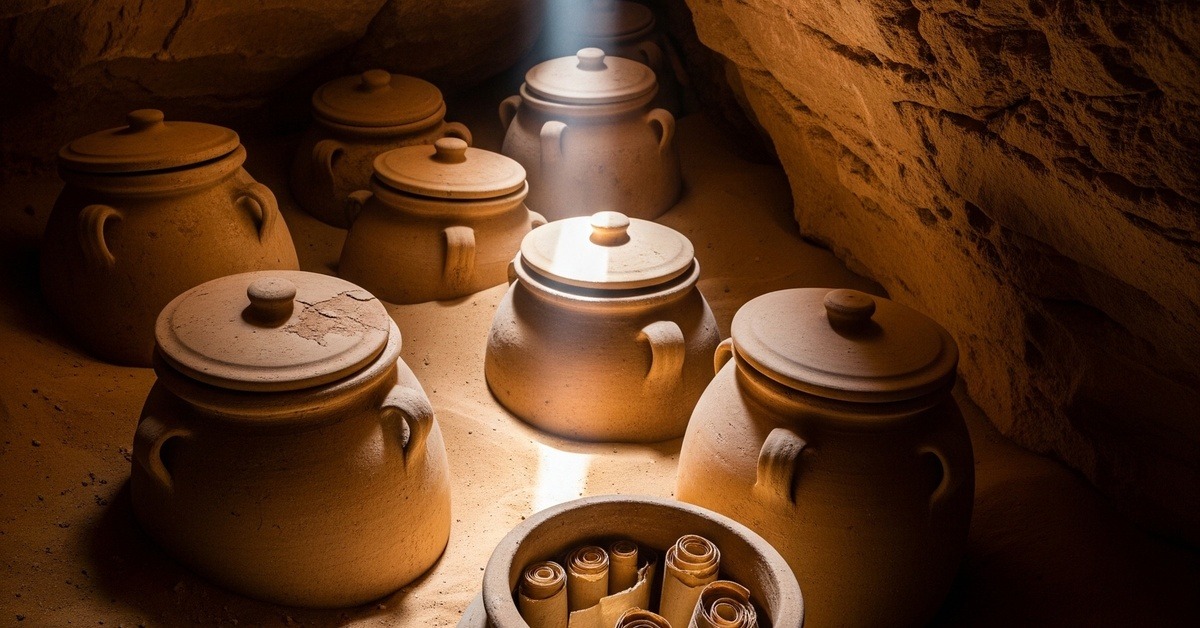
It’s 1947. A Bedouin shepherd throws a stone into a limestone cave near Qumran, above the Dead Sea. He’s not looking for history. He hits a clay jar by accident. Inside are scrolls — biblical texts, community records, fragments so old that scholars still haven’t finished reading them. Most of them, anyway. Some fragments were too dark. Too damaged. Too defeated by time. So researchers just… set them down and walked away.
Until this year.
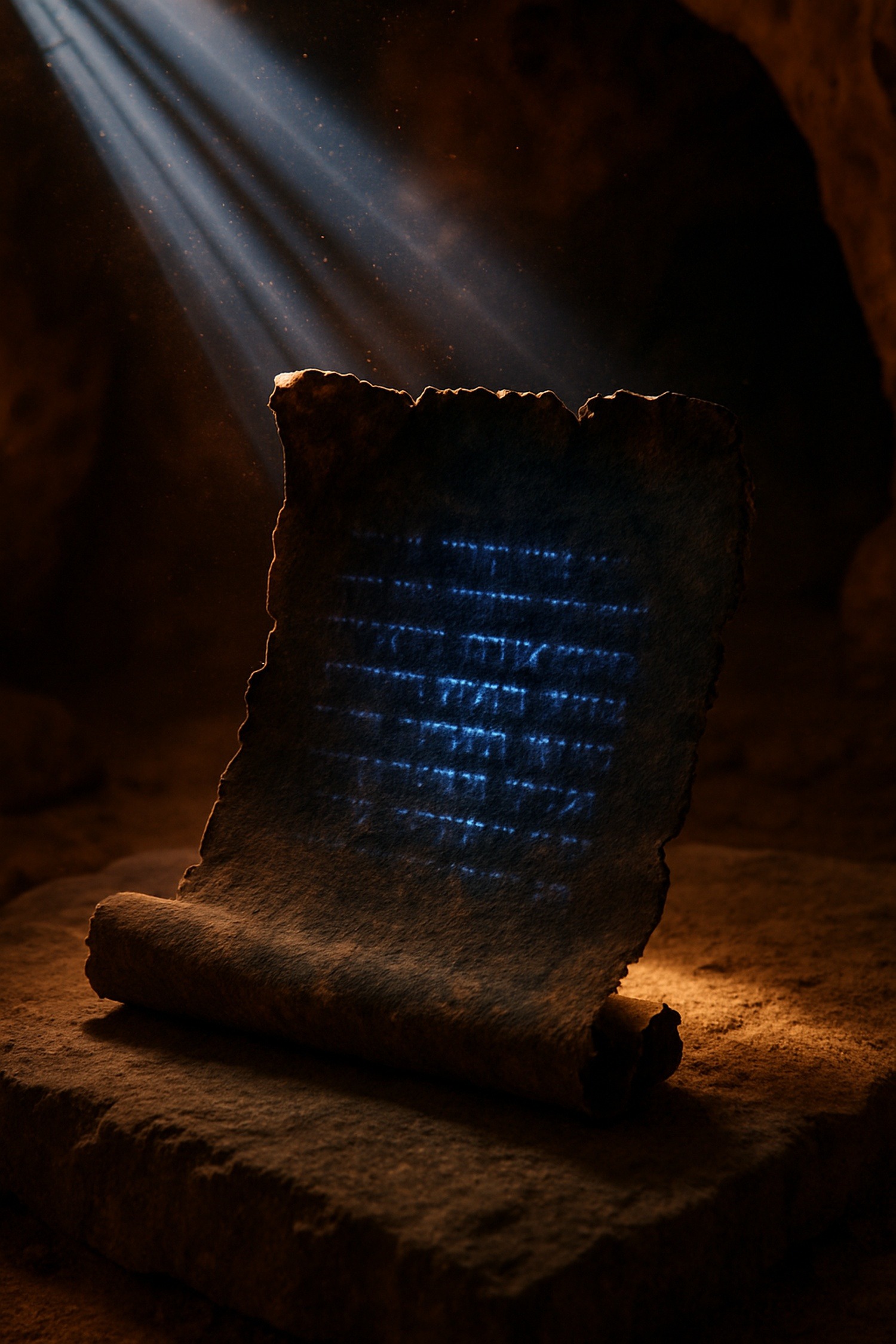
A team of researchers pointed multispectral imaging at one of those abandoned fragments — light wavelengths the human eye can’t even see — and letters emerged from the black like they’d been waiting for permission to be visible. The text had been there the entire time. Every scholar who’d held that parchment in the last seventy years was carrying a complete message and didn’t know it.
Key Facts
- In 1947, a Bedouin shepherd discovered the Dead Sea Scrolls in a limestone cave near Qumran, above the Dead Sea, after a stone he threw struck a clay jar.
- A research team used multispectral imaging — light wavelengths the human eye cannot see — to recover text from a fragment long considered too dark and damaged to read.
- Dr. Oren Ableman of the Israel Antiquities Authority was present when the previously invisible text reappeared under infrared and other light bands.
- Carbon-based ink absorbs infrared strongly while aged parchment reflects more of it, restoring contrast that the naked eye had lost as the animal-skin parchment darkened over 2,000 years.
- The newly recovered lines include calendar notations tied to the Essenes, a sect that withdrew from Jerusalem around 150 BCE and followed a 364-day solar calendar.
In short: A Dead Sea Scroll fragment near Qumran, blackened by 2,000 years and abandoned as unreadable, was recovered using multispectral imaging — invisible light wavelengths that restored the contrast between carbon ink and darkened parchment. The Israel Antiquities Authority’s Dr. Oren Ableman saw the text reappear, revealing Essene biblical reflections and calendar notations.
Dead Sea Scrolls Decoded: When Light Becomes a Translator
Multispectral imaging works by flooding ancient materials with dozens of different light wavelengths simultaneously. Ink and parchment respond differently to infrared, ultraviolet, and other bands. What looks uniformly black to human eyes becomes a conversation when you’re asking the right questions in the right invisible light.
Dr. Oren Ableman at the Israel Antiquities Authority was there when the text reappeared.
Think about that. The words were always there. We just didn’t have ears — or eyes — for them yet. That last fact kept me reading for another hour, because it raises an obvious question: how much else are we holding that we can’t see? How many messages are we walking past because we don’t have the right tools?
Why a Blank Fragment Isn’t Actually Blank
To understand the recovery, you have to understand the chemistry of what went wrong in the first place. Most of the Dead Sea ink was carbon-based — soot or charcoal suspended in a binder. Carbon is remarkably stable, which is part of why these texts survived at all. But the parchment underneath is animal skin, and skin ages badly. Over twenty centuries the collagen darkens, oxidizes, and absorbs minerals leaching out of the cave walls and the clay jars. Eventually the background grows almost as dark as the ink sitting on top of it.
That’s the trap. To the naked eye, contrast is everything. When dark ink sits on a dark background, your visual system simply has nothing to grab onto — the letters are physically present but optically invisible. Add a layer of gelatinized, cracked surface and a faint sheen of cave residue, and a fragment can look like a uniform brown-black chip of nothing.
What saves the message is that ink and skin are different substances, and different substances interact with light differently no matter how similar they look. Carbon ink absorbs infrared light strongly; aged parchment reflects more of it. Shine an infrared band on the fragment and photograph the reflection, and suddenly the ink reads as deep shadow against a brighter field. The contrast your eyes lost is recovered in a part of the spectrum your eyes were never built to see.
The Essenes: A Community That Decided to Write Instead of Panic
The newly recovered lines contain biblical reflections and calendar notations — ritual cycle records tied to sacred observance. This was the work of Essene scribes, a sect that withdrew from Jerusalem around 150 BCE. They didn’t flee in terror. They built a library in the desert on purpose, convinced the temple establishment had rotted and the end of days was approaching.
They ground their ink from minerals in the cliff stone surrounding them. The desert gave them shelter. They used the desert to write. Their tools and their sanctuary were made of the same stone — a kind of poetic circularity that probably wasn’t accidental.
These weren’t copyists on autopilot.
They were scribes who understood, on some level, that they were archiving for a future reader they’d never meet. For you, maybe. For anyone who’d learn to look at the dark and ask what might be hiding there.
The calendar notations matter more than they sound. The Essenes followed a solar calendar of 364 days, a fixed and tidy number that divided cleanly into weeks and never let a festival drift onto the Sabbath. The temple authorities in Jerusalem used a lunar reckoning instead. That disagreement wasn’t a footnote — it meant the two communities literally celebrated the holiest days of the year on different dates. When a fragment turns out to carry calendar data, it isn’t dry administration. It’s evidence of one of the deepest fault lines in the religious world of the time, written down by the side that lost the argument.
How Clay Jars Became the Best Librarians in History
Here’s what doesn’t get mentioned: the preservation wasn’t accidental. The scrolls were sealed inside clay jars, deliberately wrapped, stored in caves with near-perfect climatic conditions — dry air, stable temperatures, minimal light. The community at Qumran understood they were protecting something that needed to outlast them. They were betting on the future. They were right.
For two thousand years, no flood touched those jars. No fire reached them. The desert, indifferent to human meaning, turned out to be the most reliable librarian humanity ever hired.
And the silence held until someone invented light that could see in the dark.
The geography did most of the heavy lifting. The Qumran caves sit in one of the driest places on Earth, more than four hundred meters below sea level, where rainfall is rare and humidity stays low for most of the year. Organic material decays fastest in warmth and moisture, where microbes and mold thrive. Strip out the water and the biology mostly stops. The same conditions that make the region almost uninhabitable for people make it close to ideal for parchment — a natural archive maintained at no cost by the climate itself. The scribes didn’t just get lucky; they read the landscape correctly and trusted it.
The Strange Part: Scripture That’s Still Being Written
The recovered lines contain linguistic variations that don’t appear in any later biblical version. Not typos. Not minor spelling differences. Actual textual divergences — phrasing choices, word selections, structural variations — that suggest the text being copied at Qumran hadn’t yet hardened into the form we recognize today.
Scripture, at that moment, was still being written.
Still being argued over. Still in motion. Still negotiable. These weren’t people receiving a fixed, finished document from heaven. They were participants in something still being shaped — right up until they sealed those jars and the desert swallowed everything. You can read more about how ancient communities preserved sacred knowledge in unexpected ways over at this-amazing-world.com.
That reshapes how we understand the relationship between ancient communities and the texts they considered sacred.
That’s not a small thing.
The Technology That Broke Silence
Multispectral imaging has been quietly transforming ancient text recovery for two decades, but its application to the most damaged Dead Sea fragments is recent. It’s the same technology used to read carbonized scrolls from Herculaneum, buried by Vesuvius in 79 CE — letters preserved in ash by accident, now visible through light that doesn’t exist in nature.
What’s striking?
Researchers estimate there are scroll fragments — some tiny, some substantial — that haven’t been fully analyzed yet. Each one is a potential message from someone who believed the world was ending and wanted to make sure something survived it. That wasn’t a metaphor to them. That was their actual belief. And they were meticulous because of it.
How the Imaging Actually Works, Step by Step
The process is less like taking a photograph and more like interrogating an object. A fragment is placed under a camera and lit, in sequence, by a bank of LEDs tuned to specific wavelengths — running from the ultraviolet, through the visible spectrum we know, and out into the near-infrared. At each wavelength the camera captures a separate exposure. A single fragment might generate a dozen or more images, each one a portrait of the same surface as seen by a different slice of light.
None of those individual frames is the answer. The breakthrough comes afterward, in software. Researchers stack the images and run statistical techniques that hunt for the wavelength — or the mathematical blend of several wavelengths — where ink and parchment separate most sharply. One band might make the ink leap out; another might suppress a distracting stain or a water-mark that has nothing to do with the writing. Combine them intelligently and a legible page can emerge from what looked like a ruined chip.
Crucially, none of this touches the object. There’s no solvent, no heat, no chemical that might damage a two-thousand-year-old surface. The fragment is only ever bathed in light. That non-destructive quality is why the method has spread so quickly through museums and archives: a curator can let a scroll reveal its secrets without risking a single fiber of it. The same approach has been turned on medieval palimpsests — pages scraped clean and reused, where an erased older text still hides beneath the newer one — and on charred library rolls thought to be lost forever.
By the Numbers
- Over 900 manuscripts identified since 1947 — the largest collection of ancient Jewish texts ever found in one location.
- The scrolls date from roughly 250 BCE to 68 CE, spanning approximately three centuries of scribal activity across multiple generations of writers.
- Some fragments are as small as a postage stamp; the Great Isaiah Scroll stretches to 734 centimeters in length.
- Multispectral imaging can distinguish ink from darkened parchment even when there’s effectively zero contrast to the naked eye — recovering text that conventional photography, enhanced scanning, and decades of expert examination had completely missed.
Field Notes
- The ink was made from carbon and metallic compounds found locally. The scribes weren’t importing materials — they were literally writing with the same landscape they were hiding in.
- Multiple scribal hands appear on single documents. Some fragments show evidence of collaborative or supervised copying sessions where one scribe would write while others watched, checking for errors.
- The Essenes had strict rules about who could touch scripture. Initiates went through years of probation before being trusted with texts. A copying mistake wasn’t just an error — it was considered desecration that could disqualify a scribe entirely.
- Not all the scrolls are biblical. About a third of the collection contains texts entirely unknown before 1947 — community rulebooks, hymns, apocalyptic visions, priestly liturgies that had simply vanished from human memory.
What the Scrolls Rewrote About the Bible Itself
Before 1947, the oldest complete Hebrew manuscripts of the biblical text were medieval — roughly a thousand years younger than the Qumran fragments. Scholars had long suspected that a millennium of hand-copying must have introduced drift, but they had no way to test it. The scrolls handed them that test. When researchers laid the ancient Qumran versions beside the medieval ones, the level of agreement was, in many books, startling: across a thousand years of copying, much of the wording had held remarkably steady.
And yet not all of it. Alongside the familiar readings sat genuine alternatives — different word orders, fuller or shorter passages, phrasings that matched the ancient Greek translation rather than the later Hebrew standard. The picture that emerged wasn’t a single perfect original slowly corrupted, nor a chaos of free invention. It was something more interesting: several text traditions living side by side in the same period, sometimes in the same cave, before one family of readings gradually won out and became standard. The fragment recovered by light is one more data point in that long story — a reminder that the text we treat as fixed was, for centuries, a living thing being copied, compared, and quietly chosen.
Why Dead Sea Scrolls Decoded Matters Beyond the Fragment
The significance isn’t just one text in one cave. It’s about the nature of historical knowledge itself — how much of what we think we know is shaped by which documents survived, and how we’ve been reading them. Every time a new line of ancient scripture surfaces with a variation that doesn’t match our canonical versions, it asks a quiet but radical question: how many other variations existed that we’ll never recover?
How many voices wrote their version of these stories into parchment that didn’t survive?
The scribes at Qumran sealed their jars because they were afraid of losing something irreplaceable. They were right to be afraid — most of it was lost anyway. What remains is a fragment of a fragment. But fragments, it turns out, can speak volumes. Each piece of parchment is a message in a bottle — thrown not into water but into time.
A community of people who believed civilization was collapsing sat down in a desert cave and decided the most important thing they could do was write carefully, preserve faithfully, and trust that someone, someday, would know how to read what they’d left behind. They waited two thousand years for the right light.
And then it came.
Frequently Asked Questions
Q: How can imaging read text that’s invisible to the human eye?
Because the ink and the parchment are different materials, and they reflect and absorb light differently even when they look identical to us. Carbon ink soaks up infrared light while aged parchment bounces more of it back. A camera tuned to those invisible wavelengths sees a sharp contrast where our eyes see only uniform black, so the letters reappear without anyone touching the fragment.
Q: Does multispectral imaging damage the scrolls?
No. The fragment is only exposed to light — no chemicals, no heat, no physical contact beyond careful handling. That non-destructive quality is exactly why archives trust the method: a priceless object can give up its hidden text while remaining completely intact for future study.
Q: Are there still unread Dead Sea Scroll fragments?
Yes. Thousands of fragments survive, and many of the smallest or most damaged pieces have never been fully analyzed with modern imaging. As the technology improves and is applied to more of the collection, researchers expect further hidden text to surface — which is why scholars say the caves almost certainly haven’t given up their last secret.
There are more fragments waiting in the collections. More parchment still dark, still silent, still carrying messages that only the right wavelength will reveal. The cave gave up one secret. It’s almost certainly not the last.
Illustrations are AI-generated. Article fact-checked and human-edited.