Titanic Message in a Bottle: Jeremiah Burke’s Final Note
The most haunting Titanic message in a bottle wasn’t fiction. A teenager wrote nine words. He sealed them in glass. Then he threw the bottle into the freezing dark. He never reached a lifeboat. Somehow his last sentence reached Ireland.
On the night of 14 April 1912, nineteen-year-old Jeremiah Burke of Glanmire, County Cork is somewhere on the lower decks. He’s emigrating to America. He has a small bottle of holy water his mother gave him. As the ship fails around him, he tears a scrap of paper, scribbles a goodbye, and trusts it to the sea. What are the odds the Atlantic carries it anywhere at all?
Key Facts
- Jeremiah Burke was 19 when he boarded Titanic at Queenstown on 11 April 1912.
- His note read: “From Titanic, Goodbye All, Burke of Glanmire, Cork.”
- The bottle washed ashore at Dunkettle, County Cork, in 1913 — roughly a year later.
- The find site sits just a few miles from the Burke family home.
- Niece Mary Woods donated the bottle to Cobh Heritage Centre in October 2011.
In short: The Titanic message in a bottle was written by Jeremiah Burke, a 19-year-old emigrant from Cork who died when the ship sank in 1912. His bottled note drifted nearly a year before washing ashore at Dunkettle, miles from his home. The family kept it for a century before donating it to a museum.
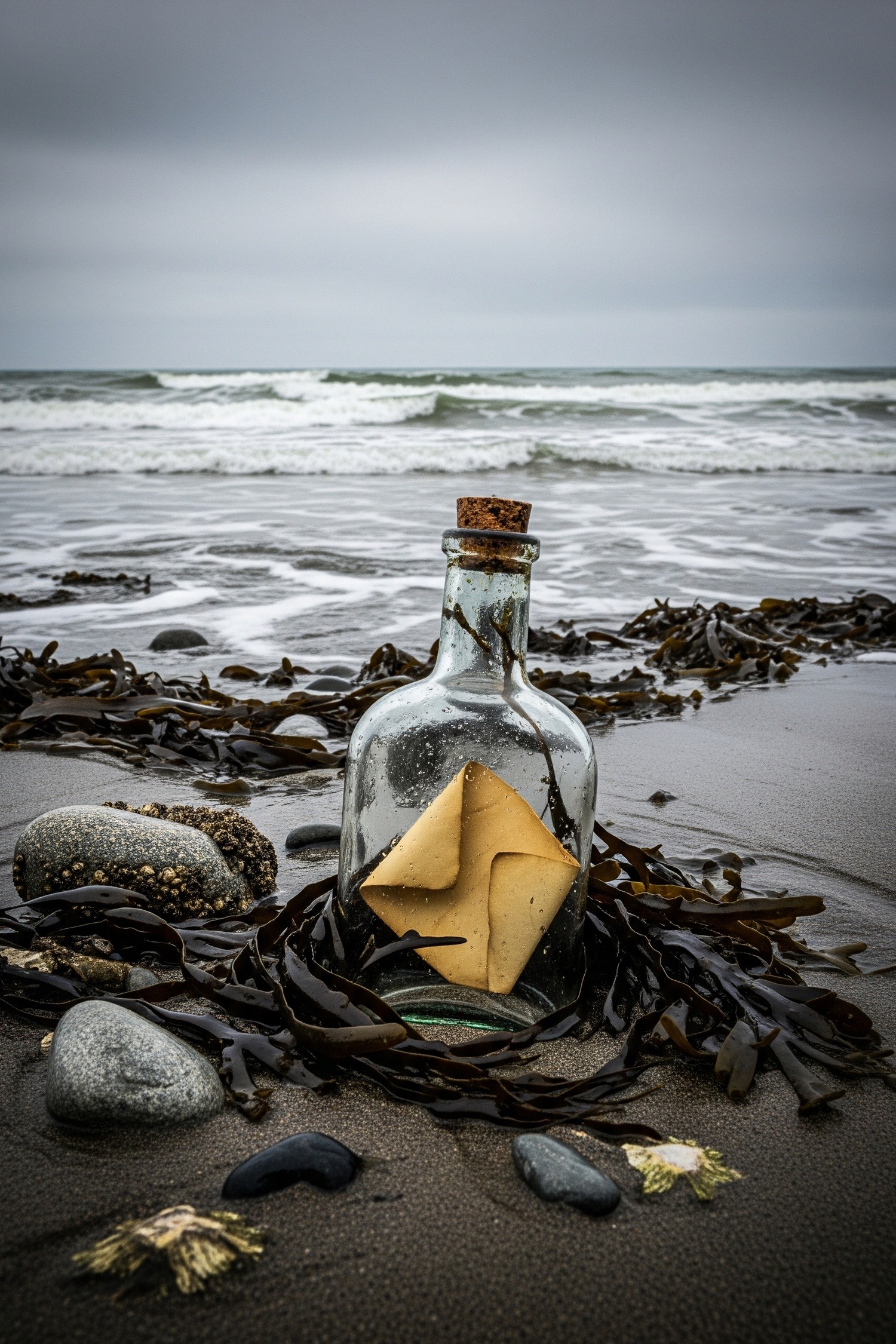
Who was the young man behind the Titanic message in a bottle?
Jeremiah Burke comes from a farming family in Glanmire, a green parish on the River Lee just east of Cork city. In the spring of 1912 he’s doing what tens of thousands of young Irish people did that decade — leaving. America means work, wages, a future the small farm can’t promise. His cousin Nora Hegarty travels with him. According to records held by Encyclopedia Titanica, the maritime research archive founded in 1996, the pair board the ship as third-class passengers at Queenstown on 11 April 1912. Before he leaves, his mother presses a small bottle of holy water into his hands. It’s meant to keep him safe on the crossing. He carries it the way you carry a mother’s worry — folded into a pocket, half forgotten.
Third class on Titanic sits low and forward, far from the boat deck. When the iceberg tears into the hull just before midnight, the people down there are the furthest from the lifeboats and the last to learn how bad it is. Burke and his cousin are among them. We don’t know the exact path of his final hour. We know the outcome. Neither Jeremiah nor Nora survives the night.
What he does survive on is paper. Somewhere in the chaos, he empties the little holy-water bottle, finds a scrap, and writes. Then he lets the sea take it.
How the bottle found its way back to Cork
The note is short and almost unbearably calm: “From Titanic, Goodbye All, Burke of Glanmire, Cork.” No panic. No plea. Just a name, a place, and a farewell. He sealed it inside the bottle his mother had given him and dropped it into the North Atlantic somewhere off the coast of Newfoundland. For a deeper sense of how families on land waited for word in the weeks after the disaster, the survivor accounts collected across our archive of human stories show just how long hope and grief could run in parallel.
Then the ocean did something a physicist could explain and a mother never could. Currents in the North Atlantic — the cold Labrador stream meeting the warmer drift of the Gulf Stream — push surface debris in long, looping arcs. A sealed glass bottle floats high and travels far. Over months it crossed thousands of kilometres of open water, riding wind and current eastward toward Europe, toward the very island Jeremiah had sailed away from.
In 1913, roughly a year after the sinking, the bottle washed up at Dunkettle — on the shore of Cork Harbour, only a few miles from the Burke farm in Glanmire. Someone found it. Someone read the name. Someone carried it back to the family.
Why this story still unsettles historians
Maritime historians are careful people, and the bottle’s journey invites exactly the kind of scrutiny they live for. Could a note have travelled from the wreck site to Cork Harbour in twelve months? Drift research, including the documented account of Burke’s bottle and decades of ocean-circulation studies, consistently shows that buoyant objects can ride North Atlantic currents across the basin within a year, and Cork sits squarely in the path of the eastward drift. The physics doesn’t rule it out. What the physics can’t address is the landing point — that of every kilometre of European coastline, the bottle chose the strand within a morning’s walk of the boy who wrote it.
Skeptics have asked the obvious question: is it genuine? The handwriting, the family provenance, and the unbroken chain of custody through the Burke descendants all point one way. The bottle stayed in the family for nearly a century — not displayed, not sold, just kept. That quiet custody is itself a kind of authentication. Forgeries get shown off. Grief gets put in a drawer.
Here’s the thing about coincidence at this scale: it stops feeling like statistics and starts feeling like a message. That’s the line historians refuse to cross, and the line every visitor crosses the moment they see it.
How did the bottle end up on public display?
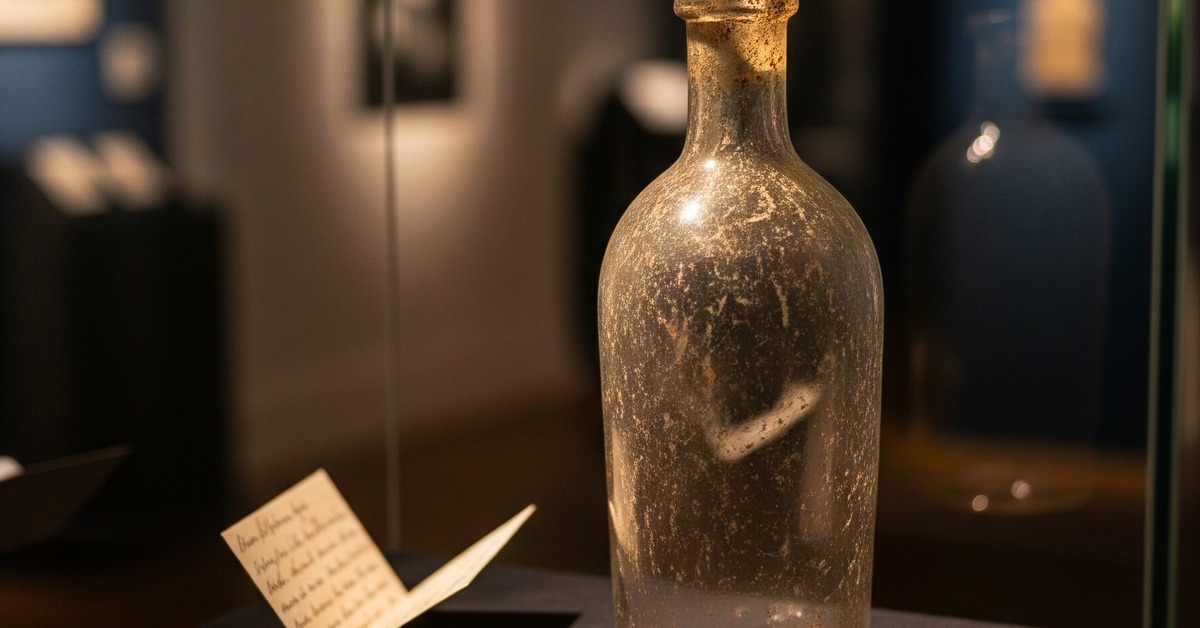
For decades the bottle lived privately with the Burke family, passed down like any heirloom — except this one held a dead boy’s last words. Then in October 2011, Jeremiah’s niece, Mary Woods, made a decision. She placed the bottle and its note in the hands of the Cobh Heritage Centre, where it joined the permanent Titanic/Queenstown Story exhibition. The timing carried weight: the centenary of the disaster was months away, and the world’s attention was returning to 1912. You can read the wider history of the ship’s final stop in the documented account of Queenstown’s role as Titanic’s last port.
The choice of venue could not be more exact. Cobh — known in Burke’s day as Queenstown — was the final port Titanic ever called at, on 11 April 1912, three days before she went down. From this harbour 123 passengers boarded the ship, most of them Irish emigrants chasing the same dream Jeremiah Burke chased. Of those who joined at Queenstown, only a fraction lived. The bottle now rests in the very town from which its writer sailed to his death.
Visitors stop at the case longer than at almost anything else in the building. There’s no wreckage here, no grand artifact — just a small bottle and nine handwritten words, returned to within sight of where the story began.
What a single sentence outweighs
More than 1,500 people died on the night of 14-15 April 1912, and the vast majority left no personal trace at all. They survive in passenger manifests, in lifeboat tallies, in the cold accounting of who reached New York and who didn’t. The disaster was so large that the individual disappeared inside the number. The British Board of Trade inquiry that convened in May 1912 ran to thousands of pages of testimony, yet almost none of it preserved a voice that belonged to a third-class emigrant from rural Ireland.
That’s what makes the bottle so disproportionate. One boy, with no time and almost no materials, refused to be a statistic. Nine words did the work that an entire bureaucracy of inquiry never managed for the people in steerage — they put a name, a face, and a home parish back into the record. The note isn’t valuable because it’s old or rare. It’s valuable because it’s personal, and almost nothing personal made it off that ship.
Cobh today calls itself the town of the Titanic, and it has earned the title in the most literal way. The bottle came home. So, in a sense, did he.
How It Unfolded
- 11 April 1912 — Jeremiah Burke boards Titanic at Queenstown (Cobh), the ship’s last port of call.
- 14 April 1912 — On the night of the collision, he seals his farewell note in his mother’s holy-water bottle and casts it into the Atlantic; he does not survive.
- 1913 — Roughly a year later, the bottle washes ashore at Dunkettle, Cork Harbour, miles from his family home, and is returned to the Burkes.
- October 2011 — Niece Mary Woods donates the bottle to the Cobh Heritage Centre for the Titanic/Queenstown Story exhibition.
By the Numbers
- 1,500+ people died in the sinking on the night of 14-15 April 1912.
- 9 words make up Jeremiah Burke’s entire surviving message.
- 123 passengers boarded at Queenstown, Titanic’s final port, on 11 April 1912.
- ~1 year passed between the sinking and the bottle reaching Cork in 1913.
- ~100 years the bottle remained in private family hands before its 2011 donation.
Field Notes
- Burke wasn’t the only Titanic passenger said to have left a bottled note — at least one other purported message surfaced in later decades — but his is the one with an unbroken family chain back to 1913, which is why it carries the strongest provenance.
- The holy-water bottle was a deliberate choice, not a found object: it was the one keepsake his mother gave him for protection, which makes its survival sharper than chance alone suggests.
- Queenstown’s role as Titanic’s last port made Cobh a town of widows and waiting families; the bottle landing there reframes the disaster as something that came home, not just something that happened far at sea.
- One question still has no clean answer: did the bottle truly drift from the wreck site, or was it cast from the ship while she was still closer to the Irish coast on her outbound leg? Researchers can model the currents but cannot fix the exact point it entered the water.
Frequently Asked Questions
Q: Is the Titanic message in a bottle a real artifact?
Yes. The bottle and note written by Jeremiah Burke are genuine and have been authenticated through unbroken family provenance dating to 1913. The Burke descendants kept it privately for nearly a century before donating it in October 2011 to the Cobh Heritage Centre, where it’s displayed today. Its handwriting, materials, and chain of custody all support its authenticity, and historians regard it as one of the most credible personal relics of the disaster.
Q: What did Jeremiah Burke’s note actually say?
The note read: “From Titanic, Goodbye All, Burke of Glanmire, Cork.” Just nine words. It named the ship, said goodbye, and identified him by surname and home parish. The brevity is part of its power — there was no time and little paper. He used a scrap and the holy-water bottle his mother had given him before he left Glanmire for America in 1912.
Q: How could a bottle drift all the way back to Ireland?
North Atlantic surface currents carry buoyant objects in long eastward arcs, and drift studies show such items can cross the ocean within roughly a year. Cork Harbour sits in the path of that drift. What the science explains is the direction and timing; what it cannot explain is the precision — the bottle came ashore at Dunkettle, only a few miles from the Burke home, sometime in 1913.
Q: Where can I see the Titanic message in a bottle today?
It’s held at the Cobh Heritage Centre in Cobh, County Cork, Ireland, as part of the Titanic/Queenstown Story exhibition. Cobh — then called Queenstown — was the last port Titanic visited on 11 April 1912. The centre sits beside the original White Star Line wharf, so visitors stand close to the very spot where Jeremiah Burke walked aboard the ship he would never leave.
Editor’s Take — Sarah Blake
Strip away the sentiment and one fact remains stubborn: a boy with no time and almost no paper made sure his name would not be lost at sea. Most of the 1,500 dead vanished into the record as a count. Burke turned himself into a sentence and trusted the ocean to deliver it. The ocean, against every reasonable odd, complied — to his own doorstep. That’s not luck you can model. It’s a debt the Atlantic chose to repay.
We remember Titanic in tonnage and lifeboat counts, in the cold arithmetic of who lived and who didn’t. But history survives in smaller vessels — in nine words sealed in glass, drifting a year through black water to wash up where a mother could read them. How many other goodbyes are still out there, riding the current, waiting for a shore that knows the name?
Illustrations are AI-generated. Article fact-checked and human-edited.