Ancient Mysteries of the Great Pyramids of Giza
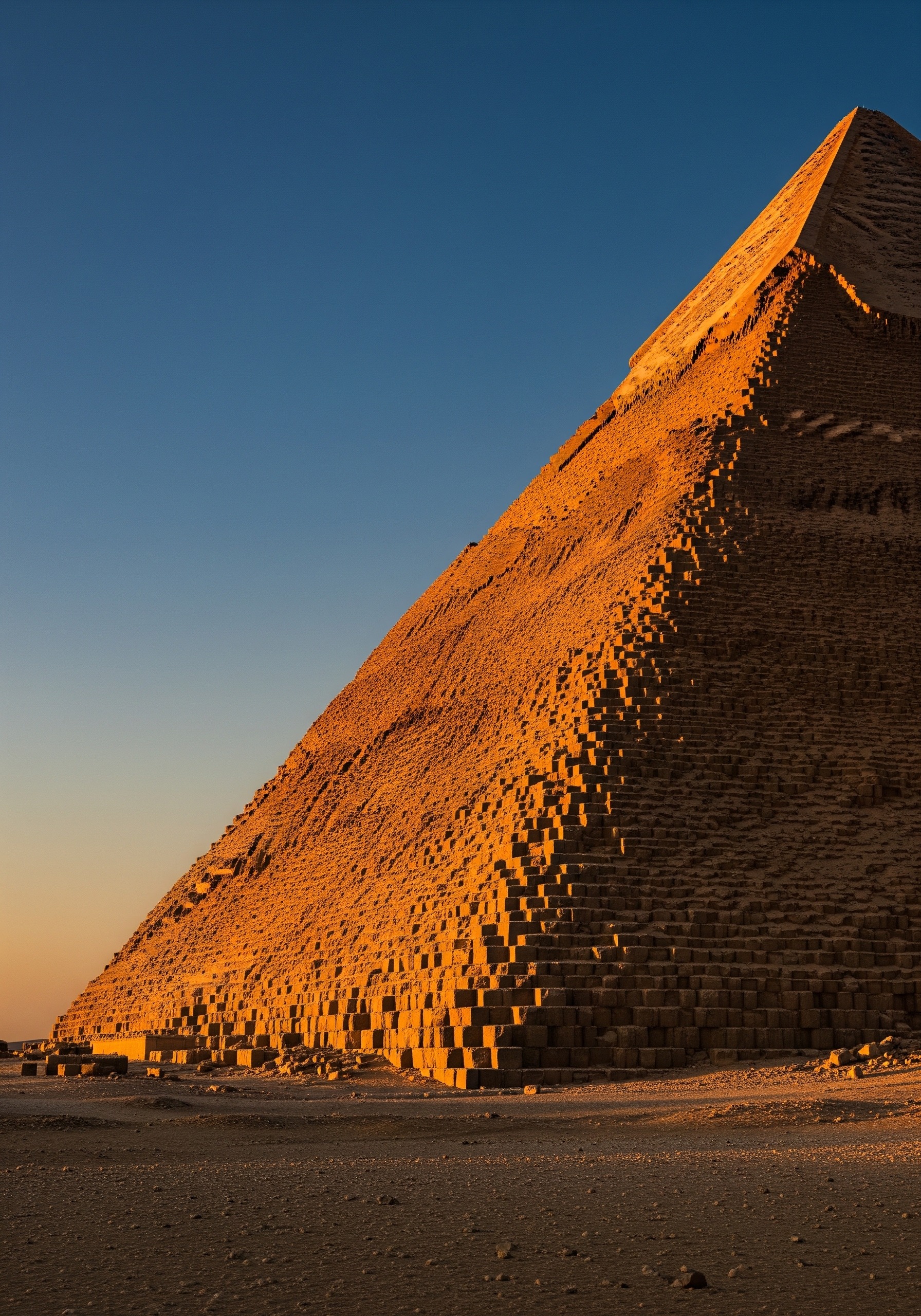
The ancient mysteries the great pyramids of Giza still guard have outlasted every empire that ever tried to read them. For 4,500 years the three pharaonic stacks on the plateau west of Cairo have absorbed every theory science could throw at them — and only in the last decade have a handful of those theories finally started to land.
Key Facts
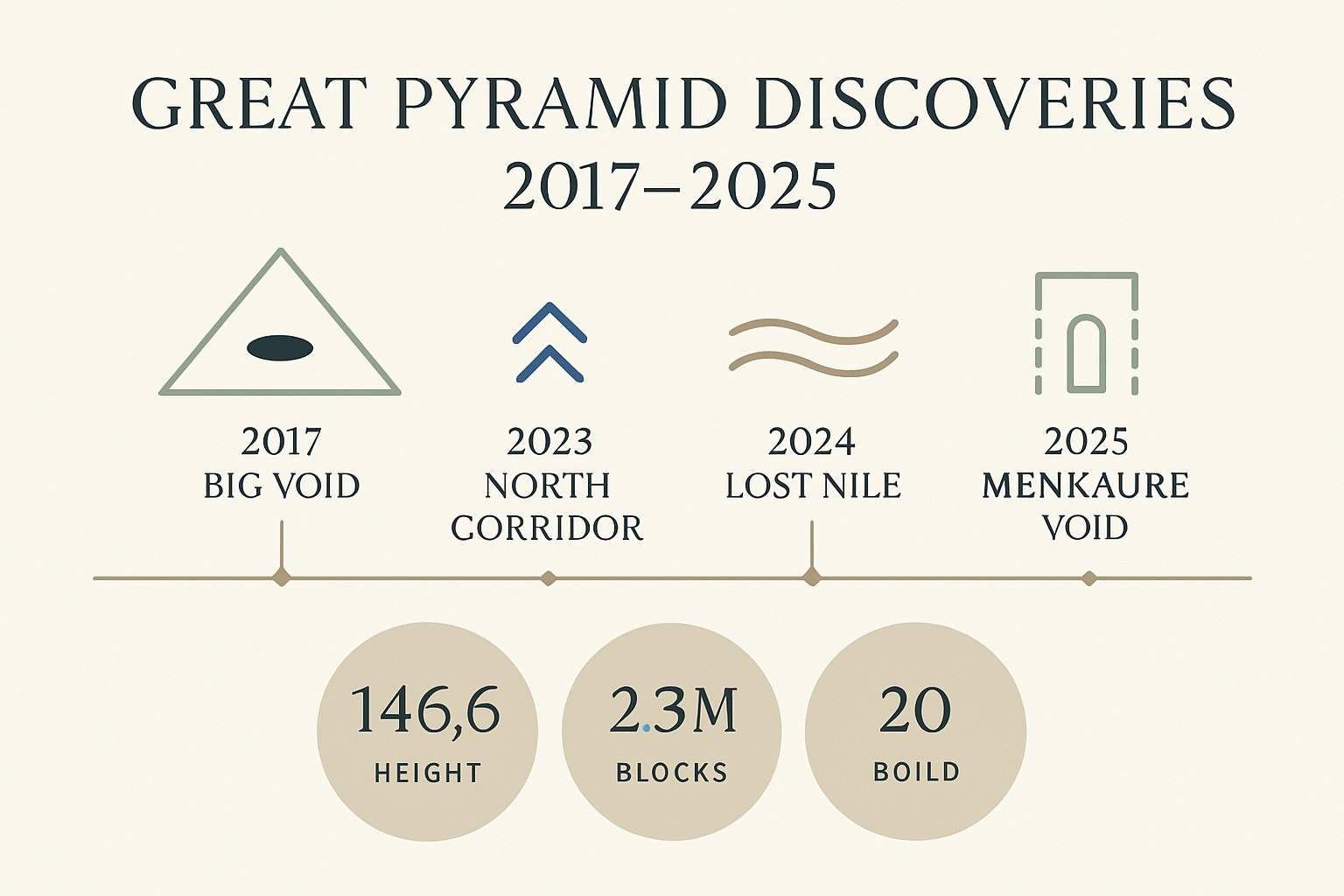
- The Great Pyramid of Khufu was built around 2580–2560 BC, originally stood 146.6 metres (481 ft) tall, and contains roughly 2.3 million stone blocks averaging 2.5 tonnes each.
- In March 2023, the ScanPyramids team confirmed an unknown 9-metre-long corridor — the “North Face Corridor” — sealed behind the chevron stones above the original entrance, filmed live by endoscope.
- A 2017 cosmic-ray muon study published in Nature revealed a much larger void, at least 30 metres long, above the Grand Gallery; its purpose is still unknown.
- In 2024, geoscientist Eman Ghoneim of UNCW and colleagues mapped a buried Nile branch — the “Ahramat branch” — that ran past at least 31 pyramids, finally explaining how the stones reached the plateau.
- The Diary of Merer, found in 2013 at Wadi al-Jarf, is a 4,500-year-old logbook by a foreman whose crew shipped Tura limestone casing blocks to Khufu’s pyramid by boat.
In short: Most of the “unsolved” puzzles around the great pyramids are not unsolved any more — but a few real ones still are. Here’s what muons, satellites, and a lucky cave find at Wadi al-Jarf have actually settled, and what genuinely remains a mystery.
Key Facts
- The Great Pyramid of Khufu was built around 2580–2560 BC, originally stood 146.6 metres (481 ft) tall, and contains roughly 2.3 million stone blocks averaging 2.5 tonnes each.
- In March 2023 the ScanPyramids team confirmed an unknown 9-metre-long corridor — the ‘North Face Corridor’ — sealed behind the chevron stones above the original entrance.
- A 2017 cosmic-ray muon study published in Nature revealed a void at least 30 metres long above the Grand Gallery, whose purpose is still unknown.
- In 2024, geoscientist Eman Ghoneim of UNCW and colleagues mapped a buried Nile branch — the ‘Ahramat branch’ — that ran past at least 31 pyramids.
- The Diary of Merer, found in 2013 at Wadi al-Jarf, is a 4,500-year-old logbook by a foreman whose crew shipped Tura limestone casing blocks to Khufu’s pyramid by boat.
In short: Most ‘unsolved’ puzzles around the Giza pyramids are no longer unsolved. Muon scans, satellite radar and the Diary of Merer have settled how stones reached the plateau and revealed hidden corridors and voids. The genuine open question is how the blocks were finally raised into place.
The corridor a tiny camera found in 2023
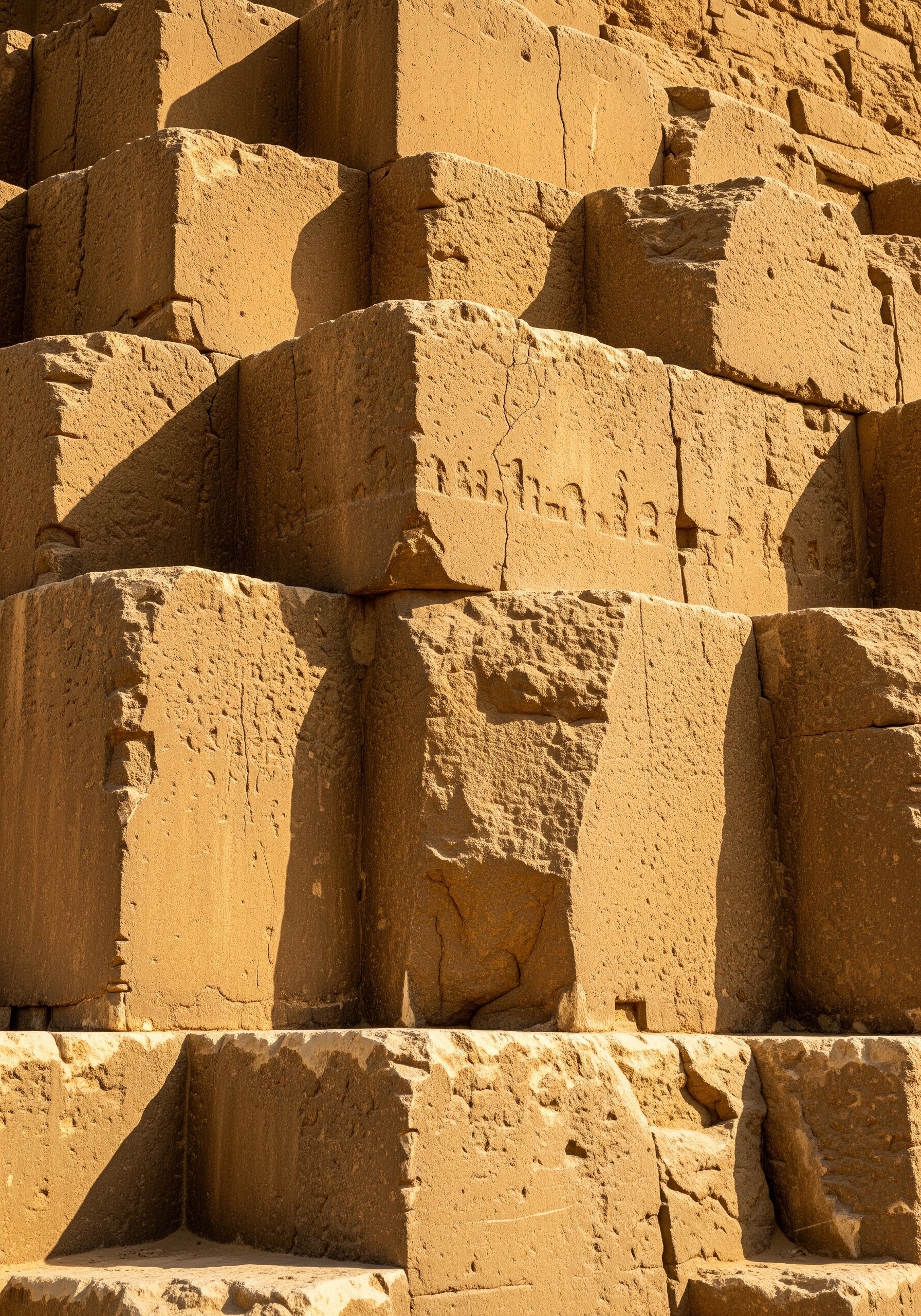
On 2 March 2023, the ScanPyramids team threaded a 6-millimetre endoscope through a narrow gap between the limestone blocks of Khufu’s north face. The footage — grainy, dust-blown, oddly intimate — showed the inside of a sealed corridor no human eye had seen since the Old Kingdom. They named it the SP-NFC: roughly 9 metres long, 2 metres wide, with a gabled ceiling, sitting just behind the famous chevron of relieving stones above the original entrance.
Turns out the chevron itself was the clue all along. Some Egyptologists had argued for years that the stones were too elaborate to be merely decorative — they were probably hiding load above something. They were right.
Independent confirmation came in a 2025 Scientific Reports paper that fused radar, ultrasound, and muon imaging on the same volume of stone. What the corridor is for, no one knows. It could be a stress-relieving void. It could redirect to a still-hidden chamber. The ScanPyramids team plans to drill a slightly larger hole and look further.
The lost river the satellites finally saw
One question used to dominate every pyramid documentary ever made: how did the Egyptians move 2.3 million stone blocks, some weighing dozens of tonnes, into the middle of the desert? In May 2024 a team led by Eman Ghoneim of the University of North Carolina Wilmington gave the cleanest answer yet, in the journal Communications Earth & Environment.
Using radar satellite imagery — the kind that can see through several metres of sand — plus ground-penetrating radar and two long sediment cores, Ghoneim’s team mapped a long-dead branch of the Nile that once flowed right past the desert edge where most of the great pyramids stand. The river was roughly 64 km long, between 200 and 700 metres wide, and it ran beside at least 31 pyramids built across nearly a thousand years.
Ghoneim’s team named it the Ahramat branch, from the Arabic word for pyramids. Crucially, many of the pyramid causeways — including Khufu’s — end exactly at the proposed riverbank. The desert quarries were not the bottleneck. The water was the highway.
{IMAGE_2}
The 4,500-year-old worker diary that survived
If the Ahramat branch is the highway, the Diary of Merer is the trucker’s logbook. The papyrus fragments were excavated in 2013 by a French mission under archaeologist Pierre Tallet of Paris-Sorbonne, at the long-abandoned Red Sea port of Wadi al-Jarf. They are, by some distance, the oldest inscribed papyri ever found.
Merer was a middle-ranking inspector running a crew of roughly 40 boatmen during the 26th — and apparently last — regnal year of Khufu. His daily entries log trips between the Tura limestone quarries east of the Nile and a port called Ro-She Khufu, the receiving station at Giza. Every ten days his crew completed two or three round trips, carrying perhaps 30 blocks of 2–3 tonnes each. The accounting is mundane to the point of beauty: rations issued, boats loaded, distances rowed.
It is the only first-person eyewitness account we have from the actual construction of the Great Pyramid. And it is shockingly ordinary — a state logistics operation, not a mystery cult.
How the great pyramid construction really worked, so far as we can tell
Stitching the three discoveries together — workers’ town, Ahramat branch, Merer’s diary — gives the clearest picture of great pyramid construction ever assembled. Khufu’s pyramid was a national infrastructure project of roughly 20 years. Tens of thousands of skilled rotating workers (not slaves, as Mark Lehner’s excavations at the Giza workers’ town have shown for decades) lived on site in organised barracks. White Tura casing limestone arrived by boat from the east bank; coarser core blocks came from a local quarry just south of the pyramid. Granite for the King’s Chamber — some single beams over 60 tonnes — was hauled almost 900 km downriver from Aswan.
What still escapes consensus is the last step: how the blocks were raised. Proposals range from a single straight external ramp, to a spiral ramp wrapping the structure, to an internal ramp argued by French architect Jean-Pierre Houdin. No single theory accounts for every observation. This is the genuine open question, not the one TV documentaries usually flag.
The big void — and what cosmic rays still can’t tell us
Above the Grand Gallery, something is missing from the pyramid where rock should be. In 2017 the ScanPyramids team announced — in Nature — a void at least 30 metres long, detected independently by three separate muon-tracking technologies. Muons, the unstable cosmic-ray cousins of electrons, pass more easily through empty space than through limestone, and the deficit in their count painted an unmistakable shape inside the pyramid.
What is it? Cautious archaeologists say a construction-period void, sealed when no longer needed. Others — Houdin’s camp among them — argue it is a structural feature, perhaps part of an internal ramp. A few hope it is an unopened chamber. Honest answer: we still don’t know. Muons measure shape, not contents.
Ancient mysteries the great pyramids no longer hold (myth vs. evidence)
A lot of “mysteries” survive only because nobody bothers to update the wikis. A short reckoning, in plain language:
“Slaves built the pyramids.” No. Mark Lehner and Zahi Hawass have excavated the workers’ cemetery and town at Giza since the 1990s; skeletal evidence, bread bakeries, and grave goods all point to a skilled, fed, organised, paid labour force rotating in from villages across Egypt.
“The capstone was solid gold.” Almost certainly not. No surviving pyramidion from the Old or Middle Kingdom is solid gold; the few we have (such as Amenemhat III’s, in the Egyptian Museum in Cairo) are granite or basalt, sometimes gilded. The Giza pyramidions were probably never installed, were removed for stone in antiquity, or simply did not survive.
“The base aligns to true north with impossible accuracy.” The alignment is impressive — within about 4 arcminutes — but Egyptologist Kate Spence and others have shown plausible stellar-sighting methods using two circumpolar stars (Kochab in Ursa Minor and Mizar in Ursa Major). Remarkable, not supernatural.
“It encodes pi, the speed of light, and Earth’s circumference.” Coincidence and cherry-picked ratios. Egyptian builders used a slope unit called the seked, not pi. The “speed of light at the latitude of Giza” claim is numerological pareidolia.
By the numbers — Khufu’s pyramid
- Built: c. 2580–2560 BC (4th Dynasty)
- Original height: 146.6 m (481 ft) — tallest human-made structure on Earth for ~3,800 years
- Base side: 230.3 m, square to within ~4 arcminutes of true north
- Stone: ~2.3 million blocks, average 2.5 t, total mass ~5.75 million tonnes
- Build time: ~20 years, by tens of thousands of paid, rotated workers
- Logistics confirmed (2024): moved on the Ahramat branch of the Nile, now buried under desert
Menkaure’s “second door” and the next mystery in line
At Menkaure — the smallest of the three Giza pyramids — the newest open question is unfolding right now. In late 2025 a German–Egyptian team led from the Technical University of Munich reported air-filled anomalies behind the pyramid’s east face, detected by ground-penetrating radar, electrical resistivity and ultrasound. The data suggest a possible second entrance — and a void behind it. A remotely operated camera has already been threaded in for a first look.
Same pattern, every time. The instruments now beat the theories. Every five years, something the textbooks called “lost” turns out to have been hiding behind a wall.
Why ancient mysteries the great pyramids still hold actually matter
Strip away the alien-channel mysticism and the pyramids are something stranger and more useful: the oldest hard evidence of what an organised civilisation can do at scale with stone, water and time. Every new discovery — the corridor, the river, the diary, the void — moves the story from “magic” toward “engineering”. That is the real giza secrets payoff. The pyramids were not built by gods. They were built by Egyptians who kept receipts.
Frequently Asked Questions
Q: What is the biggest unsolved mystery of the Great Pyramid today?
A: The purpose of the large, at-least-30-metre void above the Grand Gallery, confirmed by cosmic-ray muons in 2017. We know it is there. We do not know what is in it, or whether it is a structural cavity, a relieving void, or a sealed chamber.
Q: Were the great pyramids built by slaves?
A: No. Decades of excavation at the Giza workers’ town by Mark Lehner and Zahi Hawass have shown a skilled, paid, well-fed labour force, rotating in shifts from villages across Egypt.
Q: How were the giant stones transported across the desert?
A: By boat, along a now-dried-up branch of the Nile that the 2024 UNCW study named the Ahramat branch. Most of the pyramid causeways end exactly at its ancient banks.
Q: Why is the Great Pyramid missing its capstone (pyramidion)?
A: It is not known. The most likely explanations are that the pyramidion was never installed, was removed for reuse in antiquity, or simply did not survive. There is no credible evidence it was made of solid gold.
Sources
- Confirmation of the ScanPyramids North Face Corridor in the Great Pyramid of Giza using multi-modal image fusion — Scientific Reports, 2025
- Morishima et al., Discovery of a big void in Khufu’s Pyramid by observation of cosmic-ray muons — Nature, 2017
- Ghoneim et al., The Egyptian pyramid chain was built along the now abandoned Ahramat Nile Branch — UNCW press release, May 2024
- The Diary of Merer (Wadi al-Jarf papyri) — discovered by Pierre Tallet, 2013
- National Geographic — How were the Pyramids of Giza built?
The pyramids will keep giving up answers, slowly, in 9-metre corridors and 25-metre sediment cores. The mysteries that survive are smaller now, and more interesting for it — questions about engineering, logistics, and the long memory of stone, asked by people with sharper instruments every year.
Illustrations are AI-generated. Article fact-checked and human-edited. Our editorial standards.