Animals That Can Camouflage: The Six Tricks of Vanishing
Animals that can camouflage are doing more than hiding — they are running a precise optical exploit on the eyes of whatever wants to eat them, or whatever they want to eat. The same trick, refined by 400 million years of evolution, plays out in a cuttlefish on a sand flat off Cape Cod and a moth pressed against birch bark in a Devon hedgerow.
Key Facts
- Camouflage is not one trick. Sensory biologists describe at least six distinct strategies, from background matching to masquerade to motion dazzle.
- A common cuttlefish (Sepia officinalis) carries on the order of millions of skin pigment cells called chromatophores — each one a tiny biological pixel under direct nervous-system control.
- Cephalopods are colorblind. They match colors they themselves cannot see, using light-bending cells called iridophores and leucophores layered beneath the pigment.
- A snowshoe hare’s autumn molt is triggered by day length, not snow. As warming shortens winter, hares now stand out white against bare ground for a growing number of mismatch weeks each year.
- Some camouflage costs nothing; some costs everything. Animals locked into one disguise — like the dead-leaf butterfly Kallima — pay for it in restricted habitat, behavior, and posture.
In short: Animals that can camouflage win the survival lottery through six well-mapped strategies — background matching, disruptive coloration, countershading, masquerade, mimicry, and active color change. The mechanisms are clever, expensive, and now, for some species, breaking down under climate change.
Key Facts
- Sensory biologists describe at least six distinct camouflage strategies: background matching, disruptive coloration, countershading, masquerade, mimicry, and active color change.
- A common cuttlefish (Sepia officinalis) carries on the order of millions of skin pigment cells called chromatophores, each a tiny biological pixel under nervous-system control.
- Cephalopods are colorblind, matching colors they cannot see using light-bending iridophores and leucophores layered beneath the pigment.
- A cuttlefish’s three skin layers can fire in roughly a tenth of a second, per Roger Hanlon’s team at the Marine Biological Laboratory.
- A snowshoe hare’s autumn molt is triggered by day length, not snow, so warming leaves hares mismatched white against bare ground for growing periods.
In short: Animals camouflage through at least six mapped strategies: background matching, disruptive coloration, countershading, masquerade, mimicry and active colour change. Cuttlefish run the fastest display, firing three skin layers in about a tenth of a second despite being colourblind. The framework comes from sensory ecologist Innes Cuthill at the University of Bristol.
The six categories of animals that can camouflage
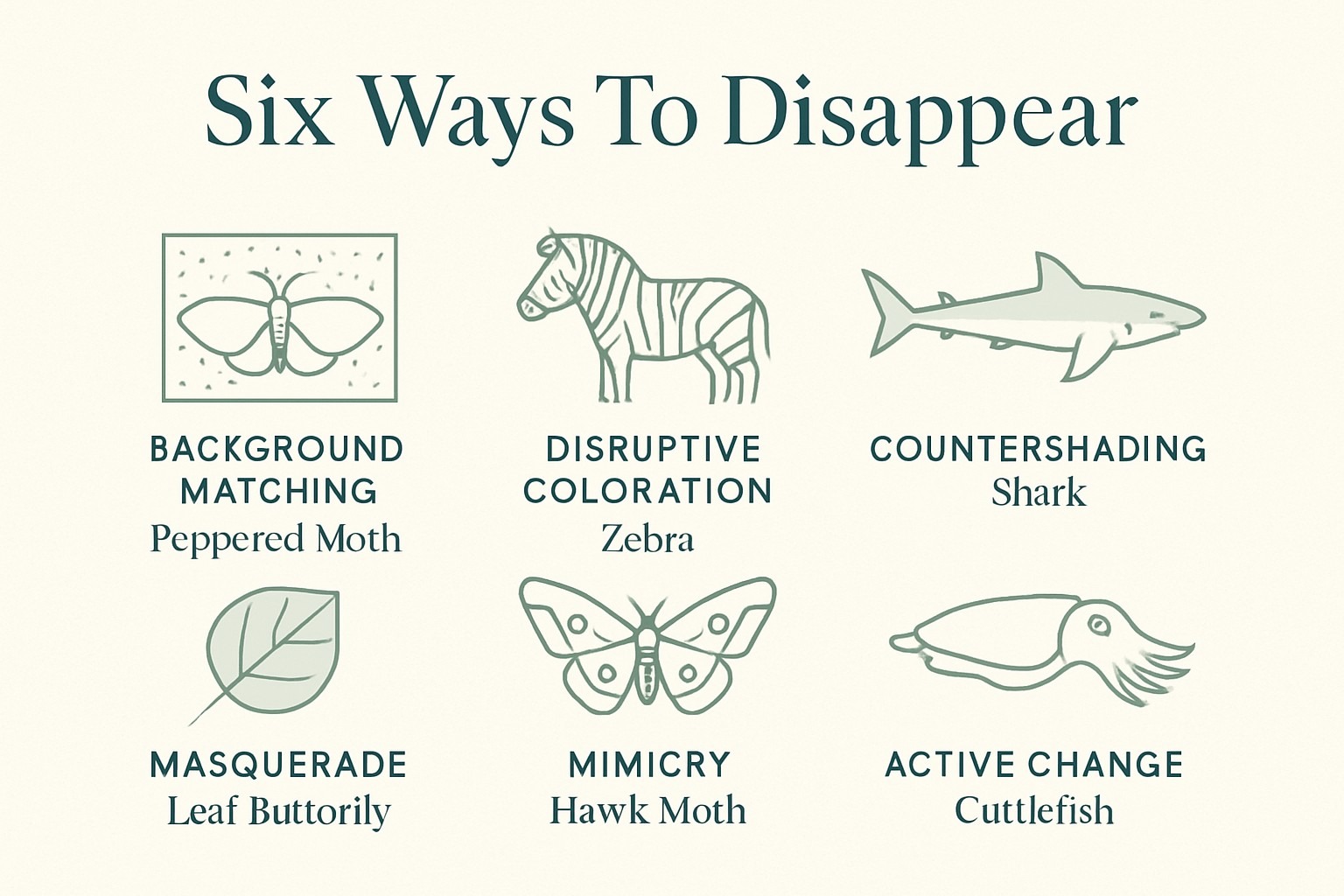
Before any animal vanishes, the trick has to be classified. The modern framework comes from sensory ecologist Innes Cuthill at the University of Bristol, whose lab has spent two decades mapping camouflage as a conversation between an animal’s coat and an observer’s brain. Cuthill’s 2019 review in the Journal of Zoology splits the toolkit into six tactics — and almost every famously “invisible” creature is using two or three at once.
The first is background matching: become the substrate. A peppered moth on a soot-darkened oak. A flounder over coral sand. Second, disruptive coloration, is the opposite — bold edges of high-contrast color (a zebra’s flanks, a tiger’s stripes) that don’t blend in at all but instead shatter the outline of the body, so the eye never assembles a recognizable animal.
Then countershading: dark on top, pale below, so overhead light flattens the body into a shadowless silhouette. Almost every open-ocean fish and most antelope wear it. Masquerade is pretending to be a specific non-food object — a stick, a leaf, a bird dropping. Mimicry borrows another animal’s threat, like the hawk-moth caterpillar that inflates into a fake serpent’s head. And motion camouflage, the rarest and strangest, lets a predator approach by appearing to remain stationary on its prey’s retina, used by dragonflies in flight.
| Strategy | How it works | A master of it |
|---|---|---|
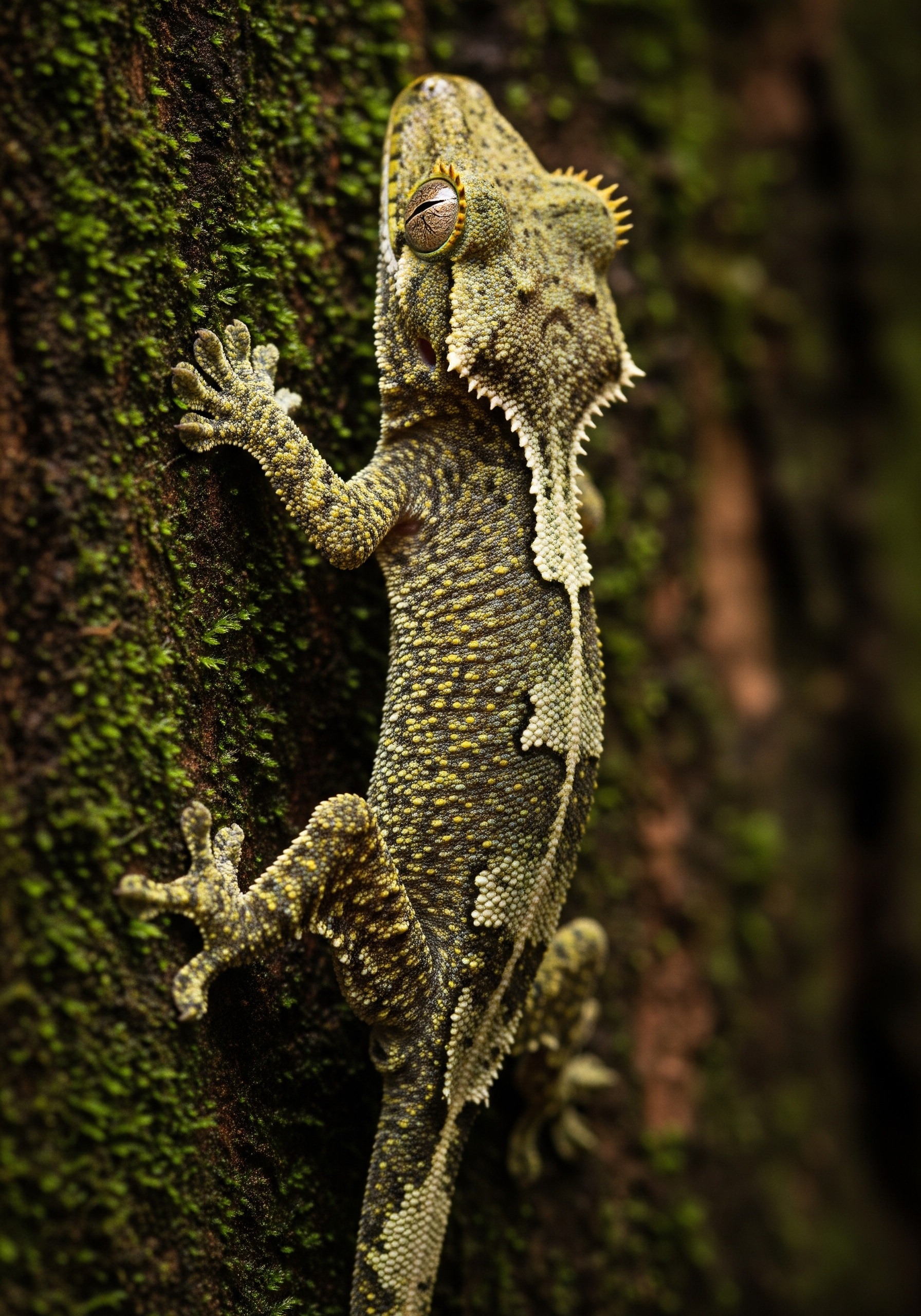
| Background matching | Coat replicates the dominant color and pattern of habitat | Peppered moth, leaf-tailed gecko |
| Disruptive coloration | Bold contrasting edges shatter the body outline | Zebra, tiger, ringed plover |
| Countershading | Dark back, pale belly cancels the overhead shadow | Great white shark, gazelle |
| Masquerade | Body imitates a specific inedible object | Dead-leaf butterfly, stick insects |
| Mimicry | Body copies a more dangerous species | Hawk-moth caterpillar, mimic octopus |
| Active color change | Skin cells alter color and pattern in real time | Cuttlefish, chameleon, flounder |
How cephalopods run the world’s fastest skin display
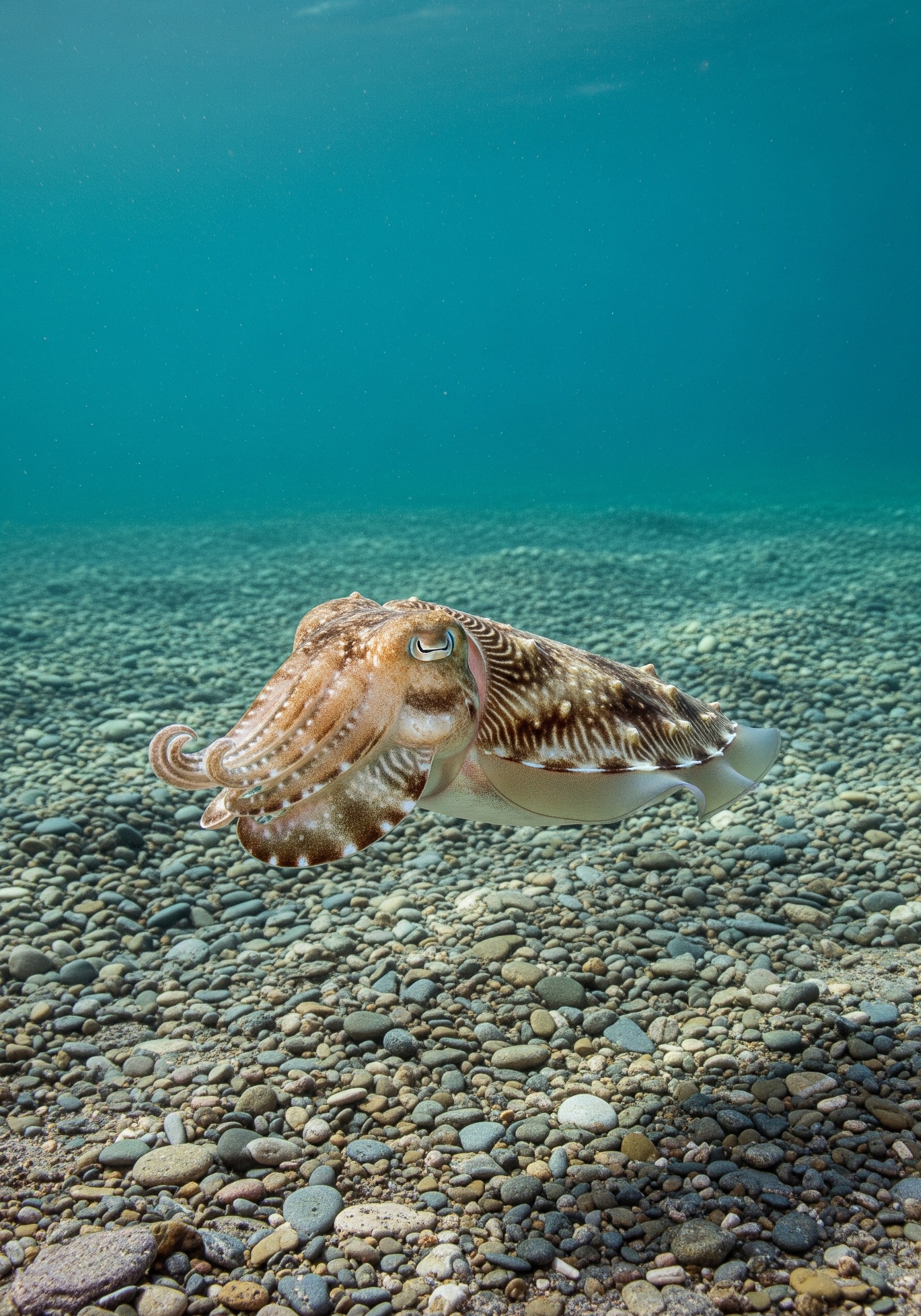
The animals that can camouflage best are, almost certainly, the ones that can do it on demand — cuttlefish, octopus, and squid. Roger Hanlon, a Senior Scientist at the Marine Biological Laboratory in Woods Hole, has spent his career filming what they actually do. His footage of a common cuttlefish dropping a perfect imitation of a sand-and-pebble seabed in under a second has become the most-watched piece of marine science video on the public internet.
Here is the strange part. Cephalopods are, as far as anyone has tested, colorblind.
What they can do is run a three-layer optical sandwich. At the surface sit the chromatophores — pigment-filled sacs ringed by tiny radial muscles. When the muscles contract, each sac stretches open like a parasol, dialing in red, yellow, or brown. Beneath that lies the iridophore layer, stacked protein plates that reflect specific wavelengths the way a beetle’s shell does. Below everything sits the leucophore, a near-perfect light scatterer that produces whatever shade of white the surroundings happen to offer. Hanlon’s team at MBL has shown that all three layers can fire in roughly a tenth of a second, and that a cuttlefish’s brain — not its eyes alone — drives the pattern by reading contrast, edges, and object-size cues from the substrate itself.
It is the closest thing biology has built to a real-time display screen. The trade-off is energetic: powering that display costs calories no slower camouflager pays.
{IMAGE_2}
Animals that can change colors — and the ones that fake it
The popular image of a chameleon turning red to match an apple is wrong. Chameleons change color mostly to signal mood, dominance, and temperature; background matching is a side benefit, not the main act. Their mechanism is also unusual. Instead of pigment, a panther chameleon adjusts the spacing of nano-crystals embedded in its skin, physically tuning the wavelength of light it reflects — a structural color, not a chemical one.
Flatfish do it differently again. A flounder lying on a sand flat samples its surroundings with its eyes, then signals skin chromatophores until the dorsal pattern roughly matches the substrate beneath. The match is good enough to fool a human diver standing two meters away. It is not, however, instantaneous; a flounder takes minutes, not milliseconds, to settle into a new bottom.
And then there are the animals that look like they change color but really do not. An Arctic fox swapping its white winter coat for a charcoal-brown summer one is running a seasonal molt, scheduled by daylight months in advance — closer to a wardrobe change than to a chameleon’s neural display.
Hidden animals that masquerade as something inedible
Masquerade is the most reader-friendly camouflage because the trick is so literal. Be a leaf. Be a twig. Be a piece of bird dropping. Predators do not bother attacking inedible objects, so the animal’s safety relies entirely on getting the impression of “boring object” across in the first half-second of a glance.
Kallima inachus, the dead-leaf butterfly, is the textbook case. Its underwings carry the veins, blotches, and curved torn edge of a fallen leaf so convincingly that the 19th-century naturalist Alfred Russel Wallace listed it as one of the strongest pieces of evidence for natural selection he had ever encountered. The Australian wrap-around spider Dolophones goes further — flattening its body around a branch so its silhouette literally becomes the branch.
A pygmy seahorse Hippocampus bargibanti, no bigger than a fingernail, was unknown to science until 1969 because the divers collecting its host gorgonian coral could not see it on the colony they had just put in a bucket. Each pygmy spends its whole adult life on a single coral species and grows tubercles in the same color and arrangement the coral does. That, too, is masquerade — only the model is a single living individual rather than a generic twig.
The snowshoe hare’s 2026 problem
Here is the camouflage story almost no listicle is telling. The snowshoe hare’s white winter coat is one of the most efficient seasonal disguises in North America. It is also now failing measurably, and the failure has been tracked by researchers in real time.
Why is the most precise disguise in the boreal forest suddenly off? Because the trigger for the molt is photoperiod — the length of the day — meaning hares turn white on roughly the same date their grandparents did. The snow, however, no longer arrives or leaves on the old schedule. A 2025 paper in Royal Society Open Science, tracking hares through a Yukon boreal forest across years of warming, reported that the average autumn whiteness of the hares now exceeds the average whiteness of the landscape beneath them — a measurable mismatch that grows year over year. Earlier Montana fieldwork by L. Scott Mills and colleagues at the University of Montana put the cost plainly: every additional week of mismatch raises the weekly mortality rate of a hare, mostly to lynx and great-horned owls.
The hares appear to sense something is wrong; they do not appear to behave differently because of it. The schedule is not negotiable. It is the cleanest field example we have of a perfect camouflage becoming the wrong camouflage.
The hidden costs of being invisible
Camouflage is never free. A dead-leaf butterfly cannot use a brightly colored upperwing to attract a mate without breaking its own disguise, so it courts only with brief, low flights. A pygmy seahorse can never leave its coral. A countershaded gazelle has to keep its belly toward the ground; the moment it rolls, the trick collapses. And every cuttlefish powering its skin display is burning ATP it could otherwise spend on growth or eggs.
After a century of careful experiments, the honest verdict is that camouflage is one of the most expensive insurance policies in nature — and overwhelmingly worth it. Cuthill’s lab has shown in controlled predation trials that disruptive coloration alone can cut the chance of being eaten by roughly a third, while masquerade can push survival even higher. Animals that vanish are not getting lucky. They are paying, every minute, for the right to be missed.
Frequently Asked Questions
Q: What animal can camouflage the best in the world?
A: There is no single winner, because camouflage is judged against a specific habitat. For raw versatility, the common cuttlefish is hard to beat — it can imitate sand, gravel, rock, and seaweed in under a second. For precision-of-fit, the pygmy seahorse, which matches a single coral colony down to the bumps, is unmatched.
Q: Can humans see all animal camouflage?
A: No. Many camouflages are tuned to the visual system of a specific predator — usually a bird, a fish, or an insect. A pattern that looks crude to a person can be near-perfect to a hawk, which sees ultraviolet light and reads contrast differently than we do.
Q: Do chameleons really change color to match anything?
A: Mostly no. Chameleons change color chiefly to signal stress, social status, and temperature. True background matching is a secondary, more limited ability — flounders and cephalopods do it far better.
Q: Is animal camouflage evolving fast enough to keep up with climate change?
A: For some species, yes. For seasonal coat-color animals like the snowshoe hare, Arctic fox, and mountain hare, current research suggests not — their molt timing is genetically locked to day length and cannot adjust quickly to disappearing snow.
Sources
- Cuthill, I. C. (2019). Camouflage. Journal of Zoology, 308(2), 75-92. University of Bristol.
- Hanlon, R. T., Marine Biological Laboratory (Woods Hole, Massachusetts) — research program on cephalopod camouflage and adaptive coloration.
- Royal Society Open Science (2025). Seasonal coat-colour moulting phenology of snowshoe hares in a Yukon boreal forest undergoing climate change.
- Mills, L. S., et al., University of Montana — long-term snowshoe hare camouflage-mismatch fieldwork.
- Natural History Museum, London — public collection notes on crypsis and animal disguise.
Camouflage is not magic. It is a very old, very precise argument about light, eyes, and brains — and the animals that can camouflage are simply the ones whose ancestors won the argument enough times to still be here.
Illustrations are AI-generated. Article fact-checked and human-edited. Our editorial standards.