How Do Woodpeckers Not Get Brain Damage? The 2022 Answer
The honest answer to how do woodpeckers not get brain damage isn’t the one most articles still give you — and the real one is stranger. For half a century, biology textbooks said the woodpecker’s skull was a shock absorber, a tiny biological helmet that softened every blow. In 2022 a team of European biomechanists filmed three species drilling into wood at 4,000 frames per second and proved the textbooks wrong. The skull doesn’t cushion anything. The bird’s head is a stiff hammer. And it gets away with it for a reason that has almost nothing to do with anatomy.
Key Facts
- A woodpecker delivers roughly 8,000–12,000 pecks per day during breeding season, at up to 20 strikes per second.
- The bird’s head decelerates at around 400 g on impact, and as high as 1,200–1,400 g during deep nest excavation — well above the ~60–100 g range that concusses a human.
- A 2022 study in Current Biology by Sam Van Wassenbergh of the University of Antwerp found that woodpecker skulls absorb essentially zero shock — under 3.3 % in the single bird that showed any reduction at all.
- A typical woodpecker brain weighs about 2 grams — roughly the size of a pea, and around 700 times smaller than a human brain.
- Computer simulations in the same 2022 study showed that even during the hardest pecks, intracranial pressure stays below 60 % of the value known to concuss a primate brain.
In short: Woodpeckers don’t get brain damage because their skulls were never really cushioning anything. Their brains are tiny enough that the same impact that would scramble ours barely registers — and the rigid, hammer-like skull is what makes the drilling work at all.
Key Facts
- A woodpecker delivers roughly 8,000–12,000 pecks per day during breeding season, at up to 20 strikes per second.
- The bird’s head decelerates at around 400 g on impact, and up to 1,200–1,400 g during deep nest excavation—far above the ~60–100 g that concusses a human.
- A 2022 Current Biology study by Sam Van Wassenbergh of the University of Antwerp found woodpecker skulls absorb essentially zero shock.
- A woodpecker brain weighs about 2 grams—roughly pea-sized and around 700 times smaller than a human brain.
- Simulations showed intracranial pressure stays below 60% of the value known to concuss a primate brain, even during the hardest pecks.
In short: Woodpeckers avoid brain damage not because their skulls cushion blows—a 2022 University of Antwerp study found near-zero shock absorption—but because their roughly 2-gram brains are tiny enough that impacts of 400 g or more barely register. Their rigid, hammer-like skulls actually make the drilling efficient.
What actually happens when a woodpecker hits a tree
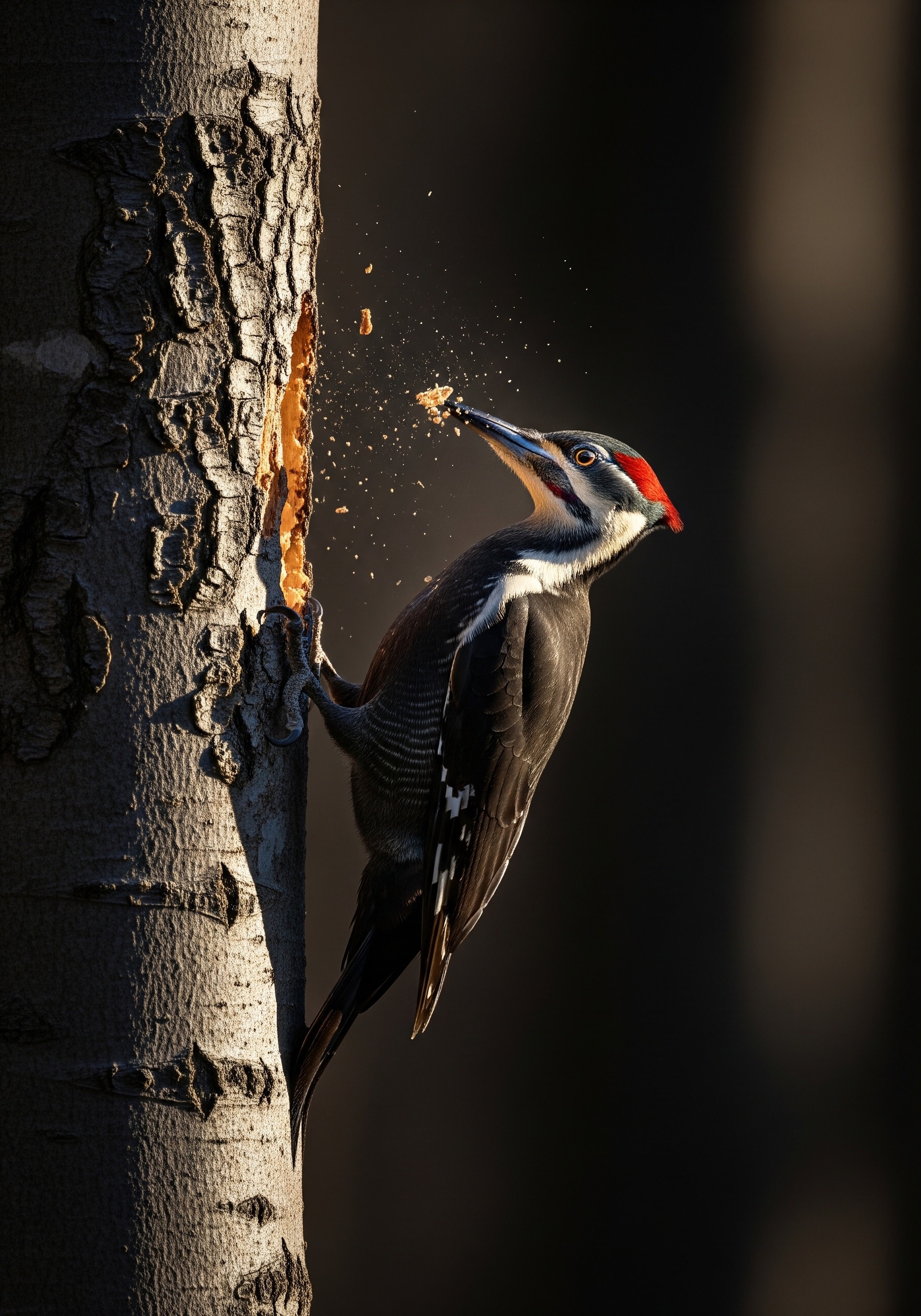
Picture a pileated woodpecker on the side of a dead beech. The bird’s neck snaps forward. The beak meets the wood. Beak, skull, brain — everything stops at the same instant. There is no give. There is no spring. There is no measurable padding between the bone the beak is attached to and the soft tissue behind it.
That single observation, captured in 2022 by Sam Van Wassenbergh and Maja Mielke at the University of Antwerp working with Erica Ortlieb and Robert Shadwick at the University of British Columbia, is what overturned the old story. Their team filmed black woodpeckers, pileated woodpeckers, and great spotted woodpeckers at 4,000 frames per second and tracked the motion of the eye relative to the beak tip. If the skull truly absorbed shock, the brain would decelerate more slowly than the beak. It didn’t. The two structures stopped together, in lockstep.
This sounds counterintuitive until you think about what the bird is actually trying to do. A shock-absorbing skull would waste energy — every joule swallowed by a cushion is a joule that didn’t go into splitting the wood. As Van Wassenbergh put it bluntly in the study, any meaningful absorption “would impair the bird’s hammering performance,” which is exactly why natural selection would have edited it out long ago.
So the real question stops being “how does the skull soften the blow?” and becomes the much weirder one: why doesn’t the blow matter?
Why woodpeckers don’t get headaches: the small-brain physics
This is the part nobody mentions on the helmet ads. Size, not engineering, is the protection.
{IMAGE_2}
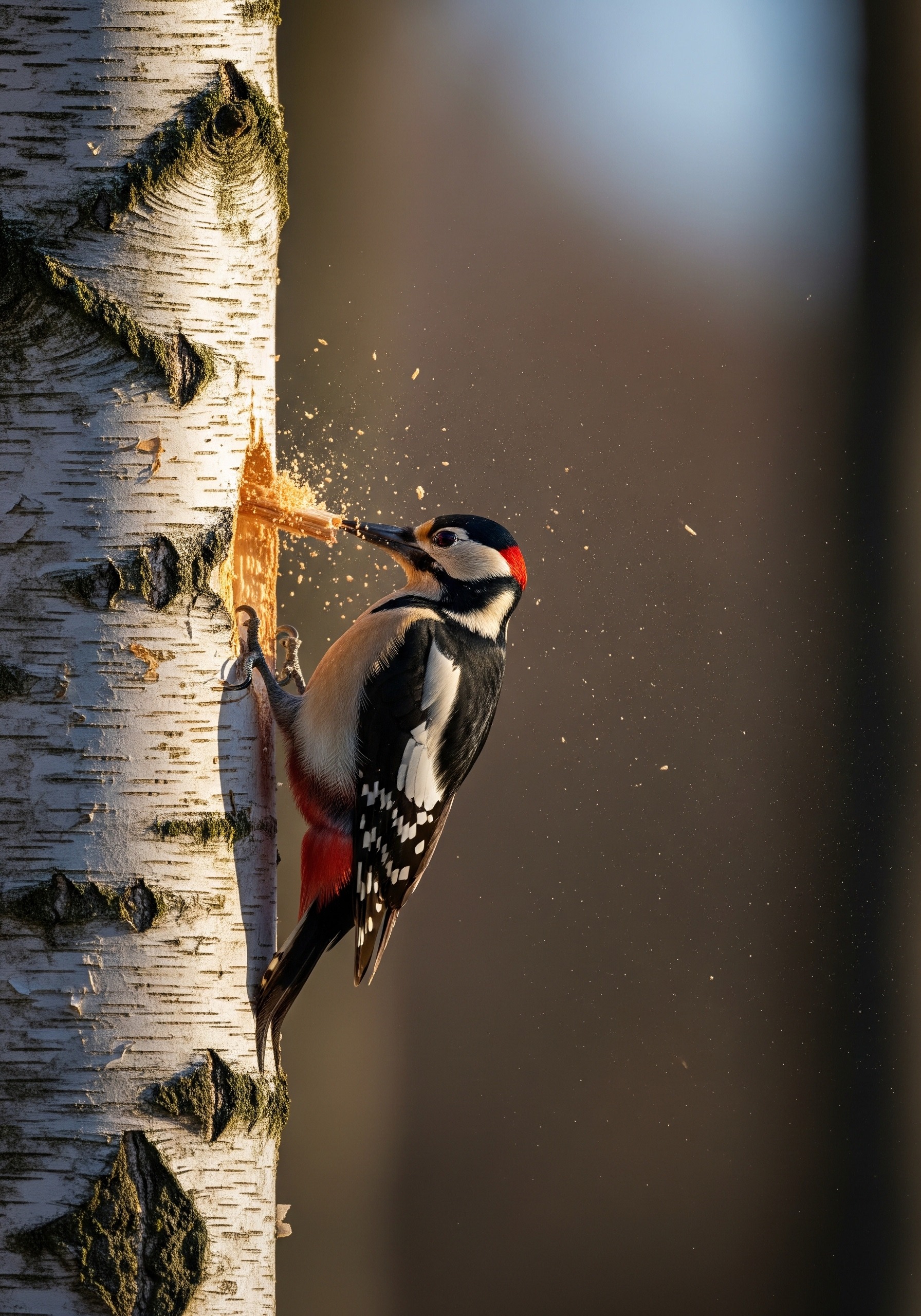
A woodpecker brain weighs about two grams. A human brain weighs around 1,400. When a moving object stops, the force a brain experiences depends on how much mass that brain has and how far it travels inside the skull during deceleration. Shrink the brain, and you shrink both numbers at once. The damage potential drops faster than the impact rises.
Van Wassenbergh likes a homely analogy: think about a housefly slamming into a window pane. It hits at a speed that, scaled up, would shatter a human skeleton — and then it flies off, dazed for a second, fine. Small mass, short braking distance, low absolute force. The woodpecker is the same trick, refined by 25 million years of evolution.
The numerical simulations the Antwerp team ran put hard numbers on this. Even during the worst pecks they recorded — the deep, two-handed excavation work that drives a nest cavity into living wood — the pressure built up inside the woodpecker’s skull stayed below 60 % of the value known to give a macaque a concussion. The bird has roughly a 2× safety margin. To actually hurt itself, a great spotted woodpecker would have to peck about twice as hard or twice as fast as it ever does in the wild.
Inside a woodpecker skull: the anatomy that was misread
None of this means woodpecker skulls are ordinary. They aren’t. The bone has a striking architecture — dense and compact on the outer table, spongier and more trabecular on the inner one, with the heaviest reinforcement concentrated around the beak and the back of the cranium. Older papers read those features as evidence of shock damping. They are probably evidence of something simpler: stiffness.
A stiff skull keeps the beak and the brain moving as one rigid unit. If the skull flexed even a few millimetres on each strike, the brain would lag behind, smacking the inside of the bone with every blow. The dense-on-the-outside, light-on-the-inside design is also just an efficient way to build a strong shell for very little weight, which matters for an animal that has to fly.
The brain itself is packed unusually tight. There is very little cerebrospinal fluid between brain and bone — the cushioning lake that protects a human brain during sudden movement is, in a woodpecker, more of a thin film. That sounds dangerous and isn’t, because the same setup that would be ruinous in a large mammal stops the brain sloshing inside the skull on every strike. The brain is also oriented at a slight tilt, so the contact area between bone and tissue is spread out rather than concentrated on a single point. Less point-loading means less localized pressure.
How woodpeckers peck — speed, force, and the hyoid “seatbelt”
The numbers on woodpecker work are still genuinely startling once you sit with them. A foraging downy woodpecker may strike a branch 8,000 to 12,000 times in a day. Peak rates during territorial drumming reach 20 strikes per second; in pileated woodpeckers the rate is slower but the force per blow is much higher because the bird is bigger. Decelerations of 400 to 600 g during ordinary feeding pecks are routine, and 1,200–1,400 g during cavity excavation has been measured by accelerometer.
For comparison, a boxer’s jab tops out around 50 g. The threshold most often cited for a human concussion sits between 60 and 100 g. A woodpecker shrugs off ten to twenty times that, every few seconds, for hours.
One often-cited piece of anatomy plays a real but smaller role than it gets credit for. The hyoid bone — a thin, springy bone supporting the tongue — wraps around the back of the skull and loops over the top in most woodpeckers. Cornell Lab ornithologists describe it as a kind of internal seatbelt that distributes some of the impact load around the cranium rather than letting it concentrate at the point of strike. It is not the main reason the bird survives. It is one of several small reinforcements stacked on top of the dominant fact that a 2-gram brain inside a rigid skull does not need much help.
The 2018 surprise: did scientists find brain damage after all?
Here is the inconvenient piece. In 2018, researchers at the Field Museum in Chicago, working with George Farah and colleagues, examined preserved woodpecker brains from museum collections and found something nobody expected: a buildup of tau protein, the same misfolded protein that accumulates in human brains after repeated head trauma and is the hallmark of chronic traumatic encephalopathy in former football players.
That was reported around the world as “woodpeckers do get brain damage.” The honest answer is more careful. The team found tau, but they did not show it was harming the birds, and tau in woodpeckers may turn out to be protective rather than destructive — a way of stabilizing neurons under repeated mechanical load rather than a sign they are failing. As Margaret Rubega, an ornithologist at the University of Connecticut, has pointed out, woodpeckers go on living perfectly normal lives, raising chicks and excavating cavities, year after year. Whatever tau is doing inside that pea-sized brain, it is not preventing the bird from being a woodpecker.
This is one of the cases where the truthful sentence is “we don’t fully know yet.” Anyone who tells you with confidence that woodpeckers definitely do, or definitely do not, suffer cumulative neurological injury is ahead of the published evidence.
What this means for helmets — and the woodpecker myth that won’t die
For about two decades, every other pop-science article about woodpecker shock absorption ended with a paragraph about engineers designing better football helmets, motorcycle helmets, or aerospace black-box mounts inspired by the bird. Patents were filed. Magazine covers were sold. There is a small, persistent academic literature on “bio-inspired” shock absorbers modeled on woodpecker anatomy.
The 2022 Antwerp study is, frankly, awkward for all of it. If the bird’s skull doesn’t actually absorb shock, then copying the bird’s skull won’t help you absorb shock either. Wesley Hochachka of the Cornell Lab of Ornithology, asked about the engineering angle, was diplomatic: there may still be useful lessons in how woodpecker tissue is arranged, but the headline story — bird as helmet — was based on a measurement that turned out to be wrong. The interesting question for designers now is the opposite one: how do you build a tool that hits hard and stops hard without breaking the thing on the other end? That’s a stiffness problem, not a cushioning one.
For the rest of us, the takeaway is gentler. The woodpecker is not a triumph of engineering. It is a triumph of being small enough that the problem the engineers were trying to solve doesn’t really exist.
Frequently Asked Questions
Q: Why don’t woodpeckers get headaches or concussions?
A: Their brains are tiny — about 2 grams — so the same impact force that would concuss a much larger primate brain doesn’t generate enough internal pressure to injure the woodpecker’s. Simulations show intracranial pressure stays under 60 % of the human concussion threshold even during the hardest pecks.
Q: Does a woodpecker’s skull really act as a shock absorber?
A: No, and this is the biggest correction in the field. A 2022 University of Antwerp study filmed three species at 4,000 frames per second and found the skull absorbs essentially no measurable shock. The head and beak stop in unison, like a stiff hammer.
Q: How hard and how often do woodpeckers peck?
A: A foraging woodpecker may strike a tree 8,000 to 12,000 times a day, at up to 20 pecks per second during drumming. Each strike decelerates the head at 400–600 g typically, and up to 1,200–1,400 g during deep cavity excavation.
Q: What does the hyoid bone do?
A: The hyoid is a long, flexible bone that supports the tongue and wraps around the back of the skull. It helps distribute impact load around the cranium, but it is one supporting feature among several, not the main reason the bird is protected.
Sources
- Van Wassenbergh, S., et al. “Woodpeckers minimize cranial absorption of shocks.” Current Biology, July 2022.
- Smithsonian Magazine — “Woodpeckers Don’t Have Shock-Absorbing Skulls” (2022).
- Audubon Magazine — “New Study Shakes Up Long-held Belief on Woodpecker Hammering.”
- NPR — “Why don’t woodpecker brains get damaged from pecking? They’re tiny, scientists say” (July 2022).
- Cornell Lab of Ornithology, Bird Academy — “Built to Peck: How Woodpeckers Avoid Brain Injury.”
- Farah, G., et al., Field Museum of Natural History — research on tau protein in woodpecker brains (2018).
For half a century the woodpecker stood in for human ingenuity — a feathered helmet patent waiting to be born. The truth turned out to be quieter and a little humbler. The bird isn’t protected by clever engineering. It’s protected by being two grams of brain in a rigid skull, hitting wood so fast that the physics of small things takes over. Sometimes the most elegant answer in biology is the one that admits it didn’t need a trick at all.
Illustrations are AI-generated. Article fact-checked and human-edited. Our editorial standards.