Ancient Mysteries of Easter Island and the Walking Moai
The ancient mysteries of Easter Island sit fifteen hundred miles from the nearest inhabited land, frozen in stone — more than 900 stern, long-eared faces staring out across the grass. They are the moai, and for three centuries outsiders have asked the same questions: who carved them, what they meant, and how a Polynesian society without wheels, animals, or cranes moved 82-tonne giants miles across an island the size of a small city.
Key Facts
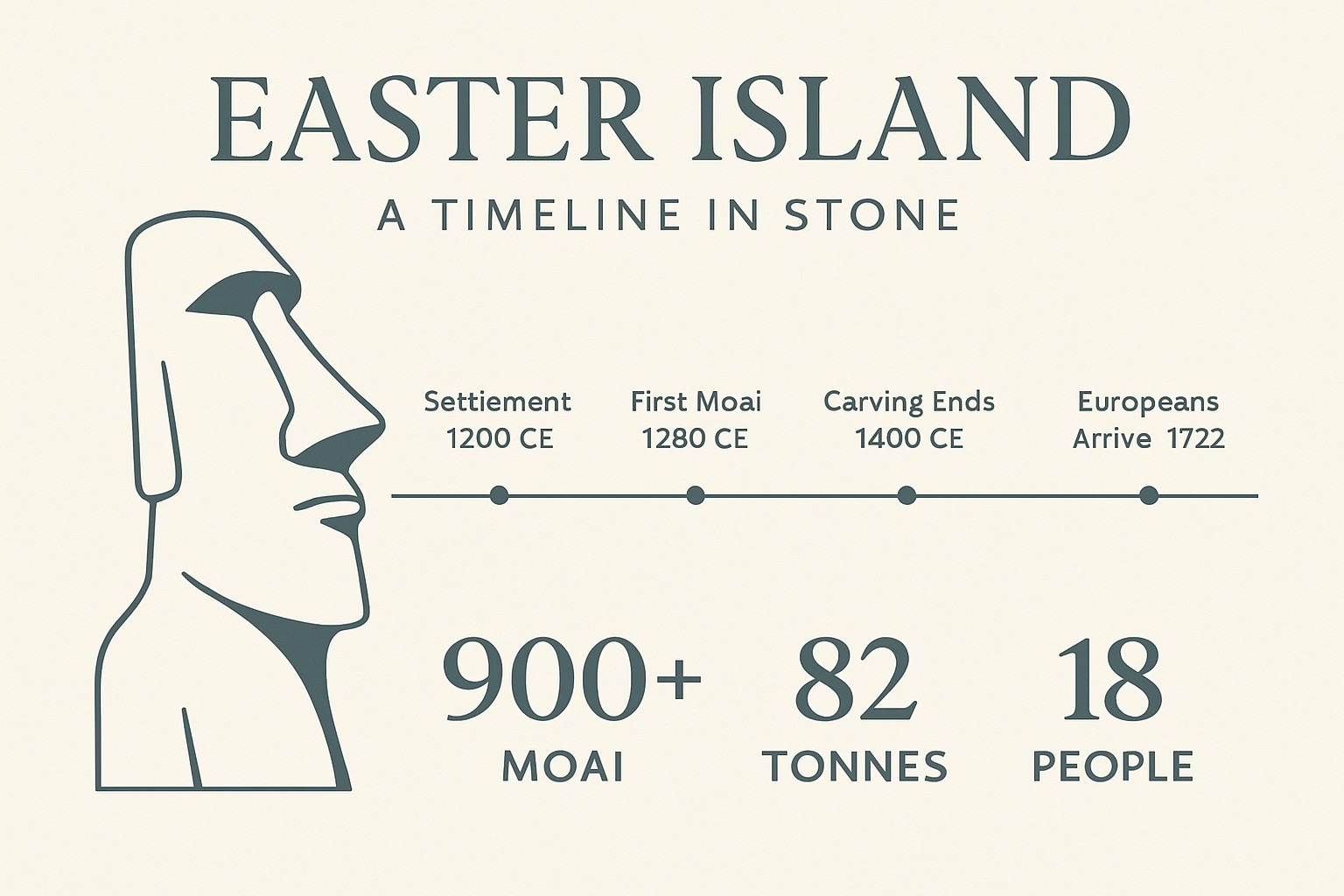
- More than 900 moai have been identified across Rapa Nui; 394 of them still sit, unfinished, inside the Rano Raraku quarry.
- The average moai stands about 4 m (13 ft); the largest one ever raised — Paro — reached almost 10 m (33 ft) and roughly 82 tonnes.
- Nearly all were carved between about 1250 and 1500 CE, during a roughly 250-year construction boom.
- A 2025 study in the Journal of Archaeological Science confirmed that as few as 18 people, using only ropes, could “walk” a 4.35-tonne moai down purpose-built roads.
- The classic “ecocide” story — that Rapa Nui collapsed by destroying its own environment — has been largely overturned by ancient-DNA and population evidence published in Nature.
In short: The moai were carved by the direct ancestors of today’s Rapa Nui people, “walked” upright on ropes through clever pendulum-like motion, and the famous tale of self-inflicted civilizational suicide no longer fits the evidence we now have.
Key Facts
- More than 900 moai have been identified across Rapa Nui; 394 of them still sit unfinished inside the Rano Raraku quarry.
- The average moai stands about 4 metres (13 ft); the largest one ever raised — Paro — reached almost 10 metres (33 ft) and roughly 82 tonnes.
- Nearly all the moai were carved between about 1250 and 1500 CE, during a roughly 250-year construction boom.
- A 2025 study in the Journal of Archaeological Science confirmed that as few as 18 people, using only ropes, could ‘walk’ a 4.35-tonne moai down purpose-built roads.
- The classic ‘ecocide’ story — that Rapa Nui collapsed by destroying its own environment — has been largely overturned by ancient-DNA and population evidence published in Nature.
In short: The moai were carved by the direct ancestors of today’s Rapa Nui people, ‘walked’ upright on ropes through clever pendulum-like motion, and stationed on platforms to face their villages. The famous tale of self-inflicted ecological suicide no longer fits the ancient-DNA and population evidence now available.
The ancient mysteries of Easter Island, briefly stated
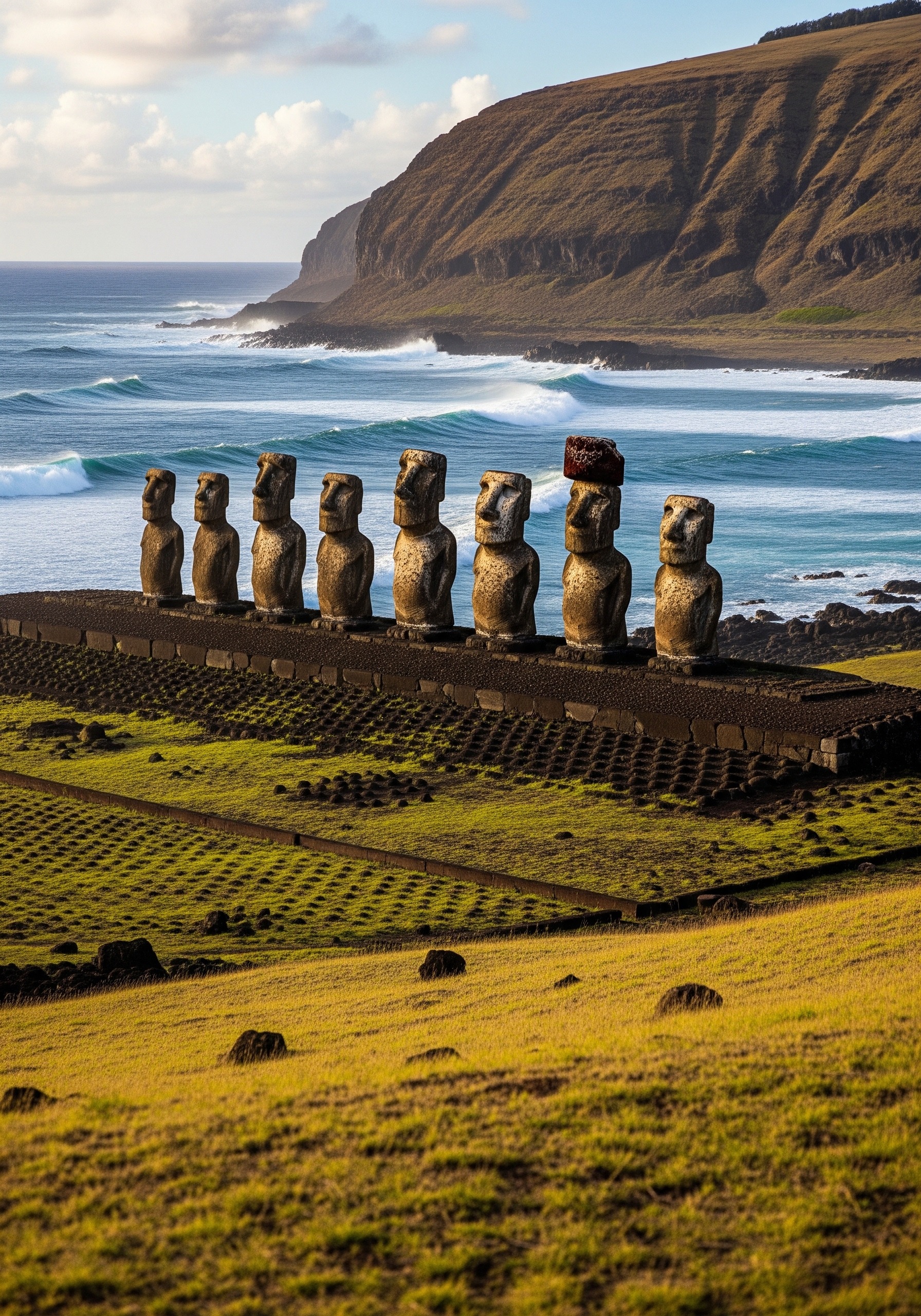
Strip away the legend, and three real puzzles remain. First, purpose: an isolated Polynesian community pours generations of labor into nearly a thousand giant ancestor figures. Why? Second, mechanics: how do you move a 30-ton statue eleven miles, on foot, with rope? Third, fate: what actually happened to Rapa Nui society between European arrival in 1722 and the demographic catastrophe of the 1860s — and was it really their own fault?
Until recently, popular books gave neat answers to all three: “ancestor worship,” “log sledges,” and “ecocide.” Each of those answers turns out to be wrong, partly wrong, or radically oversimplified. The new picture, pieced together from physics modeling, ancient DNA, and re-examined oral tradition, is more interesting — and far more flattering to the islanders.
The quarry, the carvers, and the timeline
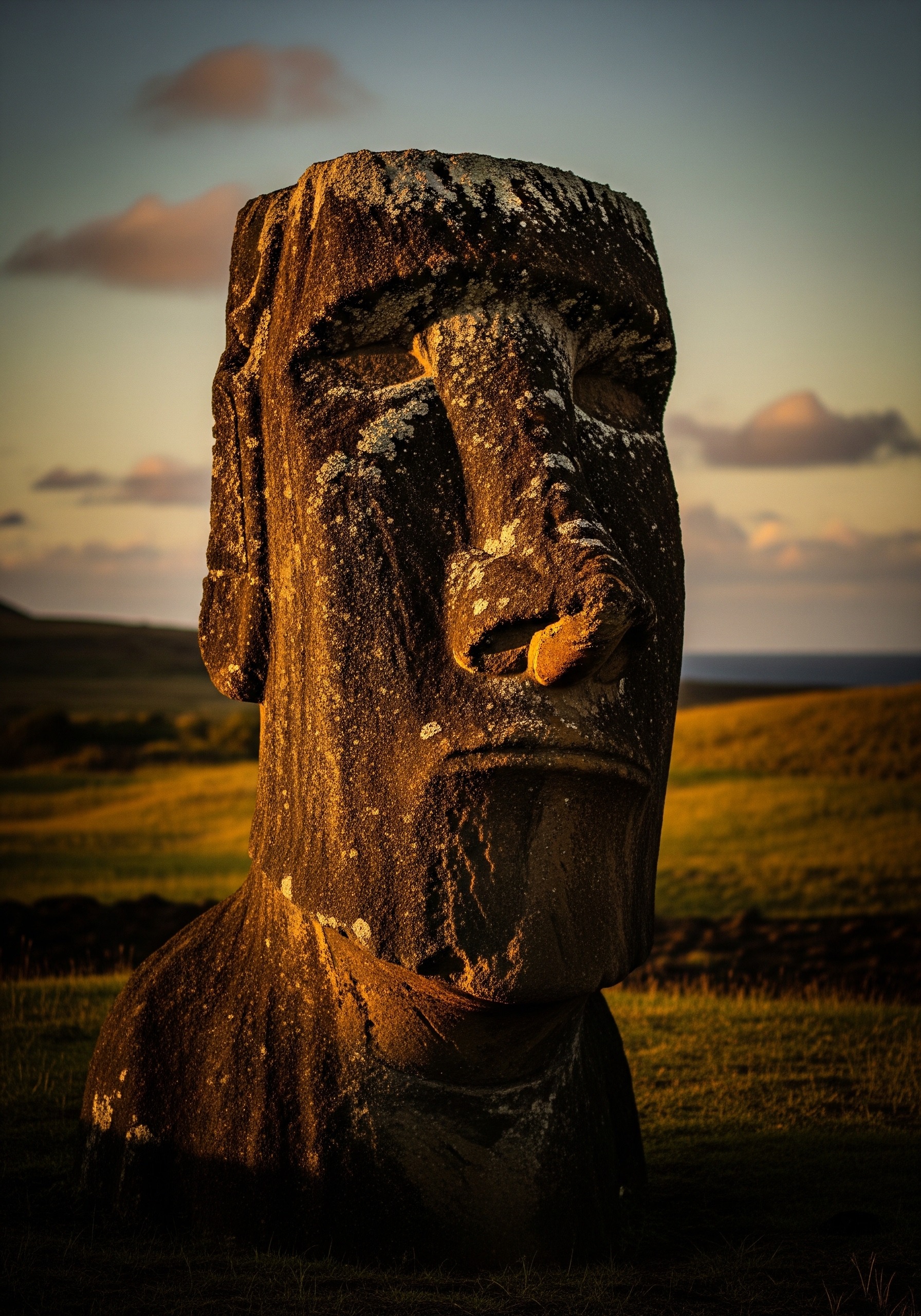
Almost every moai begins in one place: Rano Raraku, an extinct volcanic crater on the eastern side of the island. Its rim and inner slope are a kind of frozen workshop — 394 statues abandoned mid-process, some still attached at the back to the bedrock, others standing buried to the chest in centuries of slope wash. Carvers worked the stone with basalt hand-picks, called toki, releasing each figure face-up from a single slab of volcanic tuff.
Radiocarbon dating places the great carving boom between roughly 1250 and 1500 CE. That’s about 250 years of intense, skilled production — long enough for techniques to refine, but short enough that no individual mason saw the cycle complete. Most moai are tuff. A handful — 13 in basalt, 22 in trachyte, 17 in fragile red scoria — show that craftsmen experimented with rarer, harder stones when status or symbolism demanded it.
Then, sometime in the 1500s, the chisels stopped. Statues froze where they stood. Why is part of the third mystery.
How the moai really moved
{IMAGE_2}
Here’s the thing the textbooks got wrong for half a century. For decades, the assumed transport method was Thor Heyerdahl’s horizontal sledge: lay the statue on its back, lash it to wooden runners, and haul. That story demanded huge numbers of felled trees — which is exactly where the “ecocide” narrative began.
The Rapa Nui themselves told a different story. Their oral tradition says the moai walked. Anthropologists used to treat that as poetic. Archaeologists Terry Hunt of the University of Arizona and Carl Lipo of Binghamton University took it literally, and in 2012 they showed experimentally that an upright, leaning moai with a wide D-shaped base could be rocked side-to-side and “walked” forward with ropes (much like shuffling a heavy refrigerator across a kitchen).
In 2025, Lipo and Hunt closed the loop. In a Journal of Archaeological Science paper titled The Walking Moai Hypothesis: Archaeological Evidence, Experimental Validation, and Response to Critics, they ran a statistical analysis of nearly 1,000 statues, focused on the 62 moai broken along the island’s old transport roads. Every one of those road statues shares two features — a forward lean and a wide, curved base — that make zero sense for a horizontal sledge but are exactly what’s needed for upright walking. A field crew of 18 people moved a 4.35-tonne replica 100 metres in 40 minutes.
“Once you get it moving, it isn’t hard at all — people are pulling with one arm,” Lipo told reporters when the paper appeared. “It conserves energy, and it moves really quickly.”
Engineering details back this up. The transport roads are 4.5 metres wide with a shallow concave cross-section that cradles a rocking statue and stops it tipping. Counter-intuitively, the bigger the moai, the better the geometry works — pendulum dynamics improve with mass, so the largest standing statues are also the most efficiently shaped for walking.
What the moai were actually for
Moai are not idols of gods. In Rapa Nui language they are aringa ora ata tepuna — “the living faces of deified ancestors.” Each statue was a chief or revered forebear made permanent, set on a stone platform called an ahu, and turned to face the village he protected. Coral-and-obsidian eyes were inlaid only on activation; once those eyes opened, the ancestor’s mana — sacred protective power — was understood to flow into the community.
That ancestral function explains the geography. A 2019 PNAS study led by Robert DiNapoli, Carl Lipo and colleagues showed that the placement of ahu correlates strongly with freshwater sources — coastal seeps where groundwater rises through volcanic rock. Ancestors were stationed where life was. Each ahu typically belonged to one kin group; the scale and number of their statues advertised the lineage’s status. A clan’s reputation, in stone, watching the spring.
The ecocide story has crumbled
Jared Diamond’s 2005 book Collapse made the now-famous version popular: thousands of Rapa Nui felled every tree to move their statues, soils eroded, food ran out, war and cannibalism erupted, and the society crashed before Europeans even arrived. It is a tidy modern parable.
It is also, on the current evidence, wrong.
Rapa Nui’s forests did vanish — but the slowest-acting culprit was the Polynesian rat, which arrived with the first settlers and ate palm-tree seeds faster than the palms could reproduce. Carrying-capacity work led by Binghamton archaeologist Robert DiNapoli, mapping the island’s rock-mulch gardens, estimates a sustainable food base for roughly 3,000 people — almost exactly the number European visitors counted in 1722. A 2024 ancient-DNA paper in Nature, sequencing pre-European Rapa Nui individuals, found no signal of the severe population bottleneck the ecocide story requires.
Collapse came later, and it was not self-inflicted. Peruvian slave raiders in 1862-63 abducted around a third of the population. Smallpox and other introduced diseases finished the demographic damage. By 1877, only 111 Rapa Nui were alive. The story of self-inflicted doom is durable because it flatters us — it lets a modern audience read its own anxieties into a Polynesian past — but the evidence has moved on, and so should the textbooks.
Myth vs. evidence: the new picture
| The popular story | What current evidence shows |
|---|---|
| Statues “magically” appeared, or were the work of a vanished people | Carved by direct ancestors of today’s Rapa Nui, c. 1250–1500 CE |
| Moai dragged horizontally on log sledges, requiring mass deforestation | Moai walked upright on ropes by small crews along 4.5 m-wide engineered roads |
| Population peaked at 15,000+ and crashed in a pre-contact “ecocide” | Sustainable population around 3,000, confirmed by rock-garden capacity and ancient DNA |
| Society fell because it destroyed its own forests for statues | Real catastrophe followed 1862 Peruvian slave raids and introduced disease |
Rongorongo: the script nobody can read
One genuine mystery survives every revision. The Rapa Nui are the only people in Polynesia to have produced anything resembling writing — Rongorongo, a system of glyphs incised on driftwood and wooden tablets, with images of birds, fish, plants, and human postures. Fewer than 30 inscribed objects remain.
For a long time, scholars assumed Rongorongo was invented after contact with Europeans, perhaps inspired by the 1770 Spanish proclamation the islanders were made to “sign.” A 2024 paper in Scientific Reports radiocarbon-dated one of the Rome tablets to 1493–1509 — more than two centuries before Europeans arrived. The implication is extraordinary: Rapa Nui may have invented writing independently, one of only a handful of human societies ever to do so.
Can anyone read it? No. Some calendrical and possibly genealogical structure has been identified, but no glyph has been securely deciphered. The corpus is too small, and the language register the script encoded is lost.
What’s still genuinely unknown
An honest list of unsolved questions is short and real. Why did moai carving stop, abruptly, around 1500 CE — climate stress, religious reform, political change? What does Rongorongo actually say? How exactly did the islanders engineer the famous topknots — the cylindrical red pukao hats, some weighing 12 tonnes — onto heads already ten metres in the air? Were the carving roads paved deliberately to ease walking, or did walking traffic itself shape their concave profile over time?
And the deepest question of all: how did a few hundred people, in a single founding voyage from the central Pacific around 1200 CE, build a culture confident enough to spend a quarter-millennium turning a volcano into a city of stone ancestors? That is the real mystery of Rapa Nui. It is not why they “failed.” It is how, on the most remote inhabited island on Earth, they so visibly succeeded.
Frequently Asked Questions
Q: How many moai are there on Easter Island?
A: More than 900 have been identified to date. About 394 still sit at the Rano Raraku quarry, many half-finished, and roughly 288 were successfully transported and erected on ahu platforms before the carving era ended around 1500 CE.
Q: How were the moai really moved?
A: Modern archaeological consensus, based on the 2012 and 2025 work of Carl Lipo and Terry Hunt, is that the statues were “walked” upright. Crews on either side used ropes to rock the moai side-to-side along purpose-built 4.5 m-wide roads, producing a forward shuffle. As few as 18 people could move a multi-tonne replica. The Rapa Nui’s own oral tradition — which insisted the statues walked — turned out to be literally true.
Q: Did Easter Islanders really cause their own collapse?
A: Almost certainly not in the way Jared Diamond’s Collapse describes. Recent ancient-DNA evidence published in Nature, plus carrying-capacity studies of the island’s rock-mulch gardens, indicate a sustainable population of around 3,000 at European contact in 1722. The real demographic catastrophe came later, from the 1862 Peruvian slave raids and introduced disease.
Q: What is Rongorongo, and has anyone deciphered it?
A: Rongorongo is a system of glyphs incised on wooden tablets, found only on Easter Island. Fewer than 30 surviving objects exist. A 2024 radiocarbon study dated one tablet to 1493–1509 CE, suggesting the script was invented independently, before any European contact. Despite more than a century of effort, no glyph has been securely read.
Sources
- Binghamton University — news release on Lipo & Hunt’s 2025 Journal of Archaeological Science paper, “The Walking Moai Hypothesis”
- “Moai,” English Wikipedia — overview of statue counts, dimensions, dates and materials
- University of Arizona News — research challenging the “ecocide” narrative of Rapa Nui collapse
- Ferrara et al., “The invention of writing on Rapa Nui: new radiocarbon dates on the Rongorongo script,” Scientific Reports (Nature), 2024
- DiNapoli, Lipo et al., “Rapa Nui (Easter Island) monument (ahu) locations explained by freshwater sources,” PNAS
Easter Island is small enough to walk across in a single afternoon and remote enough to feel like another planet. What the new evidence keeps showing is that everything strange about it — the giant ancestors, the engineered roads, the script no one else invented — was the work not of mystery, but of a small, durable Polynesian society that knew exactly what it was doing.
Illustrations are AI-generated. Article fact-checked and human-edited. Our editorial standards.