Are Velvet Worms Dangerous? Inside the Slime-Cannon Predator
Are velvet worms dangerous? Picture a damp Costa Rican forest floor after midnight: a cricket steps onto a wet log, and a finger-length, velvet-skinned creature fires twin jets of glue at three metres per second and locks the insect inside a sticky cage in under a tenth of a second. To that cricket — lethal. To the person holding the worm in their palm — not even slightly.

Key Facts
- Velvet worms are harmless to humans. The slime is non-toxic, they carry no venom, and there are essentially no documented bite cases.
- The slime jet travels at 3–5 metres per second and can reach about 30 cm — roughly ten times the worm’s own body length.
- The jet oscillates at about 30–60 Hz, but no muscle moves that fast. The physics does the work.
- There are about 232 described living species in two families: Peripatidae (tropics) and Peripatopsidae (cooler temperate forests).
- Their lineage stretches back over 500 million years to the Cambrian — older than dinosaurs by more than a quarter of a billion years.
In short: Velvet worms are devastating ambush predators of small invertebrates, but they are biologically incapable of harming a person. The slime is a hunting and defence tool; the jaws are reserved for prey the size of a beetle. If one ends up on your hand, the only real risk is to your laundry.
Key Facts
- Velvet worms are harmless to humans—their slime is non-toxic, they carry no venom, and there are essentially no documented bite cases.
- The slime jet travels at 3–5 metres per second and can reach about 30 cm, roughly ten times the worm’s body length.
- The jet oscillates at about 30–60 Hz driven by elastic instability, not muscle.
- There are about 232 described living species in two families, Peripatidae (tropics) and Peripatopsidae (cooler temperate forests).
- Their lineage stretches back over 500 million years to the Cambrian.
In short: Velvet worms (onychophorans) are harmless to humans—no venom, non-toxic slime—but devastating ambush predators of insects. They fire twin jets of sticky slime at 3–5 metres per second, oscillating 30–60 times a second through elastic instability rather than muscle. About 232 living species survive from a lineage over 500 million years old.
Are velvet worms dangerous to humans? The honest answer
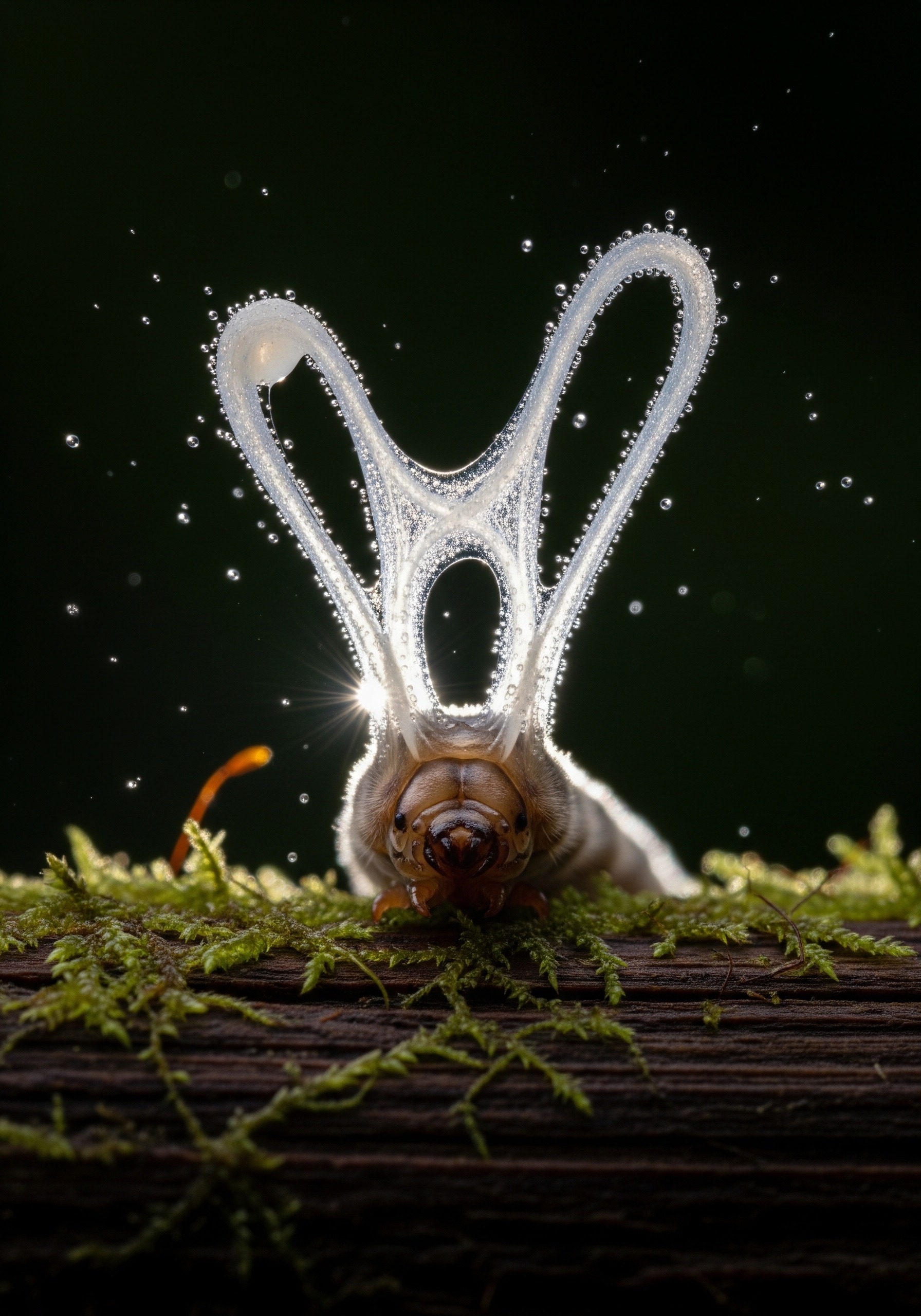
No. Not in any meaningful sense.
Onychophorans — the group’s scientific name — produce no venom, are not known carriers of any human pathogen of concern, and their slime, while chemically remarkable, sits on human skin the way a smear of dilute wood glue would: tacky, easily washed off, biologically inert. Britannica and the Australian Museum both describe them as harmless to people, and researchers routinely handle them bare-handed.
Here’s the thing, though: they ARE dangerous — to the right victim. A two-inch worm in wet leaf litter is a precision predator that takes down crickets, termites, woodlice, spiders and even small centipedes. By body-mass ratio that is roughly the equivalent of you ambushing a leopard. The same evolutionary machinery that makes them harmless to your finger is what makes them lethal to an insect 30 centimetres away.
What the slime cannon actually does
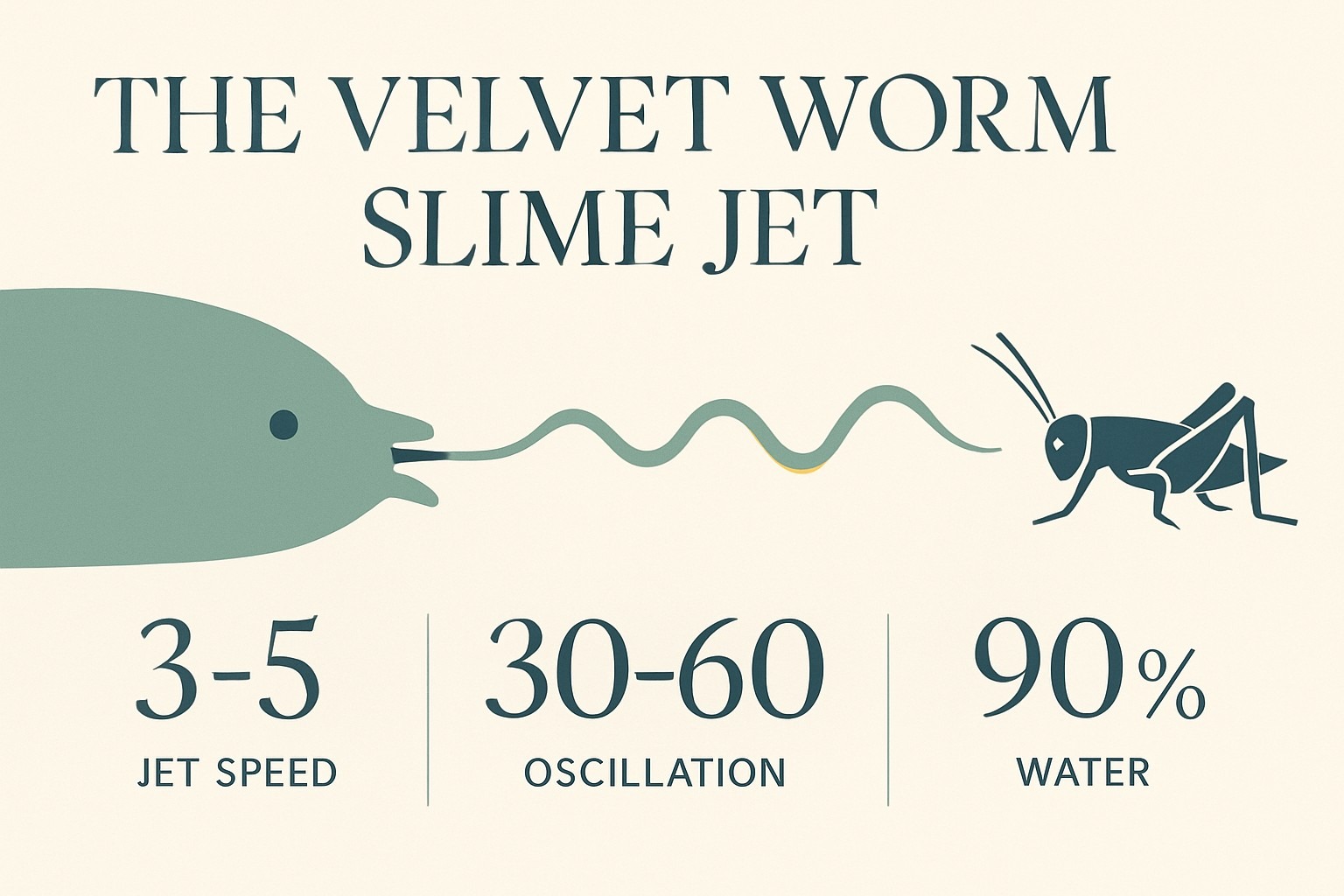
The slime cannon is the headline act, and it deserves to be. From two short oral papillae on either side of the mouth, the worm fires sticky, milky-white threads at speeds clocked between three and five metres per second, with an effective range out to roughly 30 cm.
The geometry matters. Each jet doesn’t fly straight — it weaves side to side in a chaotic, oscillating pattern that wraps the victim in a net rather than a single line of paste. Within seconds the threads stiffen into a rubbery mesh. The prey, glued in place, can’t escape. The worm walks up, finds a soft spot in the cuticle with its antennae, and bites in.
{IMAGE_2}
The 30-60 Hz secret: physics that needs no muscle
For a long time the oscillation looked impossible. The papillae whip back and forth around 30 to 60 times a second — far faster than any muscle in a soft-bodied worm could plausibly contract. So what was doing the flicking?
In 2015, a team led by physicist Andrés Concha at Adolfo Ibáñez University in Santiago, Chile, published the answer in Nature Communications. They filmed the Costa Rican giant velvet worm Peripatus solorzanoi in slow motion and ran the maths. The conclusion was elegant: muscles are not needed at all. The worm contracts a single reservoir behind its head, forcing slime through narrow, flexible papillae. At that pressure and through that geometry, the elastic walls of the papillae start to flutter on their own — the same instability that makes an unattended garden hose thrash around on a lawn. The animal supplies the squeeze; physics supplies the aim.
“Our analyses show that muscles are not needed,” Concha told National Geographic at the time. Palaeontologist Richard Fortey of London’s Natural History Museum, reviewing the work, framed it more broadly: “‘primitive’ animals can evolve sophisticated techniques of attack and defence using apparently simple materials.” That single observation explains half of why velvet worms are still here after half a billion years.
Inside the slime: 90% water and one molecule no other animal makes
If you scraped a velvet worm’s slime onto a slide, you would find that nine-tenths of it is water. The rest is a thin, ordered cocktail of collagen-type proteins, sugars, lipids and surfactants. Two things make it remarkable.
First, the way it sets. Wet, the slime is liquid enough to fire from a tiny opening at 5 m/s. Within seconds of touching the prey, its proteins reorganise into a stiff, elastic mesh that grips like cured rubber cement. (Concha’s team noted, with admiration, that a fired droplet stayed stuck to one of their cameras for two years.) Researchers studying biomimicry care about this a great deal — a glue that travels as a liquid and sets on contact, with no solvents, is a small miracle.
The velvet worm slime jet — by the numbers
- Composition: ~90% water; remainder mostly collagen-type proteins, plus sugars, lipids and surfactants
- Unique molecule: nonylphenol — onychophorans are the only known organisms that biosynthesise it
- Jet speed: 3–5 metres per second
- Oscillation frequency: ~30–60 Hz, driven by elastic instability — not by muscle
- Range: up to about 30 cm (often ~10× body length)
- Set time: seconds; once cured the glue can stay sticky for years
Second, a molecule called nonylphenol. It’s a surfactant — soap-like — and as far as biologists currently know, velvet worms are the only living organisms that actually make it themselves. (Industrially it is a synthetic chemical and a known pollutant; finding it in an animal at all was startling.) Why an animal would invest in producing nonylphenol of all things is an open question. The best current guess is that it helps the slime flow at impossible speeds without breaking up mid-jet.
Can a velvet worm bite you?
Anatomically, yes. Practically, almost never.
Velvet worms feed by puncturing prey with a pair of sharp, crescent-shaped jaws — modified claws, in fact — set inside the mouth. They cut a small hole and pump in digestive saliva that liquefies the prey from the inside. The jaws are real, and a large species (the giant onychophorans of Central America push past 20 cm) could in principle nip a finger. Two things keep this from being a meaningful danger: the worms are extremely reluctant to use the jaws defensively — they curl into a tight ball instead — and the rare reported cases of skin contact produced no injection of anything harmful. No venom, no clinically important bacteria.
If a velvet worm did bite, the honest expectation is a small pinprick, no swelling, washed and forgotten within a minute. Treat it the way you’d treat any minor scrape from handling wildlife: clean it, move on.
Where you’d actually meet one
You probably won’t, and that’s part of why they’re so understudied. Velvet worms live in damp, dark, undisturbed places — under rotting logs, deep in leaf litter, in the crevices of cave entrances — almost exclusively in the wet tropics and the southern temperate forests. Australia and South America hold the biggest diversity. New Zealand has a small set of native peripatus species so locally loved that the country runs a community programme to spot and protect them.
People who do find velvet worms tend to find them by accident: turning a log in a Tasmanian forest, lifting a stone in a Costa Rican coffee plantation, or — increasingly — in herbarium drawers, where new species are still being named from old specimens. Their 500-million-year history means any patch of ancient, wet forest is a candidate hiding place.
Why they survived 500 million years — and why we’re still finding new ones
That is the part of the story I find most interesting. A soft-bodied, slow-moving, water-dependent animal should have been an easy meal for everything that evolved after the Cambrian. Yet velvet worms are still here, almost unchanged, while the dinosaurs came and went and the Earth froze and thawed.
The reason seems to be conservatism. They picked a niche — damp forest floor, ambush at night, slime cannon — and stayed in it. They reproduce slowly, sometimes giving live birth after gestating embryos for over a year, and they tolerate almost no drying out. That sounds fragile. In practice it kept them locked inside stable microhabitats that survived every mass extinction, and competition there is essentially zero, because nothing else hunts the same way.
And the species count keeps climbing. In May 2025 a new velvet worm was formally described from the arid Karoo of South Africa — a surprise, because the region’s dry climate seemed wrong for an animal that hates losing water. The species apparently rides out the dry season inside damp soil cracks and emerges only after rain. Long-standing estimates that the true global count is more than double the ~232 currently described are looking conservative.
Frequently Asked Questions
Q: Can a velvet worm kill or paralyse a human with its slime?
A: No. The slime is sticky and at most mildly irritating. It carries no toxin, no venom, no anaesthetic. It is engineered to immobilise insect-sized prey, not anything with our muscle mass.
Q: Are velvet worms poisonous if a pet eats one?
A: There is no published evidence of poisoning from velvet worm ingestion in pets or wildlife. The slime is mostly water and protein, and the worm itself contains nothing known to be toxic. The wider issue is just that pets shouldn’t snack on unfamiliar invertebrates in general — separate problem, not specific to this animal.
Q: How fast is a velvet worm’s slime attack?
A: The jet leaves the papillae at 3–5 metres per second and oscillates at about 30–60 Hz, hitting and immobilising prey in well under a second. The worm only needs to squeeze a single internal reservoir; the wobble that wraps the prey is automatic, driven by elastic instability.
Q: Where are velvet worms found in the wild?
A: Mostly in damp tropical and southern temperate forests — Australia, New Zealand, South and Central America, the Caribbean, parts of Africa, Southeast Asia and northeast India. They live under rotting wood and leaf litter and avoid dry sunlight. Encounters with humans are rare.
Sources
- Concha et al., “Oscillation of the velvet worm slime jet by passive hydrodynamic instability,” Nature Communications (2015)
- National Geographic — “Bizarre Velvet Worms Shoot Slime Jets — Now We Know How”
- The Australian Museum — Velvet Worm fact sheet
- Encyclopaedia Britannica — Velvet Worm (Onychophora)
- Stellenbosch University / Phys.org — May 2025 description of a new Karoo velvet worm species
So, are velvet worms dangerous? Only if you’re an insect smaller than a coin and you stepped on the wrong log at the wrong time. To everything bigger, they are one of the gentlest miracles in the forest: a 500-million-year-old animal that hunts with a slime jet powered by physics no one understood until ten years ago. Worth lifting a log for. Worth putting back, very carefully, exactly how you found it.
Illustrations are AI-generated. Article fact-checked and human-edited. Our editorial standards.