How Banff’s Wildlife Crossings Cut Collisions by 96 Percent
Here’s the paradox at the heart of Banff wildlife crossings: a highway built to move humans faster became the infrastructure that saved animal populations from fragmentation. Four lanes of Trans-Canada asphalt slice through some of North America’s most critical migration territory. Yet beneath that same highway, in carefully engineered underpasses and vegetated overpasses, thousands of wolves, bears, and elk have learned to cross safely — so consistently that large mammal collisions dropped 96 percent in fenced sections. That single statistic, repeated in conservation journals worldwide, explains why one park’s road engineering experiment became the template for wildlife infrastructure globally.
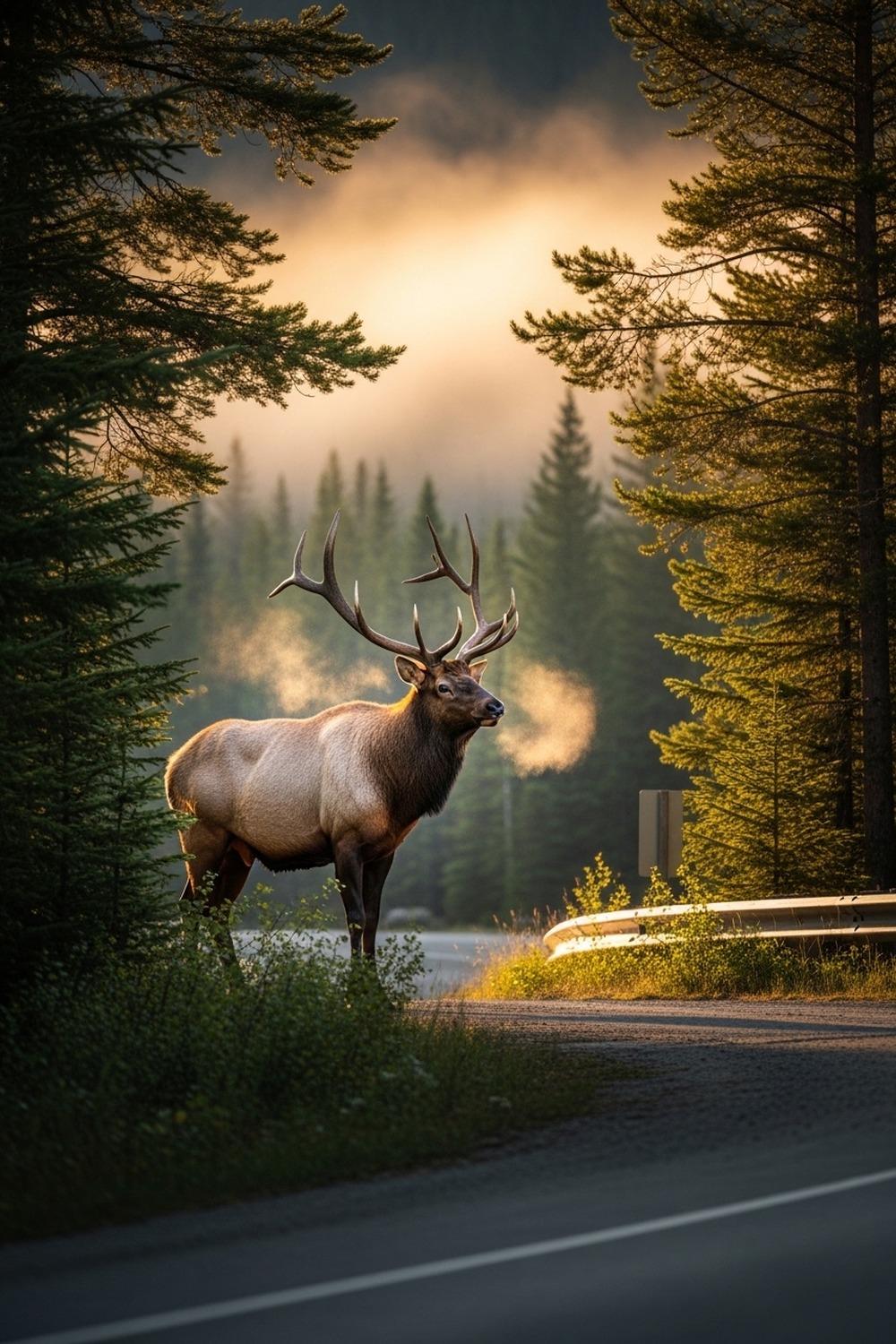
The Trans-Canada Highway slices through Banff National Park like a scar across one of the most ecologically important landscapes on Earth. Before 1978, the road was fragmenting migration corridors that wolves, elk, bears, and cougars had followed for millennia. The collisions were relentless. Habitat was fracturing faster than anyone could document it. Nobody was entirely sure an engineered solution could change animal behavior at scale.
What happened next rewrote the textbook on road ecology.
Key Facts
- Banff wildlife crossings reduced large mammal-vehicle collisions by 96 percent within fenced sections of the Trans-Canada Highway
- Banff installed 44 crossing structures, 6 overpasses and 38 underpasses, along about 82 kilometers of high-tensile fencing
- Parks Canada began fencing the highway in 1978, with the first dedicated crossing structures built in 1982
- Over 152,000 wildlife crossings by at least 11 large mammal species were logged by camera trap between 1996 and 2014
- Grizzly bears made over 12,000 documented crossings in that same monitoring period
In short: Banff wildlife crossings, 44 structures spanning the Trans-Canada Highway with 82 kilometers of fencing, cut large mammal collisions by 96 percent in fenced sections. Begun in 1978, the system logged over 152,000 crossings by 11 species between 1996 and 2014 and a 2014 genetics study showed grizzly bears interbreeding across the road.
How Banff Wildlife Crossings Changed Road Ecology Forever
The story begins in 1978, when Parks Canada started fencing sections of the Trans-Canada Highway running through Banff National Park in Alberta, Canada. The initial goal was simple and blunt: stop animals from walking into traffic. Fencing alone, researchers quickly realized, just displaced the problem. If you block access to a road without offering an alternative route, you don’t save animals — you strand them.
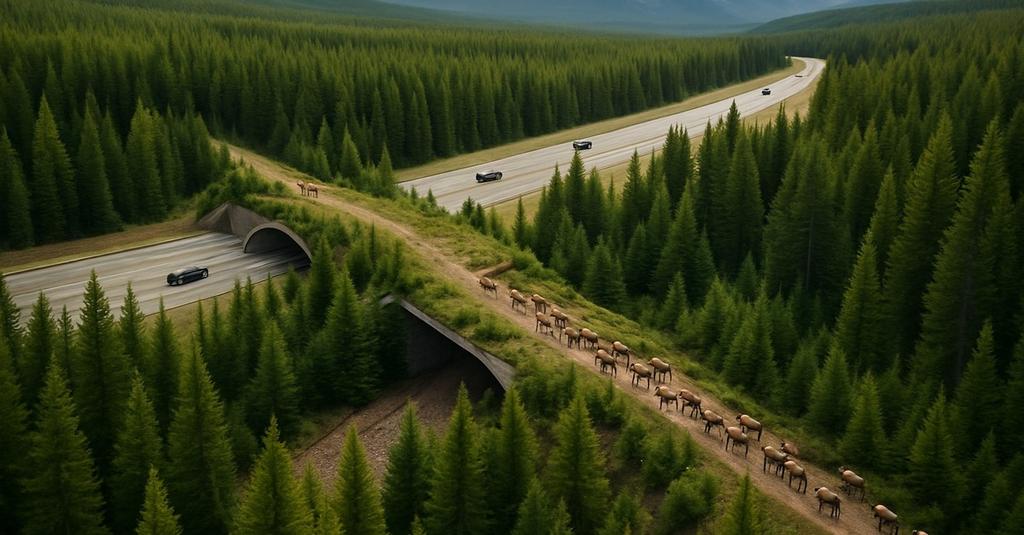
It took another decade of planning, ecological surveying, and political lobbying before the first dedicated wildlife crossing structures were built in 1982. By the time the full system was operational, Banff had installed 44 crossing structures — six overpasses and 38 underpasses — paired with approximately 82 kilometers of high-tensile fencing. The program became the most studied wildlife crossing system in the world.
Researchers from Europe, Australia, and Asia descended on Banff wanting to know whether it actually worked. The verdict, tracked by University of Calgary researchers across a monitoring period stretching into the 2000s, was unambiguous: large mammal-vehicle collisions dropped by 96 percent within fenced sections. That’s not a rounding error. That’s near-elimination. And here’s the thing — it wasn’t achieved through a single brilliant design. It came from an iterative process of watching animals, adjusting structures, and letting the landscape do the work. Some underpasses were widened after cameras showed deer hesitating at narrow openings. Vegetation on the overpasses was planted and replanted until it mimicked surrounding forest closely enough to feel, to a bear’s nose and eye, like natural ground.
The fencing is what most visitors never think about. Ecologists will tell you it’s the whole system’s backbone. Without it, even the most beautifully designed overpass is just scenery. Animals need to be channeled, gently and consistently, toward the crossing point rather than the asphalt. Get that right, and everything else follows.
Animals Learned to Use the Crossings Faster Than Anyone Expected
Wolves are notoriously suspicious of novel structures. Bears are cautious in ways that can look, to a human observer, almost paranoid. So when ecologists first set up camera traps on Banff’s wildlife crossings in the early 1990s, they expected years of avoidance before the wariest species would commit to using man-made corridors.
What they found instead was one of conservation biology’s most encouraging surprises. Grizzly bears — animals with home ranges of hundreds of square kilometers and an acute sensitivity to human scent and disturbance — began using the overpasses within two to three years of construction. Wolves followed. Cougars, which were thought by some researchers to be too skittish for structured crossings, turned out to be among the most regular users. This mirrors what researchers studying other apex predators have observed globally: animals that appear inflexible are often far more adaptable than we assume, provided the alternative they’re offered is genuinely safe and consistent.
It’s the same behavioral plasticity you see in species adapting to fragmented habitats worldwide — whether that’s a gliding mammal threading through the shrinking forest corridors of Southeast Asia or a mountain predator learning to trust a green bridge over a highway. But what made Banff different wasn’t just that animals could adapt. It was that someone measured it.
Over 152,000 wildlife crossings by at least 11 large mammal species were logged between 1996 and 2014 — that’s the scale of the camera trap data Parks Canada and University of Calgary researchers collected. Elk accounted for the highest raw numbers, tens of thousands of crossings documented. But the ecologically significant data came from the carnivores.
Grizzly bears made over 12,000 documented crossings in that same period. Each crossing represented a bear moving between habitat patches that the highway would otherwise have made permanently inaccessible. That’s gene flow. That’s population connectivity. That’s the difference between a locally isolated subpopulation and a functioning metapopulation.
One finding from 2006 stood out sharply: female grizzlies — the most vulnerable to disturbance during cub-rearing — were using the crossings at nearly the same rate as males. That hadn’t been guaranteed. Females with cubs are extraordinarily risk-averse, and researchers had worried they’d avoid the structures entirely. When the camera data showed otherwise, it fundamentally changed expectations for what crossing systems could achieve for bear conservation.
Why the World Is Now Copying the Banff Blueprint
Within a decade of its results becoming widely published, transportation agencies and conservation organizations across North America, Europe, and Southeast Asia were referencing the Banff model when designing their own crossing systems. Banff’s success didn’t stay in Alberta. The Netherlands had been building wildlife crossings — called ecoducts — since the 1980s, and by 2023 had more than 600 across the country.
In the United States, the I-10 Wallis Annenberg Wildlife Crossing in California’s Santa Monica Mountains, approved in 2019 and completed in 2025, was explicitly designed with Banff’s lessons in mind: wide vegetated overpasses, high fencing on approach corridors, and extensive pre-construction wildlife monitoring. Why does the Banff model resonate so powerfully with infrastructure planners worldwide? Because it proved connectivity isn’t theoretical — it’s measurable, durable, and economically defensible.
According to National Geographic’s coverage of global crossing projects, road mortality is now considered one of the top five direct killers of wildlife globally, affecting an estimated one million vertebrates per day on roads worldwide. Banff’s documented success gave the field both the evidence base and the political language to argue for infrastructure investment in ecological connectivity.
What took the broader infrastructure world years to fully absorb is that connectivity isn’t a luxury feature in conservation planning. It’s the foundation. A protected area bisected by a high-speed road isn’t a protected area in any meaningful ecological sense. The animals inside it can’t access seasonal food sources, find mates, or respond to climate-driven habitat shifts without crossing that road. Fragmentation is a slow catastrophe. The crossings don’t solve fragmentation entirely, but they arrest it — and the data from Banff showed, for the first time at this scale, that the arrest was measurable.
Critics of wildlife crossing programs often cite construction expenses — major overpasses can run $5 million to $10 million USD or more. But transportation economists who’ve studied the Banff data point to the flip side: vehicle collisions with large mammals are expensive in insurance claims, vehicle damage, human injuries, and fatalities. Prevent enough of them and the crossings pay for themselves. Watching a continent-wide infrastructure movement emerge from a single park’s fencing project, you realize cost-benefit analysis can move policy just as effectively as emotional appeals to wilderness.
What the Camera Traps Revealed About Banff Wildlife Crossings and Genetics
The most scientifically significant findings from Banff’s crossing program didn’t come from counting collisions. They came from the genetics lab. In 2014, researchers from the University of Alberta published a study examining the genetic structure of grizzly bear populations on either side of the Trans-Canada Highway. The question they were asking was fundamental: were the bears using the crossings to actually breed across the highway, or were they simply moving through the structures without meaningfully connecting the two populations genetically?
Years of hair snare sampling, non-invasive genetic analysis, and statistical modeling followed. What they found was that gene flow across the highway had been maintained — not perfectly, but significantly — in areas where crossing density was highest. Bears weren’t just walking over the road. They were interbreeding across it. That’s the difference between a corridor that works as a path and a corridor that works as conservation infrastructure.
A population that can’t interbreed with neighboring groups becomes genetically isolated. Inbreeding depression sets in over generations. Disease resistance drops. Reproductive success declines. The implications compound quickly: the population shrinks not because of direct mortality but because of invisible genetic erosion happening across decades. The crossings, in this context, aren’t just preventing bears from being hit by trucks. They’re preventing the slow genetic collapse of a population that would otherwise look, from the outside, perfectly healthy — right up until it wasn’t.
Parks Canada has continued monitoring since the 2014 study, using GPS collaring and remote camera networks to track individual animal movements. Microhabitat features — soil moisture, canopy cover, approach topography — that weren’t originally part of the design criteria were found to determine which crossings outperformed others. That information is now fed directly into new crossing projects. Banff isn’t just a model. It’s still an active laboratory.
What Banff’s Crossings Mean for Climate-Stressed Wildlife
As average temperatures climb across western Canada, species are shifting their ranges northward and upward in elevation. Mountain ecosystems like Banff’s are particularly vulnerable because the altitudinal zones animals can retreat to are finite — there’s only so much mountain. For populations to track their climate envelope, they need to move laterally as well as vertically, across landscapes fragmented by roads, fences, and development.
A 2022 analysis by the federal Canadian Wildlife Service estimated that maintaining connectivity corridors will be as important to species persistence under mid-century climate projections as reducing direct habitat loss. The Banff model, built decades before climate connectivity became a mainstream conservation concept, turns out to have been accidentally ahead of its time. What changes if connectivity infrastructure isn’t scaled up to meet climate-driven range shifts? Populations that can’t move become locally maladapted. Predator-prey relationships that depend on synchronized seasonal movements break down. Ecosystem functions — seed dispersal, nutrient cycling, vegetation control by large herbivores — start fraying at the edges.
And here’s what gets overlooked in the climate adaptation literature: the wildlife crossings at Banff aren’t just saving individual animals from being hit by cars. In a warming world, they’re preserving the pathways through which entire communities of species will need to move across the coming century.
Stand on the Bow Valley overpass on a late October evening, when the larches have gone gold and the light sits low across the mountains. Below, headlights streak east and west without pause. Above, a forest sits in silence — planted, tended, monitored, and crossed by animals that have no idea a highway exists beneath their feet. That quiet, engineered wildness is what the data looks like when it becomes a place.
How It Unfolded
- 1978 — Parks Canada begins installing high-tensile fencing along the Trans-Canada Highway through Banff National Park, the first systematic attempt to reduce wildlife-vehicle collisions in the park.
- 1982 — The first dedicated wildlife crossing structures are constructed, marking the beginning of what would become the world’s most studied crossing program.
- 1996–2014 — University of Calgary researchers conduct systematic camera trap monitoring, logging over 152,000 wildlife crossings by 11 large mammal species and establishing the global evidentiary benchmark for crossing effectiveness.
- 2025 — The I-10 Wallis Annenberg Wildlife Crossing in California — the world’s largest urban wildlife crossing, explicitly modeled on Banff principles — opens to wildlife after years of construction, bringing the Banff blueprint to a major metropolitan region for the first time.
By the Numbers
- 96% — reduction in large mammal-vehicle collisions within fenced highway sections after the Banff crossing system reached full operation (Parks Canada, ongoing monitoring data).
- 44 crossing structures — including 6 overpasses and 38 underpasses — installed along approximately 82 kilometers of the Trans-Canada Highway through Banff National Park.
- 152,000+ wildlife crossings documented by camera trap between 1996 and 2014, representing at least 11 large mammal species including grizzly bears, wolves, elk, and cougars.
- 12,000+ grizzly bear crossings recorded in the same monitoring period — each one representing movement between habitat patches previously severed by the highway.
- $5–10 million USD — typical construction cost range for a single large wildlife overpass, a figure transportation economists argue is offset by reduced collision costs, insurance claims, and human injury within a decade of operation.
Field Notes
- In 2006, camera trap data from Parks Canada revealed that female grizzly bears with cubs — among the most disturbance-sensitive animals in North America — were using the Banff overpasses at rates nearly matching adult males, a finding that surprised researchers who had expected cub-rearing females to avoid the structures entirely.
- The vegetation on Banff’s wildlife overpasses isn’t decorative — it’s functional camouflage. Ecologists found that crossing use rates increased significantly when plant cover on the overpass surface reached a density close enough to surrounding forest that the structure no longer visually registered as an open, exposed environment to wary species like wolves and cougars (and this matters more than it sounds: it’s the difference between infrastructure and art).
- Bears appear to teach crossing use to their offspring. Camera sequences at multiple Banff overpasses have captured the same female bear using a crossing repeatedly across years, always accompanied by cubs who are documented using the same crossing independently after maternal separation — suggesting learned spatial behavior passed between generations.
- Researchers still can’t fully explain why some crossings are used far more than others with nearly identical structural designs. Factors like prevailing wind direction, proximity to water sources, and subtle soil chemistry differences in vegetation are hypothesized but not yet confirmed as the deciding variables. The preference hierarchy among individual animals for specific crossings remains an open question.
Frequently Asked Questions
Q: How do Banff wildlife crossings actually work — do animals find them naturally?
A combination of physical infrastructure and behavioral channeling makes Banff wildlife crossings function seamlessly. High-tensile fencing running for up to 82 kilometers along the Trans-Canada Highway blocks animals from accessing the road directly, guiding them toward crossing structures instead. Overpasses are planted with native vegetation to reduce animals’ perception of exposure. Most species begin using the crossings within two to three years of installation — wolves and grizzlies, the wariest species, were documented using structures regularly within that window. Animals don’t need signage or training. They follow the fence until they find the gap.
Q: Which animals use the Banff crossings most often?
Elk and deer account for the highest raw crossing numbers, given their population size and frequent movement across the Bow Valley. But the ecologically significant users are the carnivores. Grizzly bears have made over 12,000 documented crossings since monitoring began in 1996. Wolves, cougars, black bears, wolverines, and lynx are all regular users. Crossing preference varies by species — wolves tend to favor wider overpasses with dense vegetation, while smaller mammals like badgers and coyotes use both underpasses and overpasses at comparable rates.
Q: Isn’t the 96 percent reduction figure too good to be true?
It sounds extraordinary — but it’s been independently verified across decades of Parks Canada and university monitoring data, and it’s specifically measured within fenced highway sections, not the entire park. The number reflects the effect of combining two systems: the crossing structures themselves and the fencing that channels animals toward them. Neither element alone produces anything close to that outcome. Studies that have examined crossing programs without comprehensive fencing consistently show far lower collision reductions, which is why ecologists insist the two must be designed as a single integrated system, not separate additions.
Editor’s Take — Alex Morgan
What stays with me about the Banff data isn’t the 96 percent. It’s the 2014 genetics study. We built infrastructure to stop animals from being killed by cars, and it turned out we’d also — accidentally, unknowingly — preserved the genetic connectivity of a grizzly bear population across a generation. That’s the kind of consequence that doesn’t show up in collision statistics. It shows up thirty years later, in a population that shouldn’t be as healthy as it is, and researchers having to work backward to understand why. Infrastructure built for safety became infrastructure for survival. We should be building it everywhere.
The Trans-Canada Highway still carries roughly 25,000 vehicles a day through Banff National Park. Traffic hasn’t thinned. Speeds haven’t dropped. What changed was the assumption that a road and a wild landscape are fundamentally incompatible — that once you’ve drawn asphalt through an ecosystem, the damage is done and fixed. Banff’s wildlife crossings challenged that assumption with decades of camera trap footage, genetic sampling, and collision data, and won the argument decisively. History has a way of treating the people who ignored this kind of evidence unkindly. The question now is how many highways we’re willing to leave without them while that evidence sits on the shelf.
Illustrations are AI-generated. Article fact-checked and human-edited. Our editorial standards.