The Squid That Lives Fast and Dies Before Age One
Nobody set out to find the fastest-growing large invertebrate on the planet. They were just watching squid. And then someone ran the numbers on how much one of them was eating per day, and the whole research team had to sit down.
Thirty percent of its own body weight. Every day. Sepioteuthis lessoniana — the bigfin reef squid — doesn’t pace itself. It doesn’t have time to. This animal’s entire existence, from hatching to death, fits inside a single calendar year. And the way it spends that year is one of the stranger biological stories I’ve come across.
How the Bigfin Reef Squid Grows So Impossibly Fast
Here’s the thing about the growth rate: it’s not a rounding error, and it’s not a fluke sample. Marine biologist Yoko Hirota, studying Sepioteuthis lessoniana populations in Japanese coastal waters, found that during peak growth phases, the species’ metabolic output rivals warm-blooded animals. For an invertebrate, that’s a genuinely strange finding — the kind that makes researchers double-check their data before publishing it.
From hatching to 0.6 kilograms takes roughly four months. Four months.
The 30% daily food intake isn’t a quirk — it’s the price of running a body that’s dismantling and rebuilding itself at a cellular level, continuously, the entire time it’s alive. Stop eating for even a day and the system starts to stall. There’s no buffer, no reserve metabolism to coast on. The machine only runs at full throttle.
That Skin Isn’t Just Pretty — It’s Doing Work
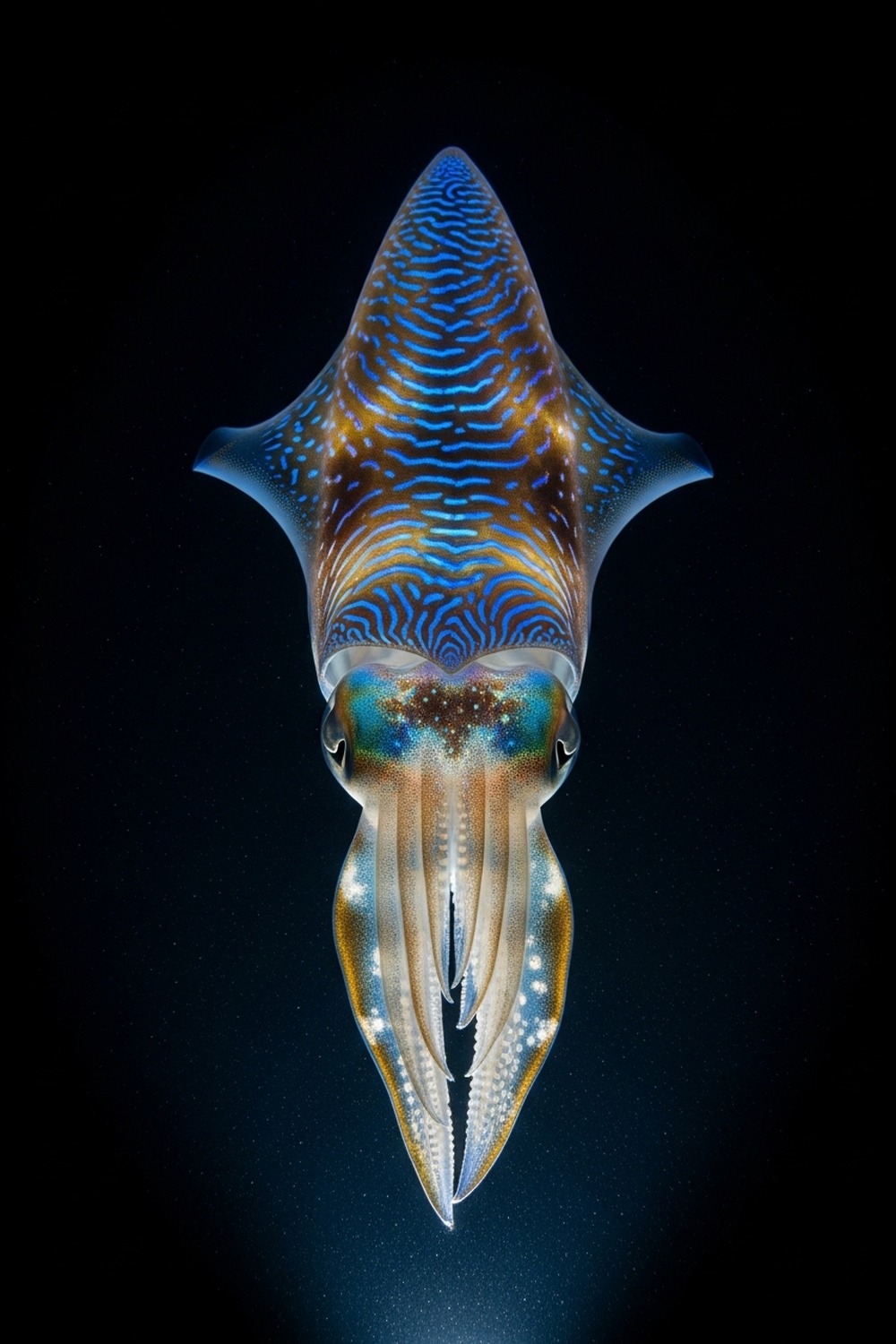
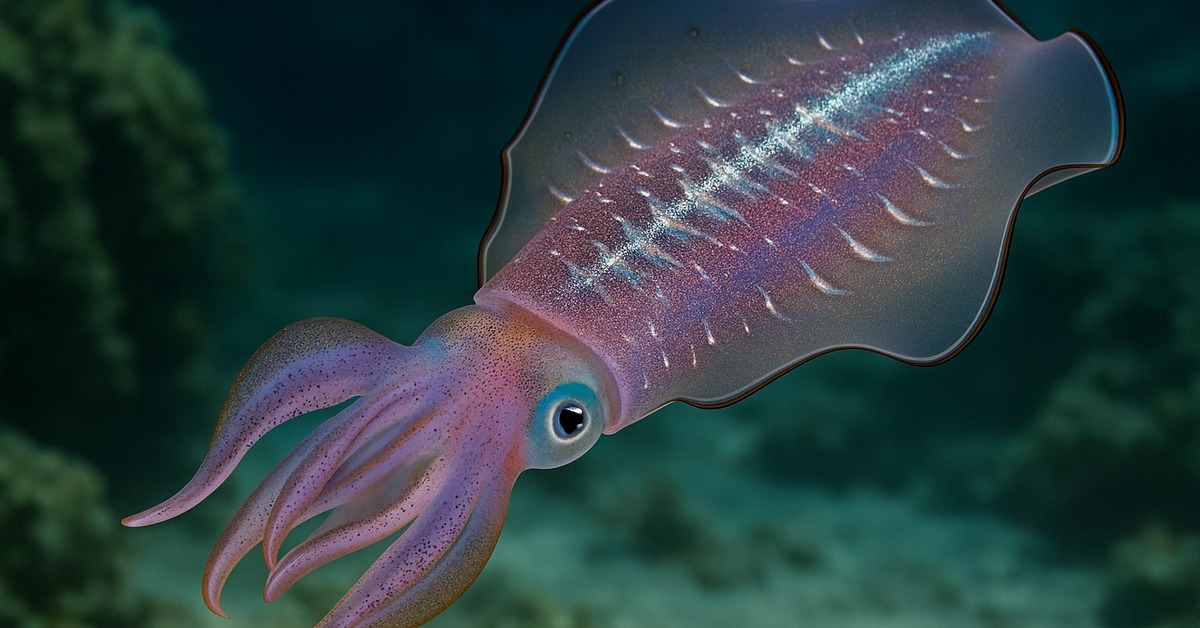
Thousands of pigment-filled cells called chromatophores are embedded across the squid’s mantle, fins, and arms. Each one connects directly to the nervous system — no hormones, no relay delays. When the brain fires a signal, the skin responds in milliseconds. Rippling waves of blue, white, and gold move across the body like something being projected onto it from outside.
Researchers have catalogued at least 34 distinct visual signaling patterns in the wild. Each one tied to a specific behavioral context. Though several of those patterns still don’t have a confirmed explanation, which is the part that kept me reading about this for another hour after I probably should have stopped.
Some patterns are clearly for hunting — a strobing effect that seems to disorient prey fish. Others pulse during courtship with a precision that looks almost choreographed. And then there’s a handful that activate when nothing obvious is happening at all. Nobody’s confirmed yet whether those are communication, camouflage, or something else that doesn’t map cleanly onto either category.
The Light Show Has a Social Layer Nobody Expected
This is the part that breaks your brain a little.
The bigfin reef squid can run two completely different skin displays at the same time — one on each side of its body. Left side signaling aggression to a rival male. Right side running courtship patterns toward a female. Simultaneously. That’s not a metaphor for multitasking. It’s literal split-screen communication, confirmed by multiple research teams after early observers assumed it had to be a recording artifact. For more on animals with cognitive and behavioral abilities that don’t fit the usual frameworks, this-amazing-world.com has a deep collection worth exploring.
Divers who encounter these squid at night describe something that doesn’t feel like watching an animal behave. It feels like watching a conversation you can almost understand. Colors traveling through a whole school of squid like a signal passing through a network. Something clearly being communicated. You just can’t read it.
Speed Has a Cost — and the Bill Comes Due Fast
All that furious growth, all those light shows, all that hunting and competing and mating — it runs on a clock with a hard stop.
The species lives less than a year. Not a slow year, not a quiet year. A maximum-output year in which the squid reaches sexual maturity, reproduces, and dies — all within a single trip around the sun. Most large invertebrates play a longer game. Octopuses live one to three years. Some cuttlefish push two. Sepioteuthis lessoniana made a different trade-off: burn bright, burn fast, leave eggs behind.
And the eggs are already carrying the next sprint before the parent’s body has finished decomposing.
The Death Is Built Into the Biology, Not the Environment
Turns out it’s not predation that ends the squid’s life. It’s senescence — a programmed biological shutdown that kicks in almost immediately after spawning. The muscle tissue starts degrading. The mantle loses structural integrity. Feeding drops off sharply. Within days to weeks of reproduction, the animal is gone. This pattern appears across nearly all cephalopods, but the bigfin reef squid runs the cycle faster and more visibly than almost any other species in the group.
What that means is worth actually sitting with for a second: this squid spends its entire life in peak mode. No slow adolescence. No middle-aged plateau where things level off. Every single week it’s alive is a week at maximum biological output.
By most evolutionary standards, that’s wildly inefficient.
Except the species has been doing this for millions of years and is currently thriving across a massive stretch of the Indo-Pacific. So maybe “inefficient” is the wrong word for what’s actually happening here.
By the Numbers
- 30% of body weight consumed daily — placing it among the highest mass-specific consumption rates of any large invertebrate on record.
- 34 distinct chromatic signaling patterns identified in wild populations. That count has grown with every new field study, and researchers consider it a floor, not a ceiling.
- 0.6 kg in approximately four months from hatching.
- Under 12 months total lifespan — compared to the 1–3 year range for most comparably sized cephalopods, which makes Sepioteuthis lessoniana a significant outlier even within its own taxonomic neighborhood.
Field Notes
- The split-sided display — running two completely different chromatic patterns simultaneously on each half of the body — was initially dismissed as a recording artifact. Multiple independent research teams eventually confirmed it in live specimens. It’s the behavioral equivalent of holding two separate conversations at the same time without letting either one bleed into the other.
- Commercially critical across Asia. Japan, Philippines, Taiwan, Red Sea — this animal that lives less than a year is one of the most economically significant invertebrates in the ocean.
- Hatchlings emerge already capable of basic chromatic displays — pre-loaded with the signaling system before they’ve had a single day of experience using it. The first thing they do, essentially, is signal.
Why This Squid Makes Us Rethink What a Life Looks Like
The bigfin reef squid doesn’t fit the framework most people carry around for what a successful animal looks like. Doesn’t live long. Doesn’t grow carefully. Doesn’t conserve energy or find a sustainable pace. It pushes every biological system to its limit for under a year, communicates in ways that still confuse the researchers watching it, and then exits — leaving eggs that will run the exact same sprint.
It almost reads as reckless. Except the species has been doing this for millions of years.
That quietly challenges something we assume without really examining it: that longer, slower, more cautious is inherently more successful. The bigfin reef squid has been running the opposite bet for longer than our genus has existed. Understanding how creatures like this push biological limits — growth rates, senescence timing, neural control of behavior — has real implications for how we think about metabolism, aging, and what the word “efficiency” actually means in living systems.
There’s something genuinely unsettling about an animal that lives at full speed and never coasts. No resting phase. No cautious middle chapter. Just relentless biological output until the clock runs out. Short doesn’t mean small — the bigfin reef squid’s less-than-a-year existence contains more biological complexity than most long-lived animals will ever run. If this kind of thing keeps you up at night, there’s more at this-amazing-world.com. The next one is stranger.