The Ghost Dolphin: Inside a Rare Albino Sighting Off Chincoteague
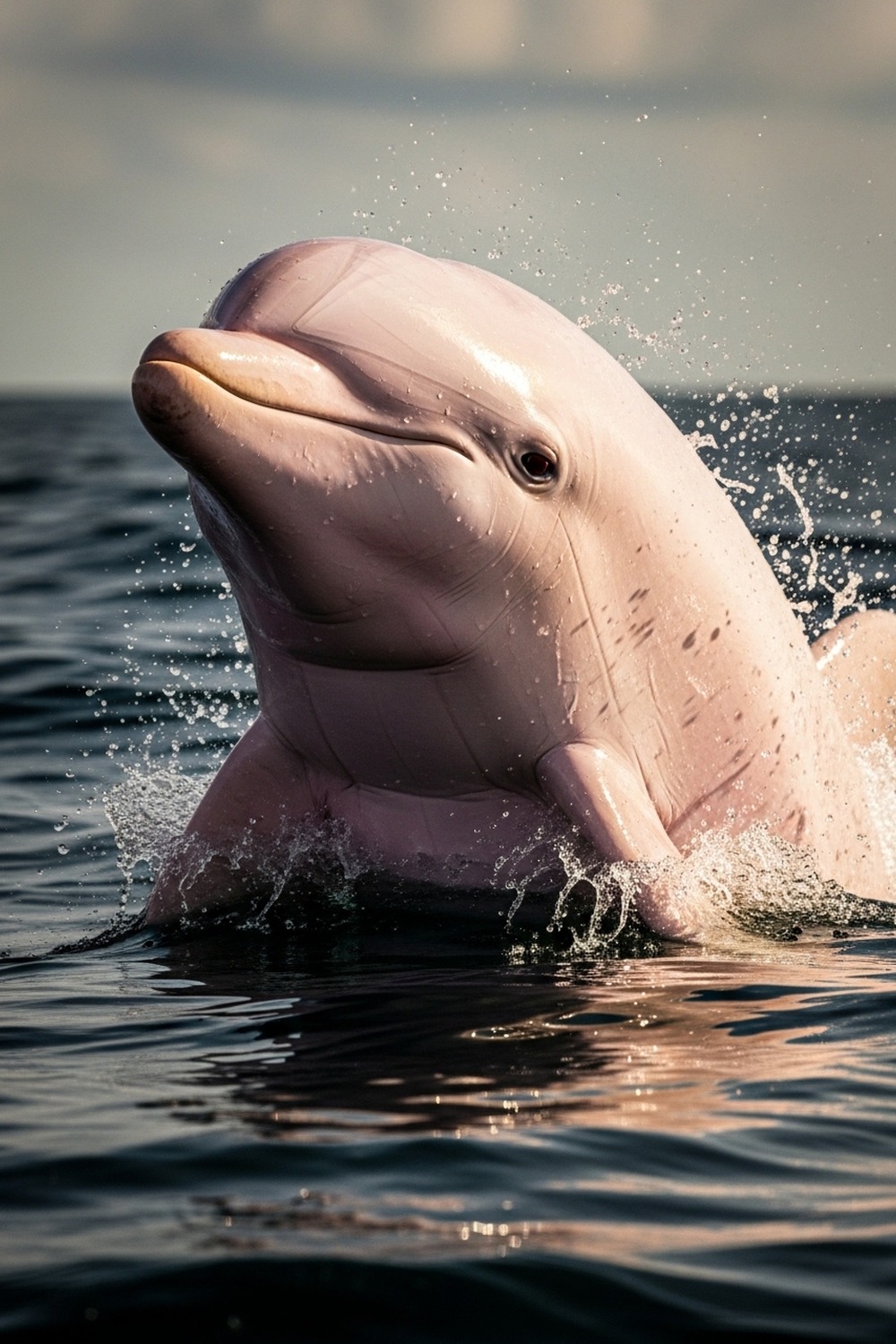
Albino bottlenose dolphins are so rare that science has documented fewer than ten worldwide — and most researchers will never see one in the wild. So when a pink-white dorsal fin broke the surface off Chincoteague Island, Virginia, cutting against the dark Atlantic chop at the wrong color entirely, the researchers on nearby vessels didn’t just reach for their cameras. They reached for their notebooks. What they found goes well beyond a striking photograph.
Not a regional rarity. Not a few dozen scattered across warming seas. A handful. Worldwide. That alone would make this animal extraordinary. But what researchers discovered during this Chincoteague sighting goes deeper than color — into genetics, survival odds, and what a single white dolphin tells us about the ocean’s most unforgiving selection pressures.
What Makes an Albino Bottlenose Dolphin So Rare
Albinism in cetaceans is caused by a recessive genetic mutation that disables the body’s melanin-producing pathways entirely. In most mammals, melanin does at least three things: it provides skin and coat coloration, it absorbs ultraviolet radiation, and it contributes to the pigmentation of the retina. When a bottlenose dolphin — Tursiops truncatus — inherits two copies of a nonfunctional version of the gene responsible for melanin synthesis, all three functions collapse at once. The result is an animal with pale, pinkish-white skin, a reduced ability to screen UV radiation, and eyes that appear reddish or pale due to visible blood vessels in the iris. The condition is documented in detail by the National Oceanic and Atmospheric Administration (NOAA), which has tracked unusual cetacean colorations along the Atlantic seaboard since the 1980s.
Because both parents must carry the recessive allele for it to express, and because dolphin pods don’t breed in closed genetic loops the way isolated land populations sometimes do, the statistical odds of this mutation surfacing visibly are extraordinarily low. You can read more about the biology of albinism in animals to understand how melanin pathways fail at the molecular level.
Migaloo, a white humpback whale first spotted off Queensland, Australia, in 1991, became one of the most photographed marine mammals on Earth — partly because his blinding white flanks made him impossible to miss from a vessel deck. The Chincoteague sighting isn’t the first time a white cetacean has stopped researchers cold, but Migaloo is believed to be leucistic rather than truly albino, meaning his melanin production is suppressed but not fully eliminated. True albinism — complete absence — is rarer still. The distinction matters scientifically. It means different UV vulnerability, different eye function, and potentially different social dynamics within the pod.
Here’s the thing: the animal was swimming with a group of normally pigmented dolphins at the Chincoteague site. It wasn’t isolated. It wasn’t trailing behind. Keeping pace. That single behavioral detail carries more weight than it might seem.
Chincoteague’s Waters and Why This Corridor Matters
Chincoteague Island sits at the heart of one of the Atlantic coast’s richest migratory corridors, and that positioning is critical to understanding why this sighting happened here rather than somewhere else. The shallow barrier island ecosystem — backed by Chincoteague National Wildlife Refuge and fronted by the open Atlantic — funnels enormous volumes of baitfish north and south with the seasons. Bottlenose dolphins follow those fish highways with almost mechanical precision, and the Virginia coast sees regular pods moving through from late spring through early autumn.
Why does this corridor matter beyond the fish? Because it comes with decades of observational infrastructure. Virginia Aquarium & Marine Science Center’s stranding response team has documented cetacean behavior in this region for decades, building photo-identification catalogs that allow individual animals to be tracked across years — the kind of long-term dataset that transforms a single unusual sighting into something more than anecdote. The albino bottlenose dolphin spotted here isn’t just an anomaly floating in open water. It’s an anomaly that can now be placed inside a known population, compared to known behavioral baselines, and potentially followed across future seasons. Much like the hidden complexity behind a pygmy seahorse vanishing into its coral reef, marine camouflage — and the catastrophic absence of it — shapes every survival calculation an ocean animal makes.
Chincoteague’s offshore waters sit within range of bull sharks and occasionally great white sharks tracking the same migratory prey. For a normally pigmented bottlenose dolphin, gray skin against gray-green water is a functional defense — disrupting the silhouette, diffusing visual contrast. For an albino animal, that defense doesn’t exist. From below, looking upward toward surface light, a white dolphin against the surface is as visible as a signal flare. Researchers at the College of William & Mary’s Virginia Institute of Marine Science (VIMS) have noted that predation pressure in Atlantic barrier island corridors is measurably higher than in offshore deepwater zones, which makes the Chincoteague sighting site particularly interesting from a survival-odds perspective.
And yet the animal appeared healthy. No visible scarring consistent with shark contact. Body condition looked good — no pronounced ribbing, no lethargy in its surfacing rhythm. Whatever pressures its unusual coloration creates, this dolphin has so far found a way to live inside them.
The Science of Survival Without Camouflage
How does an animal this conspicuous survive long enough to be spotted by researchers? The honest answer is: we don’t fully know. But the data we do have from other documented albino and leucistic marine mammals offers some instructive fragments. A 2019 review published in Smithsonian Magazine examined documented cases of albino and leucistic cetaceans globally and found that social integration — remaining within a pod rather than becoming solitary — appears to be the single most protective factor for survival. Pods provide echolocation overlap, group threat detection, and cooperative defense that can partially compensate for an individual’s visual vulnerability. Being white in a gray ocean is survivable, turns out, if you’re not alone in it.
The review also noted that UV radiation damage accumulates differently in albino cetaceans (researchers actually call this photooxidative stress), potentially causing chronic skin lesions in animals living at higher latitudes with stronger seasonal sun exposure. Chincoteague’s summer sun, reflecting off shallow barrier water, represents exactly the kind of UV environment that would stress an albino animal’s skin over time.
An albino bottlenose dolphin stranded at the surface of an ocean that punishes visibility — and surviving anyway — is not a biological accident. It’s evidence of something the species figured out long before we started watching.
What’s counterintuitive is that the albino bottlenose dolphin may actually gain a short-term advantage in certain lighting conditions. In early morning or late afternoon light, when the water surface carries a glare that washes out color differentiation, a pale animal may be no more visible than a gray one. Predators that rely on contrast — and many sharks hunt partly by visual contrast cues in addition to electroreception — may find their edge reduced in those transitional light windows. It’s a narrow margin. But in open-ocean survival, narrow margins compound over time.
Reduced melanin in the eye can mean reduced contrast sensitivity in bright light — a real liability for an animal that hunts fast-moving fish in well-lit shallow water. Researchers are still working out the functional implications of the reddish eye pigmentation seen in truly albino dolphins.
What the Albino Bottlenose Dolphin Tells Us About Genetic Diversity
Sightings like this one don’t just tell us about one unusual animal. They’re a signal — faint but readable — about the genetic architecture of the population the animal came from. For a recessive mutation to express visibly, both parents must carry it silently. Somewhere inside the Chincoteague-area bottlenose population, at least two carrier animals exist. That’s not alarming in itself — recessive mutations are carried silently in virtually every population of every species on Earth. But the frequency with which albino animals appear in a population can, over time, become a rough proxy for inbreeding pressure or population bottleneck effects. The Marine Mammal Commission, which has monitored U.S. cetacean populations under the Marine Mammal Protection Act since its passage in 1972, tracks genetic diversity as part of its long-term population health assessments. A single albino sighting doesn’t trigger conservation alarm bells. But it does add a data point to a conversation about whether Atlantic bottlenose sub-populations are maintaining enough genetic mixing to buffer against the compounding effects of environmental stressors.
Atlantic bottlenose dolphins along the U.S. East Coast are divided by NOAA into distinct management units — inshore versus offshore stocks — and the two don’t interbreed freely. That subdivision, maintained by behavioral fidelity to specific coastal zones, means some stocks are genetically narrower than the overall species might suggest. A population that’s behaviorally loyal to a specific coastal corridor for generations accumulates genetic signatures specific to that corridor. Rare mutations surface more visibly in smaller, more isolated breeding pools. It’s not crisis genetics — but it’s worth watching.
Researchers at Duke University’s Marine Laboratory in Beaufort, North Carolina, have been building genetic profiles of mid-Atlantic bottlenose subpopulations since the early 2000s. The Chincoteague sighting, if the animal can be biopsied non-invasively — a small skin sample taken by crossbow dart or sloughed naturally — could add a genuinely valuable sequence to that database.
Where to See This
- Chincoteague National Wildlife Refuge, Virginia, USA — bottlenose dolphin pods move through the offshore Atlantic corridor from late May through October; early morning boat-based tours from Chincoteague Island offer the best odds of cetacean encounters during summer months.
- Virginia Aquarium & Marine Science Center (virginiaaquarium.com) operates stranding response and marine mammal monitoring programs along the Virginia coast and publishes sighting data relevant to the mid-Atlantic bottlenose population.
- For readers wanting deeper background, NOAA Fisheries’ Marine Mammal Stock Assessment Reports — freely available at fisheries.noaa.gov — document Atlantic bottlenose dolphin stock boundaries, population estimates, and any flagged unusual sightings on an annual basis.
By the Numbers
- Fewer than 10 albino or suspected-albino bottlenose dolphins have been formally described in the peer-reviewed scientific literature worldwide as of 2024.
- Atlantic coastal bottlenose dolphins (Tursiops truncatus) in the Western North Atlantic number approximately 77,000 individuals across all stocks, according to NOAA’s 2023 stock assessment report.
- Migaloo, the best-documented white humpback whale globally, has been photographed on at least 26 confirmed occasions since his first sighting off Queensland in 1991 — making him the longest-tracked unusual-pigmentation cetacean on record.
- UV radiation in mid-Atlantic summer surface waters can reach a UV Index of 10-11 on clear days — conditions that cause measurable photooxidative skin stress in melanin-deficient mammals within hours of prolonged exposure.
- Enacted in 1972, the Marine Mammal Protection Act has reduced direct human-caused mortality of Atlantic bottlenose dolphins by an estimated 90% compared to pre-protection baselines, according to the Marine Mammal Commission’s 2022 annual report.
Field Notes
- In 2017, a white bottlenose dolphin nicknamed “Pinky” was repeatedly documented in the Calcasieu Ship Channel in Louisiana — unusual enough that marine biologists from Louisiana State University noted it appeared to be thriving well into adulthood, suggesting at least some albino individuals can survive to reproductive age despite their visibility disadvantage.
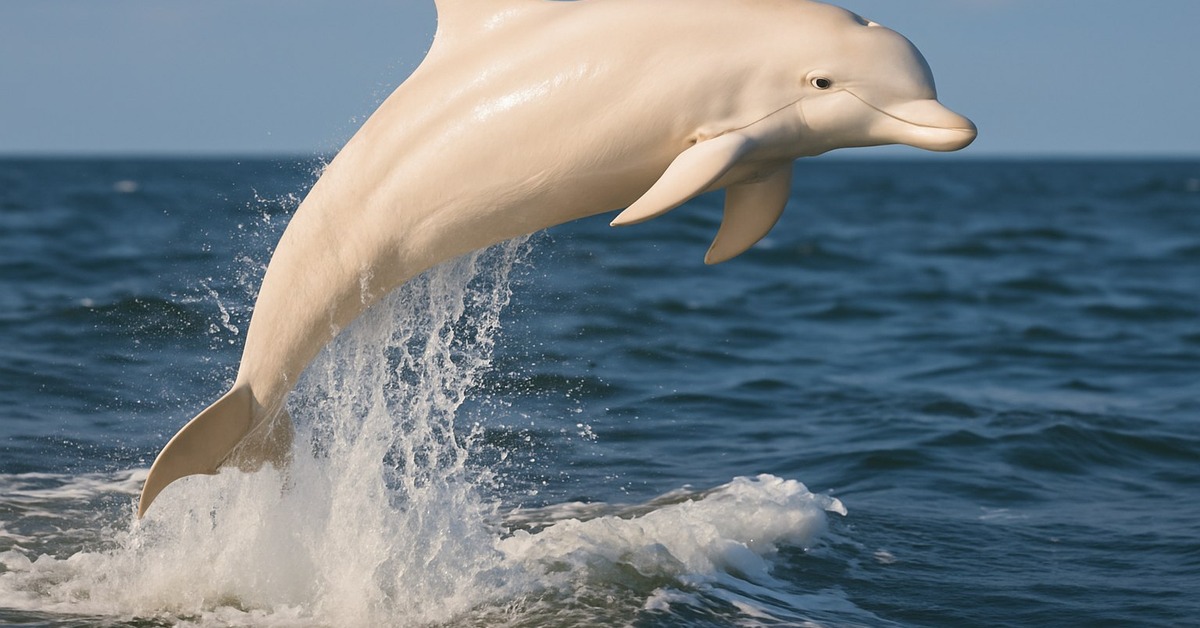
- Albino dolphins don’t always appear pure white. In direct sunlight, blood vessels near the skin surface can give the animal a distinctly pink flush — particularly visible on the rostrum and dorsal fin. This pinkish cast is sometimes the first visual cue researchers notice before confirming full albinism.
- Dolphin pods have been observed in multiple documented cases actively positioning themselves around a visually impaired or unusual individual — a behavior consistent with the coalition-support dynamics described in social cetacean research, which may partially explain how some albino animals reach maturity.
- Researchers still can’t reliably determine from visual observation alone whether a white bottlenose dolphin is truly albino or leucistic — a distinction that requires either a genetic sample or close examination of eye pigmentation. The two conditions carry meaningfully different UV sensitivity profiles, yet most field sightings never yield close enough access for confirmation.
Frequently Asked Questions
Q: How rare is an albino bottlenose dolphin compared to other albino animals?
Genuinely rare — not just unusual. Albino individuals appear across thousands of species, from snakes to deer to peacocks, but in oceanic cetaceans the combination of low base population density, recessive genetics requiring two carrier parents, and the extreme survival pressure on conspicuous individuals keeps documented numbers tiny. Fewer than 10 confirmed or strongly suspected albino bottlenose dolphins appear in the global scientific literature as of 2024. Albino white-tailed deer, by comparison, are estimated to occur at roughly 1 in every 30,000 individuals — still rare, but orders of magnitude more common.
Q: Does albinism affect a dolphin’s ability to echolocate or hunt?
Echolocation itself — the biological sonar that dolphins use to locate prey — is produced by specialized structures in the forehead called the melon and the phonic lips, and doesn’t depend on melanin at all. So an albino bottlenose dolphin’s sonar capability is almost certainly unaffected. Where albinism may create functional challenges is in vision. Melanin contributes to retinal development, and animals with complete albinism often show reduced visual contrast sensitivity in bright light — meaning a strongly lit, shallow-water hunting environment like Chincoteague’s inshore zone could present real perceptual challenges during peak daylight hours.
Q: Can an albino bottlenose dolphin reproduce successfully?
There’s no biological reason albinism would directly prevent reproduction. The mutation affects pigmentation pathways, not reproductive hormones or anatomy. The practical barrier is survival — an animal that’s highly visible to predators, and potentially more vulnerable to UV-related skin damage, faces a steeper road to reproductive age. But “Pinky” in Louisiana appears to have done exactly that. Some researchers who have tracked her believe she may have produced calves, though genetic confirmation is difficult without tissue samples. If an albino dolphin survives long enough to breed, it passes the carrier gene to offspring — silently, invisibly, potentially for generations.
Editor’s Take — Alex Morgan
What strikes me most about this sighting isn’t the animal’s color. It’s the pod around it. We spend a lot of time cataloging what’s wrong with an albino dolphin — the UV risk, the predator visibility, the visual deficits — and almost no time asking what the group does about it. If these animals are genuinely positioning themselves to compensate for an individual’s disadvantage, that’s not just touching. That’s behaviorally complex in a way our models don’t fully account for. The white fin is the story that gets the cameras out. The gray fins around it might be the more important one.
One white dorsal fin in a dark Atlantic chop. It sounds like a simple image — almost cinematic, easy to aestheticize. But pull back far enough and what you’re actually seeing is the full weight of evolutionary pressure made visible. Every adaptation that normally hides this species from its predators, every melanin molecule doing quiet structural work in skin and retina and social camouflage — all of it absent, in a single animal, swimming anyway. The ocean doesn’t offer second chances to the conspicuous. Which makes you wonder: what else has this dolphin figured out that we haven’t noticed yet?