The Ancient Plague That Still Devours Nations in Hours
A square kilometer of desert locusts. Eighty million insects moving as one. They’ll eat what 35,000 people need to survive in a year — and they’ll do it before lunch.
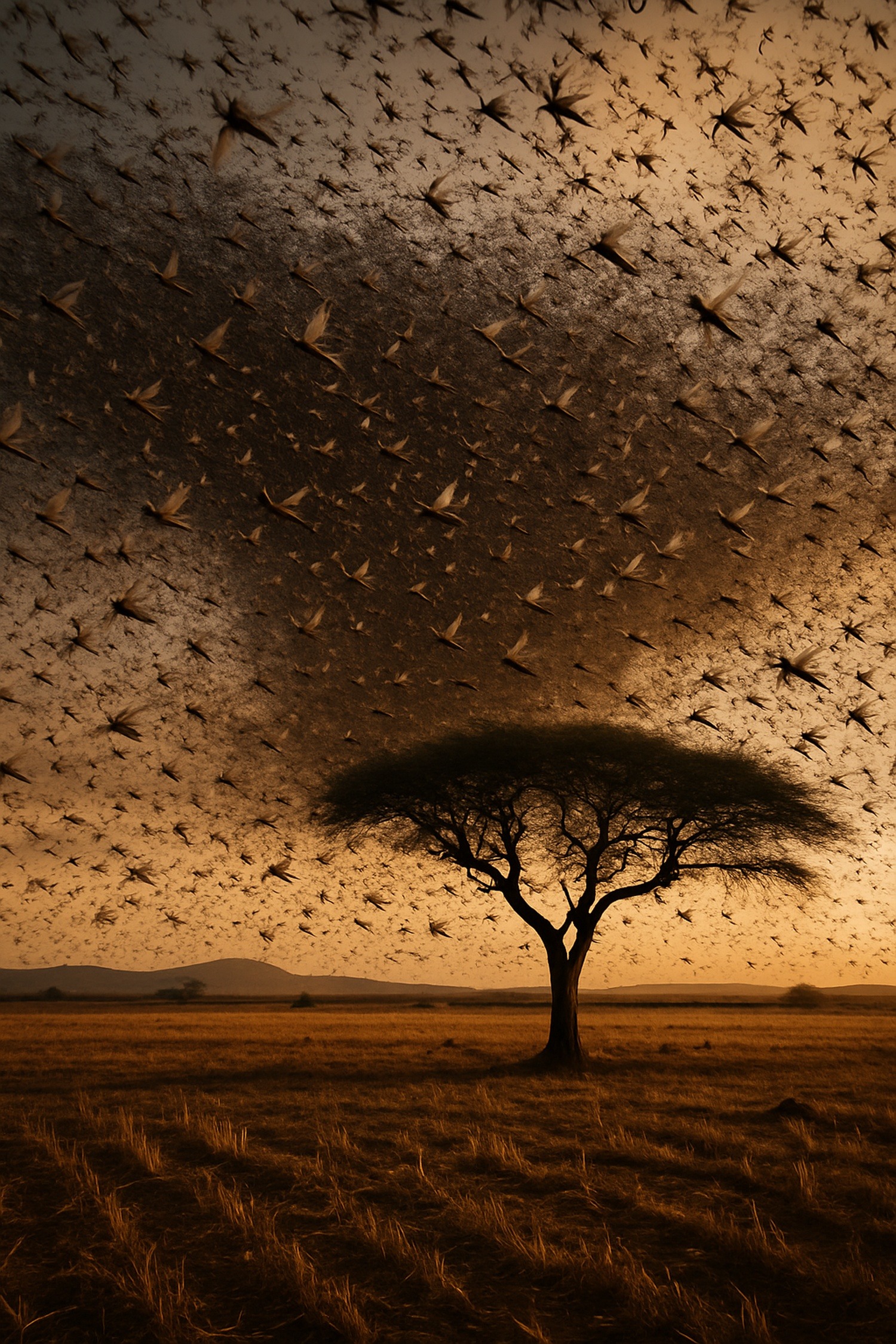
I fell into this research at 2am because I kept seeing the same photo: Kenya, 2020, the sky actually dark in the middle of the day. Not cloudy. Dark. The swarm that did it was the size of Moscow. It wasn’t the largest on record, but it was the worst thing the region had seen since 1950, and it materialized out of nowhere because nobody was watching the right corner of the desert when the rain came.
Key Facts
- A single square kilometer of desert locust swarm can hold around 80 million insects and eat what 35,000 people need to survive in a year.
- One desert locust (Schistocerca gregaria) eats roughly two grams of vegetation a day; within hours of crowding, rising serotonin switches it from a solitary to a gregarious, swarming phase.
- The 2020 East Africa outbreak was Kenya’s worst in 70 years and the worst in 25 years for Ethiopia and Somalia, according to the UN Food and Agriculture Organization.
- Swarms can travel up to 150 kilometers in a single day on wind currents, with densities reaching about 80 million locusts per square kilometer.
- Each locust generation can multiply the population roughly twentyfold, and a generation can complete in well under two months under the right conditions.
In short: Desert locusts are normally shy, solitary insects, but after rain crowds them together, rising serotonin transforms them within hours into swarming, ravenous insects. A single square kilometer holds about 80 million locusts that travel 150 kilometers a day. The 2020 East Africa outbreak was the worst Kenya had seen in 70 years.
Here’s where it gets strange
A single desert locust eats roughly two grams a day. Two grams. By itself, a locust is the least threatening thing in the Sahara. It’s shy. It avoids crowds. It just wants to exist quietly in the desert scrub.
Then the rain comes. Vegetation explodes across normally barren ground. And something switches.
Within hours of touching other locusts — physical contact in these sudden blooms of green, bodies pressing against bodies — their brains flood with serotonin. The same neurotransmitter that makes humans feel less depressed makes locusts transform into gregarious, coordinated, apocalyptically hungry versions of themselves. Schistocerca gregaria doesn’t just change behavior. It changes shape. Its legs elongate. Its color darkens. Its social instincts completely invert. Entomologists have documented this happening in real time — same insect, same species, functionally a different animal.
The weird part? It’s reversible. Isolate a swarming locust from the crowd for long enough, and it slowly reverts back to being solitary. Which means there’s a version of that insect that could have existed peacefully if the rain had never come.
The trigger is touch, not hunger
The detail that took me longest to accept is how trivial the trigger is. It isn’t starvation, or heat, or some grand environmental signal. It’s contact — specifically, repeated brushing against the hind legs. When desert vegetation suddenly thickens after rain, scattered locusts are forced together onto the few green patches, and the sheer crowding means their back legs keep bumping into one another. That mechanical stimulation is the switch.
Researchers studying the closely related migratory locust have traced this to a cascade of brain chemistry, with serotonin rising sharply within a couple of hours of crowding. The insect that walked into the green patch as a wallflower walks out as a joiner. And because the change runs on a neurotransmitter, it can be dialed up by company and dialed back down by solitude — the biology behind that strange reversibility.
This matters far beyond curiosity. If the transformation depends on a known chemical pathway, then in principle it can be interrupted. That single insight — that a plague is a behavioral state rather than a fixed species trait — is why locust science keeps circling back to phase change. Stop the gregarious phase from forming, and you stop the swarm before it has wings. The trouble, as always, is doing that across millions of hectares of empty desert before the green fades and the crowds disperse on their own anyway.
The 2020 outbreak rewrote the geography of hunger
East Africa in early 2020. Kenya: worst outbreak in 70 years. Ethiopia: worst in 25 years. Somalia: worst in 25 years. The UN Food and Agriculture Organization called it historically disorienting, which is bureaucrat-speak for “we haven’t seen this in living memory.”
Satellite data showed swarms stretching across 60 kilometers of sky.
Moving up to 150 kilometers in a single day on wind currents they weren’t navigating — just riding, like they’d been designed for it. (They had. Evolution had designed them for exactly this.)
A farmer in Samburu County, northern Kenya, described it this way: the sound came first. A low, dry rustling that built and built until it was everywhere. Then the sky changed color. Then the swarm landed.
When it lifted again, the field was gone. Not damaged. Gone. The entire year’s work erased in hours.
That last fact kept me reading for another hour straight.
The cruel part
The same rain that saves a farm can, hundreds of kilometers away in some remote breeding zone, quietly set the next swarm in motion. By the time monitoring systems catch it, by the time governments coordinate, by the time spray planes even take off, the swarm has already multiplied three times over. And every multiplication changes the math of what it costs to stop.
Climate change is making this worse.
Warmer Indian Ocean temperatures have been linked to more intense, more unpredictable rainfall across the Horn of Africa. More rain means more breeding cycles. More breeding cycles means more swarms arriving faster, in larger numbers, with fewer windows to intervene. The trap is tightening.
- Peak 2020 swarm consumed daily what 2.5 billion people need annually.
- One hectare of locusts — roughly two and a half football fields — eats as much in one day as 10 elephants. Every single day, they keep eating.
- They travel 150 kilometers per day on wind. Borders don’t stop them. International agreements barely slow them down.
- 80 million locusts per square kilometer.
How a single egg becomes a moving wall
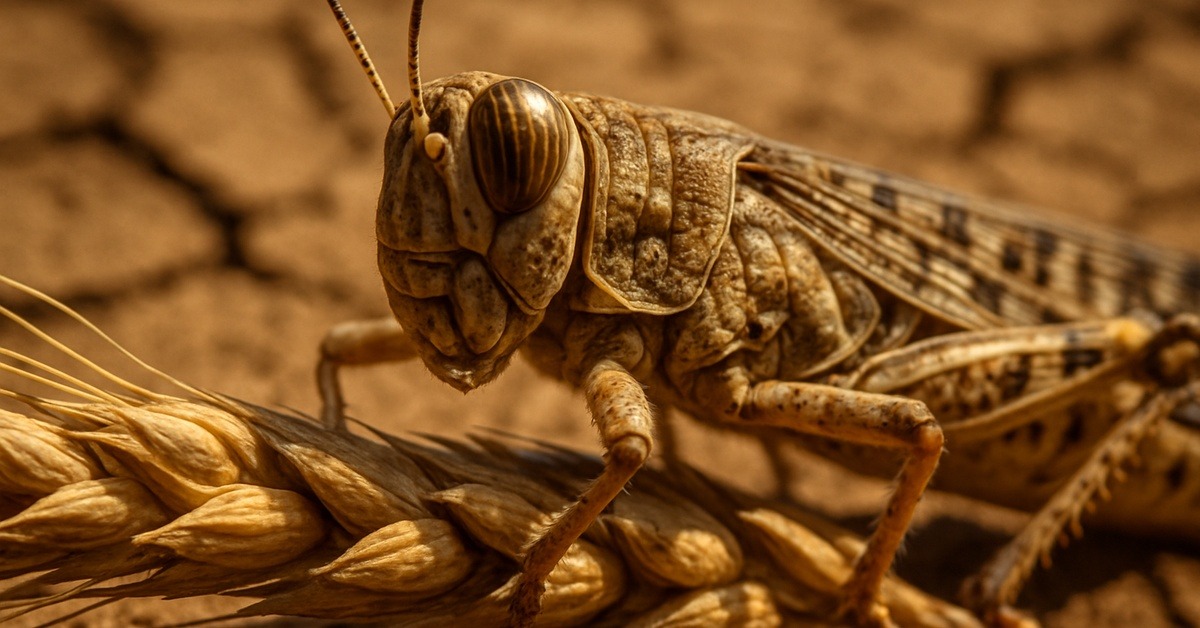
The terrifying math starts underground. A female desert locust lays her eggs in moist sand, depositing dozens in a single pod and, over her life, several pods. Where conditions are right — warm soil, recent rain, fresh vegetation for the hatchlings — a generation can complete in well under two months. Each generation can multiply the population roughly twentyfold. Two or three successful generations in a row, and a quiet corner of desert goes from a scattering of insects to a population in the hundreds of millions.
The young that hatch can’t fly yet. They march. These wingless juveniles, called hoppers, band together into rolling carpets that move across the ground on foot, eating as they go. This is actually the best moment to intervene — the band is concentrated, grounded, and hasn’t yet reached the air. Miss that window, the hoppers molt into winged adults, and the problem leaves the ground for good.
Once airborne, the swarm stops being a local pest and becomes an atmospheric event. It climbs into warm air, catches the prevailing wind, and lets the weather carry it. Crucially, the same low-pressure systems that bring the rains the locusts need also generate the winds that deliver the swarm to fresh feeding grounds. The insect doesn’t have to be clever. The atmosphere does the navigation, dropping the swarm wherever the wind dies down — which tends to be exactly where rain has just fallen and crops are greenest.
Why we still can’t stop them
Here’s the geography problem: breeding zones occupy some of the most remote, under-resourced, conflict-affected land on Earth. The Sahel. The Horn of Africa. The Red Sea coast. The Thar Desert. These aren’t places where spray planes land quickly. Governments don’t coordinate smoothly. A swarm can double in size three separate times before any pesticide hits the air.
The communities at highest risk were already the most food-insecure.
A locust outbreak doesn’t arrive in a vacuum. It hits people who were already counting every harvest, every month, every kilogram. When the swarm lands, it doesn’t just take food. It demolishes the entire survival calculation a family had built their year around. It’s not a setback. It’s a reset.
One insect eating its body weight daily. Multiply that by 80 million. Give them wings. Give them a favorable wind. “Small” stops meaning anything.
The arsenal we actually have
The frontline weapon is still chemistry. Light aircraft fly low over a marching band of hoppers or a settled swarm and lay down a fine mist of insecticide. It works, but it is blunt. The same chemicals that kill locusts can kill bees, beetles, and the birds and lizards that eat the locusts, and spraying across borders means coordinating governments that may not be on speaking terms. Crop loss is visible and immediate; the cost of broadcasting pesticide across fragile drylands is slower and harder to see.
That cost is why the most promising tool of the last few decades isn’t a chemical at all. It’s a fungus. A naturally occurring soil fungus, formulated into an oil-based spray, infects locusts specifically and spares almost everything else. It is slower than a nerve agent — the locusts sicken over days rather than dropping from the sky — but it is selective enough to use near water, livestock, and people, and it can keep killing as infected insects spread spores through the band. For grounded hopper bands in sensitive areas, this biological approach has become a genuine alternative rather than a science-fair curiosity.
And then there is the oldest tool of all: watching. The most cost-effective intervention ever devised against locusts is early detection. A swarm caught as a few hectares of hoppers can be smothered for a tiny fraction of what it costs to chase a thousand-square-kilometer adult swarm across three countries. This is why the FAO runs a permanent Desert Locust Information Service, why field teams trek into breeding zones with GPS and survey forms after every significant rain, and why satellite vegetation maps are scanned for the tell-tale green flush. The whole game is to act during the few weeks when the problem is still small — and to lose as few of those weeks as possible.
We’ve known about this forever
It is 1347 BC. An Egyptian scribe records a locust plague in hieroglyphic script on temple walls. It is 1200 BC. Sanskrit agricultural texts from the Indian subcontinent describe mass swarms stripping harvests across what is now Pakistan. It is somewhere in the Mediterranean, sometime before paper, and the Quran references these swarms as divine punishment. The Book of Exodus names them. Ancient Jewish records describe them. Chinese agricultural texts. Persian medical texts.
Every culture that farmed got devastated by locusts.
The descriptions are nearly identical: sky darkening, sound before sight, fields stripped bare. Not metaphorical. Field reports. Eyewitness accounts separated by thousands of miles and centuries, describing the exact same thing because the exact same thing was happening over and over and over.
These weren’t rare events. They were recurring catastrophes.
What actually happens
- Locusts don’t navigate to food. They ride atmospheric patterns and land where wind stops pushing them, which makes prediction almost impossible even with satellites.
- The shift from solitary to gregarious phase is reversible — a discovery that’s opened entirely new approaches to biological control and chemical intervention.
- Communities across East Africa and the Middle East have eaten locusts during outbreaks for centuries. Nutritionally dense. 75% protein by dry weight. Possibly the most practical response humans have found to the problem.
Why it still matters
It is tempting to file locusts under solved problems — a biblical plague reduced to a footnote by aircraft and satellites. The 2020 outbreak said otherwise. With modern monitoring, modern pesticides, and an international agency dedicated entirely to the threat, the swarms still crossed borders, still stripped fields, and still pushed millions of people deeper into hunger before they could be brought under control.
The deeper lesson is about timing, not technology. The desert locust is a problem of windows: a few weeks between rain and wings, a few hectares before the few thousand square kilometers, a single grounded band before the airborne plague. Almost everything we know how to do works — if it happens early. Almost nothing works once the swarm is up and riding the wind. And the places where those windows open are precisely the places where roads, funding, peace, and coordination are most fragile.
That is why locusts remain a live threat in an age that has, in many ways, conquered famine. They sit at the exact intersection of weather, geography, and human capacity to respond — and a warming climate is widening the gap by handing the insects more rain, more breeding cycles, and shorter windows in which to be caught.
The desert locust has been doing this since before written history. We’ve gotten better at watching it happen. We’re still catching up on stopping it. More research on ancient agricultural collapse and modern food security at this-amazing-world.com.
Frequently Asked Questions
Q: What turns a harmless locust into a swarming plague?
The trigger is physical contact, not hunger. When rain makes desert vegetation thicken, scattered locusts are forced together onto green patches, and repeated brushing against their hind legs floods their brains with serotonin within a couple of hours. This switches Schistocerca gregaria from a shy, solitary insect into a gregarious, coordinated swarmer. The change is even reversible: isolate a swarming locust and it slowly reverts to its solitary form.
Q: How much can a locust swarm eat?
A single desert locust eats only about two grams a day, but the numbers are staggering. A square kilometer of swarm holds roughly 80 million insects and can eat what 35,000 people need in a year. At peak in 2020, swarms consumed daily what billions of people need annually. One hectare of locusts eats as much in a day as about ten elephants.
Q: Why was the 2020 locust outbreak so severe?
Early 2020 brought East Africa its worst locust outbreak in decades — the worst in 70 years for Kenya and 25 years for Ethiopia and Somalia, according to the UN Food and Agriculture Organization. Swarms stretched across 60 kilometers of sky and moved up to 150 kilometers a day on the wind. Warmer Indian Ocean temperatures linked to heavier rainfall fueled more breeding cycles and faster-arriving swarms.
Q: How fast do locust populations grow?
Explosively. A female lays her eggs in moist sand in pods, and where soil, rain and vegetation are favorable a generation can complete in well under two months. Each generation can multiply the population roughly twentyfold. Two or three successful generations in a row can turn a quiet corner of desert into hundreds of millions of insects, often before monitoring systems and spray planes can respond.
Illustrations are AI-generated. Article fact-checked and human-edited.