Do Cats Protect Their Owners? What the Science Says
Do cats protect their owners? The question sounds sentimental until you watch one closely. A cat that monitors your breathing while you sleep, that stations itself in the doorway, that stays glued to you when you’re ill, isn’t being random. It’s running an old behavioral script, and science is finally catching up to it.
For decades the house cat carried a reputation as the aloof opportunist of the animal world, a creature that tolerated us for the food. Then animal behaviorists started actually recording what cats do when they aren’t eating or knocking mugs off shelves. What surfaced was quietly humbling. Many domestic cats direct caretaking behaviors at their humans that mirror the instincts they use with their own kittens. So which is true, the indifferent predator or the small attentive guardian?
Key Facts
- The domestic cat shares roughly 95.6% of its DNA with the wild African wildcat, its solitary ancestor.
- Ethologists describe care for non-offspring as alloparenting, documented in lions, elephants, and wolves.
- A 2020 study at the University of Sussex confirmed the slow blink as a genuine signal of trust between cats and people.
- Cats were first domesticated around 10,000 years ago in the Near East, alongside early farming.
- Studies find many cats form secure attachment bonds with their owners, comparable to those seen in dogs and infants.
In short: Do cats protect their owners? Behavioral research suggests many do display protective and caretaking behavior, including guarding doorways, staying close during illness, and signalling trust through the slow blink. These actions echo the alloparenting instincts cats use with their young, reframing the bond as far more attentive than the aloof stereotype allows.
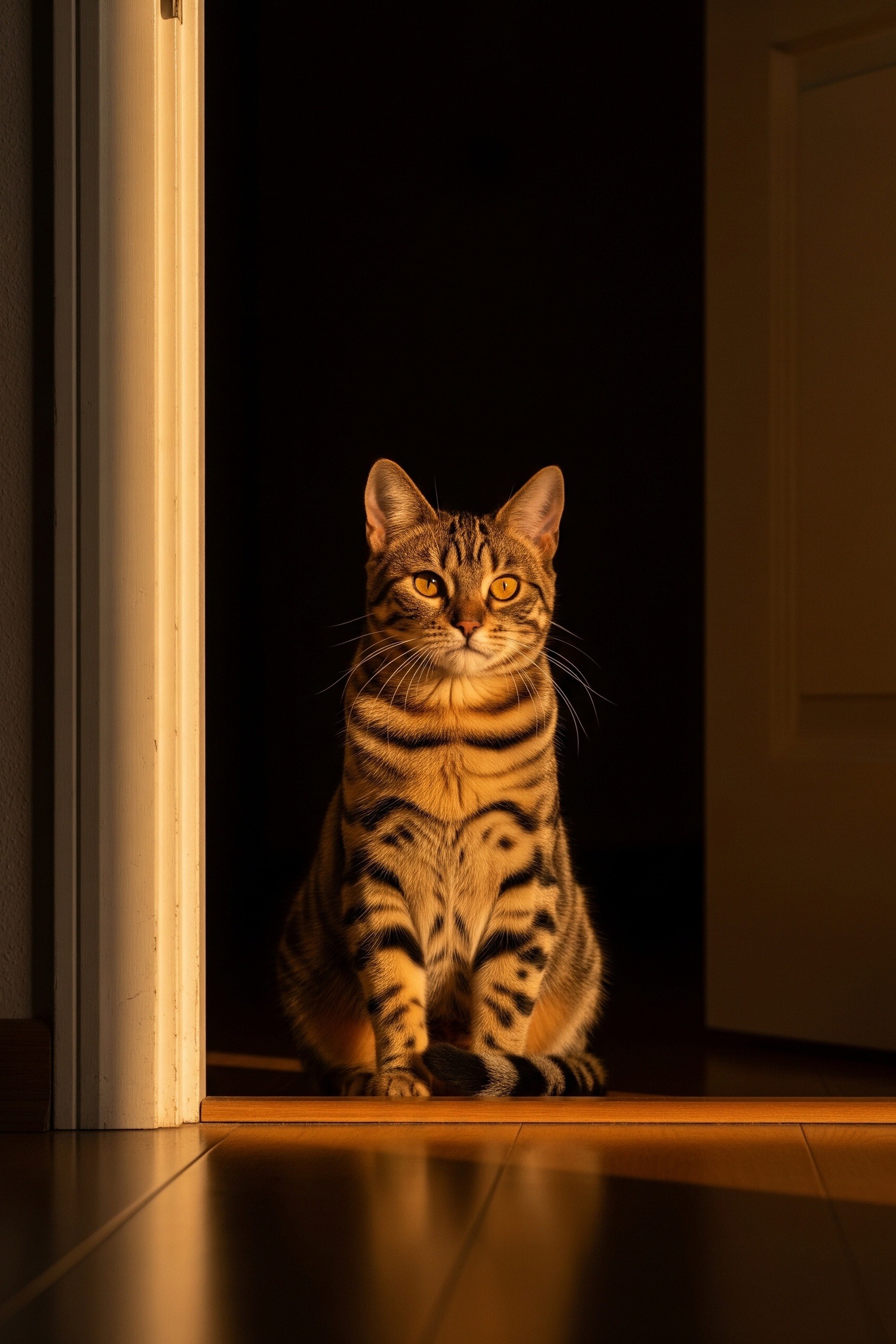
What does cat caretaking behavior actually look like?
It starts with proximity. Researchers studying companion animals, including work led by Dr. Kristyn Vitale at Oregon State University in 2019, have documented that cats actively seek closeness to their owners and behave differently when those owners are present. A cat that follows you room to room, parks itself at the threshold, or settles where it can watch you sleep is displaying the same vigilance a mother cat shows toward a litter. The instinct doesn’t switch off; it gets redirected. The roots of this trace back to the African wildcat, the solitary hunter from which every house cat descends.
The behaviors are specific, not vague affection, and that specificity is what marks genuine cat caretaking behavior. Monitoring breathing during sleep. Positioning at doorways like a small sentinel. Increased attentiveness when a person is sick or distressed. None of it proves a cat consciously “decides” to guard you, but the pattern is consistent enough that ethologists treat it as a real behavioral category rather than wishful projection by owners. The same researchers caution against over-reading it, too; a cat at your bedside is also conserving warmth and claiming a safe resting spot, and the science doesn’t pretend to untangle every motive.
What tips the balance toward genuine caretaking is selectivity. A cat that monitors one household member more closely during illness, or that changes its routine when a person’s behavior changes, is responding to the individual rather than the furniture. That responsiveness, repeated across thousands of documented households, is harder to dismiss than any single anecdote. It’s the consistency, not the sweetness, that convinces the ethologists.
Watch the doorway. That’s where the guarding instinct shows itself first.
The slow blink, decoded
The most studied signal in the feline repertoire is the slow blink, and it turns out to mean something precise. When a cat looks at you, narrows its eyes, and slowly closes them, it isn’t drowsy or bored. A 2020 study published in Scientific Reports by researchers at the University of Sussex and the University of Portsmouth found that slow blinking functions as a voluntary signal of trust and reduced threat, and that cats are more likely to approach a human who slow-blinks back. You can find more surprising animal behavior stories built on exactly this kind of careful observation.
Here’s the thing: cats rarely offer this signal to each other, let alone to another species. In feline body language, a direct unblinking stare is a threat. By half-closing its eyes in your presence, a cat is broadcasting that it feels safe enough to lower its guard. The mechanism is the inverse of aggression, a deliberate dial-down of vigilance, performed only when the animal has decided the company is trustworthy.
Blink slowly at your cat. More often than not, you’ll get the same answer back.
Why a solitary hunter would bother guarding you at all
The puzzle deepens when you consider the cat’s ancestry. The African wildcat is a solitary apex hunter that answers to no one and raises its young alone. A 2007 genetics study, reported by the National Geographic among others, traced all domestic cats to this single lineage in the Near East. So caretaking toward humans isn’t an ancient pack instinct the way it is in wolves. It’s something stranger, an old maternal program rerouted toward a species the cat never evolved to live with.
Ethologists call the broader phenomenon alloparenting, the care of individuals outside one’s own offspring, and it appears across the animal kingdom in lions, elephants, and wolves. In cats it seems to attach to the household. The four-kilogram tabby asleep on your bed retains the genome of a desert killer, yet it has folded you into the small circle of things it watches over. That contradiction is the real story.
Domestication likely did the rerouting. Unlike dogs, which humans bred deliberately over millennia, cats are widely thought to have semi-domesticated themselves, drawn to the rodents that swarmed the first grain stores of the Near East roughly ten thousand years ago. The tamer, more tolerant animals stayed close and thrived. Over hundreds of generations, that tolerance edged into something like attachment, the maternal circuitry of a solitary hunter quietly widening to include the strange upright creatures who controlled the food.
The hunter didn’t lose its instincts. It pointed them somewhere new.
Do cats protect their owners, or just tolerate us?
The deepest evidence comes from attachment science. In a 2019 study at Oregon State University, researchers adapted the “strange situation” test long used on human infants and dogs, and found that the majority of cats formed secure attachment bonds with their owners. Secure cats used the owner as a base of safety, exploring confidently when present and seeking reassurance on return. The proportion roughly matched figures seen in human babies.
Cause and effect line up cleanly. A cat that feels securely bonded shows more of the guarding and proximity behaviors, more cat caretaking behavior overall; an insecurely bonded one shows fewer. The attachment isn’t a metaphor owners invent, it’s a measurable behavioral state with predictable outputs. And it directly contradicts the centuries-old assumption that cats merely tolerate us as a reliable food source rather than a relationship. The same framework, borrowed wholesale from developmental psychology, now lets researchers compare feline bonds directly against those of dogs and human infants, and the cat holds its own in the comparison far better than its reputation would suggest.
Researchers now use these tests to assess feline welfare, treating the human-cat bond as data rather than anecdote.
Where to See This
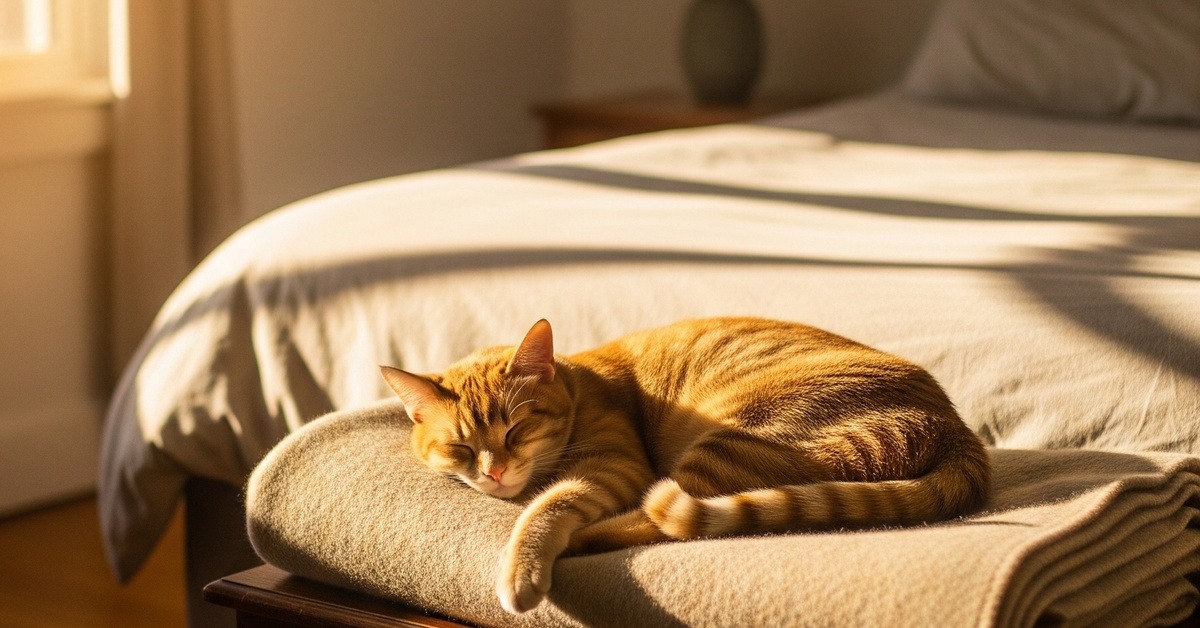
- Your own home, observed at night, where doorway-guarding and sleep-monitoring behaviors are easiest to notice.
- Feline behavior research groups such as those at Oregon State University and the University of Sussex study these patterns formally.
- A practical tip: try a slow blink at your cat and wait, a returned blink is a genuine trust signal you can test tonight.
By the Numbers
- 95.6% — the share of DNA the domestic cat shares with the African wildcat.
- ~10,000 years — how long ago cats were first domesticated in the Near East.
- 2020 — the year the University of Sussex slow-blink study was published in Scientific Reports.
- ~65% — the share of cats showing secure attachment in the 2019 Oregon State study, close to the human-infant rate.
- 4 kg — the typical weight of the household guardian descended from a desert predator.
Field Notes
- The 2019 attachment study found a cat’s bond style stayed stable when retested a year later, suggesting it’s a trait rather than a mood.
- A direct, unblinking stare from a cat is the opposite of the slow blink, in feline language it reads as a threat or challenge.
- Alloparenting, the care of others’ young, also explains why some cats adopt orphaned kittens of entirely different litters and even other species.
- Researchers still can’t fully explain why some cats guard owners intensely while littermates raised identically barely engage, a question of individual personality science hasn’t cracked.
Frequently Asked Questions
Q: Do cats protect their owners the way dogs do?
Not in the same overt way, but cat caretaking behavior is real and documented. Cats tend to guard through vigilance rather than confrontation, monitoring doorways, staying close during illness, and watching while you sleep. A 2019 Oregon State University study found most cats form secure attachment bonds with their owners. The protection is subtle and observational, rooted in the same instincts a mother cat uses with kittens, rather than the territorial defense seen in dogs.
Q: What does it mean when my cat slow-blinks at me?
A slow blink is a deliberate signal of trust and reduced threat. A 2020 University of Sussex study confirmed that when a cat narrows its eyes and slowly closes them at you, it’s communicating that it feels safe and unthreatened. Cats rarely offer this to each other, and almost never to a perceived threat. Slow-blinking back has been shown to make cats more likely to approach you, so it works as a two-way signal.
Q: Why would a solitary animal show caretaking behavior at all?
Because the instinct already existed and simply got redirected. The domestic cat descends from the solitary African wildcat, sharing 95.6% of its DNA, yet domestication over roughly 10,000 years rerouted its maternal caretaking instincts toward the household. Ethologists call caring for non-offspring alloparenting, a behavior also seen in lions and elephants. The cat didn’t evolve to live with humans, so it folds us into an older program built for protecting its own young.
Q: How do scientists actually measure whether a cat is attached to me?
They adapt the “strange situation” test first used on human infants. In a 2019 Oregon State University experiment, cats were observed with and without their owners in an unfamiliar room. Securely attached cats used the owner as a safe base, exploring when present and seeking reassurance on return. About 65% of cats showed secure attachment, a figure remarkably close to the rate measured in human babies. The bond style stayed consistent on retesting.
Editor’s Take — Sarah Blake
The temptation is to read all this as proof that cats secretly love us, and maybe they do. But the more interesting verdict is colder and stranger. A solitary desert hunter took an instinct built to protect its own kittens and, over ten thousand years, pointed it at a species it never evolved beside. The cat didn’t soften. It repurposed. That’s not affection in the human sense. It’s something older, and harder to flatter.
Somewhere in your home tonight, a small amber-eyed animal with the genome of a desert killer is watching the door while you sleep. It chose that post. Nobody trained it to. The slow blink it gives you across the room is the closest thing in its language to lowering a weapon. We needed laboratories and attachment tests to understand what was happening. The cat, it turns out, understood it all along. What does it say about us that we required the science?
Illustrations are AI-generated. Article fact-checked and human-edited.