El Castillo Hand Stencils: Did Neanderthals Paint Them?
You have almost certainly read the headline version of the El Castillo cave hand stencils and the Neanderthal story: that our vanished cousins pressed their palms to a Spanish cave wall and blew red paint around them, tens of thousands of years before the first modern humans reached Europe. It is a beautiful claim. It is also half-true, half-tangled, and quietly disputed by working scientists in a way that almost no popular article bothers to show you. The real story is stranger — and more honest — than the tidy one.
Key Facts
- El Castillo cave sits in Cantabria, northern Spain, and is UNESCO-listed among the finest Paleolithic art on Earth
- The 2012 study led by Alistair Pike of the University of Bristol dated an El Castillo red disk to a minimum of 40,800 years and its hand stencils to a minimum of 37,300 years
- The 2018 study led by Dirk Hoffmann of the Max Planck Institute reported minimum ages north of 64,000 years at La Pasiega, Maltravieso and Ardales, including a Maltravieso hand stencil at least 66,700 years old
- Uranium-thorium (U-Th) dating measures calcite crust that formed over the paint, giving only a minimum age for the art beneath
- Homo sapiens arrived in Europe roughly 42,000 to 45,000 years ago, while Neanderthals vanished around 40,000 years ago
In short: El Castillo’s hand stencils were dated to a minimum of 37,300 years by Pike’s 2012 Bristol team, while Hoffmann’s 2018 Max Planck study dated a separate Maltravieso stencil to at least 66,700 years. The 66,700-year figure, older than modern humans in Europe, implies Neanderthal authorship but is contested by critics questioning the U-Th dating method.
The claim you’ve probably heard about the El Castillo cave hand stencils and Neanderthals

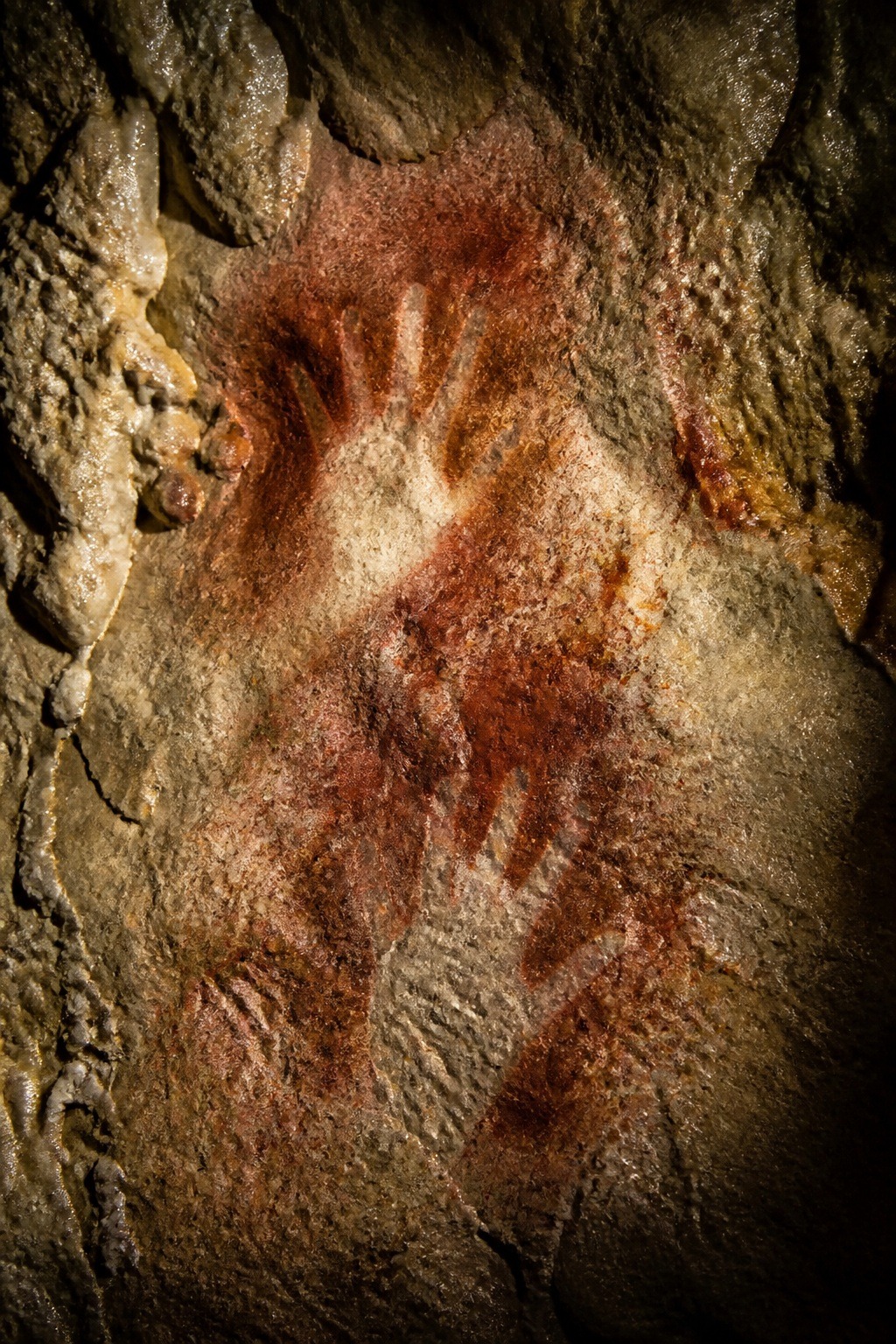
El Castillo sits in the green hills of Cantabria, in northern Spain, one of a cluster of decorated caves so important that UNESCO lists them among the finest Paleolithic art on Earth. Walk deep enough inside and the wall carries hands — dozens of them — rendered in a strange negative. Not painted hands, but the ghost-shapes left around hands. A stencil.
The technique is disarmingly simple. Someone placed a hand flat against the rock, took a mouthful of red ochre pigment mixed with water or spit, and sprayed it — by mouth, or through a hollow bone or reed — so the color settled everywhere except under the fingers. Lift the hand away and its exact outline stays behind, pale rock ringed in red. It is one of the oldest artistic gestures we know of, and it turns up on cave walls from Spain to Sulawesi.
Here’s the claim that made El Castillo famous: some of that art is old enough — older than any modern human presence in Europe — that only Neanderthals could have made it. If true, it rewrites who we thought was capable of symbolism. But before you accept it, you have to untangle two numbers that get shuffled together almost everywhere.
Two numbers, two studies — and why nearly everyone conflates them
Ask most people for “the date” of the El Castillo art and you’ll get one figure, confidently wrong in its precision. There are actually two separate studies, two different sets of caves, and two headline numbers doing very different jobs.
In 2012, a team led by archaeologist Alistair Pike of the University of Bristol dated art in eleven Spanish caves. At El Castillo itself, a simple red disk came back at a minimum of 40,800 years old, and the famous hand stencils at a minimum of 37,300 years. That already made them the oldest dated cave art in Europe — brushing right up against the moment modern humans arrived.
Then, in 2018, a different team led by Dirk Hoffmann of the Max Planck Institute for Evolutionary Anthropology went further. At three other Iberian caves — La Pasiega, Maltravieso, and Ardales — they reported minimum ages north of 64,000 years, including a hand stencil at Maltravieso dated to at least 66,700 years. That is the number that broke the internet. And here is the confusion the top search results never clear up: the 66,700-year stencil is not at El Castillo. It’s at Maltravieso, hundreds of kilometers away.
| Study | Cave(s) | Headline minimum age | Dated by |
|---|---|---|---|
| Pike et al., 2012 (Bristol) | El Castillo, Cantabria | Red disk 40,800 yr; hand stencils 37,300 yr | U-series on calcite over paint |
| Hoffmann et al., 2018 (Max Planck) | La Pasiega, Maltravieso, Ardales | 64,800–66,700 yr (Maltravieso hand stencil 66,700) | U-Th on calcite crust over paint |
{IMAGE_2}
How do you date a painting you’re not allowed to touch?
This is the single most misunderstood point in the whole debate, so slow down here. You cannot carbon-date red ochre. Ochre is iron oxide — a mineral — and it contains no organic carbon to measure. So how do you put a year on it?
You don’t date the paint. You date the rock that grew on top of it.
Caves breathe water, and that water carries dissolved calcite. Over millennia it lays down thin, glassy crusts — the same stuff as stalactites — and where a crust has formed over a painted surface, it acts like a lid sealing a jar. That calcite contains traces of uranium, which decays into thorium at a known, clockwork rate. Measure the ratio of uranium to thorium (the method is called uranium-thorium, or U-Th, dating) and you learn how long ago the crust formed. Because the crust grew after the paint, its age gives a minimum age for the art beneath — the painting is at least that old, and possibly much older. That word “minimum” does a lot of quiet work, and forgetting it is how people mangle these headlines.
Why the finger points at Neanderthals
Now the arithmetic that made archaeologists sit up. The current evidence places the arrival of Homo sapiens in Europe at roughly 42,000 to 45,000 years ago. If a painting has a minimum age of 64,800 years — as the 2018 study argues for La Pasiega — then it was already on the wall some 20,000 years before any modern human could have lifted a brush.
Subtract the one species that wasn’t there yet, and you’re left with the one that was: Homo neanderthalensis. Neanderthals lived across Ice Age Europe for hundreds of thousands of years and vanished only around 40,000 years ago. On the 2018 dates, they are the only candidate authors of the oldest Iberian art.
That matters far beyond cave decoration. For a century Neanderthals were cast as brutish dead-ends. Symbolic behavior — making a mark that stands for something, purely to mean rather than to use — was supposed to be the bright line that separated us from them. If Neanderthals were blowing pigment around their hands, that line dissolves.
Not so fast — the scientists who say the dates are wrong
This is the part almost every article, video, and museum placard leaves out, and it’s the most interesting part. The Neanderthal claim is not settled. It is actively, pointedly contested by other researchers — and their objection is technical, not stubborn.
Remember that calcite crust, the sealed lid? The whole method assumes it stays sealed — a “closed system” where no uranium washes in or out after it forms. Critics led by Ludovic Slimak and, separately, geochemist Edwige Pons-Branchu argue that in real caves the lid leaks. Water trickling over the rock can carry uranium out of the crust over time. Strip uranium away and the sample looks like it has been decaying for longer than it really has — which makes it read as older than it is.
Pons-Branchu’s team pointed to Spain’s Nerja cave, where they found direct evidence of exactly this kind of open-system behavior in the carbonate. Slimak’s group put the objection bluntly in a 2018 paper whose title says it all: “Still no archaeological evidence that Neanderthals created Iberian cave art.” Their case is that if the crusts have leaked, the true ages could fall tens of thousands of years younger — back within the reach of modern humans, and the Neanderthal headline evaporates.
Hoffmann’s team has pushed back, defending their sampling and their closed-system checks. If you ask me where the honest position sits, it isn’t with either camp’s press release — it’s in the uncomfortable middle, where the dates are genuinely provocative and genuinely not yet proven, and any article that hands you a single tidy answer is selling a certainty the science has not earned.
Why blow paint around your hand at all?
Step back from the dating fight and a more human question remains. Why would anyone — Neanderthal or modern human — do this? What is a hand stencil for?
Honestly, nobody knows, and anyone who tells you otherwise is guessing. But there are thoughtful guesses. The most intuitive is identity: a hand is the most personal signature there is, a way of saying I was here, this is me. Others read the stencils as ritual — hands laid on the living rock as a gesture toward whatever lay behind it. Some see communication or record-keeping, a tally in a place returned to again and again.
And a quieter possibility that changes the whole mood: at several stencil sites, including some in France and Spain, the hands are strikingly small. Measurements suggest a number of them belonged to women and children. The image shifts from a lone shaman to something closer to a family, taking turns pressing their hands to a wall by firelight — a scene that feels less like sorcery and more like belonging.
The bigger picture — La Roche-Cotard and a smarter Neanderthal
If El Castillo’s dates stood alone, skepticism would be the safe bet. They don’t stand alone anymore, and that’s the arc most coverage misses.
In 2023, researchers at the University of Tours, publishing in the journal PLOS ONE, described finger-traced engravings on the walls of La Roche-Cotard cave in France’s Loire Valley — deliberate patterns dragged into soft rock by human fingers. What makes them almost unarguable is the cave itself: it was completely sealed by sediment around 57,000 years ago, dated by optically stimulated luminescence, and stayed buried until modern times. Nobody could have sneaked in after modern humans arrived. The markings are Neanderthal by geological default, no contested crust required.
Put the pieces together and the picture stops looking like one shaky Spanish result. It looks like a pattern: Neanderthals making marks in France, decorating shells, using ochre, arranging stalagmite rings deep in Bruniquel Cave 176,000 years ago. Nearby, the last Neanderthals lingered in southern Iberia — and if you want to see how long they held on at the very edge of Europe, the story of the last Neanderthals who hid in a Gibraltar cave shows just how deep into our own timeline they survived. El Castillo may be disputed, but it no longer looks like a fluke.
Myths vs. the evidence
A quick reckoning, because the folklore around this topic runs well ahead of the facts.
Myth: “The El Castillo hand stencils are 66,700 years old.”
Evidence: El Castillo’s stencils have a minimum age of ~37,300 years (Pike 2012). The 66,700-year stencil is at Maltravieso, a different cave (Hoffmann 2018). Two caves, two numbers, routinely mixed up.
Myth: “Scientists carbon-dated the cave paintings.”
Evidence: Ochre can’t be carbon-dated. Researchers used uranium-thorium dating on the calcite crust over the paint, which gives a minimum age, not the exact age.
Myth: “It’s proven that Neanderthals made this art.”
Evidence: The Iberian dates are seriously contested (Slimak; Pons-Branchu’s open-system critique at Nerja). Strong, provocative, not settled.
Myth: “Neanderthals had no symbolic culture at all.”
Evidence: Independent finds — La Roche-Cotard’s sealed 57,000-year engravings, Bruniquel’s structures, ochre and shell use — increasingly say otherwise.
Sources and notes
- Pike, A.W.G. et al. (2012), “U-Series Dating of Paleolithic Art in 11 Caves in Spain,” Science — University of Bristol.
- Hoffmann, D.L. et al. (2018), “U-Th dating of carbonate crusts reveals Neandertal origin of Iberian cave art,” Science — Max Planck Institute for Evolutionary Anthropology & University of Southampton.
- Slimak, L. et al. (2018), “Still no archaeological evidence that Neanderthals created Iberian cave art,” Journal of Human Evolution.
- Pons-Branchu, E. et al. (2020), U-series study at Nerja cave on open-system behavior, Quaternary Science Reviews.
- Marquet, J.-C. et al. (2023), “The earliest unambiguous Neanderthal engravings… La Roche-Cotard,” PLOS ONE — University of Tours; reporting by the Natural History Museum, London.
Bottom line: The El Castillo cave hand stencils and the Neanderthal question aren’t a solved fact but a live, well-argued dispute — the dates are genuinely old enough to point at Neanderthals, and genuinely uncertain enough that careful scientists still disagree. Keep the two numbers straight (37,300 at El Castillo, 66,700 at Maltravieso), remember you’re dating the crust and not the paint, and you already understand this story better than most of the internet does.
Whoever pressed a hand to that cold Cantabrian wall and breathed red pigment around it left the simplest possible message — I was here — and tens of thousands of years later we’re still standing in front of it, arguing about who “I” was. That argument isn’t a failure of the science. It’s the sound of a species learning, in real time, that we may not have been the first to make a mark that meant something.
Frequently Asked Questions
Q: How old are the El Castillo hand stencils?
The 2012 study led by Alistair Pike of the University of Bristol dated the famous El Castillo hand stencils to a minimum of 37,300 years, and a nearby red disk to a minimum of 40,800 years. These figures made them the oldest dated cave art in Europe at the time. The word minimum matters: uranium-thorium dating gives the age of a calcite crust over the paint, so the art is at least that old and possibly older.
Q: Why is the 66,700-year age often linked to El Castillo?
It is a common conflation. The 66,700-year hand stencil is not at El Castillo. It comes from Maltravieso, hundreds of kilometers away, and was reported in the 2018 study led by Dirk Hoffmann of the Max Planck Institute, alongside dates north of 64,000 years at La Pasiega and Ardales. Popular articles frequently shuffle these two separate studies and caves together, attributing the record Maltravieso figure to El Castillo instead.
Q: How do scientists date cave paintings made of red ochre?
You cannot carbon-date red ochre because it is iron oxide, a mineral containing no organic carbon. Instead, scientists date the calcite crust that grows over the paint. Cave water deposits thin calcite layers containing uranium, which decays into thorium at a known rate. Measuring the uranium-to-thorium ratio (uranium-thorium, or U-Th, dating) reveals when the crust formed. Because the crust grew after the paint, its age gives a minimum age for the art beneath.
Q: Why do the dates point to Neanderthals?
Homo sapiens arrived in Europe roughly 42,000 to 45,000 years ago. If a painting has a minimum age of 64,800 years, as the 2018 study argues for La Pasiega, it was on the wall some 20,000 years before any modern human could have made it. Neanderthals, who lived across Ice Age Europe until around 40,000 years ago, become the only candidate authors. The claim remains contested, with critics led by Ludovic Slimak questioning the dating method.
Illustrations are AI-generated. Article fact-checked and human-edited. Our editorial standards.