The Fiery-billed Araçari: Beauty, Brutality & Bold Bills
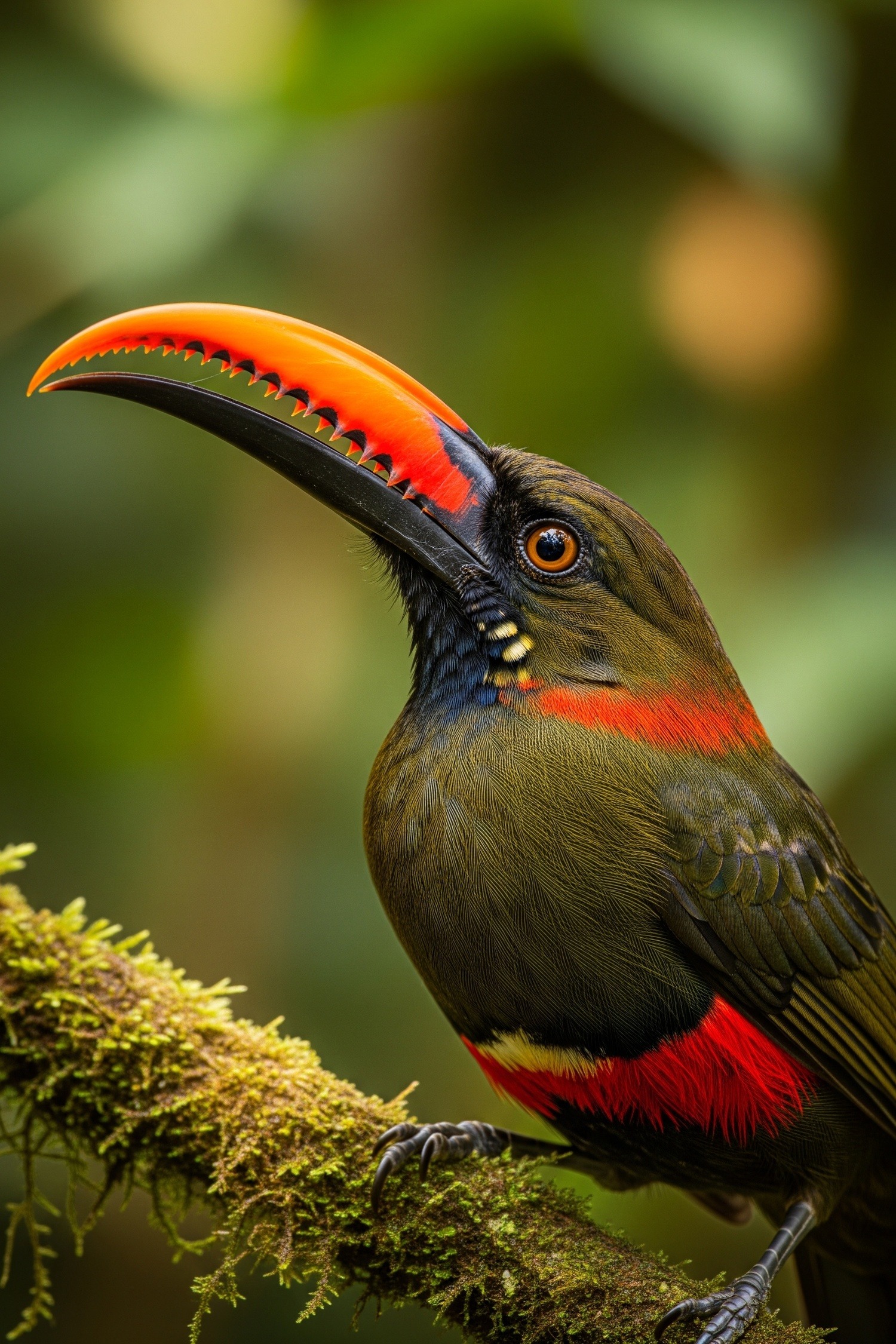
You’re standing under a fruiting fig at dawn on Costa Rica’s Osa Peninsula when the bill catches the light—and suddenly a piece of the sunrise appears to be eating fruit. That’s the Fiery-billed Araçari, and nothing about it follows the script you’d expect from a bird that spends half its time stealing the homes and nestlings of other species. The species name is *Pteroglossus frantzii*, but what matters is what you see: a medium-sized toucan relative that looks like someone designed a bird to be as visually aggressive as possible, then added a serrated bill and called it done.
Deep in the humid lowland forests along Costa Rica’s Pacific slope, the Araçari goes about its business with a single-minded efficiency. Fruit, mostly—canopy species like Heliconia, Cecropia, figs. Insects when they’re available. And when the opportunity presents itself, eggs and live nestlings emptied from active woodpecker nests, followed by a move into the newly vacant cavity. This is not a bird you’d expect to fear. But the forest does. Because every time you look closer at what the Araçari actually does, it gets stranger.
Key Facts
- The Fiery-billed Araçari (Pteroglossus frantzii) measures about 43 cm from bill-tip to tail, with the bill making up roughly a third of that length.
- It lives in humid lowland forests along Costa Rica’s Pacific slope, including the Osa Peninsula, running roughly from the Tárcoles River southward.
- It is a cooperative breeder: three to five adults may share a single tree cavity to incubate eggs and raise chicks together.
- It raids active nests of Hoffmann’s woodpecker (Melanerpes hoffmannii), eating eggs and nestlings before occupying the vacated cavity.
- Nest-raiding peaks during its own breeding season, roughly March through June, when competition for cavities is highest.
In short: The Fiery-billed Araçari is a Costa Rican toucan relative about 43 cm long, named for its serrated orange-red-to-crimson bill. It feeds mainly on canopy fruit but also raids active woodpecker nests, eating eggs and nestlings. Despite this, three to five adults cooperatively share a single tree cavity to raise young.
The Bill That Started the Fiery-billed Araçari’s Reputation
There’s a reason ornithologists keep reaching for superlatives when describing this bird. Roughly a third of its body length is dedicated to the bill alone. On adults that typically measure around 43 centimeters from bill-tip to tail, that’s substantial real estate. The upper mandible blazes orange-red at its base, transitions through yellow, and terminates in a sharp crimson tip. Below it: pure black. But the edge—and this is the detail that earns the name—is serrated, jagged, tooth-like, and deeply unsettling the first time you see it up close.
According to studies catalogued at the Ramphastidae family’s evolutionary record, toucan bills are primarily hollow—keratin and bone structured around air spaces that function as thermoregulation organs, radiating heat away from the bird’s core. Function follows form. But form in this case went wildly, gloriously overboard.
What the Smithsonian Tropical Research Institute has noted in its Central American bird work is how that coloration likely functions as a species recognition signal. Araçaris are visually busy birds in visually busy forests, and standing out matters. The male’s bill is slightly brighter than the female’s. Both sexes carry the same general palette. They don’t need gender to be their headline.
The headline is the bill, full stop.
Stand near a fruiting tree at dawn on the Osa Peninsula, and you’ll hear them before you see them—a rapid, nasal yelping, almost mechanical, from somewhere up in the canopy. Then the bill catches the light.
The Cooperative Nest Thief With a Contradiction Problem
Here’s where the story gets genuinely strange. Multiple adults—sometimes three, four, or even five individuals—share a single tree cavity to incubate eggs and raise chicks together. The Fiery-billed Araçari is, by any behavioral definition, a cooperative breeder. The communal roost, used year-round in some territories, is typically an old woodpecker hole. They pile in together at night, bills tucked under wings, bodies pressed against each other in a hollow they didn’t carve.
This isn’t unusual among toucans. If you’ve ever been curious about how beak size and nesting strategy co-evolved in this family, the evolution of the keel-billed toucan’s extraordinary beak covers exactly that territory. The parallels to the Araçari are striking. Cooperative nesting in both species points to the same evolutionary pressure: scarce, high-quality nest cavities in competitive forest environments.
But here’s the paradox that makes behavioral ecologists pause. The Araçari doesn’t just use old woodpecker holes. It actively raids active woodpecker nests.
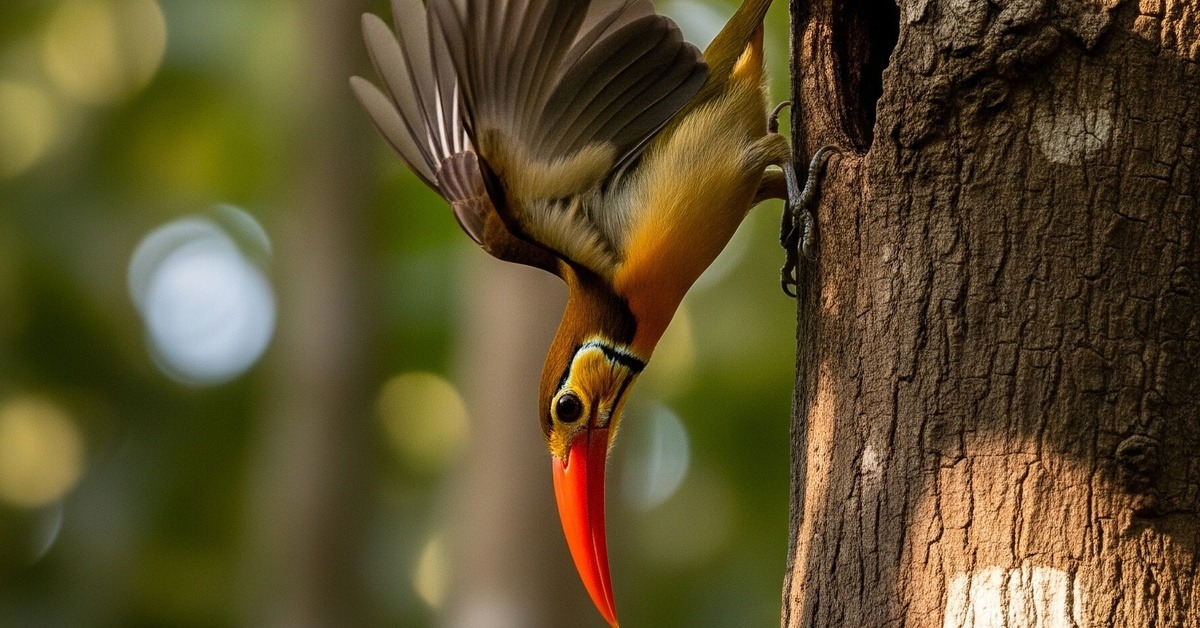
It consumes eggs and live nestlings before occupying the vacated cavity. Researchers at the Universidad de Costa Rica have documented nest predation events targeting Hoffmann’s woodpeckers (*Melanerpes hoffmannii*), a species that shares its lowland Pacific habitat. The Araçari arrives in a small flock, overwhelms the nest site by sheer presence, and the cavity changes ownership within minutes. It’s efficient. It’s brutal. And it is done by the same bird that, hours later, will huddle cooperatively with family members in its stolen home.
Timing compounds the irony. Araçaris are most aggressive toward woodpecker nests during their own breeding season—roughly March through June—when cavity competition peaks. They need space. They take it. And the cooperative care system that makes them unusually nurturing parents is funded, in part, by an act of predation that other birds in the forest have learned to fear. The mechanism is slow enough not to feel urgent. That’s the real problem with it.
Life at the Forest Edge: Diet, Range, and What Happens When Territory Shrinks
Canopy fruits make up the bulk of the Fiery-billed Araçari’s diet—Heliconia, Cecropia, various fig species—but calling it a “frugivore” would be misleading. Why does this dietary flexibility matter? Because it’s what keeps the species viable in partially degraded habitats. Like many tropical forest generalists, the Araçari fills its nutritional gaps opportunistically. Insects are taken throughout the year, particularly during breeding season when protein demands spike for chick-rearing. Eggs and nestlings are on the menu when the opportunity arises.
A 2019 assessment published by National Geographic’s animal science division on tropical frugivores found that birds capable of switching between fruit, invertebrates, and small vertebrates persist longer in forest fragments than strict specialists. That finding applies directly to the Araçari’s patchy, increasingly fragmented Pacific coastal range.
The range itself is genuinely small by global bird standards. From roughly the Tárcoles River south through Costa Rica’s Pacific lowlands, then west into Panama’s Chiriquí region—that’s perhaps 300 kilometers in length, and it’s not all contiguous forest. The species doesn’t tolerate high elevations particularly well, staying below around 1,500 meters, avoiding the drier northern Pacific where the canopy thins. It’s a bird tightly bound to a specific ecological address.
And that address is under increasing pressure.
Flocks of four to ten individuals maintain territories that overlap in complex ways within that narrow range, shifting seasonally with fruit availability. They’re not migrants in any formal sense, but they’re not sedentary either. The forest has to keep feeding them, and they follow the food—which means the patchwork of degraded land between forest blocks becomes, for them, not a bridge but a wall.
Fiery-billed Araçari and the Near-Threatened Countdown
The IUCN currently lists the Fiery-billed Araçari as Near Threatened. Technically, that means “not yet endangered.” Practically, it means “watch this closely.” Deforestation is the key driver. Costa Rica’s Pacific lowland forests—particularly in the Zona Sur around the Osa Peninsula and the Golfo Dulce region—have experienced significant clearing for agriculture, cattle ranching, and coastal development. A 2021 analysis by the Tropical Science Center (Centro Científico Tropical) in San José found that primary forest cover across the species’ core range had declined by an estimated 22% between 1990 and 2020.
Three decades of steady attrition in the most biodiverse corridor in Central America. For a species that needs large, mature trees with existing cavities, secondary forest regrowth doesn’t substitute. Young forests lack the structural complexity that Araçaris rely on.
Population size hasn’t been precisely quantified—which is itself a telling data gap. BirdLife International places it in the “100,000 to 499,999 individuals” bracket, wide enough to conceal significant decline. What’s clearer is the directional trend. As forest cover shrinks, suitable territory contracts. Smaller territories mean smaller flocks. Smaller flocks mean fewer cooperative breeders at each nest site. Watching a species disappear at this speed, you stop calling it a trend—you call it a mechanism slowly engaging.
Smaller flocks correlate, in studied toucan populations, with lower chick survival rates. Fewer cooperative breeders means less redundancy in parental care. Less redundancy means higher vulnerability to predation, accident, or simple bad timing. The system becomes more fragile even as the birds themselves keep doing everything right.
Conservation attention in Costa Rica has focused heavily on the Osa Peninsula—home to Corcovado National Park, which protects some of the last intact lowland Pacific rainforest in the country. Park rangers and researchers from the Corcovado Foundation conduct bird monitoring transects annually. The Araçari appears regularly on those counts. But the park’s boundaries are not the species’ boundaries, and the forest outside those borders is where the real contest is playing out.
Where to See This
- Corcovado National Park, Osa Peninsula, Costa Rica—one of the highest-density locations for Fiery-billed Araçaris in the world; the dry season (December through April) offers the best canopy visibility and fruit-tree activity.
- The Corcovado Foundation (corcovadofoundation.org) coordinates conservation and ecotourism programs on the Osa Peninsula, including guided birding that contributes directly to population monitoring efforts.
- For readers who can’t travel, the Cornell Lab of Ornithology’s All About Birds database and Xeno-canto’s audio library both carry confirmed recordings of the Araçari’s calls—the next best thing to standing under a fruiting Cecropia at dawn.
By the Numbers
- Estimated global population: 100,000 to 499,999 individuals (BirdLife International, 2022 assessment)
- Adult body length: approximately 43 centimeters; bill alone accounts for roughly 10–12 centimeters of that total
- Primary forest loss in core Pacific lowland range: estimated 22% between 1990 and 2020 (Tropical Science Center, San José, 2021)
- Geographic range: approximately 300 kilometers of Pacific coastal corridor from Costa Rica’s Tárcoles River region south into Panama’s Chiriquí province
- Cooperative nest groups: documented at 2 to 6 adults per cavity, with multi-adult groups showing measurably higher chick survival than pairs nesting alone
Field Notes
- In 2017, field researchers on the Osa Peninsula documented a single Araçari flock visiting the same Cecropia tree 11 times in one morning—suggesting that individual flocks maintain detailed spatial memory of productive food sources across their territory, returning on schedules that match fruit ripening cycles.
- The serrated edge of the bill functions as a gripping mechanism for slippery fruits, allowing the bird to maneuver large items before tossing them back and swallowing whole—a technique that requires more coordination than it looks (and researchers actually call this “gape-limited feeding”).
- Araçaris are among the few toucan species observed engaging in allopreening—mutual grooming between adults—which appears to reinforce the social bonds that make cooperative breeding functional. Remove that social glue, and the whole nesting system becomes less stable.
- Researchers still don’t fully understand how Araçari flocks decide which nest cavities to contest and which to avoid. Some occupied woodpecker sites are passed over entirely while others are targeted repeatedly—the decision-making criteria remain unclear, and no study has yet tracked individual flocks across a full breeding season with enough resolution to answer this definitively.
Frequently Asked Questions
Q: What exactly is a Fiery-billed Araçari, and how is it different from a toucan?
The Fiery-billed Araçari (*Pteroglossus frantzii*) is a member of the family Ramphastidae—which means it’s a toucan, technically speaking. “Araçari” refers specifically to smaller toucan species within the genus *Pteroglossus*, which tend to be slimmer and more agile than the large, iconic toucans most people picture. Adults reach about 43 centimeters in length. The blazing orange-red and black bill is the species’ most distinctive feature and gives it its common name.
Q: Why do Araçaris raid other birds’ nests if they mostly eat fruit?
Fruit is nutritionally limited in protein and fat, which are critical during breeding season when adults must provision rapidly growing chicks. Eggs and nestlings are dense protein sources that fill that gap efficiently. The Araçari’s bill—serrated, strong, and longer than you’d expect for a fruit-eater—turns out to be well-suited for nest predation too. This kind of dietary flexibility is common among tropical forest birds that face seasonally variable food supplies. It’s opportunism, not aggression for its own sake, though the outcome for the raided nest looks the same either way.
Q: Is the Fiery-billed Araçari endangered?
Not yet—but “Near Threatened” is a classification that deserves serious attention, not reassurance. The population trend is downward, driven by ongoing deforestation in the Pacific lowland forests of Costa Rica and western Panama. Unlike species that can shift northward or to higher elevations as habitat changes, the Araçari is tightly bound to a specific forest type in a specific corridor. This restricted range means it has limited room to adapt, which makes it genuinely vulnerable to continued land-use change.
Editor’s Take — Alex Morgan
What gets me about the Araçari isn’t the predation—it’s the cooperative nesting that follows it. We tend to sort animals into moral categories without meaning to: the killers, the nurturers, the survivors. The Araçari refuses that sorting. It empties a nest, moves its family in, and proceeds to be an unusually attentive communal parent. That’s not a contradiction the forest resolves for us. It just holds both things at once. Maybe that’s the more honest picture of what survival actually looks like.
The Fiery-billed Araçari is not a warning sign or a symbol. It’s a bird doing exactly what its environment shaped it to do—eating, competing, cooperating, reproducing—in a forest that is quietly running out of room for all of it. The Pacific lowland forests of Costa Rica hold some of the highest biodiversity per square kilometer on Earth. They are also some of the most pressured. When a species as conspicuous and charismatic as the Araçari starts feeling that pressure, the quieter, smaller, less-photographable species around it are already deep in trouble. What does the canopy sound like when the birds with the stolen-sunset bills stop showing up?
Illustrations are AI-generated. Article fact-checked and human-edited.