How Did Ancient People Tell Time Before Clocks?
How did ancient people tell time before clocks? They watched a shadow inch across stone, listened to water tick into a bronze bowl, and counted the slow drift of stars — and out of those patient observations they built timekeeping systems that organized empires, scheduled prayers, regulated courts, and guided harvests for thousands of years.
Key Facts
- The earliest known true sundial — an Egyptian shadow clock made of green schist — dates to around 1500 BCE and divided daylight into roughly 12 unequal parts.
- Ancient water clocks (clepsydrae) appear in Egypt by the reign of Amenhotep III (c. 1400 BCE) and worked day and night by draining water at a near-constant rate.
- For most of antiquity an “hour” was not a fixed 60 minutes — it was a “temporal hour” that grew longer in summer and shorter in winter, because daylight was always split into 12 parts regardless of season.
- By 1088 CE, Chinese engineer Su Song built a 10-meter water-powered astronomical clock tower in Kaifeng that struck the hours with mechanical figures and contained the world’s first known escapement mechanism.
- The Antikythera Mechanism, recovered from a Greek shipwreck and dated to roughly 100 BCE, used at least 30 bronze gears to track the sun, moon, eclipses, and a 19-year lunar–solar cycle.
In short: Before mechanical clocks, people read time from the sky, from flowing water, from sand and burning wax, and from elaborate astronomical instruments. Their hours were elastic, their precision was modest by modern standards, and yet their methods were ingenious enough to coordinate temples, ports, lawcourts, and entire empires from the Nile to the Yellow River.
Key Facts
- The earliest known true sundial — an Egyptian shadow clock of green schist — dates to around 1500 BCE and divided daylight into roughly 12 unequal parts.
- Ancient water clocks (clepsydrae) appear in Egypt by the reign of Amenhotep III (c. 1400 BCE) and worked day and night by draining water at a near-constant rate.
- For most of antiquity an ‘hour’ was a ‘temporal hour’ that grew longer in summer and shorter in winter, because daylight was always split into 12 parts regardless of season.
- By 1088 CE Chinese engineer Su Song built a 10-metre water-powered astronomical clock tower in Kaifeng containing the world’s first known escapement mechanism.
- The Antikythera Mechanism, dated to roughly 100 BCE, used at least 30 bronze gears to track the sun, moon, eclipses and a 19-year lunar–solar cycle.
In short: Before mechanical clocks, people read time from shadows, flowing water, sand, burning wax and the stars. Their hours were elastic and their precision modest, yet methods like Egyptian shadow clocks, water clocks and star-tracking were ingenious enough to coordinate temples, ports and empires from the Nile to the Yellow River.
A World Without Minutes: How Time Felt Before Clocks
For most of human history, time was not a number on a screen. It was a quality of the sky — the angle of light, the position of a star, the heat at midday, the lengthening of an evening shadow. There were no minutes, no seconds, often no fixed appointments. “Morning” meant from dawn until the sun was high; “evening” was the long slope after the sun passed its peak.
Anthropologists who study pre-industrial communities often describe this older sense of time as event-based rather than clock-based. A meeting happened “after the goats came in”; a journey took “two prayers” or “three hot meals.” The rhythms of cooking, prayer, work, and rest were woven into the natural day, not measured against it.
This does not mean ancient societies were time-blind. The opposite. Civilizations that needed to coordinate armies, irrigation channels, court speeches, or temple ritual built remarkably accurate instruments. But the timekeeping system they served was different from ours in one fundamental way: it was flexible, agricultural, and rooted in the sun. To understand how ancient civilizations organized their calendars is to understand a world in which the sky, not a wristwatch, was the master clock.
Reading the Sun: Ancient Sundials, Obelisks, and Shadow Clocks
The first timepieces were almost certainly shadows. A vertical stick stuck in the ground — what archaeologists later called a gnomon — casts a shadow that moves predictably as the sun arcs across the sky. By marking its tip on the dirt at intervals, anyone could divide the day into rough parts.
Ancient Egyptians refined this principle. Their towering obelisks, some of which still stand at Luxor and were transported to Rome, may have doubled as monumental shadow clocks as early as 3500 BCE, allowing priests to identify noon, the solstices, and the equinoxes from the markings around their bases. By around 1500 BCE the Egyptians built portable shadow clocks: a stone bar with a raised crossbar at one end, laid pointing east in the morning and reversed at midday, dividing daylight into roughly 12 segments.
{IMAGE_2}
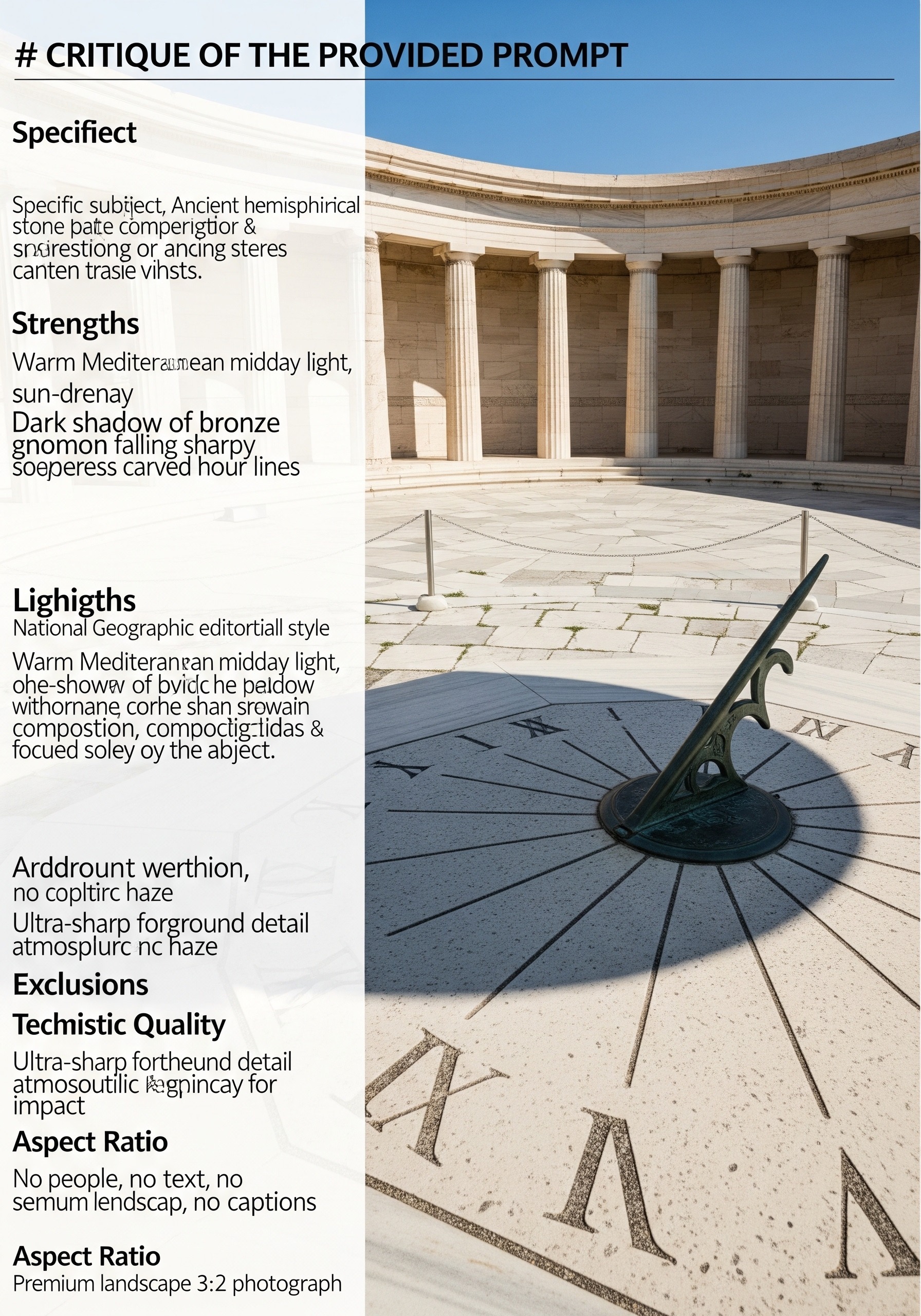
The Greeks and Romans turned the sundial into a precision instrument. Mathematicians like Eudoxus and Aristarchus understood that to keep a sundial honest year-round, the gnomon had to be angled parallel to the Earth’s axis. By the 3rd century BCE they had hemispherical sundials carved into stone bowls; by the 1st century BCE the Tower of the Winds in Athens — an octagonal marble building still standing today — bore eight large sundials on its outer walls, one for each cardinal and intercardinal direction, supplemented by an internal water clock for cloudy days.
By the height of Rome, sundials were so common that the playwright Plautus could joke about them, grumbling around 200 BCE that “the gods confound the man who first found out how to distinguish the hours… who in this place set up a sundial, to cut and hack my day so wretchedly into small portions.” The complaint feels modern — and it is, in a sense, the first recorded grumble about being ruled by the clock.
How Ancient Egypt Told Time, Day and Night
How did ancient Egypt tell time when the sun was gone? The Nile civilization left one of the most sophisticated nighttime answers in the ancient world, and it is the part most popular histories of timekeeping skip.
Egyptian astronomer-priests divided the sky into 36 decans — small groups of stars that rose above the eastern horizon at roughly 10-day intervals through the year. As Earth turned, a new decan rose every 40 minutes or so, and by tracking which decans were on the eastern horizon, a priest could divide the night into 12 hours. This is the deep origin of our 24-hour day: 12 night hours plus 10 daylight hours plus 2 twilight hours, a scheme visible in pyramid texts as early as the 21st century BCE.
To do the measurement they used an instrument called the merkhet — literally “instrument of knowing” — usually a wooden bar with a plumb line. Two priests aligned themselves on a north–south meridian, one sighting toward the pole star and the other watching a decanal star cross the line of sight. When it crossed, the hour was called. It was patient, exacting work that required a clear sky and a well-built temple roof.
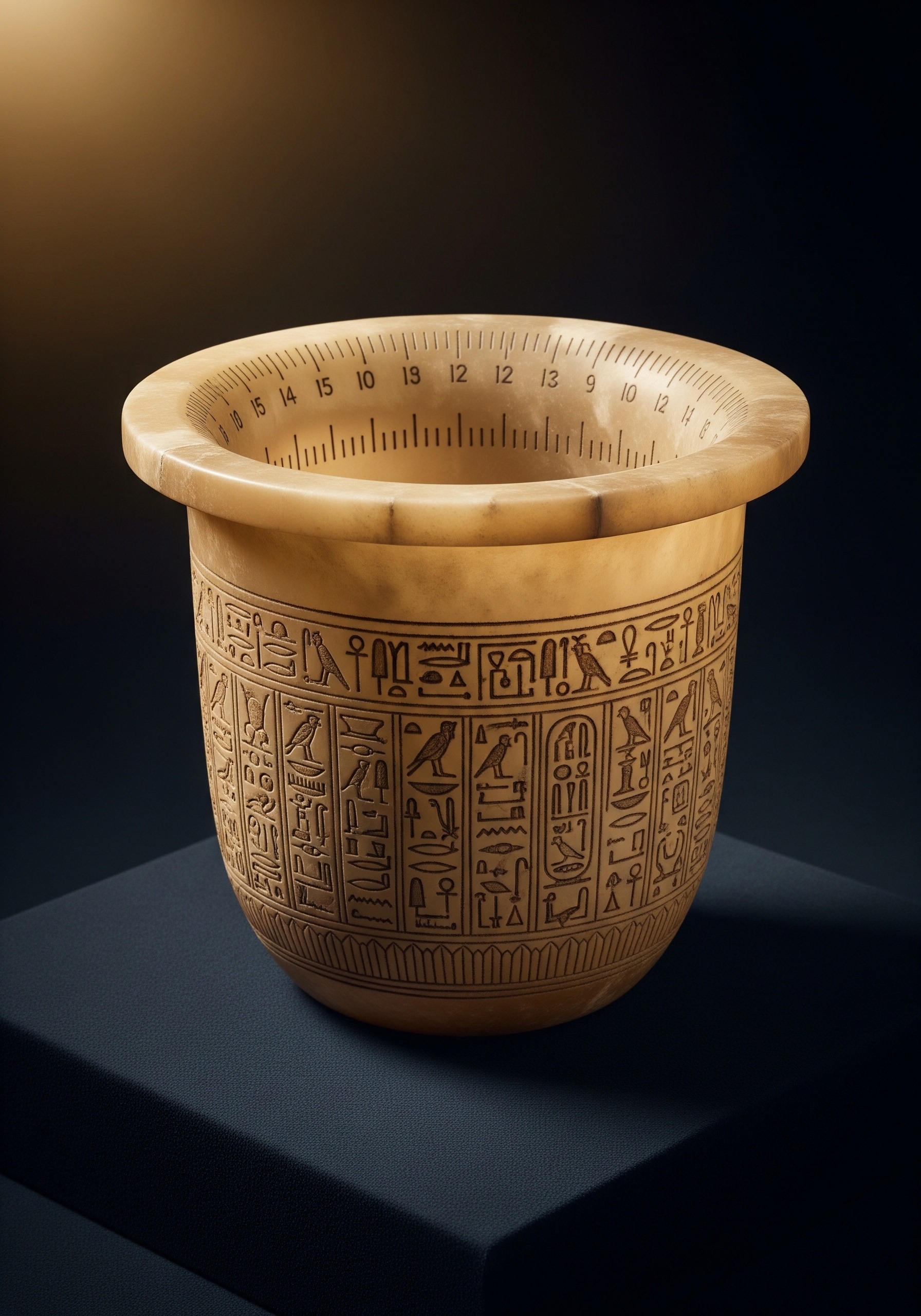
For daytime and cloudy nights the Egyptians turned to water. Tomb inscriptions credit an official named Amenemhet with describing a water clock during the reign of Amenhotep I (c. 16th century BCE). The earliest physical water clock yet recovered — a beautifully carved alabaster bowl — comes from the temple of Karnak and is dated to the reign of Amenhotep III, around 1400 BCE. According to the World History Encyclopedia, its sloped inner walls were marked with 12 separate scales, one for each month, because the length of an Egyptian hour itself drifted with the seasons.
Water Clocks: The First Timepieces That Worked in the Dark
A water clock — Greek klepsydra, “water-thief” — is, at its simplest, a vessel that drips water at a steady rate. You mark the water level on the inside of the bowl, and as the level falls (or rises in a receiving vessel), the markings tell you the hour. The principle is forgiving: even a slightly irregular drip can be made reliable by careful calibration against a sundial on a clear day.
The Egyptians invented the form; the Greeks and Romans engineered it. By around 275 BCE the Alexandrian inventor Ctesibius had built water clocks so elaborate they did far more than tell time. His designs used a constant-head feeder tank to keep the drip rate perfectly stable, a floating index pointer for the hour, and gear trains that drove tiny automata — birds that whistled, figures that pointed, pebbles that dropped — to mark the hours audibly. Roman lawcourts used clepsydrae to ration speakers; a verbose lawyer was said to be “speaking out the water,” and a corrupt one might bribe the clerk to slow the drip.
The most ambitious water clocks were architectural. A 4th-century BCE clepsydra excavated in the Athens agora held about 1,000 liters and would have run for roughly 17 hours between fillings. By the medieval period, water clocks in the Islamic world and in China had become full astronomical machines whose complexity rivaled the gear-driven Antikythera Mechanism from the 1st century BCE — the famous bronze “Greek computer” recovered from a Mediterranean shipwreck.
A timeline of ancient timekeeping
- c. 3500 BCE — Egyptian obelisks act as monumental shadow clocks.
- c. 2100 BCE — Egyptian decanal star-tracking divides the night into 12 hours.
- c. 1500 BCE — First true Egyptian shadow clock; portable T-shaped device.
- c. 1400 BCE — Karnak alabaster water clock from the reign of Amenhotep III.
- c. 6th century BCE — Babylonian base-60 math seeds our 60-minute hour.
- c. 275 BCE — Ctesibius builds the first highly accurate water clock in Alexandria.
- c. 100 BCE — The bronze, gear-driven Antikythera Mechanism is built in Greece.
- c. 50 BCE — The Tower of the Winds in Athens combines 8 sundials with a clepsydra.
- c. 800 CE — Charlemagne reportedly receives a brass water clock from Caliph Harun al-Rashid.
- 1088 CE — Su Song completes his 10-meter astronomical clock tower in Kaifeng.
- c. 1300 CE — First weight-driven mechanical clocks appear in European monasteries.
Sand, Wax, and Smoke: Hourglasses, Candle Clocks, and Incense Clocks
Water was not the only flowing medium. By the late antique and early medieval periods, several quieter alternatives spread around the world — and most of them are missing from the standard popular accounts of ancient time.
The hourglass, in which fine sand falls through a narrow waist between two glass bulbs, may have been used in classical antiquity, but the earliest unambiguous evidence dates to the 8th or 9th century CE in Europe. It became indispensable at sea, because — unlike a water clock — it did not slop in heavy waves, freeze on cold passages, or change rate with temperature. Ship’s officers used 30-minute and 4-hour glasses to measure the ship’s watches into the 19th century, and the sandglass remained the universal kitchen timer until the rise of the electric oven.
Candle clocks were standard household timepieces for centuries. The English king Alfred the Great is famously said to have used six tall candles, each marked into 12 segments, that together burned through 24 hours; a sheltering lantern with translucent ox-horn panes kept the flame steady against drafts. Chinese candle clocks were sometimes embedded with tiny metal balls hung on threads, so that as the wax burned down past each thread, a ball fell into a metal dish with a sharp ringing sound — an audible alarm a thousand years before the alarm clock.
Incense clocks were a distinctly East Asian innovation. A long shallow groove inside a wooden or ceramic case was packed with a precise length of compressed incense; as it smoldered along the groove, it crossed weighted threads, releasing small bells that chimed the hour. Some were even fragranced with different scents at different sections, so that the hour was announced by both a sound and a smell — the only timepiece in history that could be told by the nose.
China’s Astronomical Clockwork and the Tower of Su Song
While much of Europe was still relying on candles and church bells in the High Middle Ages, China had already engineered some of the most sophisticated timekeeping machines of the pre-industrial world.
The pinnacle was the clock tower of Su Song, completed in Kaifeng in 1088 CE. Roughly 10 meters tall, it housed an enormous waterwheel whose paddles tipped one by one as buckets filled, advancing the entire machine in regular small steps — what historians of technology now recognize as the world’s earliest known escapement mechanism, the very principle that would later make European mechanical clocks possible. On the front of the tower, mechanical figures emerged on a rotating wheel to strike bells and drums marking each Chinese double-hour; on the roof, a bronze armillary sphere rotated to mirror the actual sky overhead.
This level of mechanical astronomy was no accident. Imperial China treated calendrical accuracy as a political necessity — the emperor’s legitimacy was tied to predicting eclipses and setting the agricultural year — and royal observatories competed for centuries to refine instruments. The British historian Joseph Needham, who reconstructed Su Song’s tower from the surviving manual, called it “the high-water mark of Chinese horological engineering,” and modern replicas built in Henan Museum and at the National Museum of Natural Science in Taichung run on the same principles described in the 11th-century treatise.
The Islamic Astrolabe and the Muwaqqit’s Craft
In the medieval Islamic world, telling time was a religious as well as a scientific duty. The five daily prayers had to be performed at astronomically defined moments — dawn, just after midday, mid-afternoon, sunset, and night — and large mosques employed a salaried timekeeper, the muwaqqit, to calculate them precisely for the local latitude and the day of the year.
The muwaqqit’s signature tool was the astrolabe, a brass disk that worked as a hand-held analog computer of the sky. By aligning a sighting bar with the sun by day or a known star by night and rotating overlaid plates engraved for the local latitude, the user could read the local time, the qibla direction toward Mecca, and the times of upcoming prayers — all without any moving water or sand. As Britannica notes in its overview of the instrument, the astrolabe remained the most important astronomical instrument used by navigators and astronomers until the 17th century.
Astronomy-driven water clocks were also a Muslim specialty. In 13th-century Diyarbakir, the engineer al-Jazari built monumental water clocks featuring automated musicians, a moving zodiac, and a procession of small figures who emerged at every hour. He described them in such detail in his 1206 Book of Knowledge of Ingenious Mechanical Devices that working replicas now operate in museums in Istanbul, Dubai, and London.
The Strange Secret of the Hour That Changed Length
Here is the deepest surprise in the history of telling time, and it is the part most modern accounts skip: for nearly all of antiquity, the hour was not a fixed length.
Egyptians, Greeks, and Romans all divided daylight into 12 parts and night into 12 parts, regardless of the season. That meant a daytime “hour” in midsummer Rome stretched to about 75 modern minutes, while a wintertime daytime hour shrank to about 45. The Romans called these horae temporales — temporal hours — and any clepsydra used for civic life had to be re-marked every few weeks to keep up. That is exactly why the Karnak water clock has 12 different scales running down its inner wall, one for each month.
Equal hours — what scholars later called horae aequinoctiales, born of the base-60 math of Babylonian astronomers — were known to ancient scientists but used mostly for astronomy and surveying. They became the everyday hour only after the spread of mechanical clocks in late-medieval Europe, when a swinging escapement required a constant beat to function. In other words, the modern fixed hour is itself a consequence of the technology that measures it. Before clocks, time bent to the sun. After clocks, the sun bent to time.
Frequently Asked Questions
Q: How did ancient Egypt tell time at night?
A: Egyptian astronomer-priests divided the night sky into 36 “decans” — groups of stars that rose at roughly 10-day intervals — and used a sighting tool called a merkhet, paired with a plumb line, to time the rising of each decan across a north–south meridian. Twelve decans crossed during a typical night, giving 12 nighttime hours. On cloudy nights they fell back on water clocks like the alabaster vessel found at Karnak.
Q: How accurate were ancient sundials and water clocks?
A: A well-set Greek or Roman sundial could read time to within a few minutes on a clear day, but it only worked when the sun shone, and its “hours” stretched and shrank with the seasons. The best Hellenistic water clocks built by Ctesibius could keep time to within roughly 15 minutes per day — extraordinary for the era, though still far less precise than even a cheap modern quartz wristwatch, which holds time to within a few seconds per month.
Q: Who invented the water clock?
A: Credit usually goes to the ancient Egyptians, based on a tomb inscription naming an official, Amenemhet, who described a clepsydra in the 16th century BCE. The Greeks and Romans then refined the device dramatically, with Ctesibius of Alexandria building the first highly precise examples around 275 BCE, and Islamic and Chinese engineers later turning the principle into full astronomical clockwork.
Q: How did ordinary people, not just priests and emperors, tell time?
A: For most farmers, soldiers, traders, and townspeople, time was read from the sun’s position, the lengthening of shadows, the crowing of roosters, the ringing of temple or church bells, the call of the muezzin from a minaret, or simply the arrival of meals. Personal timepieces were extraordinarily rare before the 16th century; communal signals — a bell, a horn, a public sundial in the market — carried the day for almost everyone.
It is easy to assume the ancients lived in a timeless world. They did not. They lived in a deeply timed one — read off the sun, the stars, the dripping of water, and the slow burning of a measured candle. The instruments they built were not failed attempts at our clocks. They were elegant answers to a different question, and their fingerprints — the 24-hour day, the 60-minute hour, the very idea that a public moment can be appointed and shared — still shape every hour of our own.
Illustrations are AI-generated. Article fact-checked and human-edited.