How Did Early Man Discover Fire? The Million-Year Story
How did early man discover fire? Not with a single eureka moment beside a smoking lightning strike, but across a million-year apprenticeship — a slow, layered conversation between curious hominins and the burning world around them. The story is messier, older, and far more interesting than the cartoon version of a caveman bashing two rocks together.
Key Facts
- The earliest widely-accepted evidence of controlled fire use comes from Wonderwerk Cave, South Africa, where burnt bone fragments and ashed plant remains date to roughly 1 million years ago, in layers associated with Homo erectus.
- By about 780,000 years ago, hominins at Gesher Benot Ya’aqov in Israel were already cooking fish — the oldest secure evidence of using fire to prepare food.
- The earliest clear evidence of humans actively making fire (not just keeping it) appears around 400,000 years ago at sites like Beeches Pit and Barnham in England, where flint and iron pyrite were struck together.
- Fire was almost certainly “discovered” independently many times, by several hominin species — Homo erectus, archaic Homo sapiens, and Neanderthals — across Africa, Asia, and Europe.
- Anthropologist Richard Wrangham’s “cooking hypothesis” argues that habitual fire use rewired our anatomy: smaller guts, larger brains, longer childhoods, and the social architecture of the hearth.
In short: Early humans did not discover fire in a single instant — they grew into it. First they fled wildfires, then they followed and exploited them, then they kept embers alive for days, and only much later learned to spark a flame on command. Each step took tens or hundreds of thousands of years, and each one changed what it meant to be human.
Key Facts
- The earliest widely-accepted evidence of controlled fire use comes from Wonderwerk Cave, South Africa, where burnt bone and ashed plant remains date to roughly 1 million years ago, in layers linked to Homo erectus.
- By about 780,000 years ago, hominins at Gesher Benot Ya’aqov in Israel were already cooking fish — the oldest secure evidence of using fire to prepare food.
- The earliest clear evidence of actively making fire appears around 400,000 years ago at sites such as Beeches Pit and Barnham in England, where flint and iron pyrite were struck together.
- Fire was almost certainly discovered independently many times, by Homo erectus, archaic Homo sapiens and Neanderthals across Africa, Asia and Europe.
- Richard Wrangham’s ‘cooking hypothesis’ argues habitual fire use rewired human anatomy: smaller guts, larger brains, longer childhoods and the social architecture of the hearth.
In short: Early humans did not discover fire in a single moment but grew into it across a million years. They first fled wildfires, then followed and exploited them, then kept embers alive, and only much later learned to spark flame on command. Each stage took tens or hundreds of thousands of years.
The Three Stages of a Million-Year Discovery
Archaeologists and paleoanthropologists no longer talk about “the” discovery of fire as a single event. Instead, they describe a sequence of cognitive and technical thresholds that early humans crossed at different times in different places: encountering fire, tending fire, and finally making fire from scratch. Confusing these three stages is the single biggest reason popular accounts of human prehistory go wrong.
Encountering fire was the easy part — lightning, volcanic vents, spontaneous peat burns, and dry-season grassfires have shaped East African landscapes for millions of years. Every animal in those ecosystems, including our pre-human ancestors, knew what flames were. Tending fire — feeding a found ember and keeping it alive overnight — required curiosity, planning, and tolerance of risk. Making fire required understanding cause and effect at a level no other species has ever demonstrated.
Read the archaeological record through this three-stage lens, and the apparent contradictions in the literature dissolve. A “fire site” from 1.5 million years ago is not the same kind of evidence as a hearth ringed with stones from 300,000 years ago, and neither is the same as a flint-and-pyrite kit from 50,000 years ago. Different stages, different proofs.
How Did Early Man Discover Fire? The First Encounter
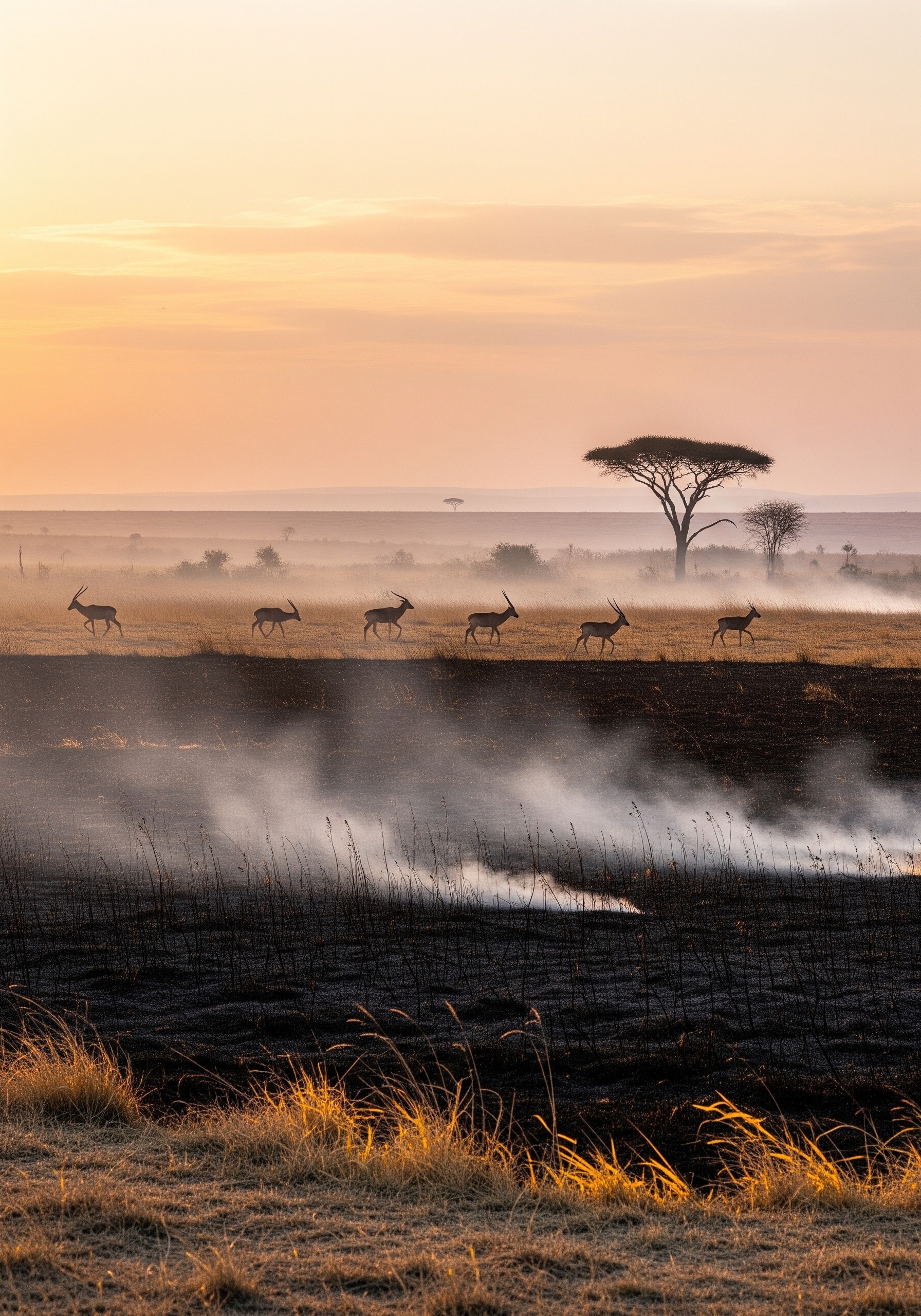
The deepest hints come from East Africa. At Koobi Fora on the eastern shore of Lake Turkana in Kenya, patches of reddened earth dated to around 1.5 million years ago sit suggestively near stone tools and bones of Homo erectus. At Chesowanja, also in Kenya, baked clay clasts of similar age tell a similar story. Neither site proves that Homo erectus kindled the fires; what they show is that flames and hominins kept turning up in the same places.
That alone is significant. In the modern Serengeti, wildfires drive antelope and rodents into the open, char tubers in the ground, and crack open tortoise shells. Modern chimpanzees in Senegal have been observed reading bushfires accurately — calmly moving aside, then returning to forage the burned ground. There is no reason to think early Homo was less attentive. The first “discovery” of fire was almost certainly the discovery that fire produces food: a smoldering grassland is a buffet.
{IMAGE_2}
The Long Apprenticeship: Tending Borrowed Flames
Carrying fire is a far bigger cognitive leap than walking up to it. To carry fire is to think about the future. Ethnographic studies of recent fire-using peoples — the Andaman Islanders, certain Tasmanian groups, Aboriginal Australians of the Western Desert — show that a small ember tucked into a bundle of slow-burning bark or dried fungus can be coaxed to keep glowing for days. The Mbuti of the Ituri rainforest historically passed embers from camp to camp, and some Andamanese groups, when first contacted, did not yet know how to make fire, even though they had used it for generations.
That analogy matters because it shows there is an entire technological plateau — the “fire-preserver” stage — between encounter and ignition. Designated keepers of the flame, slow-burning fuels like animal dung or punky wood, and the social rules to enforce vigilance can all exist long before anyone learns how to start a fire from nothing. Most of the deep prehistoric record almost certainly reflects this plateau, not free-handed pyrotechnics.
Then comes the first really hard evidence. At Wonderwerk Cave in the Northern Cape of South Africa, a team led by Francesco Berna published in 2012 the strongest case yet for in-cave burning around 1 million years ago. Microscopic analysis of bone fragments and plant ash showed temperatures consistent with controlled, low-intensity fires — not wildfire wash-in. Around the same horizon, Homo erectus bones lie in the same deposits. Wonderwerk is the moment fire moves indoors.
The First Hearths: Sites That Rewrote the Timeline
Between roughly 800,000 and 300,000 years ago, the archaeological record fills up with the unmistakable signatures of habitual fire use: repeated hearth locations, deeply burnt sediments, heat-altered flints, ash-rich middens. This is the period when fire stopped being an emergency tool and became infrastructure.
At Gesher Benot Ya’aqov in the Jordan Valley of Israel, deposits dated to roughly 790,000 years ago preserve burned flint microartefacts and — most famously — the heat-altered remains of freshwater fish, plant foods, and small game. The patterning is too tight and too repeated to be wildfire. Someone was cooking dinner there, again and again, three quarters of a million years ago.
At Zhoukoudian near Beijing, the long-studied “Peking Man” cave system yielded thick ashy layers and charred bones in deposits between roughly 460,000 and 230,000 years old. Some of the older “ash” claims have been revised by careful sediment work — not all dark layers are anthropogenic — but the upper levels still show clear, repeated burning associated with Homo erectus pekinensis. At Qesem Cave in Israel (around 400,000 to 200,000 years ago) and Schöningen in Germany (around 300,000 years ago, famous for its wooden spears), hearths are no longer occasional events. They are the center of camp life.
The Moment of Making: Friction Versus Percussion
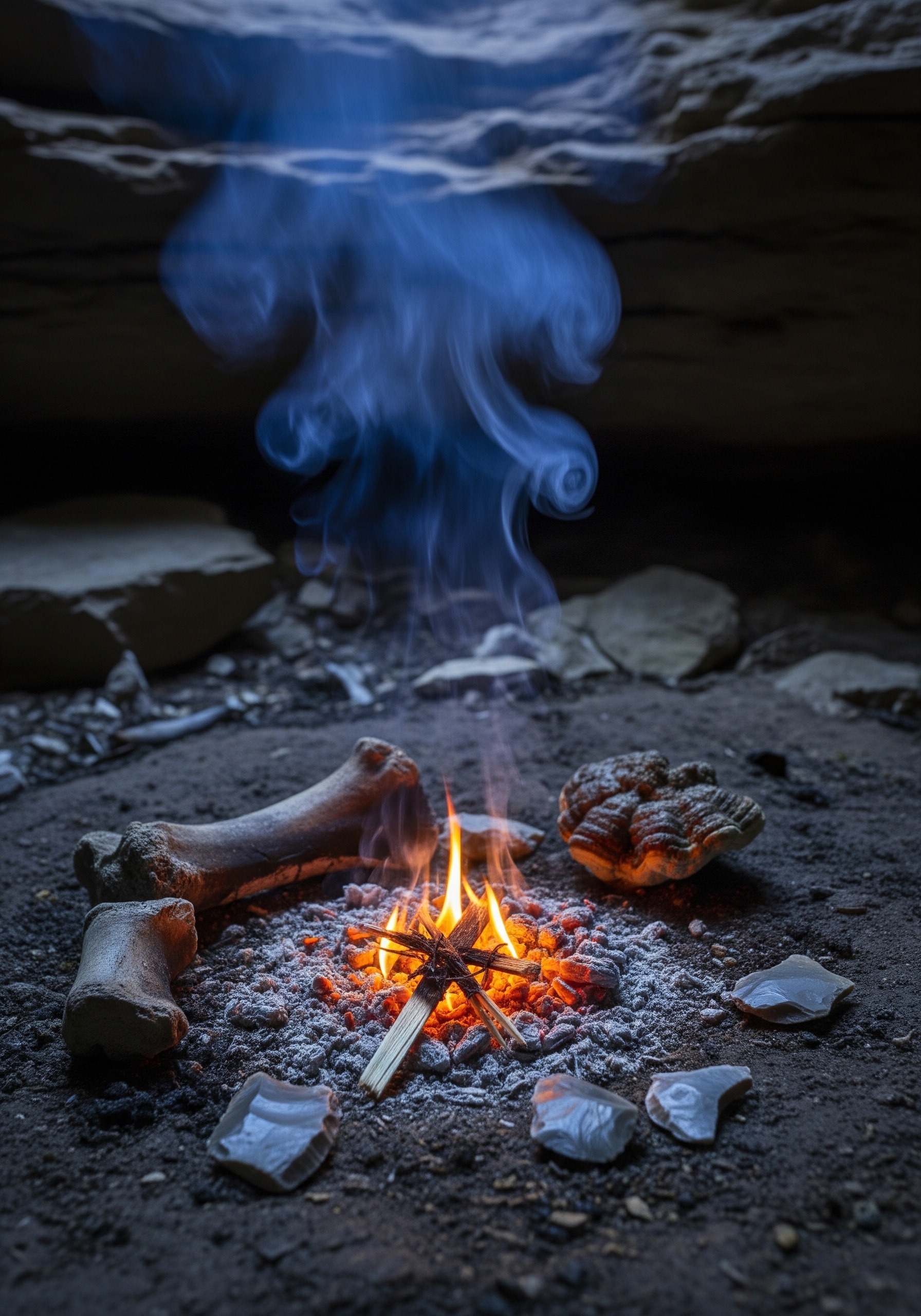
Tending a flame is not the same as kindling one, and archaeologists keep separate evidence for “fire-making” because it requires a specific toolkit. By around 400,000 years ago, that toolkit shows up in northern Europe. At Beeches Pit in Suffolk, England, and the nearby Lower Palaeolithic site of Barnham, excavators have recovered burnt sediment, fire-cracked flint handaxes, and crucially, fragments of iron pyrite — the mineral whose sulfur-rich crystals throw hot sparks when struck against flint. These are essentially Stone Age cigarette lighters.
Two great families of fire-making technology emerge from the global archaeological record. Each has different requirements and different signatures in the dirt:
| Method | How it works | Tools / materials | Archaeological signature |
|---|---|---|---|
| Friction (hand drill, bow drill, fire plough) | Rapid wood-on-wood spinning or sawing produces fine, hot dust that smolders into an ember | Two pieces of wood (a soft hearth board and a harder drill), tinder bundle | Almost invisible — wood rots; only inferred from ethnography and the absence of percussion kits |
| Percussion (strike-a-light) | A sharp blow shatters microscopic flecks of pyrite that ignite in mid-air at well over 1,500°C | Iron pyrite or marcasite + a flint or chert striker + dry tinder fungus | Worn, grooved pyrite nodules; carbonized tinder fungus; flint strikers with distinctive use-wear |
Because friction kits are made entirely of perishable plant material, the deep history of friction fire is almost certainly older than we can prove. Percussion fire, by contrast, leaves stones behind — which is why the oldest direct evidence of fire-making is a percussion kit, even though friction may well have come first.
Fire and the Human Brain: The Cooking Hypothesis
Why does any of this matter for human evolution? In a 2009 book called Catching Fire, Harvard primatologist Richard Wrangham argued that cooking — not hunting, not language, not tool-making alone — is the technology that made us human. Cooked food is softer, safer, and dramatically more calorie-dense per hour of chewing than raw food. A chimpanzee spends roughly five hours a day chewing; humans spend about an hour. That recovered time, Wrangham argues, paid for our oversized brains.
The anatomical evidence fits. Compared with our closest living relatives, modern humans have remarkably small molars, short colons, and weak jaw muscles — all consistent with a long evolutionary commitment to processed food. Brain size in the genus Homo roughly doubles between 1.8 million and 200,000 years ago, the same window in which the fire record gets thicker and more credible. Critics rightly note that the very earliest brain expansion predates the firmest fire evidence, so cooking can’t be the only driver. But few researchers now doubt that habitual cooking, once it appeared, was a decisive force shaping the modern human body and brain.
And the hearth did more than cook. It extended the day. With light and warmth came the world’s first nightlife — long evenings around the fire when stories could be told, plans made, repairs done, and children taught. Anthropologist Polly Wiessner’s work with the Ju/’hoansi of the Kalahari shows that daytime talk is dominated by economic and practical matters, while firelight conversation shifts overwhelmingly to storytelling, myth, and song. If anything close to that pattern held in deep prehistory, then fire is not just where dinner was cooked. It is where culture was incubated.
Why It Mattered: From Cave Mouths to Continents
Fire’s downstream consequences are almost impossible to overstate. It enabled the colonization of cold latitudes; the curing and bending of wood for spears like those at Schöningen; the heat-treatment of stone to make sharper blades; the production of birch-bark tar — the world’s first synthetic adhesive — by Neanderthals around 200,000 years ago; the smoking and drying of meat for long-term storage; and eventually the firing of clay, the smelting of metals, and the production of glass. Almost every later technology is, in some sense, an application of controlled fire.
The social consequences may be even larger. Fire concentrated people in space (around the hearth) and in time (after dark). It created scheduled gathering — and scheduled gathering, more than any tool, is the engine of the cumulative culture that distinguishes our species. To ask “how did early man discover fire” is, in the end, to ask how we became us. For more on the daily rhythms of these early lives, see our piece on what prehistoric humans actually ate, our overview of Stone Age tools and weapons, and our deep dive into Neanderthal daily life.
Frequently Asked Questions
Q: Who was the first human to discover fire?
A: There is no single “first.” The best current evidence points to Homo erectus as the first hominin species to control fire on a habitual basis, beginning at least 1 million years ago at sites like Wonderwerk Cave in South Africa. But other species, including archaic Homo sapiens and Neanderthals, almost certainly developed fire use independently in other regions.
Q: How did cavemen make fire without matches or lighters?
A: Two main techniques. Friction methods — most famously the hand drill and bow drill — spin a wooden shaft against a softer hearth board until the dust it grinds off smolders. Percussion methods strike iron pyrite against flint to throw sparks. Both ignite a dry, finely shredded tinder bundle, which is then coaxed into a full flame. Modern survival instructors still teach both techniques today.
Q: What is the oldest evidence of fire use by humans?
A: The most widely accepted earliest evidence is from Wonderwerk Cave, South Africa, around 1 million years ago — burned bone and ashed plant material analyzed using high-resolution microscopy and infrared spectroscopy. Older claims exist (some sites push back toward 1.5 million years), but they remain debated because natural fires can leave similar traces.
Q: How did fire change human evolution?
A: It is hard to find a corner of human biology that fire did not touch. Cooked food allowed for smaller teeth, jaws, and digestive systems, freeing energy for a larger brain. Fire enabled migration into cold regions previously closed to our ancestors. Hearths created the first scheduled social gatherings, which many researchers see as the seedbed of language, storytelling, and cumulative culture.
So how did early man discover fire? He didn’t, exactly — they did, plural, across continents and species and hundreds of thousands of years, in a slow conversation with the burning planet they happened to live on. They watched it. They followed it. They carried it home. And one day, somewhere in a deep cave or a forgotten clearing, somebody struck two stones together and made a small star fall onto a handful of dry grass. Everything that we are descends from that spark.
Illustrations are AI-generated. Article fact-checked and human-edited.