How Macquarie Island Was Cleared of Rabbits, Rats and Cats
The story of how Macquarie Island was cleared of rabbits, rats and cats is usually told as a clean conservation triumph: the pests were poisoned, the island healed, roll credits. The truth is stranger, and far more useful. Clearing this speck of green in the Southern Ocean took two centuries of mistakes, one catastrophe caused by good intentions, a helicopter fleet, a virus, and four dogs that walked the equivalent of twice around the planet’s waistline. And it nearly went wrong in a way that still makes ecologists wince.
Key Facts
- Macquarie Island sits about 1,500 km south-southwest of Tasmania and became a UNESCO World Heritage site in 1997.
- Fur-bearing pests arrived from 1810 sealers; two endemic birds were lost, the Macquarie parakeet (around 1890) and the Macquarie rail.
- Cats were eradicated by 2000, but rabbits then exploded toward about 130,000, causing a 2006 landslip at Lusitania Bay.
- A roughly A$25 million, seven-year plan (2007-2014) removed rabbits, rats and mice together.
- Calicivirus released in February 2011 killed 80-90% of rabbits, then winter aerial baiting followed; the island was declared pest-free in April 2014.
In short: Macquarie Island, a sub-Antarctic World Heritage site, was cleared of rabbits, rats and cats over two centuries of effort. Removing the cats first backfired, letting rabbits explode. A roughly A$25 million, three-weapon plan of calicivirus, aerial baiting and detection dogs finished the job, and the island was declared pest-free in April 2014.
One island, three invaders — and why the whole world was watching
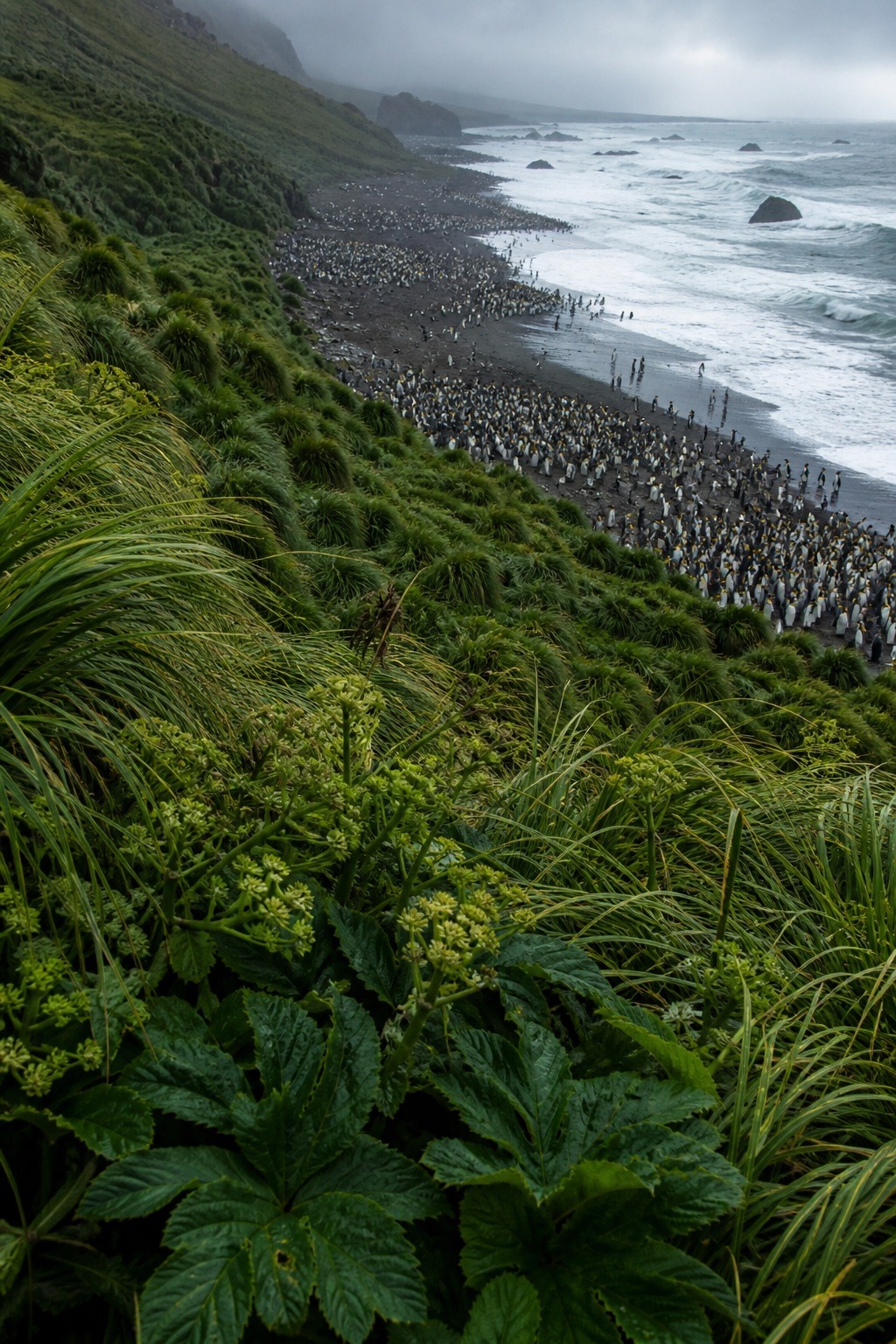
Macquarie Island sits 1,500 kilometres south-southwest of Tasmania, roughly halfway to Antarctica — a narrow ridge of land about 34 km long and barely 5 km wide, whipped by wind almost every day of the year. It is so geologically strange that UNESCO made it a World Heritage site in 1997: it is the only place on Earth where rocks from the planet’s mantle, normally six kilometres under the seabed, are actively being pushed above the waves.
On that ridge live some of the densest seabird and seal colonies on the planet — royal and king penguins in their hundreds of thousands, elephant seals, albatrosses, petrels. For most of them there is nowhere else. So when the island’s ecosystem began collapsing, the stakes were not local. This was a test case the conservation world could not afford to fail.
The pests didn’t swim there — the sealers brought them
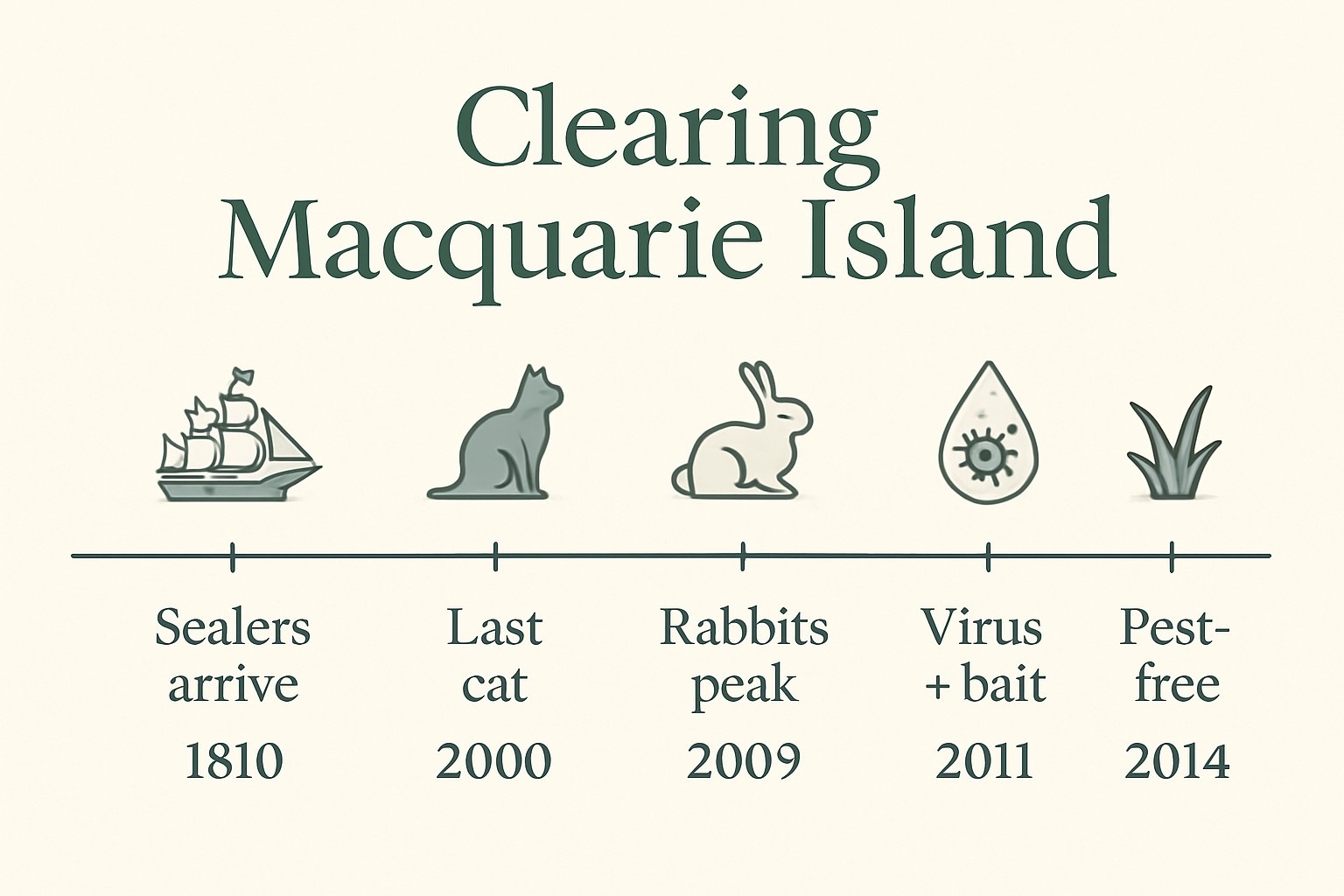
Nothing with fur is native to Macquarie. Every rabbit, rat, mouse and cat on the island arrived courtesy of people, and the trail begins in 1810, the year the sealing brig Perseverance stumbled onto the place. The gangs that followed stripped the beaches of fur seals and elephant-seal oil — and, to feed themselves on return trips, they released cats to hunt vermin aboard ship and rabbits as a living larder.
The rats and house mice needed no invitation. They simply walked down the mooring lines. By the late 1800s all four species were loose, and each found a paradise with no predators and no defences. Turns out an island that evolved without a single land mammal has no idea how to cope with four of them at once.
{IMAGE_2}
The two birds Macquarie will never get back
Read most accounts and the animal cost is invisible — a few numbers, no names. There should be names. Two unique birds vanished from Macquarie forever, and both had scientific identities all their own.
The Macquarie parakeet (Cyanoramphus novaezelandiae erythrotis), a green-and-crimson relative of New Zealand’s red-crowned parakeets, was last recorded around 1890. The Macquarie rail (Gallirallus philippensis macquariensis), a flightless-tending subspecies of the buff-banded rail, disappeared in the same window. Here’s the detail that matters: the parakeet had lived alongside cats for decades. It only crashed after rabbits and introduced wekas arrived in the 1870s and tore the ground cover apart. In other words, it wasn’t one villain — it was the combination. That lesson would come back to haunt the island a century later.
Did removing the cats first fix things? It made them worse
By the 1980s the damage was undeniable, and managers went after the most obvious killer. Feral cats were slaughtering an estimated 60,000 seabirds a year, so a shooting campaign ran through the 1990s until the last cat was gone in the year 2000. A clear win — on paper.
What happened next is the most important and least-told part of the whole saga. With cats gone, and an older myxomatosis control programme losing its bite, the rabbit population detonated. Freed of the predator that had eaten their kits, rabbits climbed toward 130,000 animals and ate the island bare. Steep coastal slopes, once armoured with tussock, turned to mud. In 2006 a huge landslip at Lusitania Bay buried part of a penguin colony.
This was not bad luck. A 2009 study led by ecologist Dana Bergstrom, published in the Journal of Applied Ecology, laid it out plainly: removing one invader without removing the others had triggered a cascade that devastated a World Heritage island. Ecologists call it mesopredator, or prey, release. Macquarie had just become its most expensive textbook example.
How Macquarie Island was cleared of rabbits, rats and cats — the $25-million, three-weapon plan
The near-disaster forced a rethink: this time, hit everything at once. In 2007 the Australian and Tasmanian governments committed roughly A$25 million to a seven-year plan to remove rabbits, rats and mice together. It became, at the time, the largest island eradication of its kind ever attempted.
The strategy had three weapons, deployed in sequence. First, in February 2011, teams released rabbit calicivirus (RHDV), which swept through the warren and killed an estimated 80–90% of rabbits within weeks. Second, over the following winter, helicopters spread brodifacoum bait across the entire island — every square metre — to finish the surviving rabbits and wipe out the rats and mice in one coordinated pass. Timing it for winter was deliberate: fewer native birds around to take the bait, and hungry rodents with nothing else to eat.
- ~130,000 rabbits at their post-cat peak (around 2009)
- ~36,000 rats and ~103,000 house mice on the island
- ~60,000 seabirds a year killed by cats before 2000 (estimate)
- ~A$25 million spent over a 7-year project (2007–2014)
- Feb 2011 calicivirus → winter 2011 aerial baiting → last rabbit seen Nov 2011
- April 2014 — officially declared pest-free after 2.5 clear years
Was it really the dogs that finished the job? Yes
Poison and virus do the demolition. They never do the last mile. After the baiting, an unknown handful of animals always survives somewhere in 12,800 hectares of cliff, cave and tussock — and if even one breeding pair is missed, the whole project fails.
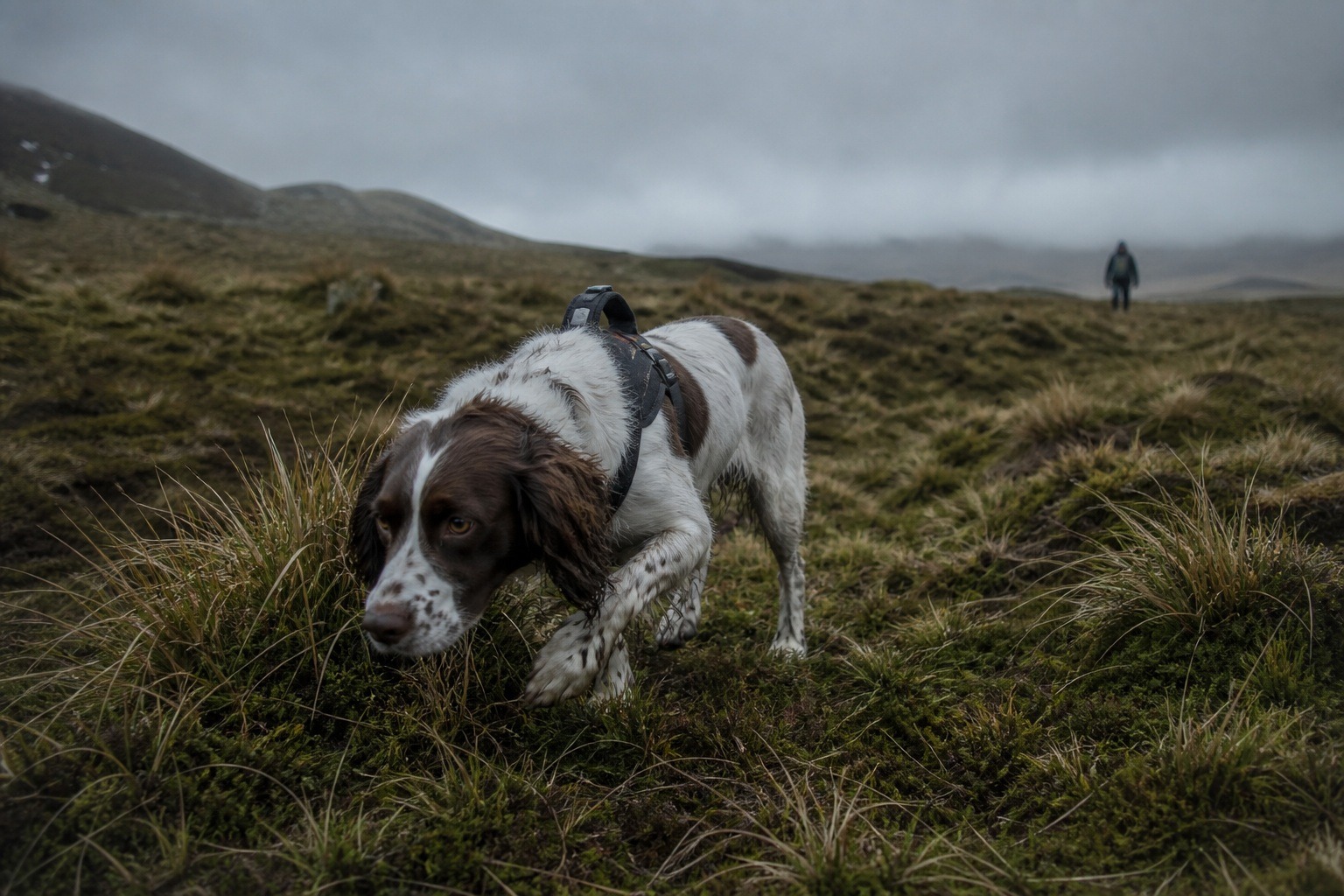
So the final phase belonged to the dogs. A small team of handlers worked springer spaniels and Labradors trained to sniff out rabbits and rodents, and over the mop-up years they and their animals covered around 90,000 kilometres on foot — twice around the Earth — sweeping the island end to end, not once but repeatedly. The dogs found the ghosts the helicopters missed: a last few adult rabbits, and a single litter of kittens overlooked from the earlier campaign. The last rabbit was recorded in November 2011. After that, the dogs kept walking, and found nothing. Which was exactly the point.
Is Macquarie Island really pest-free — and what came back?
In April 2014, with no rabbit, rat or mouse detected for two and a half years, Tasmania Parks and Wildlife Service project manager Keith Springer declared the island officially pest-free. The recovery since has outrun even the optimists.
Dr Aleks Terauds, a program leader with the Australian Antarctic Division, hiked the length of the island a decade on. “It was incredible to get back there and see the slopes that were once completely denuded of vegetation by rabbits, looking really healthy, with lots of tussock and megaherbs,” he said. The plants came first; the birds followed. Blue petrels — which cannot nest where rats hunt — rebuilt to more than 300 breeding pairs, and grey petrels roughly doubled to around 200 pairs. In 2016 BirdLife International recorded improved conservation status for several Macquarie seabird taxa, a rare piece of good news on a global Red List.
So it’s a happy ending? Not quite — enter H5N1
Just as Macquarie’s seabirds hit their stride, a new threat came riding the wind. The highly pathogenic H5N1 strain of avian influenza reached the subantarctic in 2023–2024, confirmed at Bird Island in South Georgia, then on Marion Island in September 2024, and in dead elephant seals on Crozet and Kerguelen. A virus that kills penguins, albatrosses and skuas by the thousand is now circling the very region Macquarie sits in.
Macquarie’s defence today is boring, relentless biosecurity — and the pests never fully left the risk map. Rodent-detection dogs and strict cargo screening check every vessel and container that touches the island, because a single pregnant rat stowing away could undo two decades and $25 million overnight. The mission now is not to fix the island. It is to never have to fix it again.
Myths vs the evidence
| Common belief | What the evidence shows |
|---|---|
| “They just poisoned the pests and the island bounced back.” | The poison phase took one winter; the full project ran seven years and needed a virus, aerial baiting and years of dog patrols to succeed. |
| “Removing the cats fixed the seabird problem.” | The opposite — with cats gone, rabbits exploded to ~130,000 and stripped the island, causing landslides that buried penguins (Bergstrom et al., 2009). |
| “No native animals were harmed to save the island.” | Some native birds died from bait; managers judged the short-term loss worth the long-term rescue. There is no cost-free eradication. |
| “Macquarie is safe now, job done.” | It is pest-free but not threat-free — H5N1 in the subantarctic and constant reinvasion risk mean biosecurity never stops. |
In short: Macquarie Island was cleared of rabbits, rats and cats by attacking every invader together — calicivirus, island-wide brodifacoum baiting, and years of sniffer-dog sweeps — after an earlier cats-only effort backfired disastrously. The island is now the world’s largest successful eradication of its kind, but its defence has quietly shifted from removing pests to keeping them, and a new virus, out for good.
Sources and notes
- Australian Antarctic Program / Australian Antarctic Division — “Macquarie Island’s astounding recovery, ten years on” (2024); quote from Dr Aleks Terauds
- Tasmania Parks and Wildlife Service — Evaluation Report, Macquarie Island Pest Eradication Project (2014)
- Department of Climate Change, Energy, the Environment and Water — Plan for the Eradication of Rabbits and Rodents on Subantarctic Macquarie Island (2007)
- Bergstrom, D. et al. — “Indirect effects of invasive species removal devastate World Heritage Island,” Journal of Applied Ecology (2009)
- BirdLife International (2016) Red List status updates; Australian Geographic, “Macquarie Island declared pest-free” (2014)
- Nature Communications (2025) and Department of Forestry, Fisheries and the Environment (South Africa) — H5N1 spread across subantarctic islands, 2024
Macquarie’s real gift to the rest of the planet isn’t a recipe for killing rabbits. It’s a warning written in mud and dead penguins: on an island, pull out one predator and leave the prey behind, and the prey will eat the place alive. Remove them together, or don’t start — that single, hard-won rule is now reshaping island rescues from the Galápagos to the Southern Ocean, and it was paid for here, at the bottom of the world.
Frequently Asked Questions
Q: How was Macquarie Island cleared of pests?
Through a roughly A$25 million, seven-year plan (2007-2014) that hit all invaders at once. Rabbit calicivirus released in February 2011 killed 80-90% of rabbits within weeks; helicopters then spread brodifacoum bait across the whole island that winter to finish the rabbits and wipe out rats and mice; trained dogs then cleared the survivors.
Q: Where did the Macquarie Island pests come from?
Nothing with fur is native to Macquarie. The trail begins in 1810, when the sealing brig Perseverance found the island. Sealers released cats to hunt shipboard vermin and rabbits as a living larder, while rats and house mice walked down the mooring lines. By the late 1800s all four species were loose on an island that evolved without a single land mammal.
Q: Why did removing the cats first make things worse?
Feral cats were killing an estimated 60,000 seabirds a year, so a campaign eliminated the last cat by 2000. But with the cats gone and an old myxomatosis programme weakening, rabbits detonated toward 130,000 and ate the island bare. A 2006 landslip at Lusitania Bay buried part of a penguin colony, a textbook case of prey release documented by ecologist Dana Bergstrom.
Q: Did the eradication actually succeed?
Yes. After the virus and aerial baiting did the demolition, detection dogs, springer spaniels and Labradors, walked the 12,800 hectares of cliff and tussock to sniff out any survivors, since missing even one breeding pair would fail the project. The last rabbit was seen in November 2011, and Macquarie was declared pest-free in April 2014 after clear years.
Illustrations are AI-generated. Article fact-checked and human-edited. Our editorial standards.