The White Crow: A Living Ghost Hidden in Plain Sight
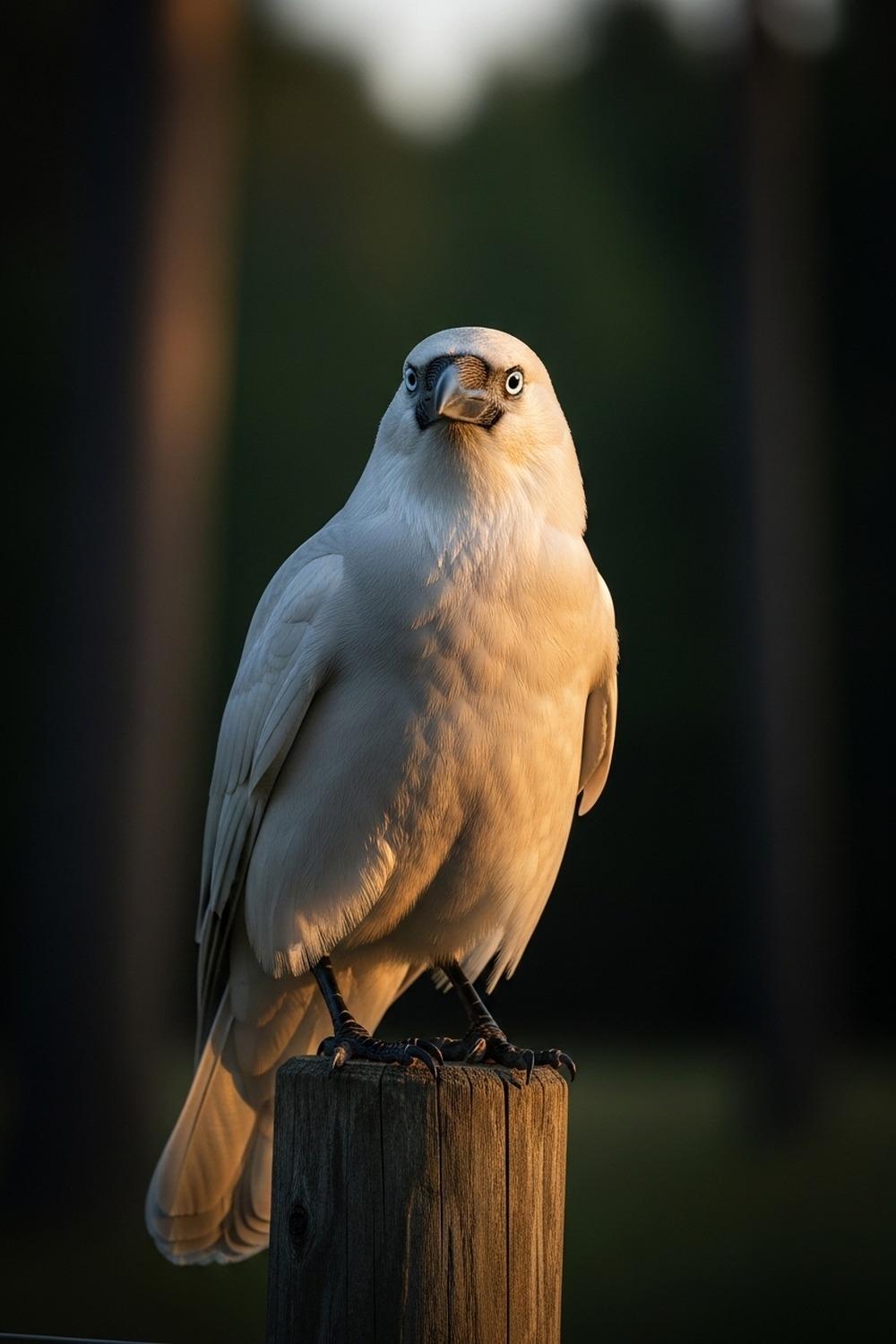
Your brain refuses it the moment you see one. A white crow shouldn’t exist — every visual instinct you possess insists the white bird in front of you is a trick of light, a mistake, something other than what it plainly is. Yet in 2019, residents in a small English village found a fledgling white crow on the ground, milk-pale and blinking, and the bird survived. Most don’t. What it represents — genetically, ecologically, culturally — is stranger and rarer than almost any wildlife encounter a person is likely to have in a lifetime.
They assumed it was sick at first. The people who found it didn’t fully understand what they’d discovered. They nursed it through its most critical weeks without that knowledge, and their ignorance may have saved its life. They treated it like a bird that needed help, not like a curiosity. That’s a rarer instinct than it sounds.
Key Facts
- True albinism in corvids occurs in fewer than 1 in 30,000 individuals, according to wildlife survey data compiled by the Cornell Lab of Ornithology through the 2010s.
- In 2019, residents in a small English village found a fledgling white crow on the ground that survived, an unusual outcome for white corvids.
- Corvid juvenile mortality exceeds 70% in the first year under normal conditions, and some rehabilitation estimates push that figure above 85% for abnormally colored individuals.
- New Caledonian crows demonstrated recursive thinking in a 2020 study published in Science, a cognitive capacity previously documented only in humans and great apes.
- A white crow photographed in Osaka in 2017 generated more than 2.3 million social media impressions within 48 hours.
In short: A white crow results from albinism or leucism, occurring in fewer than 1 in 30,000 corvids for true albinism. These birds face survival odds far worse than normal, with juvenile mortality above 85 percent, and have carried mythological weight from ancient Greece to Edo-period Japan. A 2019 English fledgling beat the odds and survived.
What Makes a White Crow Biologically Possible
True albinism in corvids — the family Corvidae, which includes crows, ravens, jackdaws, jays, and magpies — occurs in fewer than 1 in 30,000 individuals. Decades of wildlife survey data compiled by ornithologists at the Cornell Lab of Ornithology, tracking plumage abnormalities in North American bird populations since the 1990s, confirm this figure. Albinism results from a complete absence of melanin, the pigment responsible for colour in feathers, skin, and eyes. A fully albino crow will have white plumage, pink or red eyes, and pale skin around the beak and feet.
Both parents must carry the faulty gene for albinism to express in an offspring — it’s a recessive genetic mutation. This is why it’s extraordinarily rare in wild populations where carrier individuals rarely meet, let alone breed. The biology of albinism in birds is well documented, but the lived reality of an albino crow is far more precarious than the genetics suggest.
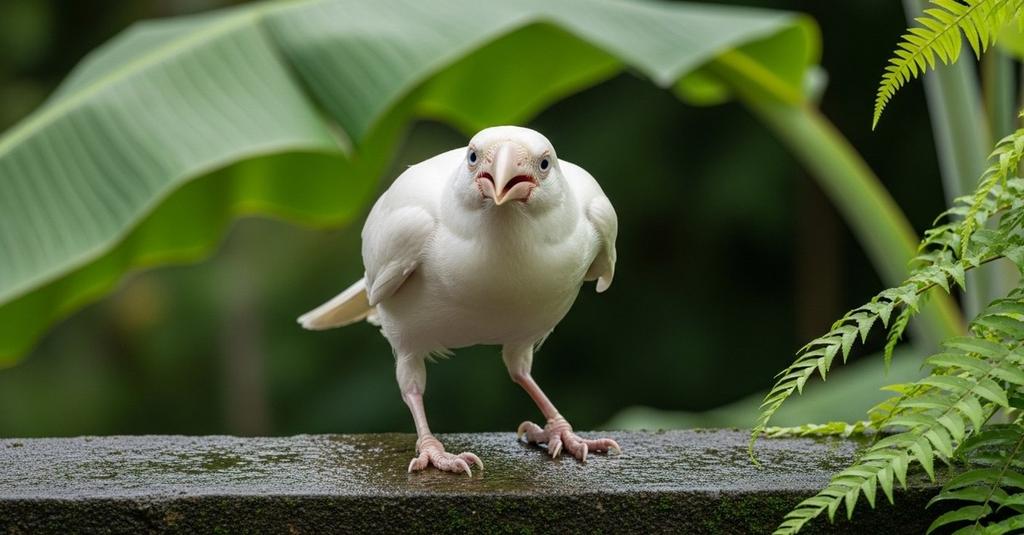
Leucism presents differently. In leucistic birds, the melanin-producing cells called melanocytes develop normally but fail to migrate properly to the feathers during embryonic development. White or washed-out plumage appears, but the eyes stay dark — that’s the giveaway. An albino crow, by contrast, has that unmistakable pinkish-red gaze, the colour of blood vessels seen through tissue with no pigment to obscure them. Both conditions create the same visual shock. The mechanism behind each is entirely different.
And here’s the thing: corvids are already among the most visually sophisticated birds alive. They navigate by landmarks, recognise individual human faces, and track colour as a key social signal. A white bird in a black flock doesn’t just look different to us. It looks different to every crow around it — and that changes everything about its life.
The Survival Odds Are Almost Impossibly Bad
Why does this matter? Because a white crow enters the world already carrying a deficit that most organisms don’t recover from. Corvid juveniles face brutal mortality rates under normal circumstances. Studies by the British Trust for Ornithology estimate that more than 70% of fledgling crows don’t survive their first year — and those are birds with full camouflage, healthy immune systems, and no social disadvantage. Pale plumage makes a bird dramatically more visible to predators. Sparrowhawks, foxes, and domestic cats are ambush hunters that rely on contrast and movement. A white bird on a dark branch might as well be lit from underneath.
Crows are also known for sophisticated social intelligence — behaviours explored in our piece on crow anting behaviour and how crows use formic acid to manage their feathers — suggesting these birds are doing far more maintenance work than we typically imagine. (And this matters more than it sounds.) A white crow can presumably ant. Whether its flock accepts it long enough for that to matter is another question entirely.
The less obvious threat is potentially the more lethal one: social rejection. Crows are profoundly social animals. They roost communally, forage in groups, and rely on flock membership for protection, information, and mating opportunities. A white crow’s abnormal colouring may trigger avoidance responses from other crows who recognise it as different without being able to categorise why. In documented cases from wildlife rehabilitation centres in the United Kingdom and the United States between 2010 and 2023, white corvids returned to the wild after recovery frequently showed difficulty reintegrating with local crow populations. Some were observed foraging alone at the flock’s edges for months before either being accepted or simply disappearing.
Crows Already Defy What We Expect From Birds
Before you can fully appreciate the strangeness of a white crow, you need a baseline understanding of how strange ordinary crows already are. In 2020, Science published research confirming that New Caledonian crows demonstrate recursive thinking — the cognitive ability to embed one concept inside another. It’s a capacity previously thought exclusive to humans and great apes. Dr. Nicola Clayton’s lab at the University of Cambridge conducted earlier work in the 2000s and 2010s showing that corvids plan for future events, hide food from rivals they know are watching, and appear to understand that other birds have minds distinct from their own. What cognitive scientists call theory of mind. National Geographic’s ongoing coverage of corvid cognition has documented how these birds hold grudges across years and actively teach their offspring which specific human faces to distrust. This is not metaphor. This is documented, repeatable behaviour.
Now imagine a white crow navigating that social world. Every interaction crows have with each other involves reading plumage, posture, and call. A white crow sends a signal that doesn’t exist in the crow’s social vocabulary. It can’t be read as dominant or subordinate, as a potential mate or a rival, as familiar or foreign. It occupies a category that simply doesn’t exist in normal crow society. Researchers who’ve observed white corvids in semi-captive settings report that other crows often approach them with extreme caution — hovering nearby, cocking their heads, withdrawing — as if the white bird is a problem they can’t classify.
That unclassifiability is actually its own form of protection. Predators, like prey, rely on pattern recognition. A white crow doesn’t match the search image for a crow. There are documented cases of predatory birds abandoning pursuit of anomalously coloured prey mid-chase — not because the prey escaped, but because the predator’s neural template for “valid target” didn’t match what it was seeing. The white crow confuses everything around it. Including us.
The White Crow at the Edge of Human Mythology
There are perhaps a dozen documented white crows alive at any given moment worldwide. That number is impossible to verify precisely — these birds don’t appear in formal population surveys, and many sightings are never formally recorded. But the cultural weight they carry is far older than any ornithological database.
In ancient Greek mythology, the crow was originally white. Apollo’s sacred bird. The god turned it black as punishment for delivering bad news — specifically, that his lover Coronis had been unfaithful. Ovid retells this in the Metamorphoses around 8 CE, and the detail has lingered in Western literary tradition ever since. A white crow, in that tradition, is the original crow — the one that existed before the world punished it for telling the truth. In 2016, folklorist and comparative mythologist Dr. Adrienne Mayor published analysis through the Princeton University Press noting that anomalous animals — white deer, black swans, albino bears — appear across cultures as threshold creatures, beings that exist between categories and therefore between worlds. The white crow fits this pattern precisely. It is a real bird that people consistently struggle to believe is real.
Japanese tradition carries something similar. The white crow — shiroi karasu — has been a symbol of impossibility since at least the Edo period. In Japanese, the phrase functions the way “blue moon” or “once in a blue moon” does in English: a marker for something that technically exists but almost never does. When a white crow was photographed in Osaka in 2017 and the images circulated on social media, the public response wasn’t awe exactly. It was more like collective vertigo. People knew the phrase. They’d used it. And suddenly the phrase had a body, a beak, and it was sitting on a wire outside a convenience store. That’s a specific kind of vertigo that only happens when language becomes material.
They don’t just surprise you. They materialise an abstraction. They make a metaphor literal, and in doing so they reverse the usual order of things — instead of language describing reality, reality suddenly looks like language. A white crow is the world making a point. Watching the cultural record pile up around sightings like this, you realise how deeply humans need animals that break the categories we’ve built. We need proof that the impossible is just rare.
Where to See This
- The United Kingdom — particularly rural England and Scotland — has produced more documented white crow sightings than any other region in the past two decades, with several confirmed individuals in Yorkshire, Dorset, and the Scottish Highlands; late spring and early summer, when fledglings leave the nest, offer the best window.
- The Cornell Lab of Ornithology (allaboutbirds.org) maintains a citizen-science database where sightings of plumage-abnormal birds can be formally logged and cross-referenced — submitting a documented sighting contributes directly to the scientific record.
- If you want to understand corvid intelligence before you look for one in the wild, Dr. Nicola Clayton’s research group at the University of Cambridge has published accessible summaries of their crow cognition work freely available through the university’s website — reading it first makes any crow encounter, white or black, genuinely extraordinary.
By the Numbers
- Fewer than 1 in 30,000 corvids show true albinism, according to wildlife survey data compiled by the Cornell Lab of Ornithology through the 2010s.
- Leucism — the more common of the two pigmentation conditions — occurs at an estimated rate of 1 in 1,800 birds across all species, though corvid-specific rates are significantly lower (British Trust for Ornithology, 2021).
- Corvid juvenile mortality exceeds 70% in the first year under normal conditions — for abnormally coloured individuals, some wildlife rehabilitation estimates push that figure above 85%.
- New Caledonian crows demonstrated recursive thinking in a 2020 study published in Science — a cognitive capacity previously documented only in humans and great apes.
- The Osaka white crow photographed in 2017 generated more than 2.3 million social media impressions within 48 hours of the images being posted — a response scale typically reserved for major news events in Japan.
Field Notes
- In 2014, a leucistic jackdaw — a close corvid relative — was documented in Somerset, England, living successfully within a normal jackdaw colony for at least three breeding seasons; researchers from the University of Exeter noted that its pale colouring appeared to reduce its social rank within the group, though it was never fully excluded, suggesting corvid societies may accommodate outliers more flexibly than previously assumed.
- Albino crows have significantly impaired vision compared to pigmented individuals — melanin plays a structural role in eye development, and its absence causes light-scattering within the retina that reduces visual acuity, a serious disadvantage for a bird whose survival depends on detecting predators at distance.
- White corvids in rehabilitation tend to be noisier than their pigmented counterparts — wildlife carers in multiple UK centres have noted this informally, speculating that increased vocalisation may be a compensatory social strategy in birds that can’t rely on visual signalling.
- Researchers still cannot determine with certainty whether leucistic or albino crows successfully reproduce in the wild — documented cases of white corvids reaching sexual maturity are extremely rare, and whether their plumage disadvantages them during mate selection remains an open question that field data has yet to resolve.
Frequently Asked Questions
Q: Is a white crow the same as an albino crow?
Not necessarily. A white crow can result from either albinism or leucism — two distinct genetic conditions. True albinism means a complete absence of melanin, producing white feathers and pink or red eyes. Leucism means melanin-producing cells failed to distribute properly during development, leaving feathers pale but the eyes dark. Both conditions are extraordinarily rare in corvids, occurring in fewer than 1 in 30,000 individuals in the case of full albinism.
Q: Can a white crow survive in the wild?
It can, but the odds are significantly worse than for a normally pigmented bird. White plumage makes the bird dramatically more visible to predators like sparrowhawks and foxes. Beyond that, corvid social structures depend heavily on visual recognition, and a white crow may face difficulty integrating into a flock — which reduces its access to communal protection and information. Some documented individuals have survived for multiple years in the wild, but they appear to remain at the social margins of their groups.
Q: Why do people keep mistaking white crows for something supernatural?
Because they violate a deeply held visual expectation. Crows are black — that’s a categorical fact in most people’s minds, reinforced by thousands of individual sightings. A white crow doesn’t fit that category, which produces a genuine perceptual disruption before the rational mind catches up. Cultures across Europe, Asia, and North America have independently assigned mythological significance to white crows for exactly this reason — the bird feels like a boundary crossing, an exception that shouldn’t be possible. The science confirms it nearly isn’t.
Editor’s Take — Alex Morgan
What gets me about the white crow isn’t the rarity statistic. It’s the specific loneliness of the thing. Here’s an animal built for a social world that runs on visual codes — and it’s been handed a set of markings that short-circuit every one of those codes. It can still call. It can still think. It carries the same extraordinary cognitive machinery as every other crow. And it has to figure out how to use all of that while looking like a creature that wandered in from a completely different story. That takes something. I’m not sure what to call it, but it takes something.
Somewhere right now, in a forest or a field or above a stretch of motorway, there may be a white crow that no one has ever photographed, reported, or named. It’s doing what crows do — watching, remembering, navigating a social world with tools sharp enough to embarrass most mammals. The white feathers don’t make it magical. They make it visible in a way it didn’t choose and can’t change. The question worth sitting with isn’t how rare it is. It’s how many have lived entire lives at the edge of flocks that couldn’t quite figure out what to make of them.
“
Illustrations are AI-generated. Article fact-checked and human-edited. Our editorial standards.