How the Mauritius Kestrel Was Saved From Extinction
How was the Mauritius kestrel saved from extinction? By a stubborn young Welsh biologist and a toolkit of field tricks that dragged the species up from a wild population of just four known birds in 1974 to a few hundred flying free today. It is the closest a bird has ever come to blinking out and coming back — a small island falcon, Falco punctatus, that was once called the rarest bird in the world and is now the national bird of Mauritius.
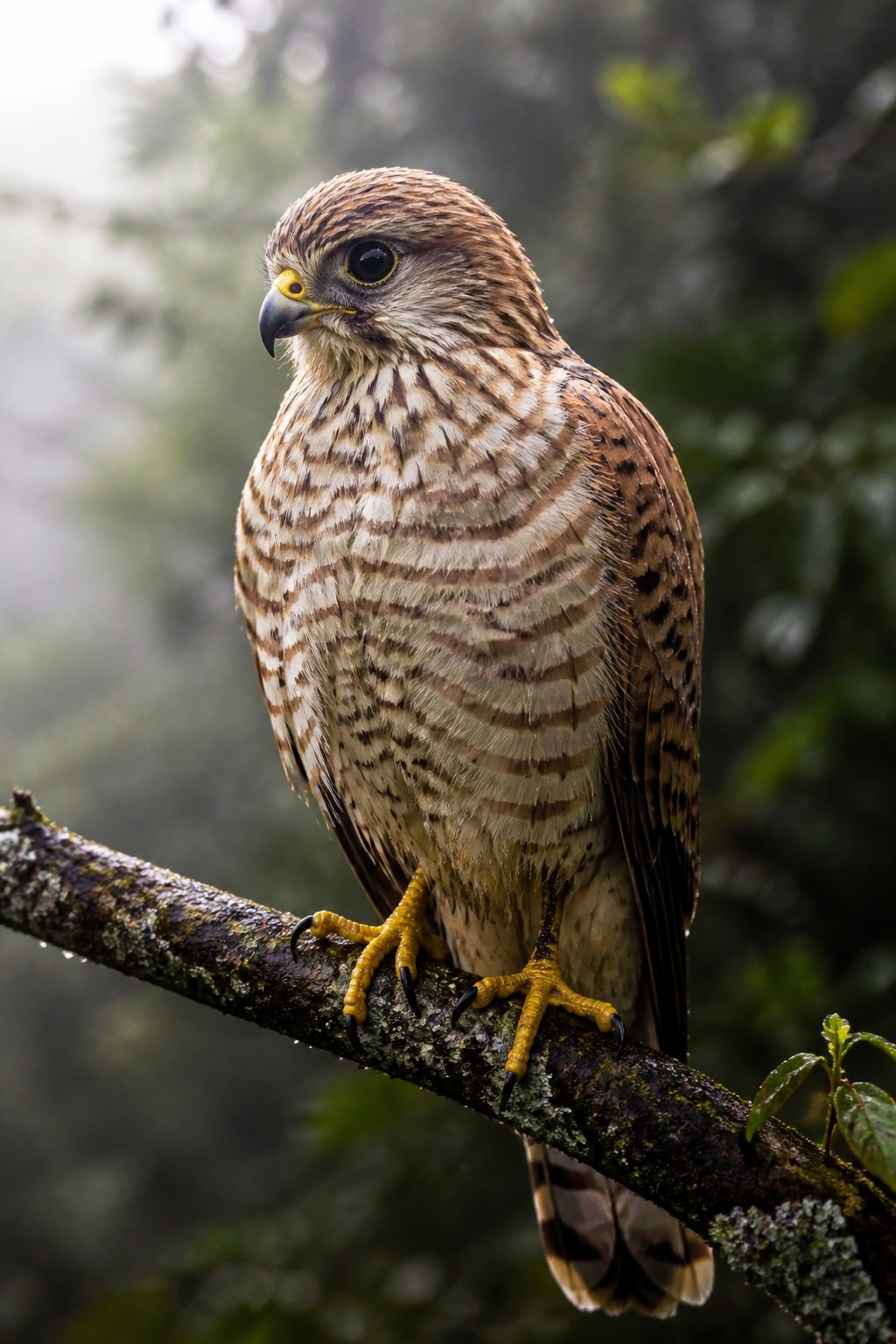
- Low point: 4 wild birds in 1974 (6 known individuals counting captives) — the rarest bird alive at that moment.
- Main killers: DDT spraying (1948–1970), loss of ~98% of native forest, and introduced mongoose, cats and monkeys.
- The rescuer: Carl Jones, a Welsh biologist with no PhD, who took over the doomed-looking programme in 1979.
- Turning point: a free-living, self-sustaining population by 1994 — the year “saved” became a real word.
- Status today: listed as Endangered again, national bird of Mauritius since March 2022, and quietly slipping in places.
Key Facts
- The Mauritius kestrel fell to just 4 wild birds in 1974 (6 known individuals counting captives), then called the rarest bird in the world.
- The main killers were DDT spraying (1948-1970), the loss of about 98% of native forest, and introduced mongoose, cats and monkeys.
- Carl Jones, a Welsh biologist, took over the recovery programme in 1979 and won the Indianapolis Prize in 2016.
- A free-living, self-sustaining population was reached by 1994; the kestrel became the national bird of Mauritius in March 2022.
- The rescue toolkit was double-clutching, artificial incubation and hand-rearing, cross-fostering, hacking releases, and predator control with PVC nest boxes.
In short: The Mauritius kestrel crashed to just four wild birds in 1974, hit by DDT, forest loss and introduced predators. Welsh biologist Carl Jones took over in 1979 and, using techniques like double-clutching and cheap PVC nest boxes, rebuilt a self-sustaining wild population by 1994. It is now the national bird of Mauritius.
The day only four kestrels were left

Picture a raptor built for a single forest on a single island, and then picture that forest almost gone. That was the Mauritius kestrel in 1974. Surveys could find just four wild birds. Two more sat in a fledgling captive programme. Six known individuals of an entire species, on a scrap of upland forest in the southwest of the island.
No bird on Earth was rarer. Ornithologists at the time openly wrote the species off; the working assumption was that documenting its final years was the most anyone could do. The kestrel had one thing going for it, and it wasn’t obvious yet: it had survived catastrophe before.
How a paradise ate its own falcon
Mauritius is famous for killing the dodo. The kestrel nearly became the sequel. Three forces did the damage, and they stacked.
First, chemistry. From 1948 to around 1970, Mauritius sprayed DDT hard to fight malaria. As with birds of prey across the world in that era, the pesticide thinned eggshells and poisoned the food chain — a textbook case of DDT wrecking a bird’s ability to breed. Second, the forest itself vanished. Sugar, settlement and logging erased the native woodland until only about 2% of it survived, leaving the kestrel a shrinking island within an island (the same fragmentation trap that hollows out wildlife everywhere edges eat into habitat — see the edge effect). Third, invaders. Mongooses, feral cats and crab-eating macaques — none native to Mauritius — raided nests and ate eggs, chicks and sitting females.
A forest falcon that nests in tree cavities, on an island now full of climbing egg-thieves, with poisoned prey. It is almost a designed extinction.
{IMAGE_2}
The Welsh biologist who ignored the experts
The American ornithologist Stanley Temple, then working through Cornell and the Peregrine Fund, launched the first captive-breeding attempts in the early 1970s. The early results were bleak enough that some of the field’s biggest names concluded the money was wasted. The influential conservation biologist Norman Myers argued publicly that the kestrel was, in effect, not worth saving — that scarce funds should go to species with better odds.
Carl Jones disagreed. A young Welshman who had bred kestrels as a hobby and arrived on Mauritius in the late 1970s, he took charge of the programme in 1979 with more conviction than credentials. Turns out conviction mattered. Jones would spend the next four decades on it, later helping build the Mauritian Wildlife Foundation and, in 2016, winning the Indianapolis Prize — conservation’s top honour — largely for this bird.
Here is the uncomfortable truth the experts missed: the kestrel wasn’t beyond saving, it was beyond saving cheaply. It needed someone willing to do the unglamorous, hands-on work every breeding season for decades — and almost nobody in the field wanted that job.
Five field tricks that pulled a species back
There was no single miracle. The recovery came from stacking practical techniques, refining each one season after season until the birds started winning more nests than they lost.
- Double-clutching: remove the first clutch so the female lays a second — two broods a year instead of one.
- Artificial incubation & hand-rearing: pull vulnerable eggs and chicks, raise them safe from predators, then return young birds to the wild.
- Cross-fostering: place eggs or chicks under other pairs to spread the parenting load.
- Hacking releases: release captive-reared young from feeding stations so they learn to fly and hunt free.
- Predator control + PVC nest boxes: guard nests from cats and monkeys, and give birds artificial cavities.
The nest box detail is my favourite, because it is so small. Early wooden boxes rotted and sweated in the island humidity. The team switched to simple PVC pipes — a few dollars each — and fledging rates climbed. A species clawed back partly on plumbing offcuts.
And the feeding stations produced one of conservation’s great images: hand-reared kestrels learned to answer a whistle. One researcher has described more than two dozen wild birds swooping in to a single call — falcons that a decade earlier had numbered four.
Why didn’t inbreeding finish them off?
This is the part almost no popular account tells, and it is the most interesting science in the whole story. Rebuild a species from a handful of survivors and you should get inbreeding depression: sickly birds, failed eggs, a slow genetic collapse. The Mauritius kestrel mostly dodged it. Why?
Because the bottleneck of 1974 was not its first. In a 2001 paper in the journal Nature, geneticists Robert Nichols, Michael Bruford and Jim Groombridge — working through Cardiff University and the Zoological Society of London’s Institute of Zoology — showed that Mauritius’s long volcanic history had repeatedly squeezed the kestrel population small over thousands of years. Each squeeze acted like a filter. The most harmful recessive genes were exposed and purged again and again, long before humans arrived. By the time the population crashed to four, much of the genetic dynamite had already been defused.
It is a humbling twist: the same violent geology that made Mauritius so isolating may be the reason its falcon could survive a bottleneck that would have doomed almost any mainland bird. Later work by researchers including the University of Kent and the Mauritian Wildlife Foundation did document some loss of genetic variation in the reintroduced population — the escape was real, but not total.
How was the Mauritius kestrel saved from extinction — the numbers
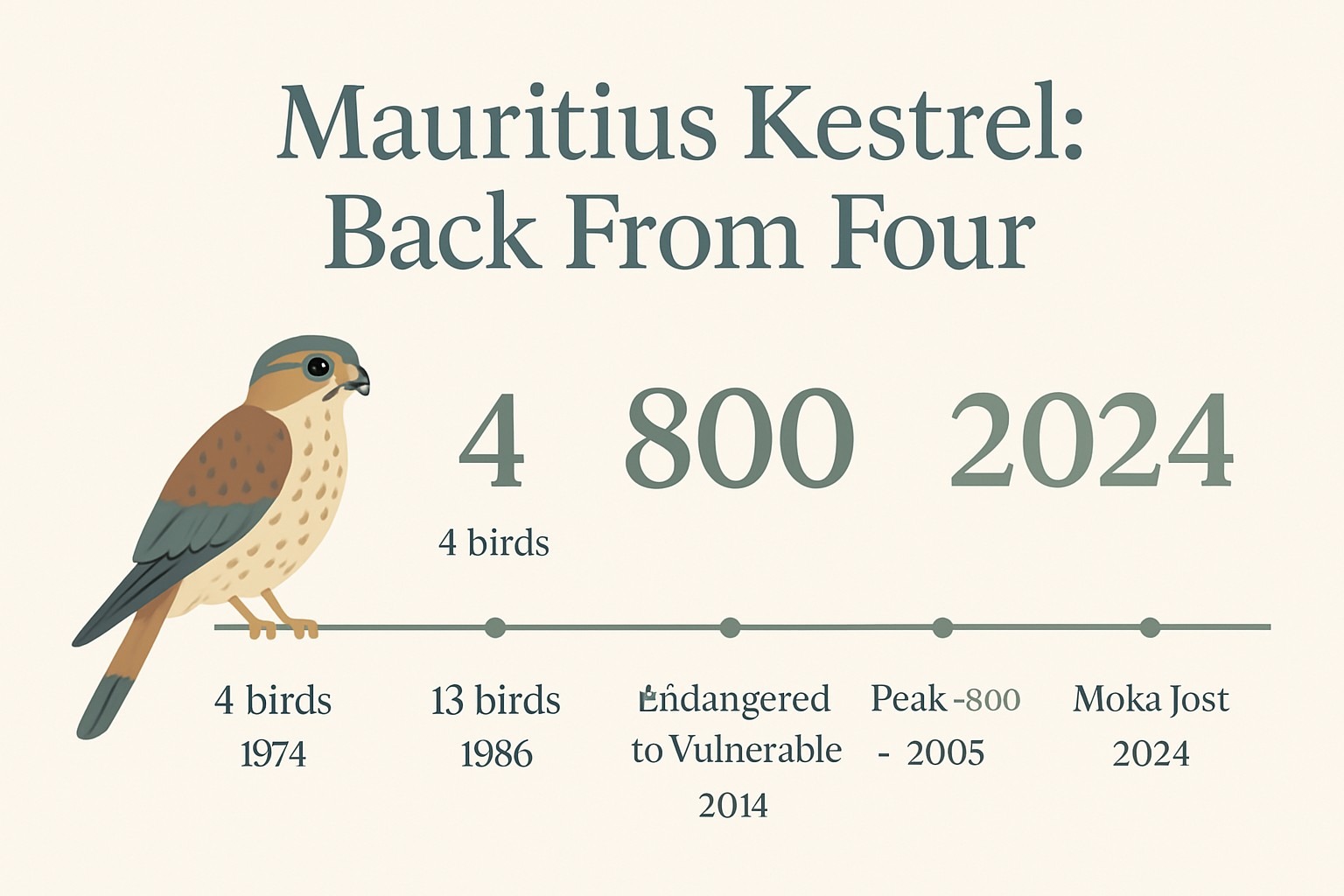
String the milestones together and the arc is astonishing. From 4 wild birds in 1974, the population reached about 13 by the mid-1980s, then climbed through captive breeding and hacking releases to roughly 200 breeding pairs by the mid-1990s, peaking near 800 individuals around 2005. In 1994 the species was downlisted from Critically Endangered to Endangered — the moment biologists judged the population free-living and self-sustaining.
But how many are there right now? Honestly, sources disagree, and no one likes to admit it. Different organisations count differently, at different times, so here is the discrepancy laid out plainly rather than pretending it away.
| Estimate / source | Figure | Note |
|---|---|---|
| Wild birds, 1974 | 4 | 6 known counting captives — the true low point |
| Peak, around 2005 | ~800 | Often quoted as the high-water mark |
| Peregrine Fund estimate | ~600–800 | Broad recent range |
| ZSL / recent monitoring | ~300 | Lower, reflecting decline since the peak |
Read the table honestly and the message isn’t “300 vs 800 — who’s right.” It is that the trend since the mid-2000s peak has been downward, which is exactly why BirdLife International’s assessment moved the kestrel back up to Endangered.
The success that nearly undid itself
In 2014 the kestrel was downlisted again, from Endangered to Vulnerable — celebrated as proof the rescue had worked. Then something quietly perverse happened. Success loosened the grip. With the species declared safer, donor attention drifted, intensive monitoring lapsed for years, and the falcon’s outlying sub-populations were left largely to fend for themselves.
They didn’t cope. The western population thinned. And in 2024, monitoring confirmed that a reintroduced sub-population in the Moka range had winked out entirely — locally extinct, on a species we supposedly saved. The kestrel has since been re-uplisted to Endangered.
And here is the verdict this whole story earns: the Mauritius kestrel was not saved once in 1994 — it has to be saved again every single year, and the years the funding relaxed are precisely the years it slipped back. Conservationists at the Mauritian Wildlife Foundation put it bluntly: with a species this dependent on human management, you cannot take your eyes off the ball. That is the real, uncomfortable lesson buried under the feel-good headline.
Quick answers
Is the Mauritius kestrel extinct? No. It survives as a managed wild population of a few hundred birds — but it is listed as Endangered, and one reintroduced sub-population was confirmed lost in 2024.
How many were there at the lowest point? Four wild birds in 1974, or six counting the two in captivity — the rarest bird in the world at that instant.
Who saved the Mauritius kestrel? Primarily Carl Jones and the team that became the Mauritian Wildlife Foundation, building on early work by Stanley Temple. It took decades of hands-on breeding and release.
Why is it the national bird of Mauritius? In March 2022 the island named this island-endemic raptor its national bird — a symbol of what conservation can pull back from the edge (a comeback echoed by other tiny-population rescues like the orange-bellied parrot).
Sources and notes
- Jones, C.G. et al. (1995), “The restoration of the Mauritius Kestrel population,” Ibis — Durrell Wildlife Conservation Trust / Mauritian Wildlife Foundation.
- Nichols, R.A., Bruford, M.W. & Groombridge, J.J. (2001), “‘Ghost’ alleles of the Mauritius kestrel,” Nature — Cardiff University / Institute of Zoology, ZSL.
- Ewing, S.R. et al. (2008), “Inbreeding and Loss of Genetic Variation in a Reintroduced Population of Mauritius Kestrel,” Conservation Biology — University of Kent / MWF.
- BirdLife International (2024), Falco punctatus Species Factsheet, BirdLife DataZone — current IUCN status: Endangered.
- Mauritian Wildlife Foundation project reports, 1973–present.
The kestrel’s real lesson is not “look what we saved.” It is that saving anything is a verb, not a trophy — a thing you keep doing, or watch quietly undo itself. Four birds became hundreds because a handful of people refused to stop showing up. The moment the world decided the job was finished, a corner of that success began to slip away. Keep that in mind the next time a rescued species is called a happy ending.
Frequently Asked Questions
Q: How close did the Mauritius kestrel come to extinction?
Extremely close. Surveys in 1974 could find just four wild birds, with two more in a fledgling captive programme, six known individuals of the entire species. It was called the rarest bird in the world, and many ornithologists openly wrote it off, assuming that documenting its final years was the most anyone could do.
Q: What nearly wiped out the Mauritius kestrel?
Three forces stacked up. DDT sprayed against malaria from 1948 to around 1970 thinned eggshells and poisoned prey. Sugar, settlement and logging erased native woodland until only about 2% survived. And introduced mongooses, feral cats and crab-eating macaques raided the tree-cavity nests, eating eggs, chicks and sitting females on an island with no defences.
Q: Who saved the Mauritius kestrel and how?
Carl Jones, a young Welsh biologist who had bred kestrels as a hobby, took charge in 1979 against expert advice that the money was wasted. The recovery stacked practical techniques: double-clutching, artificial incubation and hand-rearing, cross-fostering, hacking releases from feeding stations, and predator control with cheap PVC nest boxes that resisted the island’s humidity.
Q: Why didn’t inbreeding destroy the recovered population?
Because the 1974 bottleneck was not its first. A 2001 Nature paper by geneticists Robert Nichols, Michael Bruford and Jim Groombridge showed Mauritius’s long volcanic history had repeatedly squeezed the kestrel population small over thousands of years. Each squeeze exposed and purged the most harmful recessive genes, leaving the survivors relatively cleansed of them.
Illustrations are AI-generated. Article fact-checked and human-edited. Our editorial standards.