Japan’s School Lunches Are Teaching More Than Nutrition
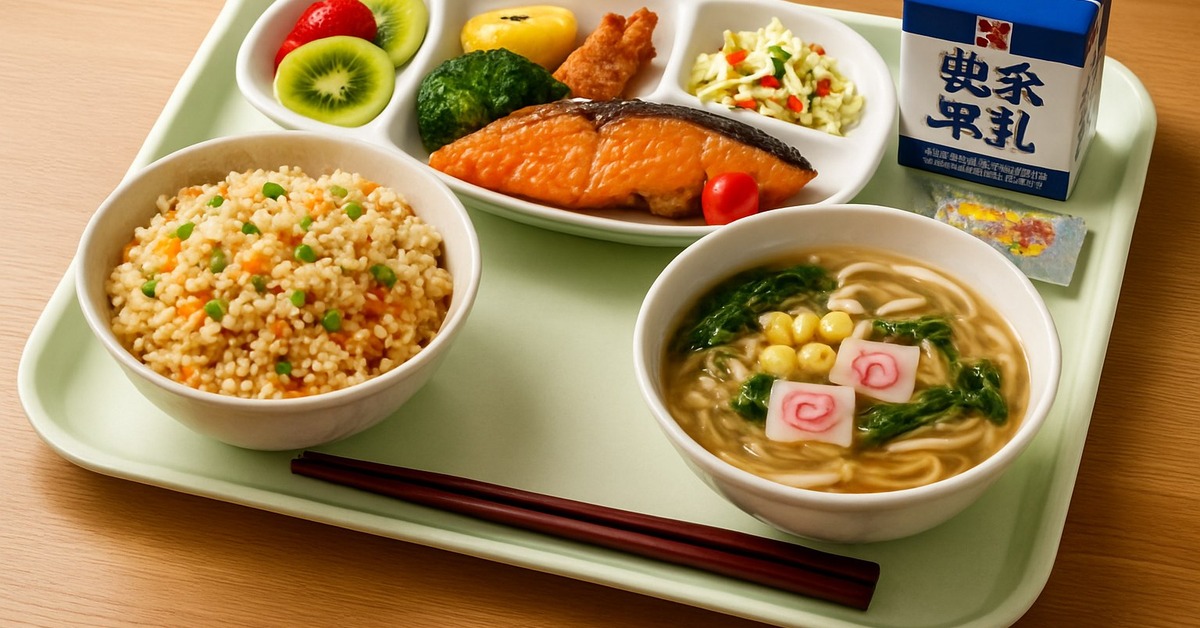
Here’s the thing about Japan school lunch — kyushoku — that nobody mentions when they cite the statistics: it has been running, without interruption, since 1954, and the children participating in it have almost no idea they’re inside a decades-long experiment in civic formation. Grilled mackerel. Rice. Miso soup. Pickled daikon. A ten-year-old in Kyoto sets her tray down with two hands, and somewhere in that gesture is seventy years of deliberate design.
Every school day, roughly 30,000 public schools across Japan serve a hot, scratch-cooked meal to nearly 10 million children. No vending machines. No processed snacks. No soda. Ingredients are locally sourced, broths hand-prepared, menus calibrated by certified nutritionists called eiyoshi. But the deeper story isn’t on the tray — it’s in everything that happens before the first bite is taken, and long after the bowls are cleared.
How Kyushoku Built a Nation’s Food Culture
Kyushoku’s origins reach back further than 1954. Japan’s first recorded school meal was served in 1889, in Tsuruoka, a small city in Yamagata Prefecture, where a Buddhist temple school provided lunch to impoverished children arriving too hungry to concentrate. That early experiment stayed local for decades. It wasn’t until the devastation of World War II, and the acute malnutrition that followed, that the national government acted. In 1947, with support from UNICEF and American aid organizations, school lunches were reintroduced in urban areas.
The School Lunch Act of 1954 formalized the system nationwide, making hot meals a legal entitlement for all public school students. Overnight, the lunchroom became a civic institution. What’s remarkable is how little the philosophy has drifted since. Japan’s Ministry of Education doesn’t treat kyushoku as a welfare program or a logistical convenience — it treats it as curriculum. Official guidelines, updated most recently in 2008, classify school lunch as part of shokuiku, or “food education,” a framework embedded in Japan’s Basic Act on Food Education, passed in 2005. Children aren’t just fed. They’re taught to understand what they’re eating, where it came from, and why it matters.
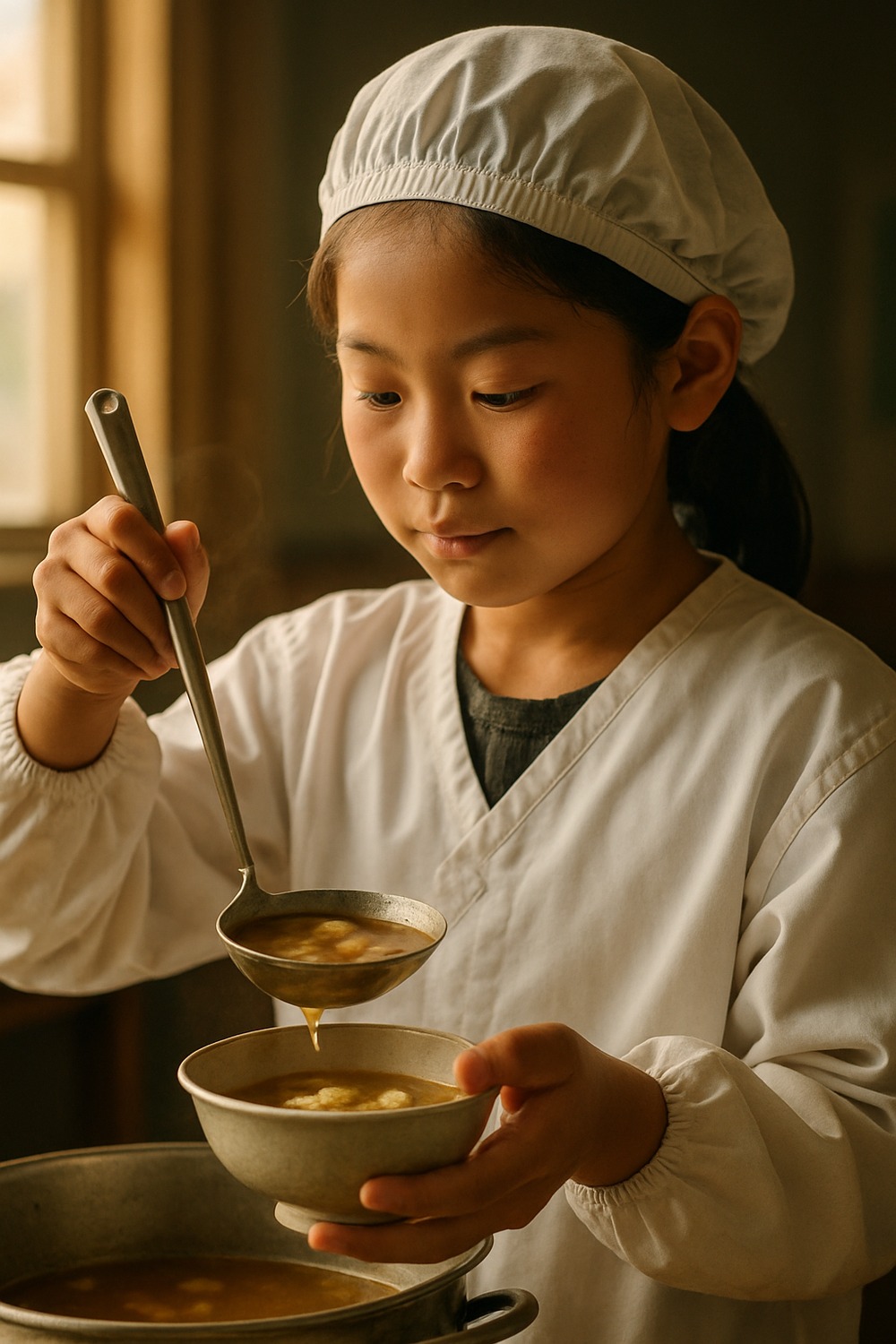
Visit a Tokyo elementary school on any weekday and you’ll see it clearly. Around 12:30 p.m., a group of eight-year-olds pulls on white aprons and hairnets and begins portioning the day’s meal into individual bowls, moving carefully, quietly. Their classmates wait. The ritual takes about fifteen minutes. Nobody complains.
The Radical Idea Hidden Inside Every Serving
Serving lunch — called toban, or “duty” — rotates through every student across the school year. No child is exempt. No child is assigned permanently. Teachers eat the same meal, at the same desks, in the same room as their students. There’s no separate faculty lounge, no hierarchy at mealtimes. The entire class eats together, and the meal is identical for everyone.
This structural equality is deliberate. It mirrors a broader cultural principle — kyodo seikatsu, or communal living — that runs through Japanese public education like a thread. Interestingly, it parallels the kind of close social bonding we see in other species; anyone who’s read about why a baby monkey clings to a surrogate figure for years will recognize how deeply early rituals of proximity and shared routine shape attachment and trust. The kyushoku table is doing something similar — quietly, every single day.
The nutritional outcomes are measurable. Japan’s childhood obesity rate in 2022 sat at approximately 9.5% — among the lowest in the developed world, compared to 19.7% in the United States (CDC, 2022) and 23% in the United Kingdom (NHS, 2023). Researchers at Keio University published findings in 2019 showing that students who participated in structured kyushoku programs had significantly higher vegetable consumption and lower rates of food neophobia (researchers actually call this the “food rejection” problem) than peers in countries without similar programs.
Ask a Japanese adult what they remember about kyushoku and they almost never talk about nutrition. They talk about the smell of soup warming in the corridor. The weight of the serving ladle. The first time they spilled miso broth on someone’s desk. Memory lives in the body. Japan’s lunch system figured that out decades before nutritional science caught up.
What the Rest of the World Is Getting Wrong
Why does this gap matter? Because the difference isn’t nutritional philosophy — it’s structural ambition.
School food policy in most countries treats lunch as a problem to be managed — a budget line, a health intervention, an allergy liability. Japan treats it as a lesson plan. A 2023 report by the BBC Future examining school food systems across 12 countries found that nations with centralized, hot-meal programs — South Korea, Finland, Brazil — consistently outperformed those with canteen-style or packed-lunch models on both nutritional outcomes and student concentration scores. Japan, unsurprisingly, topped multiple categories. But the report also noted that Japan’s success isn’t easily transplanted: it depends on a cultural scaffolding — communal responsibility, food literacy, respect for kitchen labor — that can’t be legislated into existence overnight.
What often gets missed in international discussions of Japan school lunch and kyushoku is this: the system isn’t just producing healthy eaters. It’s producing people who know how to feed others. By the time a Japanese child completes elementary school, they’ve served hundreds of meals, cleaned dozens of surfaces, and learned to handle hot soup without instruction beyond “be careful.” That’s not a metaphor for civic responsibility. It is civic responsibility, made physical and repeated until it becomes instinct. Countries that have tried to import elements of kyushoku — notably South Korea, which adopted a similar nationwide school lunch framework in the 1980s — have seen measurable improvements in childhood nutrition within a generation.
A system this quietly effective, running this long, with this much evidence behind it — the countries still treating school lunch as a welfare measure are going to look back on this era with some embarrassment.
The Japan School Lunch System’s Quiet Scientific Backbone
Behind every kyushoku menu is a certified school nutritionist — an eiyoshi — who designs meals according to Ministry of Education nutritional standards updated every five years. These aren’t guidelines. They’re mandates. Each meal must hit specific targets for protein, calcium, iron, vitamins, and total caloric intake, calibrated to the age group being served. In 2018, the National Institute of Health and Nutrition in Tokyo published a longitudinal analysis tracking 4,200 students over seven years, finding that consistent kyushoku participation correlated with reduced sodium intake in adolescence — with direct implications for Japan’s historically high rates of hypertension. The system, in other words, is doing epidemiological work without calling itself medicine.
Seasonal ingredients are woven into every menu with precision. Spring brings bamboo shoots and fresh tofu; autumn introduces sweet potato and persimmon; summer menus feature cold noodle dishes. By 2020, approximately 75% of ingredients used in Tokyo’s public school lunch programs were sourced from within the prefecture, according to the Tokyo Metropolitan Board of Education. This isn’t nostalgia — it’s functional food education. Children learn what grows when, and why eating with the seasons produces food that tastes different from food that doesn’t.
And nutritionists working within the system describe a striking feedback loop: children who serve the food become more willing to eat it. Ownership changes appetite. Something about ladling miso soup into a bowl makes a child curious about what’s in it — and less likely to push it to the side untouched.
Can the System Survive the Pressures It’s Facing Now?
Japan’s kyushoku system isn’t frozen in 1954. An aging population of school cooks — many of whom have worked in school kitchens for three or four decades — is retiring faster than they can be replaced. Rural depopulation is shrinking student numbers in some districts to the point where dedicated kitchen facilities can no longer be economically justified. A growing number of municipalities have quietly shifted from jikyu (self-cooked, on-site preparation) to kyushoku center models, where meals are cooked centrally and transported by truck to multiple schools. Critics argue this erodes the freshness and community connection that make kyushoku work. Defenders say it’s the only realistic option as budgets tighten.
The deeper pressure is cultural. Japan’s younger generation is eating more Western food than any previous cohort — burgers, convenience store sandwiches, instant noodles — and childhood food preferences are shifting. A 2021 survey by the Japan School Lunch Association found that 34% of elementary students listed “bread-based meals” as their preferred kyushoku option, up from just 18% in 2001. That’s not a catastrophe. But it’s a signal worth watching. A system that works partly because it’s culturally legible — serving food children recognize from home — has to adapt as home kitchens change.
In Kyoto’s Fushimi Ward, a school nutritionist named Yamamoto Keiko has spent seventeen years adjusting menus to honor both tradition and shifting palates. On a Tuesday in November, she serves dashi-braised root vegetables alongside a small portion of whole-grain rolls. The children eat both.
She considers this a victory.
How It Unfolded
- 1889 — A Buddhist temple school in Tsuruoka, Yamagata, serves Japan’s first recorded school lunch to children too hungry to study.
- 1947 — Post-war malnutrition prompts the government, with UNICEF support, to reintroduce school meals in Tokyo, Osaka, and Kanagawa.
- 1954 — The School Lunch Act passes, making hot, nutritionally regulated meals a legal entitlement in all Japanese public schools.
- 2005 — Japan’s Basic Act on Food Education formally classifies kyushoku as part of shokuiku, embedding it in national educational law for the first time.
By the Numbers
- ~30,000 public schools across Japan serve kyushoku daily, feeding approximately 9.8 million children (Japan Ministry of Education, 2022).
- Japan’s childhood obesity rate: 9.5% in 2022 — compared to 19.7% in the United States in the same year (CDC / Ministry of Health, Labour and Welfare).
- 75% of ingredients used in Tokyo public school lunches were locally sourced within the prefecture as of 2020 (Tokyo Metropolitan Board of Education).
- 34% of Japanese elementary students preferred bread-based kyushoku options in 2021, up from 18% in 2001 — a near-doubling in two decades (Japan School Lunch Association).
- Japan has maintained a mandatory school nutritionist program since 1954 — over 70 years of uninterrupted, professionally supervised school food.
Field Notes
- In 2017, researchers at Waseda University documented that children who took part in lunch duty — portioning and serving food — consumed significantly more of the dishes they served compared to classmates who did not, suggesting that food preparation involvement directly reduces food rejection behavior in children aged 6–12.
- Japan’s school lunch menus are publicly posted in advance and sent home to parents each month — not as a courtesy, but so families can avoid serving the same dish at dinner, deliberately maximizing children’s dietary variety across the day.
- Some rural schools in Japan still practice zenkoku kyushoku — a tradition where students visit the farm that supplied their meal’s vegetables, completing a literal farm-to-table educational loop that urban schools can rarely replicate.
- Researchers still can’t fully explain why Japan’s kyushoku model consistently produces lower food neophobia scores than comparable Western lunch programs, even when controlling for parental food habits — suggesting the school setting itself is doing developmental work that scientists don’t entirely understand yet.
Frequently Asked Questions
Q: What exactly is Japan school lunch kyushoku, and who pays for it?
Kyushoku is Japan’s national school lunch program, operating in public elementary and middle schools since the School Lunch Act of 1954. Meals are cooked from scratch daily by licensed kitchen staff, following nutritional mandates set by the Ministry of Education. Costs are split: families pay for ingredients (roughly ¥250–300 per meal, or about $2 USD), while local governments cover labor, facilities, and equipment. Low-income families receive subsidies, and no child is turned away.
Q: Do students really serve their own lunch — and how does that actually work?
Yes, and it’s more structured than it sounds. Each week, a rotating group of students called toban — typically four to six per class — puts on white aprons and hairnets, collects the prepared food from the kitchen, and portions it into individual bowls for their classmates. They also clean up afterward. Teachers participate in the meal at the same table. The rotation ensures every student takes a turn across the school year, regardless of academic ability or social standing.
Q: Is kyushoku actually responsible for Japan’s low childhood obesity rates, or is something else going on?
Kyushoku is one factor among several — Japan’s broader food culture, walking-to-school norms, and lower rates of ultra-processed food consumption all contribute. Dismissing the lunch program’s role, though, would be a mistake. A 2019 Keio University study tracking thousands of students over multiple years found that consistent kyushoku participation independently predicted lower obesity risk and greater vegetable consumption in adolescence. The structure of the meal — portioned, balanced, communal — removes many of the conditions that drive overeating in less structured environments.
Editor’s Take — Sarah Blake
What gets me about kyushoku isn’t the nutrition data — impressive as it is. It’s the structural insight buried inside it: that children who handle food become curious about it, and children who serve others become responsible for them. Those aren’t side effects. They’re outcomes that took seventy years of daily repetition to produce. Most countries are still debating whether school lunch is a welfare measure or a health policy. Japan settled that argument in 1954 and moved on to building something altogether more ambitious.
Japan’s school lunch system doesn’t make headlines. It doesn’t need to. Every weekday, in every public school, it operates with the quiet institutional confidence that only comes from seven decades of unbroken practice. The question worth sitting with isn’t whether other countries could copy it — South Korea already has, and Brazil is trying. The question is what we reveal about our own values when we hand a child a tray of processed food and call it lunch. Somewhere in Kyoto right now, a ten-year-old is ladling miso soup with two careful hands, learning something that no exam will ever test.