65 Days Without Sun: Life Inside Alaska’s Polar Night
For 65 days, the sun doesn’t set in Utqiagvik. It just stops showing up. And the town of 5,000 people doesn’t blink.
Utqiagvik sits at 71 degrees north latitude — the northernmost city in the United States. From mid-November to late January, the sun never clears the horizon. Not once. It’s the kind of fact that sounds like a riddle until you start pulling at it, and then you realize the riddle isn’t about darkness at all. It’s about what people do inside it.
Key Facts
- Utqiagvik sits at 71 degrees north latitude — the northernmost city in the United States.
- The polar night runs for 65 consecutive days each winter, from around November 18 to January 23, the longest stretch of any U.S. city per NOAA data.
- Utqiagvik’s population is roughly 5,000 year-round, and the city was officially renamed from Barrow in 2016.
- Average January temperatures hover around -14°F (-26°C), with wind chills routinely pushing below -50°F; the record low is -56°F (-49°C), recorded in February 1924.
- The Iñupiat have lived in the area for over 1,500 years, with the original name Utqiagvik translating roughly to the place where snowy owls are hunted.
In short: Utqiagvik, Alaska — the northernmost U.S. city at 71°N — experiences 65 consecutive days of polar night each winter (about Nov 18 to Jan 23). Population is roughly 5,000. January averages -14°F. The Iñupiat have inhabited the region for over 1,500 years, and the city was officially renamed from Barrow in 2016.
What Polar Night Alaska Actually Looks Like
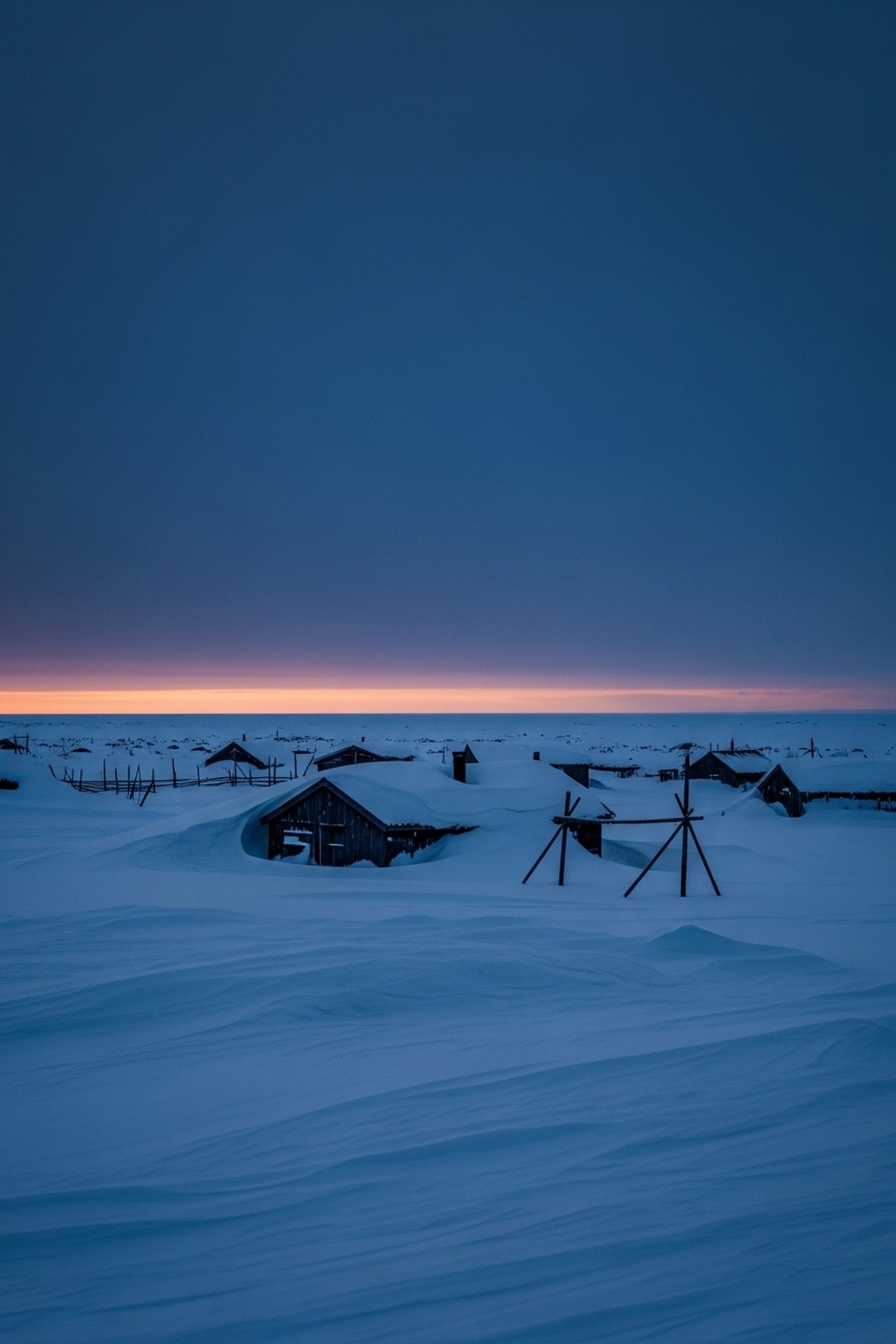
The darkness isn’t total. That’s the first thing researchers and residents will correct you on, and it’s worth correcting. For two or three hours each day, the sky moves through deep blue and bruised purple — what atmospheric scientists classify as civil or nautical twilight. Researcher Diana Savulescu, who has studied circadian disruption in Arctic populations, draws a sharp line between “polar night” and total blackness. Polar night technically just means the sun stays below the horizon for 24 continuous hours or more. The distinction matters more than you’d think.
So what does 65 days of that twilight actually do to a human brain?
The moon still runs its own schedule. On clear nights, the aurora borealis fills the entire sky — green and violet and white, moving like something with a pulse. There are nights in Utqiagvik that are genuinely, breathtakingly beautiful. That part rarely makes the headlines.
The Iñupiat Have Always Known How to Do This
It is sometime before the 6th century. People are already living here. Already building. Already naming things.
Long before anyone called it Barrow — the name assigned by Western cartographers and only officially dropped in 2016 — the Iñupiat had already spent over 1,500 years making a life on this ground. The town’s original name, Utqiagvik, likely translates to “the place where snowy owls are hunted.” That name carries knowledge. It tells you what lives here, what’s edible, what matters. Around the long darkness, the Iñupiat built storytelling seasons, communal feasts, games, ceremonies — a whole architecture of winter that turned the polar night into something livable. Something structured. You can read more about communities that thrive in extreme environments over at this-amazing-world.com.
This wasn’t survival mode. It was adaptation so complete it became culture.
The darkness wasn’t an enemy to outlast. It was a season to inhabit. And that distinction — between enduring something and actually living inside it — is exactly what outside observers keep missing.
What Happens to Your Body When the Sun Vanishes
The human body runs on light. More specifically, on the 24-hour rhythm of brightness and dark that governs melatonin production, cortisol release, sleep architecture, mood, and metabolism. Knock that cycle off for a few days and you feel jet-lagged. Knock it off for 65 days of polar night Alaska and the effects compound in ways scientists are still working to map. Studies on Arctic populations show elevated rates of seasonal depression, sleep disruption, and what’s clinically called “desynchronosis” — your internal clock losing its anchor point. The body doesn’t break.
It drifts.
That last detail kept me reading for another hour, because the drift isn’t always catastrophic. Some long-term Utqiagvik residents describe their bodies eventually learning a looser relationship with time altogether — sleep when you’re tired, eat when you’re hungry. The rigid logic of sunlit civilization softens into something more fluid. Which raises the obvious question: is that adaptation, or just a different way of being oriented?
The Town That Refuses to Slow Down
Schools open. Businesses run. Kids play outside in temperatures that routinely hit -30°F, bundled so thoroughly that only their eyes show.
The local government operates. Planes land and depart at Wiley Post–Will Rogers Memorial Airport — one of the only connections to the outside world, since there are no roads linking Utqiagvik to the rest of Alaska. During polar night Alaska, that airport becomes something closer to a lifeline: food, medicine, mail, everything that can’t be made or grown locally arrives through it. Grocery prices reflect the math of that isolation. A gallon of milk can cost more than double what it does in Anchorage. Fresh produce is a genuine luxury.
The logistics of keeping a town alive above the Arctic Circle during the coldest, darkest stretch of year are staggering. And then there’s what happens when the sun finally comes back.
The Return of the Sun Is a Real Event
The first sunrise after 65 days isn’t just noticed. It’s celebrated.
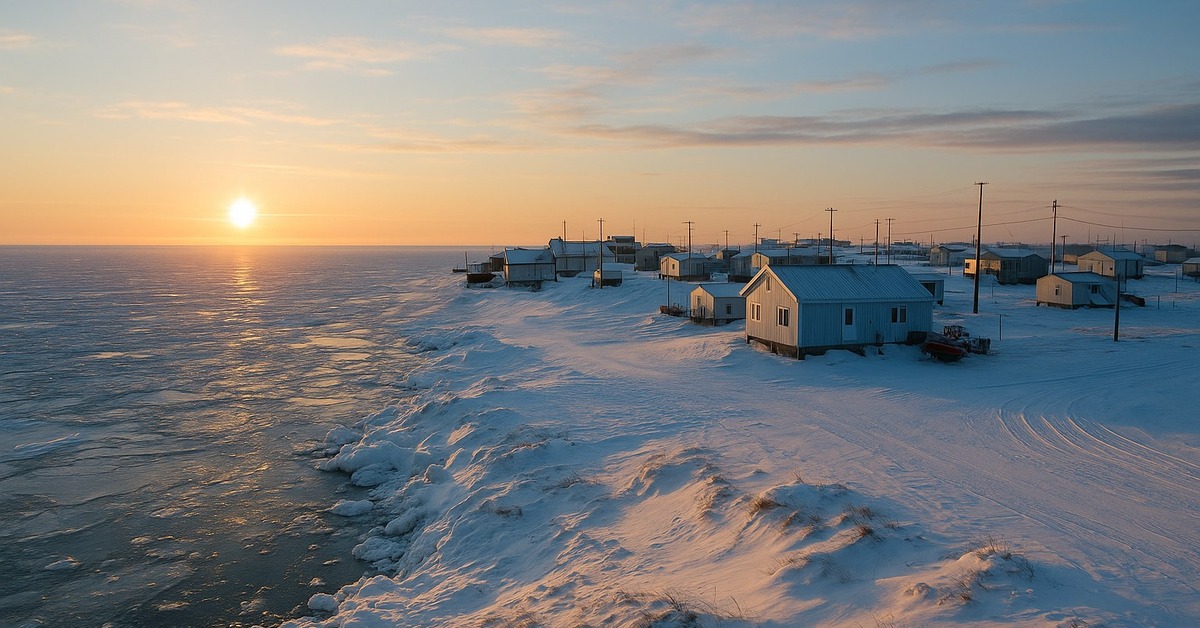
In Utqiagvik, the return of the sun draws community gatherings, news coverage, and a kind of collective exhale that’s hard to translate if you haven’t lived it. Residents describe the first sliver of orange on the horizon as viscerally emotional — people cry, photograph it, stand outside in brutal cold just to feel the light touch their face for a few seconds. After nearly ten weeks without it, sunlight stops being background noise and becomes an event with weight.
It also resets everything physiologically, almost immediately. Melatonin levels shift with the first real light exposure. People report sleeping better, thinking more clearly, feeling more like themselves within days of the sun’s return. The body was waiting the whole time. It knew exactly what it needed.
By the Numbers
- 65 consecutive days of polar night each winter, running from around November 18 to January 23 — the longest stretch of any U.S. city, per NOAA data verified annually.
- Average January temperatures hover around -14°F (-26°C), with wind chills that routinely push the felt temperature below -50°F. Exposed skin can begin to freeze in under two minutes.
- The record low: -56°F (-49°C), recorded in February 1924.
- Population sits at roughly 5,000 year-round — larger than many county seats in the lower 48, and one of the oldest continuously inhabited Arctic settlements in North America. That number is easy to gloss over, but sit with it for a second.
Field Notes
- Aurora borealis visible roughly 100 nights per year, with polar night offering the darkest viewing conditions. Some residents say they stop noticing it entirely — the way you stop noticing a familiar smell. It just becomes the sky.
- Utqiagvik also swings the other direction: roughly 80 consecutive days of polar day each summer, when the sun never sets. There’s no comfortable middle ground here. Just two extremes and an abrupt flip between them.
- The 2016 name change from Barrow back to Utqiagvik passed with about 55% of the vote. Not unanimous. That detail matters — it reflects the real, ongoing complexity of identity in a community shaped by both Indigenous culture and over a century of outside influence. It wasn’t a clean break. It wasn’t supposed to be.
Why This Story Is About More Than Darkness
Polar night Alaska is really a story about adaptation — biological, cultural, psychological, all of it tangled together. It challenges every assumption most of us carry about what a “normal” environment requires, what a functioning community needs to keep going, what the human body can learn to accept on its own terms.
The Iñupiat didn’t just endure the polar night for 1,500 years. They built language around it. Rituals inside it. An entire cosmology that made sense of a world where the sun goes away for two months and comes back. That’s not a coping mechanism dressed up in ceremony.
That’s civilization.
And in an era when researchers are scrambling to understand seasonal depression, circadian disruption, and the psychological toll of artificial light — the communities that have lived under polar night for millennia might already hold answers that no laboratory has fully explored. The knowledge exists. It’s been here the whole time. It just hasn’t always been listened to.
Sixty-five days of darkness sounds like a problem to be solved. In Utqiagvik, it’s a season to be lived — with community, with ritual, with the quiet understanding that the sun always comes back. What looks extreme from the outside turns out to be, for the people who’ve always called this place home, just winter. There’s more where this came from at this-amazing-world.com — and the next one is stranger.
Frequently Asked Questions
Q: How long does Utqiagvik go without sunlight?
For 65 consecutive days each winter — roughly November 18 to January 23 — the sun never clears the horizon in Utqiagvik. That makes it the longest polar-night stretch of any U.S. city, per NOAA data verified annually. The darkness isn’t total: for two or three hours each day, the sky moves through deep blue and bruised purple — what atmospheric scientists classify as civil or nautical twilight. Polar night technically just means the sun stays below the horizon for 24 continuous hours or more.
Q: Where exactly is Utqiagvik and how cold does it get?
Utqiagvik sits at 71 degrees north latitude, the northernmost city in the United States, with a year-round population of roughly 5,000. Average January temperatures hover around -14°F (-26°C), with wind chills that routinely push the felt temperature below -50°F. Exposed skin can begin to freeze in under two minutes. The record low is -56°F (-49°C), recorded in February 1924. The town was officially renamed from Barrow back to Utqiagvik in 2016, restoring its Iñupiat name.
Q: How have the Iñupiat lived in this environment for so long?
The Iñupiat have spent over 1,500 years making a life on this ground. The original name Utqiagvik likely translates to the place where snowy owls are hunted — a name carrying knowledge of what lives there, what’s edible, and what matters. Around the long darkness they built storytelling seasons, communal feasts, games, and ceremonies — a whole architecture of winter that turned polar night into something structured and livable. It wasn’t survival mode but adaptation so complete it became culture.
Q: What does sustained darkness do to a human body?
The human body runs on the 24-hour rhythm of brightness and dark that governs melatonin, cortisol, sleep architecture, mood, and metabolism. Knock that cycle off for a few days and you feel jet-lagged; knock it off for 65 days and the effects compound. Studies on Arctic populations show elevated rates of seasonal depression, sleep disruption, and clinical desynchronosis — your internal clock losing its anchor. Some long-term Utqiagvik residents describe eventually developing a looser, more fluid relationship with time itself.
Illustrations are AI-generated. Article fact-checked and human-edited. Our editorial standards.