The Meerkat on a Warthog’s Back Isn’t What You Think
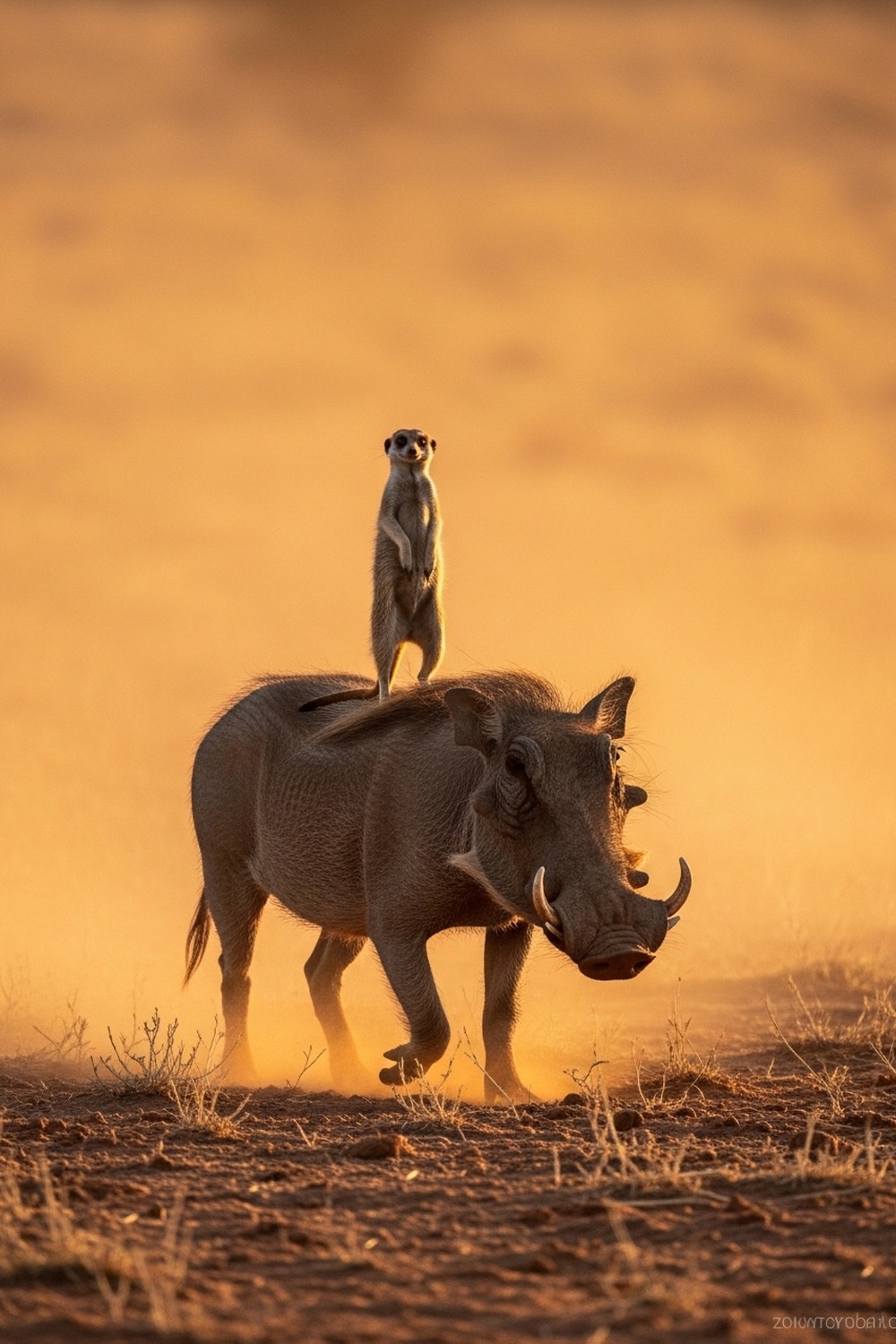
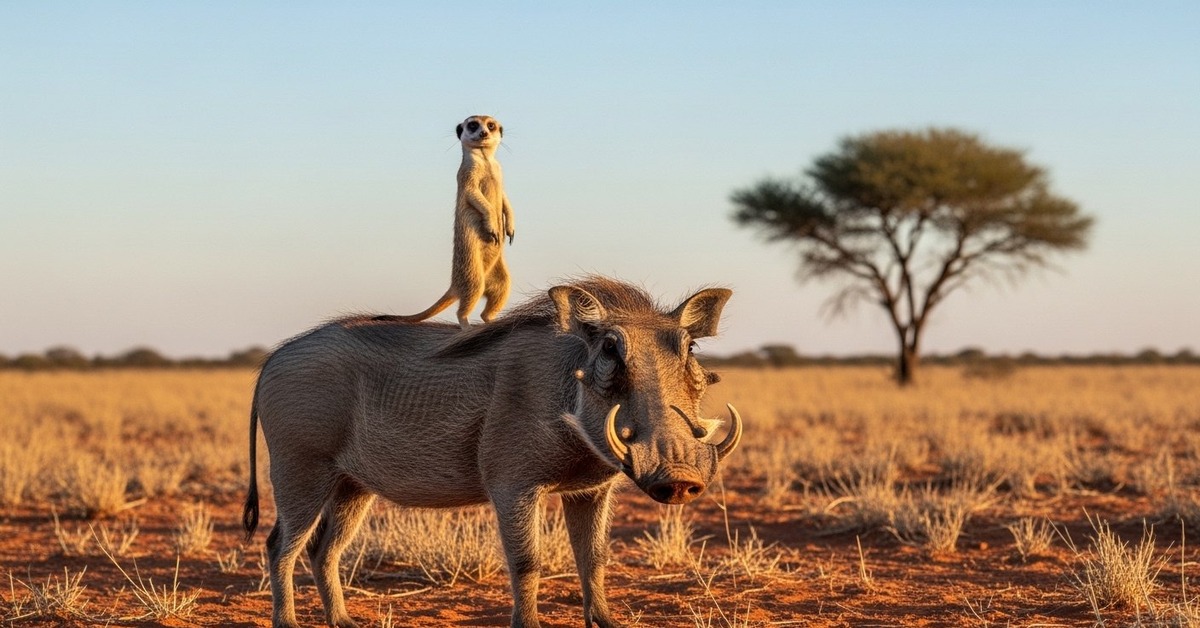
Nobody staged the photo. That’s what makes it so easy to believe. A meerkat standing upright on a warthog’s back, scanning the horizon like it owns the place — the image did what great images do, which is arrive before the questions do.
Somewhere in the Kalahari, this actually happens. The meerkat climbs up, the warthog doesn’t move, and whoever’s watching immediately starts narrating a friendship. A partnership. An unlikely duo watching each other’s backs against a dangerous world. The greeting cards practically write themselves. The problem is that wildlife biology has a long, patient habit of quietly dismantling the stories we love most.
Key Facts
- The Kalahari Meerkat Project has run continuously since 1993 and in over 30 years has never documented a stable, reciprocal vigilance arrangement between meerkats and warthogs.
- Meerkats rotate sentinel duty in shifts lasting from 1 to 90 minutes, spending up to 30% of daylight hours on guard.
- Banded mongooses are the warthog’s genuine mutualistic partner, with grooming sessions observed lasting over 45 minutes and removing hundreds of ectoparasites.
- At least 25 distinct meerkat vocalizations have been catalogued, with alarm calls encoding both predator type and urgency simultaneously.
- Meerkat groups range from 3 to 30 individuals, and larger groups maintain more consistent sentinel coverage.
In short: The viral meerkat warthog relationship looks like teamwork but fails the basic test of mutualism: there is no documented benefit flowing both ways. The meerkat simply uses the warthog as an elevated perch. The warthog’s real mutualistic partner is the banded mongoose, which removes hundreds of parasites from its hide.
The Meerkat Warthog Relationship Everyone Gets Wrong
Meerkats are genuinely extraordinary sentinels — that part’s true. Within their own family groups (called mobs, or gangs, depending on who you ask), individuals rotate dedicated lookout duty, standing upright on elevated ground while the rest of the mob forages below. Researcher Marta Manser at the University of Zurich has documented that their alarm calls aren’t just generic panic signals. They’re specific. A call for a hawk overhead is acoustically distinct from a call for a cobra at ground level, encoding both predator type and urgency simultaneously. That’s not instinct — that’s something closer to a vocabulary.
But here’s where the popular story falls apart.
The leap from “meerkats are great lookouts” to “meerkats keep watch for warthogs” is an enormous one, and it hasn’t held up to scientific scrutiny. Researchers haven’t found consistent, documented evidence of any mutual vigilance arrangement between the two species. So what’s actually happening when a meerkat climbs up there?
Opportunism Looks Exactly Like Partnership
The most likely explanation is almost aggressively boring: the meerkat is using the warthog as furniture.
In the flat, open scrubland of the Kalahari, height is survival currency. A termite mound works. A rock works. A large, warm, mostly-stationary warthog works too. The meerkat isn’t communicating with it, protecting it, or entering into any kind of arrangement with it. It’s just found a good vantage point that happens to be breathing. You can read more about how animal cognition shapes these kinds of misread behaviors over at this-amazing-world.com, where the animal kingdom keeps producing stories stranger than anything we’d script.
The warthog, for its part, probably doesn’t notice or care. It’s not receiving alarm calls calibrated to its benefit. It’s not adjusting its behavior based on anything the meerkat does. The warthog is just standing there, being a warthog, while a small mammal uses its back as a watchtower. That’s the whole dynamic.
What Real Mutualism Between Animals Actually Looks Like
The meerkat warthog relationship, as popularly imagined, fails the most basic test of mutualism: demonstrable benefit flowing in both directions. Warthogs do have a genuine mutualistic partner — it’s just considerably less photogenic. Banded mongooses will spend long stretches working through a warthog’s coarse hide, pulling out ticks, flies, and skin parasites. The warthog gets parasite relief. The mongoose gets a meal. Both parties actively participate, and the benefits are measurable, documented, and repeatable across observations.
That last fact kept me reading for another hour — because the mongoose-warthog relationship is almost never the one that goes viral, despite being the one that’s actually real.
Unglamorous. Functional. Built on clear mutual gain rather than a good camera angle. That’s what interspecies cooperation actually looks like most of the time.
Why Our Brains Keep Manufacturing Animal Friendships
Humans are pattern-recognition machines, and nowhere does that instinct run hotter than when we’re watching animals interact. Two species sharing space becomes a friendship. Proximity becomes partnership. A meerkat on a warthog’s back becomes a heartwarming story about an unlikely duo watching out for each other.
The meerkat warthog relationship fits a narrative template we already love — the small and the large, the quick and the slow, united against a dangerous world. It’s a compelling story.
It’s just not supported by the data. And that gap between what we want to see and what’s actually happening is where wildlife mythology gets manufactured, one shared photo at a time.
The Science of Alarm Calls Is Wild Enough on Its Own
Here’s the thing: the actual science of meerkat communication doesn’t need any of this embellishment. According to research on meerkat behavior, their alarm call system is one of the most sophisticated documented in any non-human mammal. Different calls identify predator type — aerial versus terrestrial — but they also encode urgency levels that prompt entirely different escape responses in the listening mob. Some researchers have drawn comparisons to rudimentary linguistic features. The structural complexity is that specific.
A small desert mammal that essentially has a vocabulary for danger.
Turns out that’s more astonishing than anything we invented about warthog teamwork. The biology was already there. We just kept looking at the photograph instead.
By the Numbers
- Meerkats rotate sentinel duty in shifts lasting anywhere from 1 to 90 minutes, with individuals spending up to 30% of daylight hours on guard — documented through the Kalahari Meerkat Project, which has been running continuously since 1993.
- Banded mongooses grooming warthogs: sessions observed lasting over 45 minutes, removing hundreds of ectoparasites in a single interaction. No equivalent benefit has been documented in any meerkat-warthog observation.
- Mob size matters more than species cooperation — meerkat groups range from 3 to 30 individuals, and larger groups maintain more consistent sentinel coverage simply because there are more bodies to rotate through duty.
- At least 25 distinct meerkat vocalizations have been catalogued. Alarm calls alone encode multiple variables simultaneously — a level of specificity that rivals communication systems studied in primates.
Field Notes
- Meerkats are immune to certain venoms, including those from scorpions and some snakes — their sentinel duty is partly backed by a biological insurance policy that has nothing to do with anything the warthog offers.
- Warthogs kneel on their front legs to graze, which puts them unusually close to the ground and dramatically increases their exposure to parasites. That’s the ecological pressure that drove the banded mongoose relationship in the first place — not a cute photo.
- The Kalahari Meerkat Project has never documented a stable, reciprocal vigilance arrangement between meerkats and warthogs. Not once. In over 30 years of continuous field observation.
What Wildlife Myths Tell Us About Ourselves
The meerkat warthog relationship story persists because it does something for us emotionally. It confirms something we want to believe — that the natural world is full of unlikely alliances, that small things can protect large ones, that cooperation crosses every boundary. That’s a genuinely beautiful idea. And nature does produce real versions of it, from cleaner fish to oxpeckers to banded mongooses working a warthog’s hide in the midday heat. But the versions we broadcast loudest aren’t always the ones with the strongest evidence behind them.
When we flatten a chance encounter into a partnership narrative, we’re not really learning about animals. We’re projecting onto them. The cost is subtle but real — it shapes what questions we ask, what relationships we study, and what we miss entirely because we’ve already decided we know the answer.
Wildlife science asks a harder, more honest question: who actually benefits here, and can we prove it? That question has produced some of the most extraordinary discoveries in biology — real mutualism, real communication systems, real cooperation that makes the invented version look thin by comparison.
The meerkat on the warthog’s back is still a great image. But the real story — a desert mammal with a complex alarm vocabulary, rotating sentinel shifts, immunity to venom, and a social system more structured than many human workplaces — doesn’t need the warthog to be extraordinary. Sometimes the honest version is the wildest one. If this kind of story keeps you up at night, there’s more at this-amazing-world.com, and the next one is even stranger.
Frequently Asked Questions
Q: Do meerkats actually keep watch for warthogs?
No. Despite the popular image, researchers have found no consistent evidence of mutual vigilance between the two species. The Kalahari Meerkat Project, running since 1993, has never documented such an arrangement in over 30 years. A meerkat climbing onto a warthog is using it as an elevated perch in flat Kalahari scrubland, not protecting it. The warthog receives no alarm calls calibrated to its benefit and does not adjust its behavior in response.
Q: What is a real example of warthog mutualism?
Banded mongooses are the warthog’s genuine mutualistic partner. They spend long stretches, with sessions observed lasting over 45 minutes, working through a warthog’s coarse hide and removing ticks, flies, and skin parasites, sometimes hundreds in a single interaction. The warthog gets parasite relief and the mongoose gets a meal. Both parties actively participate and the benefits are measurable, documented, and repeatable across observations, unlike the meerkat scenario.
Q: How sophisticated are meerkat alarm calls?
Highly sophisticated. At least 25 distinct meerkat vocalizations have been catalogued. Their alarm calls are not generic panic signals but specific ones: a call for a hawk overhead is acoustically distinct from a call for a cobra at ground level, encoding both predator type and urgency at once. Researcher Marta Manser at the University of Zurich documented this system, which some scientists compare to rudimentary linguistic features, prompting entirely different escape responses in the listening mob.
Illustrations are AI-generated. Article fact-checked and human-edited. Our editorial standards.