This Bird Hunts Spiders — Then Steals Their Silk
Nobody set out to study a bird that commits two crimes in the same hunting trip. That’s what makes the Streaked Spiderhunter so easy to miss — and so hard to forget once you find it.
Somewhere in the forest understory of Vietnam, Cambodia, or the broader tangle of Southeast Asia, a small streaked-brown bird is running what I can only describe as a two-stage operation. It finds a spider. It eats the spider. Then — and this is the part that sent me down a two-hour read at 2am — it takes the web.
Key Facts
- The Streaked Spiderhunter (Arachnothera magna) belongs to the sunbird family Nectariniidae, which has over 145 recognized species as of 2023.
- Its bill can reach up to 40mm, among the longest bill-to-body ratios in the entire sunbird family.
- The bird can reach up to 22cm in length, making it one of the largest members of the genus Arachnothera.
- It reuses leftover spider silk, which has a tensile strength of approximately 1.3 GPa and is roughly 5 times stronger by weight than high-grade steel, in nest construction.
- Heliconia plants rely on curved-bill birds for up to 90% of their pollination in some Southeast Asian forest surveys.
In short: The Streaked Spiderhunter bird of Southeast Asia hunts a spider, then steals its web, binding leaves into a hanging nest with silk roughly 5 times stronger than steel. With a 40mm bill it also pollinates heliconia flowers, filling three ecological roles, predator, nest engineer, and pollinator, in one small brown body.
Meet the Streaked Spiderhunter Bird, Nature’s Odd Criminal
The Streaked Spiderhunter (Arachnothera magna) belongs to the sunbird family Nectariniidae — over 140 species flung across Africa, Asia, and the Pacific. Ornithologist Charles Robson, who’s spent years documenting Southeast Asian forest birds, has described the Arachnothera genus as behaviorally distinct even within that already strange family. Which raises the obvious question: does any other bird in that group pull off the same two-part heist?
Apparently not with quite this consistency.
The name isn’t metaphor or marketing. Arachnothera literally means “spider hunter” in Greek. This bird got named for exactly what it does, which is either the most honest taxonomy in ornithology or a very blunt warning to every orb-weaver in a three-kilometer radius.
How It Actually Hunts — Clean, Fast, Gone
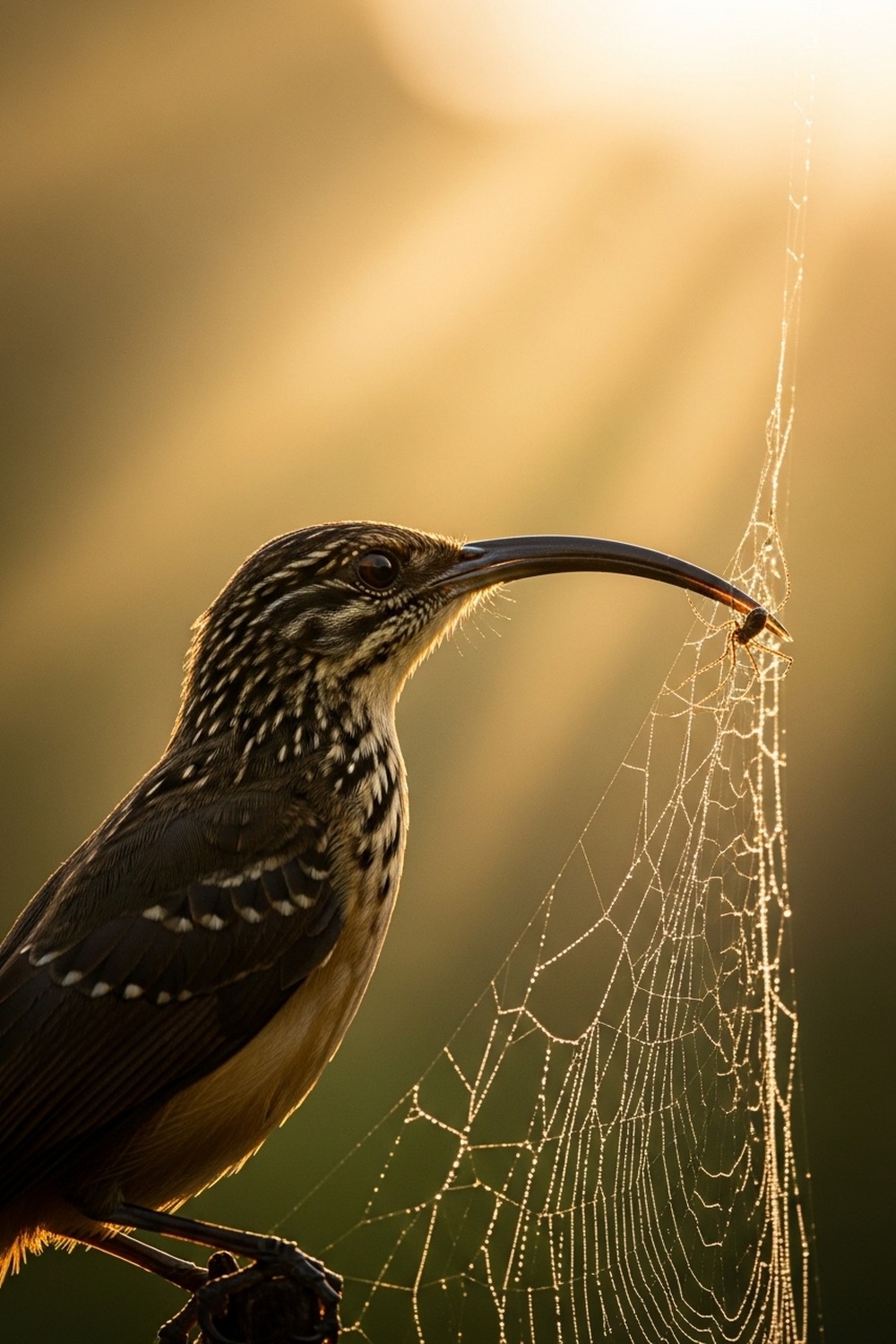
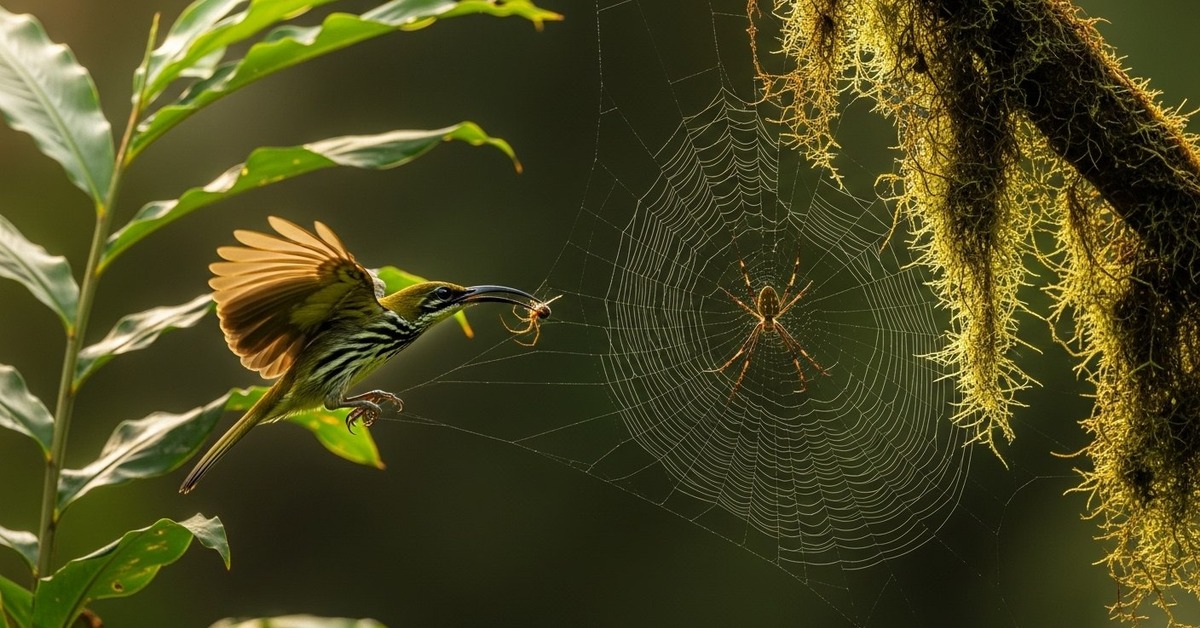
No venom. No elaborate setup. The Streaked Spiderhunter hunts by sight, scanning webs from a perch before striking with its bill in one precise movement. The spider doesn’t get a warning — one moment it’s sitting at the center of a structure it spent hours building, the next it’s gone. Researchers observing foraging behavior in Southeast Asian forest birds have noted that spiderhunters return to web-bearing locations repeatedly across a territory, which suggests something more like a patrol route than random opportunism.
Surgical is the word that kept coming up in the literature I found. Not aggressive in any dramatic sense. Just efficient in a way that feels slightly unsettling when you slow it down in your head. Short flight. Sharp bill. Done.
The Silk Theft Is Where Things Get Genuinely Clever
Here’s where the Streaked Spiderhunter stops being merely interesting and becomes something else entirely. After the spider’s gone, the web is still there — and this bird doesn’t ignore it. It collects the leftover silk and uses it directly in nest construction, binding leaves together and anchoring the whole structure to a branch. It’s taking material the spider burned real metabolic energy to produce and repurposing it as its own building supply.
Think about what that actually requires. Hunt the spider. Register that the silk still exists. Either return for it or collect it in the same visit. Then apply it structurally while building a nest.
That’s a sequence. Not instinct running on a single track.
That last fact kept me reading for another hour.
That Bill Isn’t Just Dramatic — It’s a Master Key
The Streaked Spiderhunter’s bill can hit 40mm in some individuals — long, dramatically curved, built to reach nectar sources that shorter-billed birds physically can’t touch. Heliconia plants are a documented favorite. Their tubular flowers are shaped in a way that essentially locks out competitors, and the spiderhunter reaches in, drinks deep, brushes against the flower’s reproductive structures, and moves on without apparently registering that it’s also running a pollination service on the side.
Spider killer. Silk thief. Accidental botanist.
All operating out of the same small brown body that’s nearly invisible against bark until it moves. Which means most of this happens without anyone watching.
The Nest Is Stranger Than It Looks From the Outside
The construction method is as unusual as the materials. The Streaked Spiderhunter stitches large leaves together — often leaves still attached to a living plant — using plant fibers and spider silk as thread, creating a hanging pouch that sways with the leaf instead of sitting rigid on a branch. Predators scanning for a stationary nest shape are looking for something this nest refuses to be. It moves the way the forest moves. It hides by not being still.
The silk isn’t decorative. It’s structural. Researchers examining sunbird nests have found that spider silk — stronger by weight than steel, and elastic enough to flex without tearing — gives the whole structure a durability that plant fiber alone can’t match. The bird doesn’t know materials science. But it’s practicing it anyway.
By the Numbers
- Over 145 recognized species in Nectariniidae as of 2023 — one of the most species-rich passerine families in the Old World
- Spider silk tensile strength: approximately 1.3 GPa, roughly 5 times stronger by weight than high-grade steel, which is why nests built with it survive conditions that plant-fiber-only structures don’t.
- Bill length up to 40mm — among the longest bill-to-body ratios in the entire sunbird family
- Heliconia plants rely on curved-bill birds for up to 90% of their pollination in some Southeast Asian forest surveys, which means this bird’s foraging route is also someone else’s reproductive strategy.
Field Notes
- Up to 22cm long — one of the largest members of Arachnothera, much bigger than the delicate sunbirds most people picture when they hear “sunbird family.”
- No iridescent plumage. Streaked olive-brown instead, which blends so well into dappled forest light that field observers typically hear this bird before they see it — the call comes first, and the bird materializes after.
- Documented in forest edge habitats as well as deep understory, meaning it operates in zones increasingly fragmented by agricultural expansion. That detail matters more than it might seem: a bird filling three ecological roles — predator, nest engineer, pollinator — that’s also being pushed toward the edges is a different kind of conservation problem than losing a single-function species.
Why This Bird’s World Should Matter to Ours
The Streaked Spiderhunter sits at an intersection that ecologists find genuinely difficult to replace: predation, material use, and pollination, all in one animal. That combination isn’t common. In forests shrinking under pressure from land conversion and shifting climate patterns, species that fill multiple functional roles become disproportionately important in ways that don’t always show up until they’re gone.
Lose the spiderhunter and you don’t lose one bird. You lose a spider predator, a nest engineer, and a pollinator for plants that can’t use anything with a shorter bill. That’s a cascade. Not a footnote.
And it’s all happening in understories most people will never see. The bird doesn’t need an audience. It’s been running this operation long before anyone thought to write it down — hunting clean, stealing silk, stitching nests out of someone else’s work, and moving on before the forest notices.
A small brown bird in a Southeast Asian forest is eating spiders, pocketing their silk, building nests that move like leaves, and pollinating flowers it doesn’t even seem to notice. It doesn’t need to be colorful. It just needs to keep moving — and it does. There’s more where this came from at this-amazing-world.com, and the next one is stranger.
Frequently Asked Questions
Q: What does the Streaked Spiderhunter bird eat?
The Streaked Spiderhunter hunts spiders by sight, scanning webs from a perch before striking with its bill in one precise movement, with no venom involved. It also feeds heavily on nectar, using its long curved bill, which can reach up to 40mm, to reach tubular flowers like heliconia that shorter-billed birds cannot access. This makes the bird both a spider predator and an accidental pollinator. Researchers note spiderhunters return to web-bearing locations repeatedly, suggesting a patrol route rather than random foraging.
Q: Why does the Streaked Spiderhunter use spider silk in its nest?
After eating a spider, the bird collects the leftover silk and uses it structurally in nest construction, binding leaves together and anchoring the nest to a branch. Spider silk has a tensile strength of approximately 1.3 GPa, roughly 5 times stronger by weight than high-grade steel, and is elastic enough to flex without tearing. This gives the hanging pouch nest a durability that plant fiber alone cannot match, helping it survive conditions that destroy plant-fiber-only structures.
Q: How big is the Streaked Spiderhunter?
The Streaked Spiderhunter can reach up to 22cm in length, making it one of the largest members of the genus Arachnothera and much bigger than the delicate sunbirds most people picture. It belongs to the family Nectariniidae, which contains over 145 recognized species as of 2023. Unlike its iridescent relatives, it has streaked olive-brown plumage that blends so well into dappled forest light that field observers typically hear the bird before they see it.
Illustrations are AI-generated. Article fact-checked and human-edited. Our editorial standards.