Why Your Messy Winter Garden Is a Wildlife Lifeline
Here’s the thing about a stem-nesting bees winter garden: it looks like neglect and functions like architecture. Those dried, hollow stalks standing in your January borders — the ones you’ve been pulling since October with the best of intentions — aren’t waiting to be cleared. They’re occupied. More than 100 native North American bee species have already sealed eggs inside them, packed in with pollen, capped with mud or leaf pulp, left to track cold and warmth until spring gives the right signal. Pull them too early, and you haven’t tidied the garden. You’ve demolished it.
Each January, while most gardeners assume their borders are simply dormant, something far more deliberate is happening inside those papery stems. Above them, overwintering birds work the seed heads with bills that evolution has spent millions of years perfecting. The garden looks dead. It isn’t even close.
Key Facts
- Over 100 native North American bee species nest inside hollow or pithy plant stems, per Xerces Society field surveys in 2014.
- A 2017 German iDiv study documented a 76% decline in flying insect biomass across 63 protected areas over 27 years, 1989 to 2016.
- Penn State research from 2016 to 2021 found garden plots left standing through winter produced 2.3 times more native bee emergence events and 67% higher species richness than cleared plots.
- An estimated 40 million acres of residential turf and managed garden space exists across the United States, per a 2005 NASA land-use study.
- In 2022, a Minneapolis neighborhood, Linden Hills, persuaded over 400 households to defer autumn cutting, producing measurable native bee diversity increases within eighteen months.
In short: A stem-nesting bees winter garden looks like neglect but functions as habitat: over 100 native North American bee species seal eggs inside dried hollow stems. Penn State, Xerces Society, and iDiv research shows autumn clearing devastates pollinators, while leaving stems standing until late April supports overwintering bees and seed-eating birds.
How Hollow Stems Became Winter Nurseries for Bees
Bees in the families Colletidae, Halictidae, and Megachilidae have been documented using hollow or pithy plant stems as nesting sites for thousands of years, but the relationship runs so deep it barely registers as a relationship anymore — it just looks like how things are. Researchers at the Xerces Society for Invertebrate Conservation, working with land managers in the Pacific Northwest around 2014, began systematically mapping just how many species depended on standing dead plant material specifically through the winter months. Their field surveys, published in partnership with Oregon State University, identified over 100 native bee species in North America that complete part of their life cycle inside dried plant stems — not just wood-boring species, but generalist nesters using goldenrod, elderberry, Joe-Pye weed, and raspberry canes. The Megachile genus, which includes the familiar leafcutter bees, accounts for a significant proportion of these stem-nesters, with females cutting precise circles of leaf material to seal individual brood cells against both cold and pathogens.
What makes this architecture so precise is that it’s almost invisible. The female bee doesn’t announce herself. She finds a stem of just the right diameter — often between two and nine millimetres — and works backward from the sealed tip, depositing a pollen-and-nectar loaf for each egg before capping the chamber. Some species create a dozen chambers in a single stem.
The eggs overwinter as larvae or pupae, depending on species, and emerge only when temperatures consistently break a thermal threshold in spring — typically when sustained daytime highs reach around 15°C for several days in a row. It’s not warmth in general that triggers emergence. It’s accumulated warmth over time.
Cut those stems down in October, bundle them up, and haul them to the kerb, and the larvae go with them — into a green bin, a landfill, or a composting facility where temperatures spike fast enough to kill anything inside. The bees never emerge. The garden stays tidy. Nobody connects the two.
Birds Have Been Reading These Plants for Millions of Years
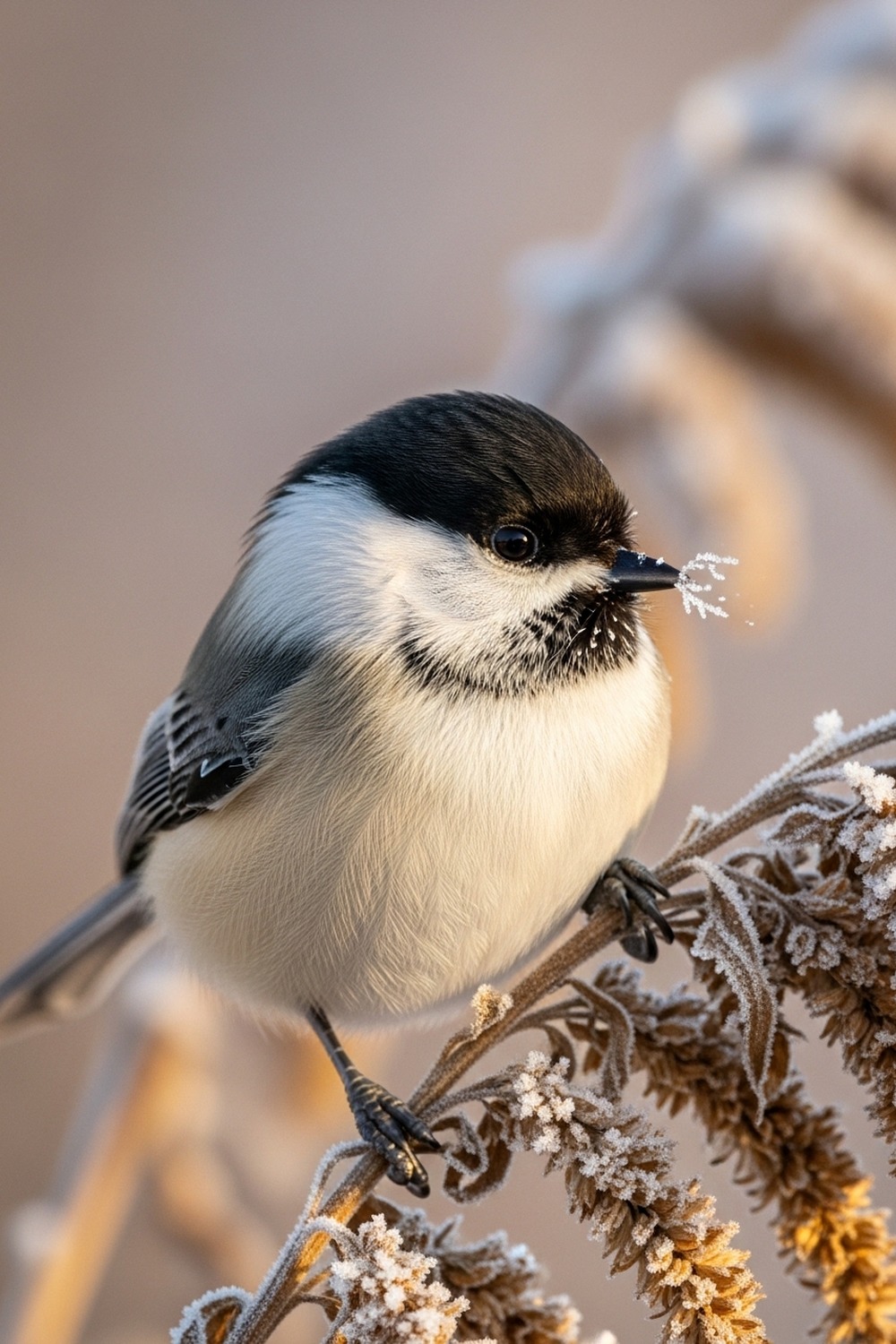
Black-capped chickadees, white-breasted nuthatches, American goldfinches, and dark-eyed juncos don’t arrive at dried seed heads by accident. They’ve been tracking specific plant species since late summer, when seeds begin to set, mapping patches the way humans map grocery stores. Studies from University of Colorado Boulder in 2016 confirmed that black-capped chickadees can recall the location of thousands of individual food caches — a capacity that requires a hippocampus that actually grows in autumn to accommodate the neurological load. It’s a behaviour that mirrors some surprisingly complex spatial memory. The parallel is striking: just as crow anting behaviour reveals unexpected cognitive depth in birds we thought we understood, these winter foragers are doing something far more deliberate than casual pecking around a garden. That kind of surprising avian intelligence hidden in plain sight keeps turning up everywhere researchers look.
Coneflowers — Echinacea purpurea — are among the most nutritionally dense seed sources in a winter garden, with seeds containing around 15% fat by dry weight. Sunflowers push higher still, averaging closer to 28% fat per seed. For a bird maintaining body temperature in sub-zero overnight conditions, that’s not a pleasant bonus. It’s critical infrastructure. A goldfinch burning through a seed head of black-eyed Susan on a February morning in Michigan is doing something metabolically essential, not decorative. Remove the plant, and the calories are simply gone — not replaced by anything else in the landscape, because there’s nothing else designed to hold seeds through January in that region.
Walk through any untouched winter meadow in the northeastern United States and the pattern is obvious. The stems that remain upright in snow — goldenrod, ironweed, wild bergamot — are the ones with birds on them. Every thirty minutes, new arrivals cycle through. The plants are functioning as a distributed feeding network, and they’ve been doing it for longer than any garden existed.
The Science Behind the “Messy Garden” Movement
Why does this matter beyond individual gardens? Because the data, turns out, was tracking something far larger than anyone initially assumed.
Around 2015, entomologists began publishing findings on what tidy landscaping was actually costing insect populations at scale — and the picture was catastrophic. A landmark paper from the German Centre for Integrative Biodiversity Research (iDiv), released in 2017, documented a 76% decline in flying insect biomass across protected areas in Germany over 27 years. Habitat management, including routine cutting and clearing of plant material, was identified as a primary driver. A Smithsonian Magazine investigation published in 2020 traced how the stem-nesting bees winter garden connection had shifted from fringe ecology into mainstream conservation concern, with municipal governments in Germany, the Netherlands, and Canada beginning to revise public green-space management guidelines as a direct result.
What the data revealed that most gardeners still don’t know: the insect losses weren’t happening in agricultural monocultures alone. Residential and suburban green spaces — covering an estimated 40 million acres in the United States according to a 2005 NASA-funded land-use study — were managed to a standard that left almost no overwintering habitat intact. Mow, blow, cut back, mulch. Repeat every autumn. The stem-nesting bees winter garden dynamic was being disrupted simultaneously across millions of private properties, by millions of well-meaning people who thought they were being responsible.
That’s the counterintuitive sting in this story. The problem isn’t factory farms or pesticide runoff alone — though those are real. A significant fraction of insect population collapse is being driven by people who care about their gardens, tidying them into ecological silence.
History has a way of treating the people who ignored this kind of evidence unkindly — and the evidence here has been accumulating, loudly, for a decade.
Stem-Nesting Bees Winter Garden: What Cutting Season Actually Costs
Field experiments run by the Penn State Center for Pollinator Research between 2016 and 2021 set up parallel garden plots — some cleared in autumn, some left standing until late April — and monitored bee emergence, species diversity, and reproductive success across three growing seasons. Plots left standing through winter produced an average of 2.3 times more native bee emergence events than cleared plots. Species richness was 67% higher in uncleared plots. Some of the most significant gains were recorded in generalist pollinators: Halictus rubicundus, Osmia lignaria, and several Lasioglossum species that form the invisible baseline of pollination services in temperate North American gardens.
The mechanism is worth understanding precisely. When a bee larva is sealed inside a stem in October, it’s not insulated from temperature fluctuations — it’s exposed to them. That exposure is part of the trigger system. The larva tracks accumulated cold exposure over weeks and months (researchers actually call this process vernalisation in plants, operating analogously in these insects). Severing the stem disrupts the microclimate inside it, sometimes fatally. Composting or shredding it obviously does. But even bundling stems horizontally in a “bug hotel” — a popular garden intervention — can change the thermal profile enough to desynchronise emergence from the flowering of the plants the bees depend on. Ideally, the stem should stay vertical, rooted, exposed to exactly the microclimate the living plant experienced.
And the Penn State data confirmed something that field naturalists had suspected for years: the damage compounds. A single year of autumn clearing depresses the following year’s pollinator population. Two consecutive years of clearing can suppress local populations for three to five subsequent seasons, because the reproductive base is gone and recolonisation from adjacent habitat is slow. Gardens don’t bounce back the way we assume they will.
Practical Ecology: What a Waiting Garden Can Actually Do
Conservation organisations in multiple countries have built the case for waiting into formal guidance. The Royal Horticultural Society (RHS) in the United Kingdom revised its winter garden management advice in 2019 to explicitly recommend leaving hollow-stemmed perennials standing until at least late March. The National Wildlife Federation in the United States followed with its own guidelines in 2020, recommending a cut date no earlier than April 15th in temperate zones — and later still in northern regions where soil temperatures lag. These aren’t fringe environmental groups. These are the mainstream voices that shape what millions of gardeners do each autumn weekend.
Leaving a ten-square-metre patch of goldenrod, coneflower, and ironweed standing through winter requires zero additional work. Zero cost. Zero new plants. The garden is already built; the decision is simply to leave it alone. Studies from the University of Minnesota’s Bee Lab, published in 2022, estimated that a single urban residential garden left uncut through winter could support overwintering habitat for between 15 and 30 individual stem-nesting bee females per season — each of which might produce six to twelve offspring the following spring. Scaled across even a single neighbourhood, those numbers become genuinely meaningful for local pollinator populations.
Minneapolis, winter of 2022. A community called Linden Hills began coordinating a street-by-street “leave it standing” campaign through their local neighbourhood association, persuading over 400 households to defer autumn cutting until May. Entomologists from the University of Minnesota monitored the area the following spring and recorded measurable increases in native bee species diversity within eighteen months. The intervention cost nothing. The plants were already there. All that changed was the date someone picked up the secateurs.
How It Unfolded
- 1991: Early field surveys by USDA Forest Service entomologists begin formally cataloguing native bee nesting substrate preferences, identifying hollow stems as a primary but under-studied habitat type.
- 2005: NASA-funded land-use mapping reveals that turf grass and managed garden space collectively cover more U.S. land than any single irrigated crop — shifting the conservation conversation toward residential landscapes.
- 2017: The German iDiv flying insect biomass study publishes its 76% decline figure, triggering a wave of mainstream media coverage and forcing European municipal green-space policies into urgent review.
- 2022: University of Minnesota Bee Lab publishes residential garden overwintering data; the RHS and National Wildlife Federation both update their member-facing autumn garden guidelines to reflect new ecological evidence.
By the Numbers
- 76% decline in flying insect biomass recorded across 63 protected nature areas in Germany over 27 years, 1989–2016 (German Centre for Integrative Biodiversity Research, iDiv, 2017).
- Over 100 native North American bee species documented nesting inside hollow or pithy plant stems (Xerces Society for Invertebrate Conservation, 2014 field surveys).
- 2.3× more native bee emergence events recorded in garden plots left standing through winter compared to plots cleared in autumn (Penn State Center for Pollinator Research, 2016–2021).
- 67% higher bee species richness in uncleared winter garden plots than in autumn-cleared controls, across the same Penn State study period.
- 40 million acres of residential turf and managed garden space estimated across the United States, a land area larger than the state of Georgia (NASA land-use study, 2005).
Field Notes
- In a 2019 study by entomologist Colleen Cirillo at Rutgers University, researchers discovered that native bee larvae sealed inside goldenrod stems experienced significantly higher survival rates when stems remained rooted and vertical versus bundled horizontally in artificial “insect hotels” — the vertical orientation maintained a thermal gradient that mimicked natural temperature fluctuations essential for development timing.
- Female Osmia lignaria — the blue orchard bee — will reject a stem cavity if its internal diameter deviates by more than half a millimetre from her preferred range, demonstrating a selectivity in nesting behaviour that rivals the precision of manufactured commercial housing systems.
- Seed heads of Echinacea purpurea (purple coneflower) remain structurally intact through January in most of North America, providing not just food but perching architecture: birds use the stiff central cone as a brace while extracting seeds, which means the plant’s structural persistence through freeze-thaw cycles is itself an evolved feature with ecological function.
- Researchers still can’t fully explain why some stem-nesting bee species show strong fidelity to specific plant genera — returning to goldenrod or elderberry even when structurally equivalent stems from other species are available in the same patch. Whether this reflects learned preference, chemical signalling, or some other cue entirely remains an open question in pollinator ecology.
Frequently Asked Questions
Q: When is it safe to cut down stems without harming stem-nesting bees in a winter garden?
General guidance from the National Wildlife Federation recommends waiting until sustained daytime temperatures are consistently above 10°C — typically no earlier than late April in temperate North America, and later in northern states or Canada. This gives overwintering larvae time to complete their thermal development cues and begin emerging. Even then, cutting stems to 30–45 cm rather than ground level preserves the lower portion of any occupied chambers that extend into the base of the plant.
Q: What plants are most valuable for a stem-nesting bees winter garden setup?
Goldenrod (Solidago spp.), Joe-Pye weed (Eutrochium spp.), elderberry (Sambucus canadensis), wild bergamot (Monarda fistulosa), and raspberry canes (Rubus spp.) are among the most consistently documented stem-nesting substrates in North American research. These plants combine the right stem diameter range — roughly 2 to 9 mm internally — with pithy centres that female bees can excavate or that naturally hollow as the plant dries. Leaving a variety of stem diameters standing maximises the number of species you can support, since different bee genera have different size preferences.
Q: Does leaving a messy garden actually make a measurable difference, or is the real problem industrial agriculture?
Both are real problems — they’re not in competition. Industrial agriculture and pesticide use are driving pollinator decline at landscape scale, but Penn State Center for Pollinator Research data shows clearly that residential garden management is an independent and significant driver, not just a secondary concern. Because managed garden and turf space collectively covers more U.S. land than any single irrigated crop, the aggregate effect of autumn clearing across millions of private gardens is ecologically substantial. Individual choices, repeated at neighbourhood scale, produce measurable population-level outcomes. The Minneapolis Linden Hills study showed this within eighteen months.
Editor’s Take — Alex Morgan
What unsettles me most about this story is the inversion at its centre. The gardeners most likely to be clearing their borders every October are the engaged ones — the people who read the seed catalogues, who know their Latin names, who care. The damage isn’t being done through indifference. It’s being done through misplaced attentiveness. We’ve built an entire aesthetic of stewardship around the wrong definition of “tidy,” and the insects have been paying for it quietly, in hollow stems, for decades. That’s not a minor irony. That’s a policy failure disguised as a lifestyle choice.
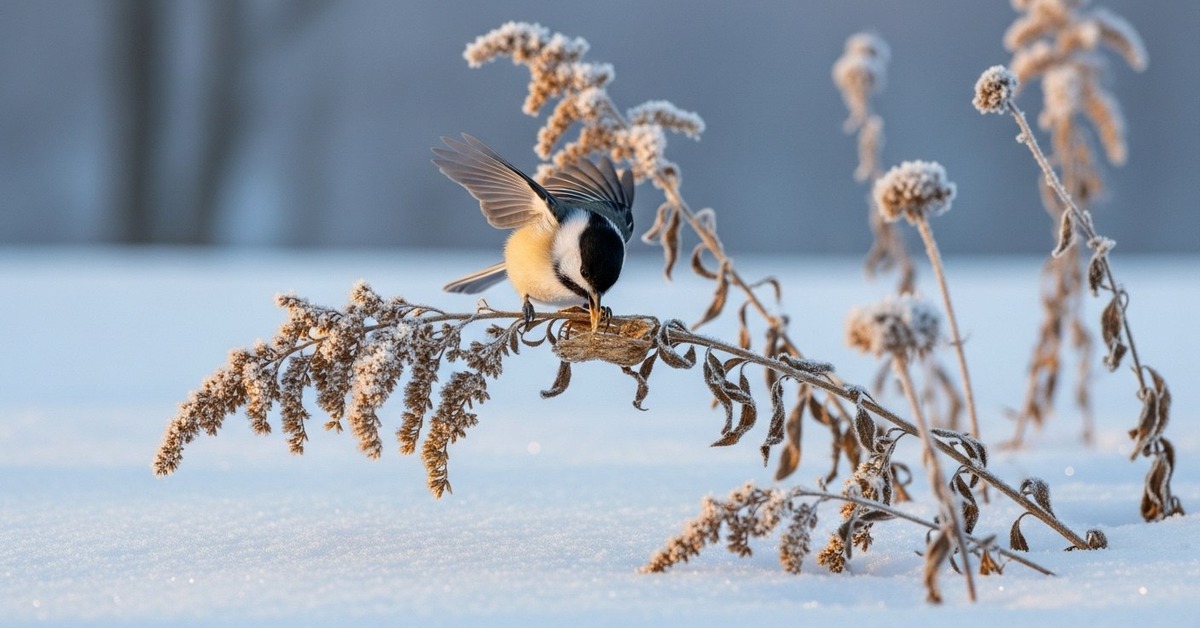
The chickadee on the goldenrod stalk in January doesn’t know it’s making an argument. It’s just doing what it’s always done — finding what the landscape offers, reading structure the way its ancestors have for millions of years. The question is whether the landscape will keep offering it. Every autumn, across millions of gardens, a choice gets made about whether to leave things standing or cut them down. It’s a small decision. It happens in about thirty seconds. And for the bees sealed in those stems, it’s the only thing between existence and erasure.
Illustrations are AI-generated. Article fact-checked and human-edited. Our editorial standards.