The Boy Who Picked the Janitor for Career Day
He walked past the doctor. Past the firefighter. Past the astronaut with the helmet. A five-year-old in Mississippi looked around a room full of carefully arranged adult ambition and pointed at the man holding a mop.
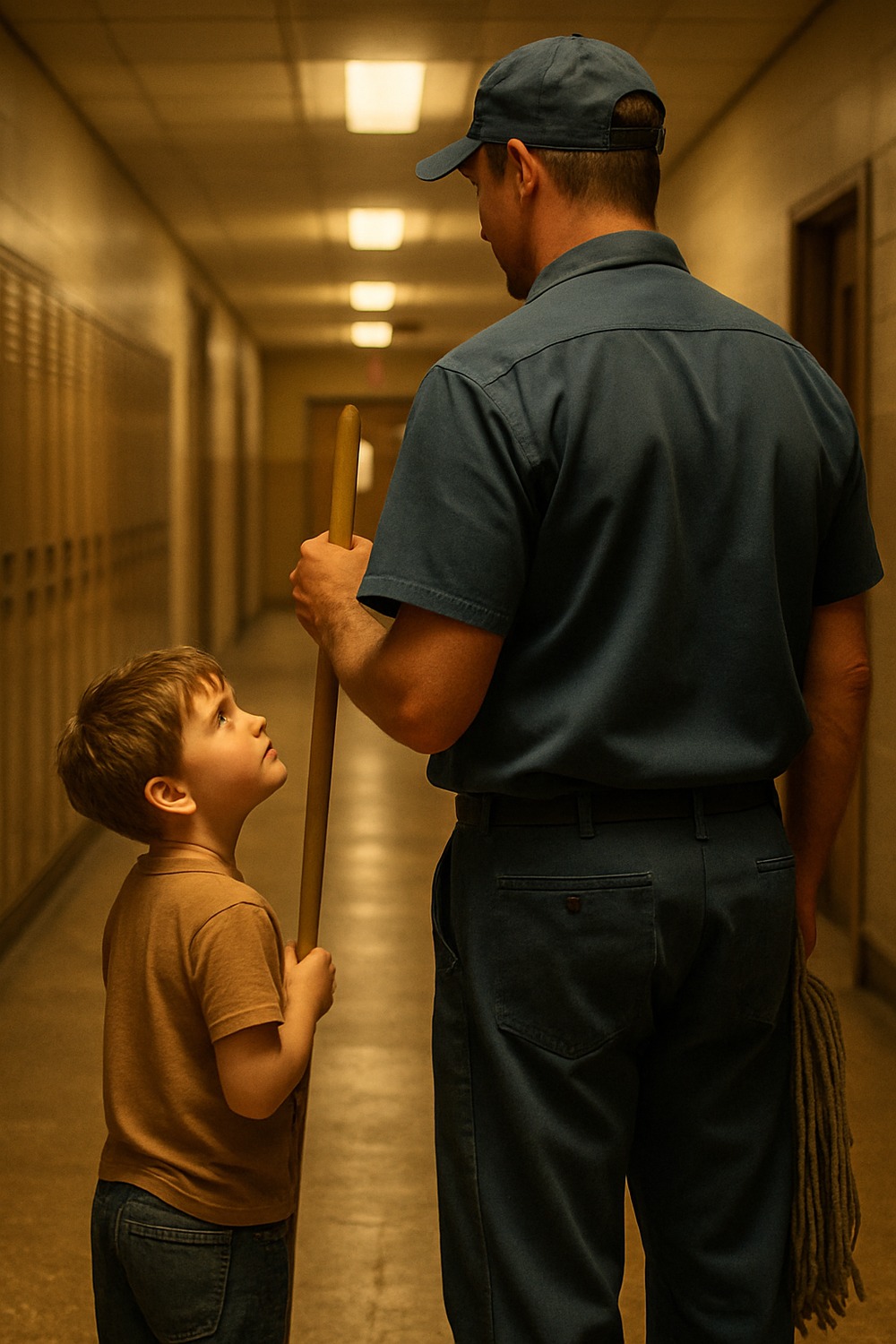
It was career day at a Mississippi preschool — the kind with construction paper name tags and parents who’ve been rehearsing their presentations in the car. Everyone expected the usual cast. Firefighters. A nurse, maybe. Someone’s dad in a hard hat. But one small boy in a collared shirt moved through all of it like it wasn’t there. He walked up to Mr. Arnold, the school’s custodian, and said: that’s my person. That’s who I’m standing next to today.
Key Facts
- At a Mississippi preschool career day, a five-year-old boy chose to stand beside the school custodian, Mr. Arnold, instead of the doctor, firefighter, or astronaut.
- There are roughly 430,000 custodial and maintenance workers employed in U.S. public schools as of 2023, per the U.S. Bureau of Labor Statistics.
- The median annual wage for school custodial staff is approximately $33,000, roughly one-fifth the average salary of school principals.
- Children begin developing occupational prestige bias, ranking jobs by perceived status, as early as age 7, per the Journal of Applied Developmental Psychology, 2019.
- A 2021 Gallup poll found 70% of American workers say feeling recognized is one of the most important factors in job satisfaction.
In short: The preschooler career day janitor story describes a Mississippi five-year-old who walked past the doctor, firefighter, and astronaut to stand beside the school custodian, Mr. Arnold. Drawing on developmental research and U.S. labor data, it shows how young children value visibility and function over salary and social rank.
Why This Preschooler Career Day Janitor Choice Hits Different
Children under six haven’t learned the rules yet. The unspoken ones. The ones that sort people into worth-celebrating and worth-overlooking.
According to research in child development, developmental psychologist Dr. Rebecca Bigler at the University of Texas has shown that young children categorize people by visibility and function — not salary, not title, not social rank. They notice who shows up. They notice what gets fixed. This boy had been watching Mr. Arnold every single morning, and somewhere in his five-year-old brain, he’d drawn a conclusion that most adults have carefully trained themselves out of drawing.
He saw the clean floors. The lights that worked. The door that used to stick and now didn’t. Kids are absorbing things constantly. The question is just what we’re giving them to absorb.
The Invisible Architecture of Every School Building
There are roughly 430,000 school custodians and maintenance workers in the United States right now. They maintain over 130,000 public school buildings — mopping hallways before sunrise, fixing heating systems in January, replacing bulbs in the classrooms where kids are learning to read. Most will never be mentioned at graduation. Most don’t get a formal thank-you. Most are, in the most literal sense, the invisible framework that holds everything else together.
Until a five-year-old points at one and says: that’s the person I want the world to know about.
And when that happened — Mr. Arnold stood up straighter. That’s not conjecture or editorial gloss. That’s just what being seen does to a person.
What Small Children See That Adults Have Forgotten
Career day was never really designed for kids, if you think about it. It was designed to reflect adult values back at children and call it inspiration. Astronauts and surgeons and lawyers. We dress it up as “showing them possibilities” but we’re mostly just showing them a hierarchy and calling it a tour.
The preschooler career day janitor story cuts through all of that. A child with zero awareness of income brackets looked at his world — the actual, physical world he moved through every day — and identified the person who made it function. No bias. No status filter. Just clear-eyed observation that adults spend years carefully unlearning.
Studies suggest children begin internalizing occupational status cues as early as age seven. Before that window closes, they see with a kind of radical fairness that’s almost startling when you encounter it directly. This boy was still inside that window. And he used it perfectly.
Mr. Arnold Didn’t Know This Was Coming
It is early morning. Mr. Arnold unlocks the building, checks the bathrooms, confirms the heat is running. Career day is happening somewhere in the schedule but it has nothing to do with him — it’s just another Tuesday of showing up before everyone else so that everyone else can show up to something that works.
And then a small boy walks over and says, essentially: you’re the one I want the world to know about.
What do you even do with that? There’s a specific weight that comes from being witnessed by someone who has absolutely nothing to gain from it. No performance. No politics. Just a kid telling the truth because he hasn’t learned yet that he’s not supposed to.
The Ripple Effect No One Tracked But Everyone Felt
The story didn’t stay in that classroom. It spread through the school, then online, then outward — the way certain stories do when they land on something people didn’t know they were hungry for. Parents shared it. Teachers printed it out. Custodial workers in other states saw Mr. Arnold’s moment and felt, for a single rare second, like someone had finally looked directly at them too.
The preschooler career day janitor story became the thing people kept forwarding to their siblings, their coworkers, the group chat that’s usually just memes and complaints about the weather.
Because it reminded people of something that quietly erodes over time: being useful matters. Being present matters. Sometimes the most important thing you can do is show up so consistently, so reliably, so well — that a child notices.
By the Numbers
- 430,000+ custodial and maintenance workers employed in U.S. public schools as of 2023 (U.S. Bureau of Labor Statistics) — most starting their shifts before a single student or teacher arrives.
- Median annual wage: approximately $33,000.
- That last number kept me reading for another hour. It’s roughly one-fifth the average salary of the school principals whose buildings these workers maintain every single day.
- Children begin developing occupational prestige bias — actually ranking jobs by perceived social status — as early as age 7, according to research published in the Journal of Applied Developmental Psychology, 2019.
- A 2021 Gallup poll found 70% of American workers say feeling recognized is one of the most important factors in job satisfaction. Custodial staff rank among the least formally recognized employee groups in education.

Field Notes
- In many districts, one custodian handles up to 30,000 square feet per shift — larger than most big-box retail stores, managed largely alone, largely overnight.
- The word “janitor” traces back to Janus, the Roman god of doorways, transitions, beginnings and endings. The person guarding every school’s entrance carries a name rooted in a god of thresholds. That’s not nothing.
- Workers in high-visibility-but-low-status roles experience what occupational psychologists call “social invisibility stress” — the chronic strain of being physically present and functionally unseen. A single moment of genuine recognition can measurably counter that effect. A single moment from a five-year-old apparently counts.
Why One Child’s Choice Should Change How We See Everyone
The preschooler career day janitor story works on people because it exposes the gap between what we claim to value and how we actually behave. We say every job matters. We say hard work is honorable. And then we spend the rest of our lives quietly sorting the world into people worth celebrating and people worth walking past without eye contact.
A five-year-old in Mississippi just handed everyone the mirror. He’s not being profound. He’s being honest. He hasn’t learned the difference yet.
Mr. Arnold didn’t change his job description after that day. He still arrived before sunrise. Still mopped and fixed and made things work before anyone arrived to notice them working. But something shifted — in the school, in the community, in the people who read the story and felt it catch somewhere behind their ribs.
That’s not nothing.
That’s actually everything.
A small boy saw a man doing quiet, essential work and decided it was worth standing next to. No strategy. No agenda. Just a child’s honest accounting of who actually makes his world function. We don’t have to lose that instinct — we just have to choose not to unlearn it. More stories like this one live at this-amazing-world.com, and the next one might surprise you even more.
Frequently Asked Questions
Q: What happened in the preschooler career day janitor story?
At a Mississippi preschool career day, a five-year-old boy in a collared shirt walked past adults representing prestigious careers, including a doctor, firefighter, and astronaut, and chose to stand beside Mr. Arnold, the school’s custodian. The boy had been watching Mr. Arnold maintain the building every morning. The moment spread through the school and then online, resonating with custodial workers and parents across multiple U.S. states.
Q: Why do young children value jobs differently than adults?
Research by developmental psychologist Dr. Rebecca Bigler at the University of Texas shows young children categorize people by visibility and function rather than salary, title, or social rank. Studies indicate children begin internalizing occupational status cues as early as age 7, according to the Journal of Applied Developmental Psychology in 2019. Before that window closes, children assess people by who shows up and what gets fixed, a kind of radical fairness adults gradually unlearn.
Q: How many custodial workers are in U.S. public schools?
As of 2023, there are roughly 430,000 custodial and maintenance workers employed in U.S. public schools, according to the U.S. Bureau of Labor Statistics. They maintain over 130,000 public school buildings, often starting shifts before any student or teacher arrives. Their median annual wage is approximately $33,000, and in many districts a single custodian handles up to 30,000 square feet per shift, larger than most big-box retail stores.
Illustrations are AI-generated. Article fact-checked and human-edited. Our editorial standards.