Metal Foam Armor Stops Bullets at 70% Less Weight
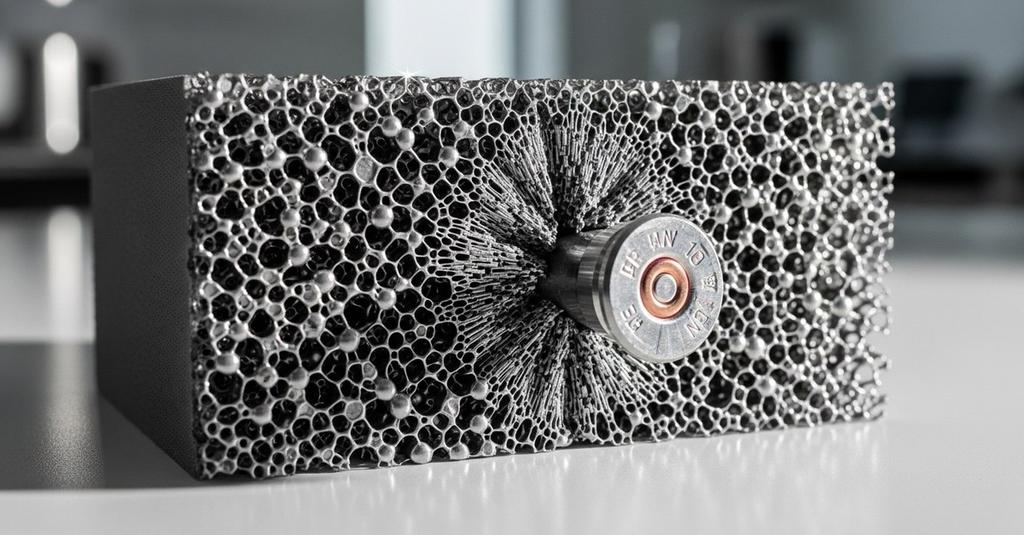
Push a bullet designed to pierce steel at composite metal foam armor and watch what happens: it stops cold. The foam looks fragile — riddled with air pockets, weighing 70% less than standard steel plate. Yet it defeats armor-piercing rounds with ruthless structural logic that shouldn’t work on any planet where physics still applies. The engineers who built composite metal foam armor say protection and weight were never supposed to coexist like this.
North Carolina State University. A materials science team spending a decade on something the laws of physics seem to actively resist: armor that’s almost too light to take seriously, yet capable of stopping rounds designed to defeat military-grade steel. The breakthrough isn’t in materials themselves. It’s in understanding how a structure filled mostly with air outperforms solid metal.
Key Facts
- Composite metal foam armor stops .30 caliber M2 armor-piercing rounds while weighing roughly 70 percent less than rolled steel plate achieving equivalent protection (North Carolina State University, 2016).
- A 25-millimeter composite metal foam panel stopped armor-piercing rounds that would require more than 80 millimeters of rolled homogeneous steel to defeat equivalently.
- In 2016 ballistic trials, back-face deformation averaged just 8 millimeters against the National Institute of Justice acceptable maximum of 44 millimeters.
- Dr. Afsaneh Rabiei began developing composite metal foam at North Carolina State University in the early 2000s, originally as a lightweight aerospace material.
- A 2017 study showed composite metal foam panels attenuate gamma rays, X-rays, and neutron radiation simultaneously, a property no one initially designed for.
In short: Composite metal foam armor, developed by Dr. Afsaneh Rabiei at North Carolina State University, stops .30 caliber M2 armor-piercing rounds while weighing about 70 percent less than steel. A 25-millimeter panel matches over 80 millimeters of steel, with back-face deformation of just 8 millimeters, and it also shields against orbital debris and ionizing radiation.
The Metallic Sponge Redefining Ballistic Protection
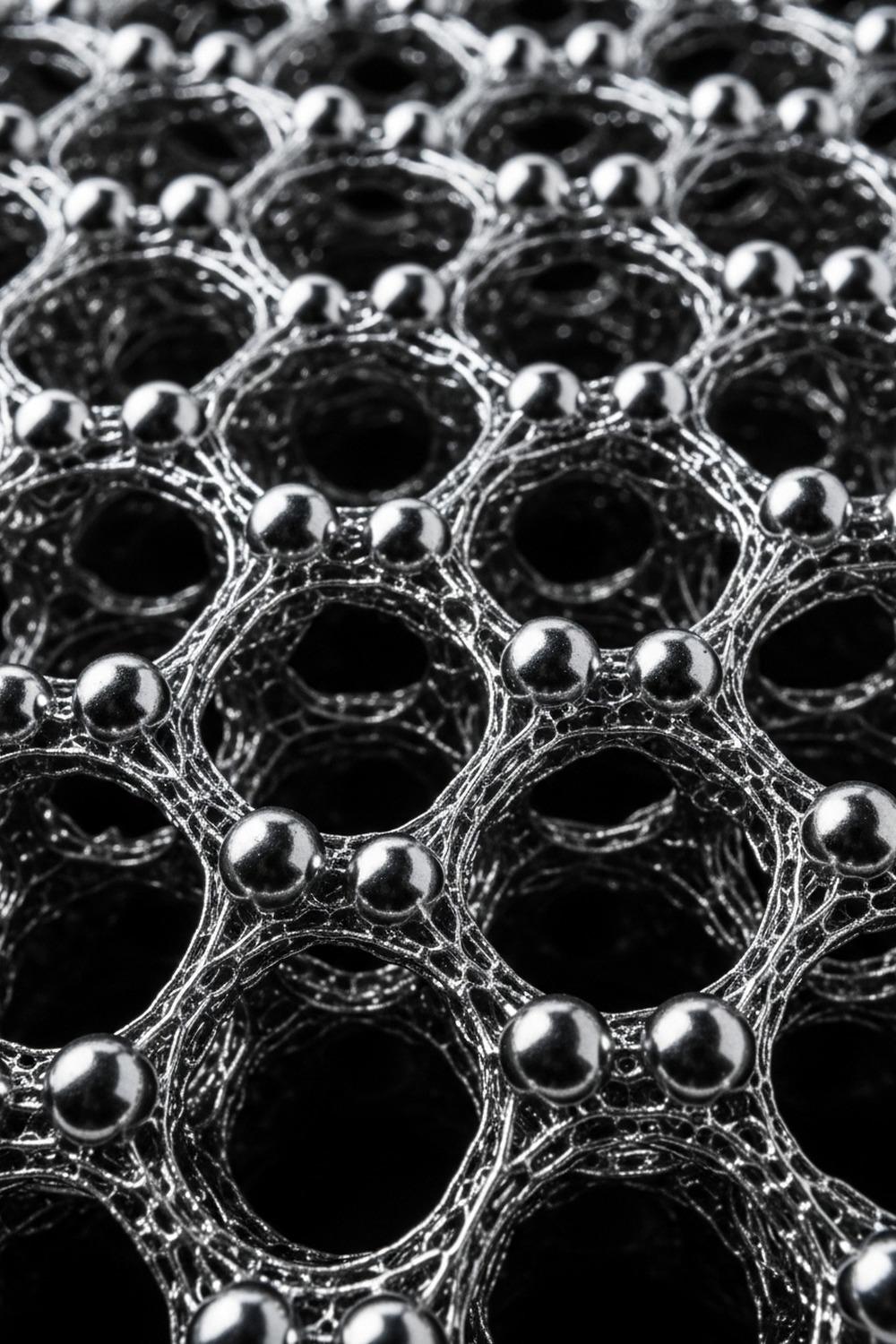
A counterintuitive premise sits at the beginning of most material breakthroughs. Dr. Afsaneh Rabiei, a mechanical and aerospace engineer at North Carolina State University, started developing composite metal foam in the early 2000s. She wasn’t chasing armor applications initially — she was building lightweight structural material for aerospace. The core concept remains deceptively simple: instead of casting a solid metal matrix, embed hollow metallic spheres (typically steel or aluminum) within a metal binder, creating a metal foam riddled with thousands of internal air pockets. Under load, those air pockets do something solid metal can’t: they collapse in sequence, absorbing and redistributing kinetic energy across the entire structure rather than concentrating it at the point of impact.
By 2016, Rabiei’s lab had published results showing composite metal foam stops .30 caliber M2 armor-piercing rounds — the same class of round that punches through conventional steel — while achieving a weight reduction of roughly 70%. That number deserves a pause.
Armor protection is typically a trade-off measured in increments. Engineers fight for a 5% weight reduction. A 10% reduction gets celebrated in technical journals. Seventy percent is an entirely different conversation — one that shifts composite metal foam armor from “promising laboratory curiosity” to “category-redefining material.” The foam’s deformation during impact is controlled and predictable. It doesn’t shatter. It doesn’t crack. It crumples inward, chamber by chamber, dissipating energy the way a crumple zone in a car absorbs a collision — strategically, sacrificially, and with the occupant’s survival as the governing design principle.
Hold a sample of composite metal foam armor in your hand and it’s disorienting. Too light. Too porous-looking to be trusted with anything serious. That cognitive dissonance is, in many ways, the point. Our instinct for what “protection” feels like is built around density. This material challenges that instinct at the molecular level.
Energy Absorption the Way Nature Intended It
Physics hides a useful parallel here. When energy travels through a uniform solid, it propagates efficiently — which is exactly the problem. A bullet’s kinetic energy needs somewhere to go, and solid steel, for all its strength, channels that energy in ways that can still cause catastrophic trauma behind the plate. But composite metal foam armor works on an entirely different principle: each hollow sphere in the matrix acts as an independent energy-absorbing cell. On impact, the outermost cells collapse first, slowing the projectile. The next layer collapses, slowing it further. The energy is not redirected — it’s consumed, step by step, until almost nothing remains.
This is the same logic that explains why engineers harvesting energy from footsteps use layered deformation systems rather than rigid substrates. Distributed collapse outperforms rigid resistance, every time. The physics doesn’t care whether you’re stopping a bullet or capturing a footfall — the principle is identical (and this matters more than it sounds: it means the material is solving a fundamental problem, not just a military one).
2019 brought detailed ballistic performance data from the North Carolina State team, published in Composite Structures. Composite metal foam armor panels measuring just 25 millimeters thick stopped armor-piercing rounds that would require more than 80 millimeters of rolled homogeneous steel armor to defeat equivalently. Back-face deformation — the dent left on the protected side — remained within survivable limits for personal body armor applications. In practical terms, a soldier carrying composite metal foam plates instead of steel could shed kilograms of load-bearing weight without sacrificing protection class.
Over an eight-hour patrol in difficult terrain, that weight difference is not trivial. It’s the difference between functional capacity and exhaustion.
Field soldiers carry, on average, between 45 and 68 kilograms of gear in active-duty configurations, according to U.S. Army logistics assessments. Shaving weight from armor — historically the heaviest non-negotiable component of that load — has direct consequences for endurance, reaction time, and survivability that no amount of tactical training can fully compensate for. Lighter armor isn’t a luxury. It’s a performance variable.
Beyond the Battlefield: Aerospace and Space Shielding
The military application is the headline. Materials scientists are already looking much further out — literally. Spacecraft face a shielding problem that makes body armor look straightforward. Why does orbital debris matter? Because in low Earth orbit and beyond, satellites and crewed vehicles encounter micrometeoroids and orbital debris traveling at velocities between 10 and 72 kilometers per second, and at those speeds, even a paint fleck carries enough kinetic energy to puncture aluminum hull panels.
Current shielding solutions, such as the Whipple shield used on the International Space Station, add significant mass — and every kilogram of mass launched into orbit costs, by current estimates, between $2,000 and $6,000 depending on the launch vehicle. Composite metal foam armor offers aerospace engineers an extraordinary proposition: equal or superior debris-stopping performance at a fraction of the weight. North Carolina State’s research group confirmed in 2020 that metal foam panels demonstrated excellent energy absorption against high-velocity impacts consistent with orbital debris threat profiles.
Lighter shielding means less fuel burned during launch. Less fuel burned means more payload capacity. More payload capacity means longer missions with more scientific instruments aboard. For crewed deep-space missions to the Moon or Mars — where every kilogram must be justified across a journey measured in months — composite metal foam armor could become a structural necessity rather than an experimental option.
There’s also a radiation angle. Watching a material solve multiple physics problems simultaneously, you stop treating it as a special case. Research published out of North Carolina State in 2017 showed that composite metal foam panels demonstrated significant attenuation of X-ray, gamma ray, and neutron radiation — the kinds of ionizing radiation that pose long-term health risks to astronauts outside Earth’s magnetosphere. One material. Multiple threat classes. That’s an unusually strong engineering proposition.
Nuclear and medical industries are paying attention too. Radiation shielding in nuclear power plants and hospital imaging suites currently relies heavily on lead — dense, expensive, and toxic. A metal foam alternative that matches shielding performance at dramatically reduced weight would simplify installation, reduce structural load requirements in facilities, and eliminate lead disposal concerns entirely.
Composite Metal Foam Armor: What the Tests Actually Show
Be precise about what the ballistic tests at North Carolina State University actually demonstrated, because hyperbole is a persistent hazard in materials science reporting. The 2016 study, published in Composite Structures and led by Dr. Rabiei’s group, tested a composite armor system consisting of ceramic face plate, composite metal foam core, and a backing panel. Against .30 caliber M2 armor-piercing rounds — a NATO-standard projectile with a hardened steel core — the combined system stopped every test round. The back-face deformation measured 8 millimeters on average. The NIJ (National Institute of Justice) standard for acceptable back-face deformation in body armor is 44 millimeters.
The system wasn’t just passing. It was exceeding by a substantial margin, and the total weight of the composite system was approximately 70% lower than a comparable rolled steel armor solution achieving the same protection level.
Subsequent testing expanded the threat matrix considerably. By 2019, the North Carolina State team had demonstrated performance against blast fragmentation threats and higher-velocity projectiles, with composite metal foam consistently absorbing and dispersing energy in ways that conventional monolithic armor materials simply can’t replicate. The key variable is what engineers call “specific energy absorption” — the amount of kinetic energy absorbed per unit of mass. Composite metal foam armor’s specific energy absorption figures are, in multiple published trials, among the highest ever recorded for a structural armor material.
Manufacturers are watching closely. Several defense contractors in the United States and Europe have entered into collaborative research agreements with university groups working on metal foam derivatives, with prototype vehicle armor panels and personal protection systems in active development as of 2024.
The Manufacturing Challenge Nobody Talks About
Here is where the story gets honest. Composite metal foam armor is not yet in widespread production, and the reasons are structural to manufacturing rather than to the material itself. Producing hollow metallic spheres at consistent size, wall thickness, and surface quality — at the volumes required for military procurement — remains technically demanding. The sintering process used to fuse spheres into a coherent foam matrix requires precisely controlled temperatures and pressures. Small deviations produce inconsistencies that affect ballistic performance in ways that a quality-control system must be able to detect and reject.
For a laboratory producing research samples, these challenges are manageable.
For a facility producing thousands of armor plates per month to military specification, they represent a significant engineering and capital investment threshold. North Carolina State’s team acknowledged this gap explicitly in a 2021 research summary, noting that scalability of the manufacturing process was an active area of investigation. Powder metallurgy techniques, additive manufacturing approaches, and hybrid casting methods are all being explored as routes to higher-volume production without compromising the material’s performance consistency.
The U.S. Department of Defense has funded multiple rounds of research toward this goal through DARPA and the Army Research Laboratory, signaling institutional commitment beyond academic curiosity. Cost per unit remains higher than steel plate armor at current production scales — but the trajectory is downward as process refinement continues. Historical precedent suggests patience is warranted. Kevlar — now the ubiquitous fiber in soft body armor worldwide — was discovered by DuPont chemist Stephanie Kwolek in 1965, but didn’t reach widespread military adoption until the late 1970s.
What’s different this time is the convergence of demand: military, aerospace, nuclear, and medical industries all want the same material simultaneously. That kind of multi-sector pull accelerates development timelines in ways that single-application materials never benefit from.
How It Unfolded
- Early 2000s — Dr. Afsaneh Rabiei at North Carolina State University begins developing composite metal foam as a lightweight structural material for aerospace applications, with no initial armor mandate.
- 2009 — First published research demonstrating composite metal foam’s exceptional energy absorption properties under high-velocity impact, establishing its ballistic potential in academic literature.
- 2016 — North Carolina State publishes landmark ballistic study in Composite Structures showing composite metal foam armor stops .30 caliber M2 armor-piercing rounds at 70% lower weight than steel equivalents.
- 2024 — Multiple U.S. and European defense contractors in active prototype development; Army Research Laboratory and DARPA funding continues toward scalable manufacturing solutions.
By the Numbers
- 70% — weight reduction of composite metal foam armor versus rolled steel plate armor achieving equivalent ballistic protection (North Carolina State University, 2016)
- 25 mm — thickness of composite metal foam panel required to stop .30 caliber M2 armor-piercing rounds, versus 80+ mm for equivalent rolled homogeneous steel
- 8 mm — average back-face deformation recorded in 2016 ballistic trials, against an NIJ acceptable maximum of 44 mm
- 10–72 km/s — velocity range of micrometeoroid and orbital debris threats for which composite metal foam demonstrates effective energy absorption in aerospace testing
- $2,000–$6,000 — estimated cost per kilogram of payload launched to low Earth orbit, underscoring the economic value of mass reduction in spacecraft shielding applications
Field Notes
- In 2017, North Carolina State researchers discovered that composite metal foam panels attenuate gamma radiation, X-rays, and neutron radiation simultaneously — a property no one initially designed for, and one that dramatically expanded the material’s application space into nuclear and medical shielding.
- The hollow spheres used in composite metal foam can be made from different metals — steel, aluminum, titanium — and the combination chosen determines whether the final material prioritizes weight, corrosion resistance, or thermal stability (researchers actually call this property tuning). There is no single “composite metal foam” — it’s a family of materials with tunable properties.
- Vehicle armor made from composite metal foam panels could, in theory, allow tanks and armored personnel carriers to carry the same protection at lower total vehicle weight — reducing fuel consumption and increasing strategic mobility, two priorities that have historically required engineers to choose between them.
- Researchers still can’t fully predict how composite metal foam armor performs under repeated impact at the same point — whether successive shots degrade protection non-linearly or follow a predictable failure curve. Real-world multi-hit performance modeling remains an open question with significant tactical implications.
Frequently Asked Questions
Q: How does composite metal foam armor stop bullets without being solid metal?
Composite metal foam armor works through sequential cell collapse rather than rigid resistance. When a projectile strikes the surface, it compresses the outermost hollow spheres in the metal matrix. Those spheres absorb kinetic energy as they deform, slowing the bullet. The next layer of spheres collapses in turn, absorbing more energy. By the time a round has traveled through the full thickness of the panel — typically 25 millimeters in 2016 test configurations — its kinetic energy is effectively spent. No solid backing required to stop it.
Q: Is composite metal foam armor actually in production for military use yet?
Not at scale, as of 2024. The material has been validated at the research level through peer-reviewed ballistic trials at North Carolina State University, and prototype panels have been produced for evaluation by defense contractors. The primary barrier is manufacturing consistency at volume — producing hollow metallic spheres and sintering them into foam matrices that meet military specification tolerance limits, at the quantities defense procurement requires. DARPA and the Army Research Laboratory are actively funding research to close this gap, and the timeline to fielded equipment is shortening.
Q: Doesn’t composite metal foam armor just collapse and become useless after one hit?
Yes, the foam collapses — that’s precisely how it absorbs energy. But the collapse is localized to the impact zone. The surrounding matrix retains structural integrity. A composite metal foam armor panel that has stopped one round is compromised at that specific location, the same as any other armor system. The difference is that composite metal foam’s failure mode is controlled and predictable. It doesn’t shatter, crack, or spall the way ceramics can. Multi-hit performance research is ongoing, but initial findings suggest degradation is localized rather than catastrophic.
Editor’s Take — Dr. James Carter
What strikes me most about this story isn’t the ballistic performance data — impressive as it is. It’s the convergence. A material developed for aerospace ends up solving a military weight problem, a spacecraft shielding problem, a nuclear safety problem, and a medical imaging problem, all at once. That almost never happens. The last material with a comparable multi-sector impact profile was probably Kevlar, and that took thirty years to reach its potential. Composite metal foam armor has the same shape of story. The difference is we can see it coming this time.
Materials science moves slowly, then suddenly. For decades, armor was a mass problem — protection came from density, and density came from weight, and weight was simply the cost of staying alive. Composite metal foam armor proposes a different deal entirely: protection through architecture rather than mass, through collapse rather than resistance. The applications that follow from that principle — spacecraft, hospitals, nuclear facilities, the next generation of military vehicles — are only now coming into focus. The question is no longer whether this material works. The question is what we build with it first.
Illustrations are AI-generated. Article fact-checked and human-edited. Our editorial standards.