45 Salmon in 10 Hours: The Bear Who Eats Like a Machine
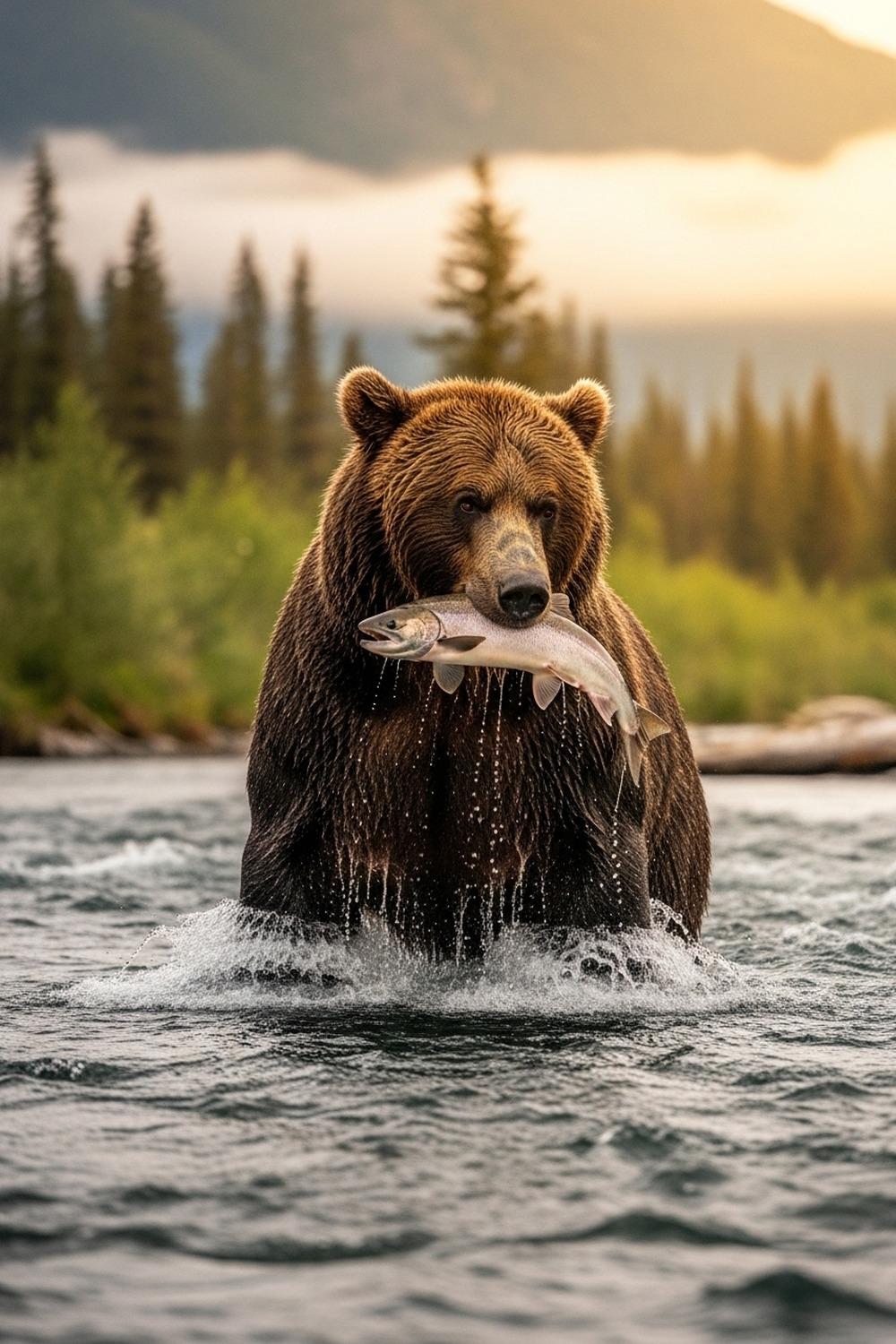
There’s a bear named Chunk standing in Brooks River right now, and on one particular day in 2024 he didn’t leave that water for ten hours. Not because he had to. Because he couldn’t stop.
Forty-five salmon. One after another. Every fourteen minutes or so he’d pull another fish out of the current, and his body just kept accepting them like it was made for exactly this — which, biologically speaking, it was.
His official designation is Bear #32. But the researchers who’ve watched him year after year at Katmai National Park in Alaska know him as someone different from the others. Not bigger. Not meaner. Just weirdly, almost mechanically efficient. He picks his spot in that rushing water, reads what’s coming, and doesn’t waste energy on fish he can’t catch. Most bears burn out after a few hours. Chunk was apparently built different.
Key Facts
- Bear #32 (Chunk) caught 45 sockeye salmon in 10.5 hours during the 2024 run at Katmai National Park, Alaska — roughly one fish every 14 minutes.
- Brown bears in hyperphagia can consume up to 20,000 calories daily, about ten times an average adult human’s needs.
- By late summer a bear’s body weight can increase 30% or more, almost entirely fat accumulated during the salmon season.
- Sockeye salmon travel up to 900 miles upstream without eating, navigating by Earth’s magnetic field and chemical memory.
- Dr. Charles Robbins at Washington State University’s Bear Center studies hyperphagia, during which bears can gain up to four pounds of fat per day.
In short: This story follows Chunk, a brown bear salmon Katmai legend who caught 45 sockeye in 10.5 hours during the 2024 run. It explains hyperphagia, the biological override letting bears eat up to 20,000 calories daily and gain 30% body weight before hibernation, and how salmon connect ocean nutrients to Alaska’s forests.
The Math on What Happened That Day
Each sockeye salmon he caught weighs somewhere between five and fifteen pounds. That’s roughly 4,500 calories per fish if you do the math. Forty-five of them in one session.
That’s over 200,000 calories.
For context: a typical human needs about 2,000 calories a day. Chunk consumed a week’s worth of human calories in the time most of us spend on a Tuesday. And here’s what really got me reading about this for hours — he wasn’t even done hunting for the year. This was just one good day during the sockeye run.
Researchers studying brown bear behavior have documented bears gaining up to four pounds of fat daily during peak salmon season. But even that number feels almost dull compared to what’s actually happening inside those bodies.
The Biological Override
What Chunk’s body was running on is called hyperphagia. It’s not hunger — not really. It’s closer to a compulsion. A complete system override where the bear’s brain stops caring about sleep, social hierarchy, territory, or anything else that normally matters. The salmon run turns every bear into a single-purpose machine.
Dr. Charles Robbins at Washington State University’s Bear Center has spent his career studying this process, and what he’s found is genuinely strange: a bear in hyperphagia experiences hormonal shifts comparable to a human body preparing for major surgery, except the bear orchestrates it all by itself. Insulin sensitivity changes. Metabolic rate spikes. Appetite signaling goes haywire.
The fat he’s building during those ten hours isn’t just energy. It’s insulation. It’s organ protection. It’s everything he needs to breathe through five or six months of hibernation without eating a single meal.
Brooks River Exists in Its Own Universe
The river runs through the heart of Katmai, and for a few weeks each summer it becomes one of the most concentrated feeding events on Earth. Sockeye salmon return from the Pacific in waves, pushing upstream to spawn in the lake where they hatched. Bears line the falls. They stake out shallow riffles. They stand in that current with an intensity that’s almost uncomfortable to watch.
The Park Service’s live-cams — the famous ones that get millions of viewers every year — have turned this annual ritual into global theater. You can log on right now and watch it happening. And every year, a few individuals emerge from the crowd.
Chunk’s been standing out for years. Not because he’s the biggest or the most aggressive.
He’s just the most patient.
Meanwhile, the Salmon Are Doing Something Impossible
While the brown bear salmon feeding frenzy plays out at the waterfall, the salmon themselves are executing an equally astonishing feat. These fish navigate thousands of miles through the open Pacific Ocean using Earth’s magnetic field as a compass. Then, as they approach freshwater, they switch to chemical memory — homing in on the exact molecular signature of the stream where they were born. That olfactory map gets imprinted when they’re young and somehow recalled years later with near-perfect accuracy.
They don’t eat once freshwater hits.
The entire upstream journey — fighting currents, leaping waterfalls, evading bears — happens on reserves built up in the ocean. They’re sprinting toward death, and they’re wired to do nothing else. The bear waiting at the water isn’t a disruption. It’s the last station in a system that’s been running for millions of years unchanged.
The Numbers That Matter
- Chunk caught 45 salmon in 10.5 hours during the 2024 run — one roughly every 14 minutes (Katmai National Park, 2024).
- Brown bears in hyperphagia consume up to 20,000 calories daily. That’s ten times what an average adult human needs.
- By late summer, a bear’s body weight can jump 30% or more — nearly all of it fat accumulated during a few weeks of salmon season.
- Sockeye salmon travel up to 900 miles upstream without food, navigating on instinct and chemistry alone.
- A bear’s entire winter survival depends on fat accumulated in roughly 12 weeks. Miss the run, and you’re thin going into hibernation. Thin bears don’t always wake up.
What Actually Happens in That River
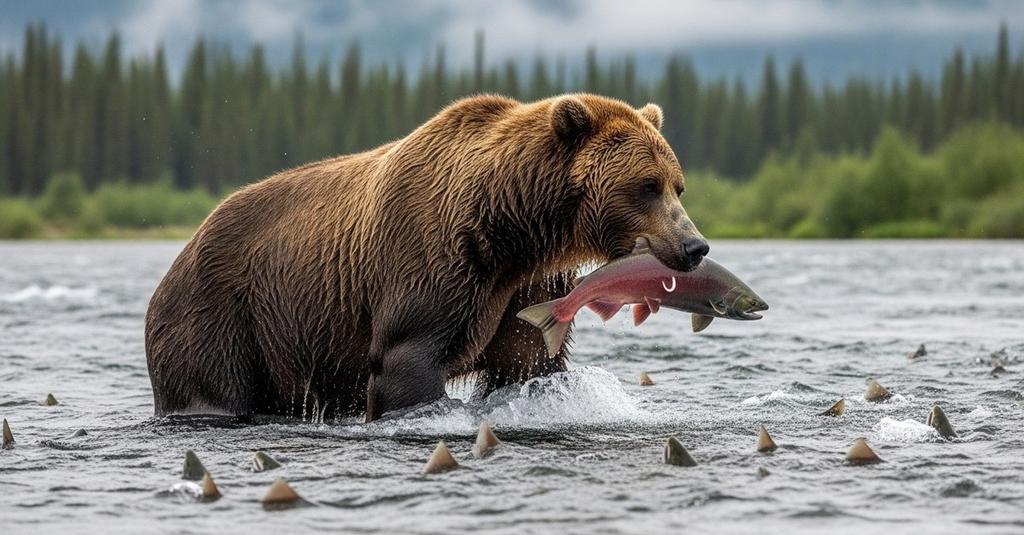
Bears at Brooks Falls have developed distinct fishing styles. Some plunge-dive from the lip of the falls. Others stand mid-stream and snag fish mid-leap. A few wade the shallows and chase by pure speed.
Chunk is a wader. Low energy. High yield. He’s figured out something about the water that the other bears haven’t — or maybe they have, but he’s just more patient about it.
There’s also Fat Bear Week, this absurd and brilliant thing the National Park Service runs every fall where people vote in a bracket-style tournament to crown the “fattest” bear. It draws millions of votes worldwide. It’s the most-watched wildlife event that doesn’t involve a single camera crew or Hollywood producer. Just bears being bears, and the internet unable to look away.
And here’s the part that actually matters ecologically: when salmon die after spawning, their decomposing bodies don’t just vanish. They fertilize the streamside forest. They feed trees that shade the water and keep the stream cool enough for the next generation to survive. The bears eating the fish are, indirectly, feeding the river itself.
This Is Bigger Than One Bear’s Appetite
What Chunk pulled off in those ten hours is a window into something that connects the Pacific Ocean to the Alaskan interior in a chain of energy transfer so clean it almost seems designed. Salmon carry marine nutrients — phosphorus, nitrogen, carbon — deep into freshwater systems. Bears carry those same nutrients even deeper, into forest soil through their waste. A single healthy salmon run measurably changes the chemistry of trees a hundred meters from the river.
When salmon runs collapse, the damage doesn’t stay in the water.
It moves uphill. Into the bears. Into the forest. Into the soil. The whole thing is one organism.
And Chunk standing in that river for ten and a half hours is both the symbol of that system’s health and its most visible proof that something profound is actually working. If the salmon stop coming, the bears go thin into winter. Thin bears don’t always come out the other side. The forest gets less nitrogen. The cycle breaks somewhere upstream or downstream, and nobody can quite predict where.
Forty-five salmon in ten hours isn’t a record. It’s just Tuesday at Brooks River when everything is functioning the way it evolved to function over millions of years. These systems are ancient. Elegant. And fragile in ways that don’t become obvious until something breaks. Chunk will be back next summer — if the run holds, if the water stays cold enough, if everything downstream cooperates. And if you’re the kind of person who falls down research rabbit holes about bears and salmon and ecosystem collapse, there’s more at this-amazing-world.com.
Frequently Asked Questions
Q: How many salmon can a brown bear eat in a day at Katmai?
During the 2024 run at Katmai National Park, the bear known as Chunk (Bear #32) caught 45 sockeye salmon in 10.5 hours — about one every 14 minutes. Each sockeye holds roughly 4,500 calories, so that single session delivered over 200,000 calories. Brown bears in peak feeding can consume up to 20,000 calories daily, around ten times what an average adult human needs.
Q: What is hyperphagia in bears?
Hyperphagia is the compulsive feeding state bears enter before hibernation, driven by hormonal shifts rather than ordinary hunger. According to Dr. Charles Robbins at Washington State University’s Bear Center, insulin sensitivity and metabolic rate change dramatically. During this period bears can gain up to four pounds of fat per day, building the insulation and energy reserves needed to survive five or six months of winter without eating.
Q: Why do sockeye salmon swim upstream without eating?
Sockeye salmon return from the Pacific to spawn in the freshwater lakes where they hatched, traveling up to 900 miles upstream entirely on energy reserves built in the ocean. Once they hit freshwater they stop eating. They navigate the open ocean using Earth’s magnetic field, then switch to chemical memory — an olfactory map imprinted in youth — to home in on their exact birth stream years later with near-perfect accuracy.
Q: What is Fat Bear Week at Katmai?
Fat Bear Week is an annual bracket-style tournament run by the National Park Service each fall, where the public votes to crown the fattest bear at Brooks River. It draws millions of votes worldwide and has become one of the most-watched wildlife events online. The contest celebrates the bears that have successfully fattened up during the salmon run, since heavy fat reserves are what carry them through hibernation.
Illustrations are AI-generated. Article fact-checked and human-edited. Our editorial standards.