The Sea That Parts Twice a Year in South Korea
Twice a year, the ocean between two Korean islands just… stops. It opens. For exactly an hour, you can walk on what used to be the sea floor, and nobody really agrees on why this particular stretch of coast decided to do something so impossible.
On the southwestern edge of South Korea, something happens that shouldn’t. The water between Jindo Island and Modo Island doesn’t gradually recede like a normal tide. It pulls back far enough — 2.8 kilometers, sometimes wider — to expose ancient seabed that’s been underwater for months. You can walk it barefoot. You can cross it. And then the ocean comes back, quietly, like it never left.
Key Facts
- The sea between Jindo Island and Modo Island in South Korea recedes up to 2.8 kilometers, exposing seabed up to 40 meters wide
- The Yellow Sea averages just 44 meters deep, compared to the global ocean average of 3,688 meters
- The annual Yeongdeung Festival draws nearly 500,000 visitors
- The event occurs twice yearly, around late February and late June, governed by lunar cycles
- French Ambassador Pierre Randi publicized the phenomenon as the ‘Korean Moses Miracle’ in a French newspaper in 1975
In short: The Miracle of Jindo sea parting happens twice a year off South Korea, when syzygy and the funnel-shaped Yellow Sea coastline pull the tide back up to 2.8 kilometers, exposing a walkable seabed corridor up to 40 meters wide. The annual Yeongdeung Festival around the event draws nearly 500,000 visitors.
What’s Actually Happening Here
The real mechanism is called syzygy — basically when the sun, moon, and Earth line up in a way that cranks the tidal pull to its absolute extreme. Fine. Except that happens everywhere. The reason Jindo works is geometry.
The Yellow Sea is weirdly shallow. Averaging around 44 meters deep — compare that to the actual ocean, which averages 3,688 meters — it’s like someone drained most of the water out. And the Korean coastline curves in this specific way that acts like a funnel, amplifying the tidal effect far beyond what the moon alone could do. Oceanographer Dr. Choi Byung-ho spent years studying this, trying to understand why other shallow coastlines don’t produce anything remotely similar.
Turns out it’s not just one thing. It’s the combination.
Remove the funnel-shaped basin. Reshape the coastline slightly. The path never appears.
Before Scientists Named It, Locals Were Already Walking Across It
There’s a legend — possibly centuries old, possibly older — about a grandmother named Bbyong. She got separated from her family when they fled to Modo Island to escape a tiger. The story says she stood at the water’s edge, desperate, and prayed. The sea opened for her. A path appeared.
She crossed.
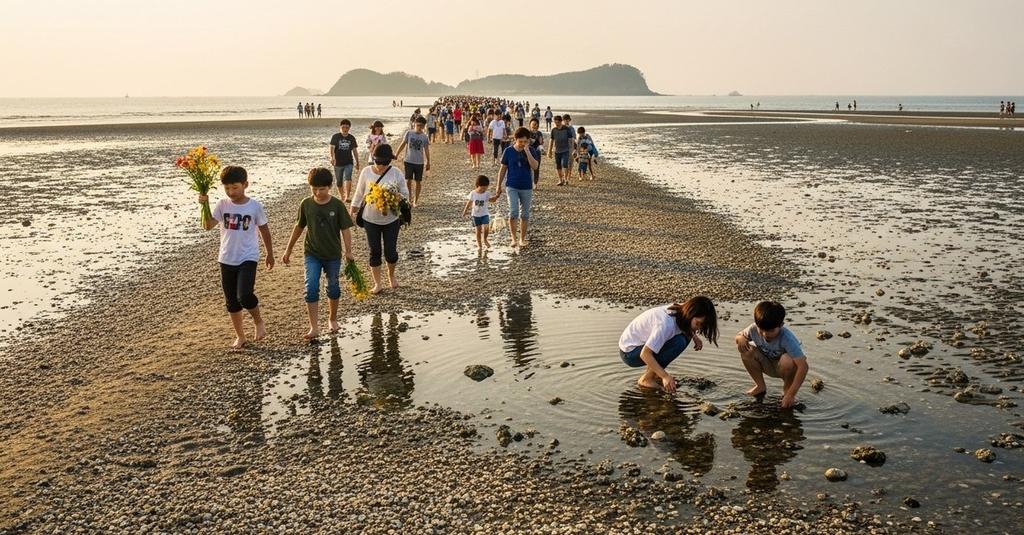
Long before anyone had a word for astronomical alignment, the people of Jindo were marking this moment on their calendar. They built it into how they lived. The annual Yeongdeung Festival started as a way to acknowledge the event — carrying flowers down onto the exposed seabed, making offerings, celebrating the strange grace of a miracle (or a tidal anomaly, depending on how you frame it). Now it draws nearly 500,000 visitors a year.
What’s interesting is that the legend and the science haven’t killed each other. They coexist. An elder explaining syzygy to a child at the festival is still working with the story of Bbyong. The flowers still get carried down. The ritual still happens. That last fact kept me reading for another hour — this idea that a community can hold both explanations at once, that they’re not fighting for the same space.
The Path Itself Isn’t What You’d Expect
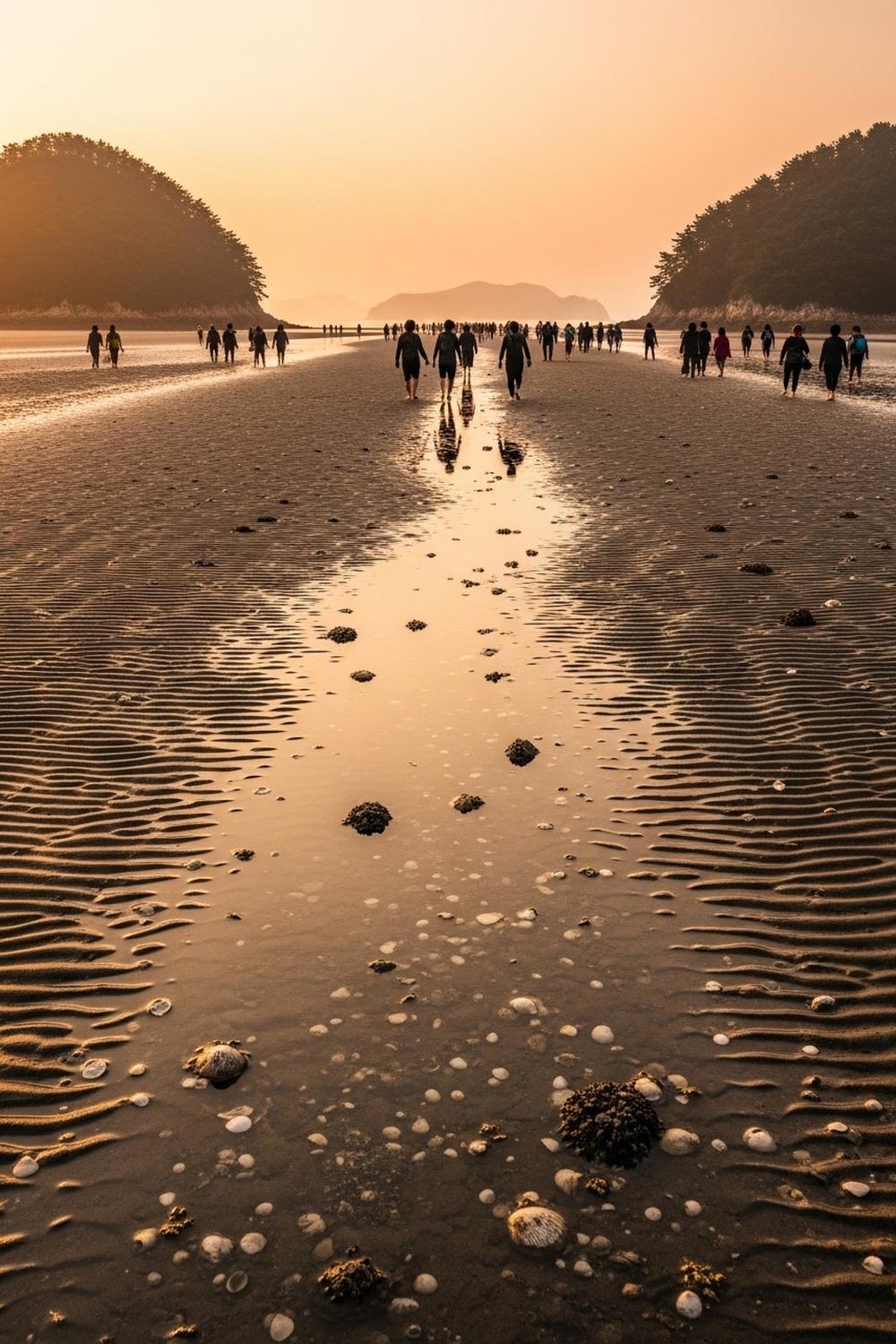
At its widest, the exposed corridor stretches nearly 40 meters across. That’s not some narrow strip you’d shuffle sideways over. That’s a genuine landscape — rippled sand sculpted by years of current, tidal pools catching light, shellfish exposed mid-breath, small life panicking at an unexpected hour of air.
The sound is strange. Water draining through sand makes a soft, constant noise. The smell is salt and brine and something else — something deeper.
Visitors describe it in ways they can’t quite articulate. Not vertigo. Not quite awe. The disorientation of standing on the ocean floor with the horizon on both sides.
And then it starts coming back. Slowly at first.
Then fast.
Why This Doesn’t Happen Everywhere
Syzygy is clockwork. It occurs on a predictable astronomical schedule — twice yearly, when the sun and moon align to pull tides to their absolute lowest point. Most coastlines in the world experience this. Most coastlines produce a modest low tide. Notable, maybe. Worth planning around. But nothing that empties an entire seabed corridor.
The Korean peninsula is different. The Yellow Sea’s shallow basin combined with the specific curve of the coastline creates a tidal amplification that’s almost unnatural in its efficiency. It’s like someone engineered it. They didn’t — millions of years of geological accident did — but that’s what it feels like.
By the Numbers
- 2.8 kilometers of seabed exposed at peak recession
- Up to 40 meters wide — wide enough to drive across, wide enough to forget where you are
- The Yellow Sea averages 44 meters deep, compared to the global ocean average of 3,688 meters
- Nearly 500,000 visitors attend the annual festival, making it one of South Korea’s largest nature-based celebrations
- The event happens twice yearly — late February and late June — but the exact timing shifts because it’s governed by lunar cycles, not the calendar
What Actually Matters Here
- The exposed corridor isn’t empty. Tidal pools fill with sea cucumbers, crabs, clams, mollusks. Locals have historically harvested during the window. This isn’t just spectacle — it’s seasonal food source.
- The wider world barely knew this existed until 1975, when French Ambassador Pierre Randi witnessed it and wrote about the “Korean Moses Miracle” in a French newspaper. International attention exploded from there.
- The event doesn’t stick to a consistent clock time year to year. It’s driven by lunar and solar cycles, not the Gregorian calendar. The exact moment of maximum recession shifts. You can’t just show up.
Why This Matters
The planet is operating on timelines and forces we’ve mostly stopped noticing. The same gravitational mechanics that open this seabed are shaping coastlines, influencing ecosystems, driving tidal patterns across every ocean. We’ve just built our daily lives to ignore all of it.
The Miracle of Jindo shows up twice a year to remind us that we didn’t change the planet’s schedule. The planet doesn’t care about ours.
There’s something else, though. The way Jindo has held this event in living memory for generations — not explaining it away, but marking it, celebrating it, carrying flowers into it — that matters. That’s a community staying in conversation with something larger than itself. Most of us stopped doing that.
The sea opens. People walk. The sea comes back. It’s been doing this since before anyone was watching. But for sixty minutes, twice a year, it hands you something rare — a direct window into how the planet actually works, dressed up as a miracle. If this kind of story keeps you awake at 3am, there’s more at this-amazing-world.com. The next one is stranger.
“
Frequently Asked Questions
Q: What causes the Miracle of Jindo sea parting?
The parting is driven by syzygy, the alignment of the sun, moon, and Earth that pulls tides to their extreme. What makes Jindo unique is geometry: the Yellow Sea averages only 44 meters deep, and the Korean coastline curves like a funnel that amplifies the tidal effect. The combination exposes a seabed corridor up to 2.8 kilometers long, far beyond what occurs on ordinary shallow coastlines. It happens about twice yearly.
Q: When does the Jindo sea parting happen each year?
The event occurs twice yearly, typically around late February and late June. The exact timing shifts year to year because it is governed by lunar and solar cycles rather than the Gregorian calendar. The maximum recession lasts roughly an hour, and because the moment moves, visitors cannot simply show up on a fixed date. The annual Yeongdeung Festival is scheduled around the predicted peak recession.
Q: How wide is the exposed seabed path at Jindo?
At its widest, the exposed corridor stretches nearly 40 meters across and runs about 2.8 kilometers between Jindo and Modo islands. That is wide enough to walk or even drive across. The landscape includes rippled sand, tidal pools, and exposed shellfish such as sea cucumbers, crabs, and clams, which locals have historically harvested during the roughly hour-long window before the water returns.
Q: How many people visit the Jindo festival?
Nearly 500,000 visitors attend the annual Yeongdeung Festival, making it one of South Korea’s largest nature-based celebrations. The festival began as a ritual acknowledging the sea parting, tied to a centuries-old legend about a grandmother named Bbyong for whom the sea reportedly opened. Visitors carry flowers onto the exposed seabed and make offerings, a tradition that has continued alongside the scientific explanation of syzygy.
Illustrations are AI-generated. Article fact-checked and human-edited. Our editorial standards.