One Woman’s Shovel Cut Armenia Off the Internet
“`html
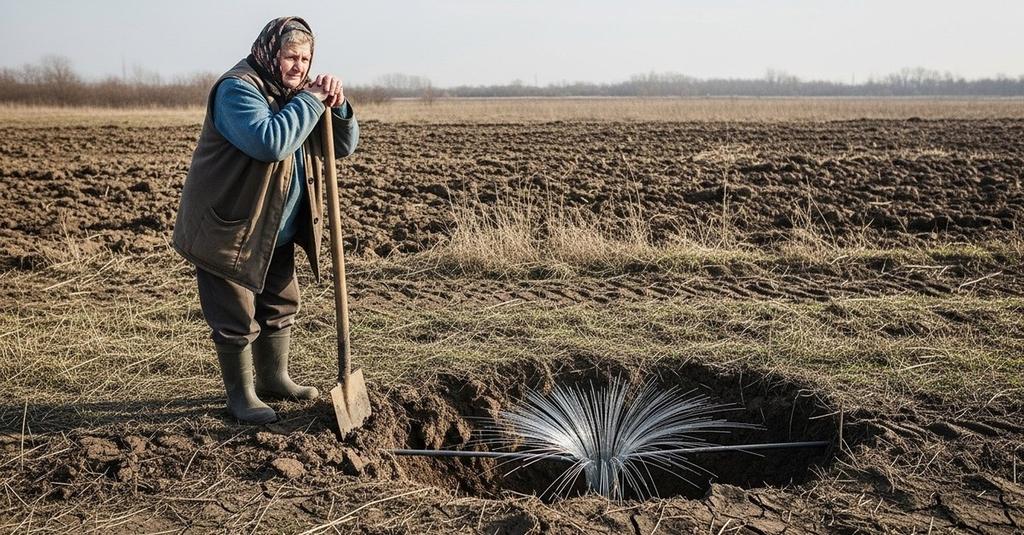
One shovel. One woman. Three million people went dark because nobody had bothered to mark the cable running beneath her feet. The Armenia internet outage 2011 started when Aytäkin Mämädova, 75, struck a fiber-optic line while digging for scrap copper outside Tbilisi — and ended an entire nation’s connection to the outside world.
March 28, 2011. A field near Tbilisi, Georgia. Mämädova was looking for copper to sell when her spade hit something that would shut down 90% of Armenia’s internet traffic. She’d never heard of the internet. The cable beneath her feet didn’t belong to Armenia — it belonged to Georgian Railway Telecom, a state-owned provider that had inherited Soviet-era infrastructure running along an old rail corridor through the Caucasus. That single line carried everything: business traffic, government communications, personal email. All of it. None of it had a backup.

How One Cable Became a Nation’s Only Lifeline
Here’s the thing: Armenia didn’t choose this vulnerability. It inherited it. When the Soviet Union collapsed in 1991, the newly independent states of the South Caucasus got what the USSR had built — networks designed for control, not resilience. Redundancy was Western thinking. Soviet planners built one line because one line was enough to monitor. They never imagined a future where that single line would sustain millions of internet users.
Geography made Armenia’s problem worse. Landlocked. Two closed borders — Turkey to the west, Azerbaijan to the east. Those aren’t just political facts; they’re infrastructure constraints. Building a second international cable route means negotiating transit rights through hostile or contested territory, burying fiber across terrain that doesn’t cooperate, absorbing costs that don’t pay off until the moment of catastrophic failure. For a small economy, the math never favored redundancy.
By 2011, Armenia had actually built something worth protecting. Yerevan was becoming known for software development. Internet penetration had climbed through the 2000s. But none of that growth had translated into route diversity.
The cable Mämädova struck wasn’t secondary or backup.
It was the only artery. Engineers call this a single point of failure — one component whose breakdown freezes an entire system. Armenia in 2011 was a textbook case.
The outage rippled outward almost immediately. Parts of Georgia went dark. Azerbaijan reported disruptions. At Georgian Railway Telecom, engineers scrambled to assess damage and begin repairs — a process that took between five and twelve hours depending on region and provider. For a nation of 3.2 million people, that meant a full working day without internet access. Not slowdown. Not degradation. Cessation. The digital economy simply stopped.
Mämädova was arrested on property damage charges, then released. Because she was 75. When asked about the incident, she told authorities she had no idea what the internet was.
The Global Pattern Nobody Really Wants to Examine
Armenia’s vulnerability was dramatic, but it wasn’t isolated. Why does the world’s internet depend on infrastructure this fragile? Because building it differently is expensive, difficult, and optional — until it isn’t.
The internet doesn’t float in the cloud. It travels through undersea fiber-optic cables — approximately 400 systems spanning over 1.2 million kilometers of ocean floor. According to reporting by the BBC’s Future team, roughly 97% of all international internet traffic moves through these cables. They’re no thicker than a garden hose. Anchors drag them. Sharks gnaw them. Earthquakes slice them. In 2008, three years before Mämädova picked up her shovel, two cable cuts in the Mediterranean disabled internet access for 75 million users across the Middle East, South Asia, and East Africa simultaneously. TeleGeography, which has tracked cable cuts for decades, documents the same pattern repeatedly: concentration creates catastrophe.
What made Armenia different — what made it resonate globally — was the human face on the infrastructure. Not a ship dragging an anchor. Not seismic activity. A retired woman looking for copper. Watching a nation disconnect because one person with a spade didn’t know what the internet was, you stop calling it a technical problem. It’s a choice. A repeated choice to defer resilience.
Most internet users assume the cloud is everywhere and nowhere — distributed, resilient, self-healing. The reality is it runs through very specific holes in the ground and very specific trenches on ocean floors. The infrastructure has names: Georgian Railway Telecom. TeleGeography. Specific companies, specific cables, specific points where the system can fail.
What Changed After March 28, 2011
In the months following the Armenia internet outage 2011, telecommunications analysts and policy researchers began examining how such an event had become possible. The International Telecommunication Union (ITU) had been flagging countries with fewer than two independent international gateway routes since the mid-2000s, noting they faced disproportionate risk from single infrastructure failures. Armenia fit that profile almost exactly.
The ITU’s Telecommunication Development Bureau had already identified landlocked nations across Central Asia, the South Caucasus, and Sub-Saharan Africa as structurally vulnerable — not from hostile actors or sophisticated attacks, but from simple geography combined with chronic underinvestment. The data made clear what Armenia’s outage would prove in practice.
Economics explains the rest. Running a second international fiber route requires expensive cross-border negotiations, difficult terrain, and upfront capital that generates no revenue until the moment when the primary line fails. For a small economy, the incentive to build redundancy is always weaker than the incentive to defer it. The 2011 outage changed that calculation overnight. Within two years, Armenian telecommunications providers had accelerated investment in alternative routing through Iran and satellite backup capacity. Not elimination of single-point risk — narrowing of it.
Mämädova’s trial ended quietly. Prosecutors declined to pursue a formal conviction, citing her age and the absence of meaningful intent. The cable got repaired. The internet returned. Somewhere in a field outside Tbilisi, presumably, there is now a better-marked cable.
How It Unfolded
- 1991: Following the dissolution of the Soviet Union, Armenia, Georgia, and Azerbaijan inherit a telecommunications infrastructure built for centralized control with minimal redundancy, setting the conditions for future vulnerability.
- 2008: Two simultaneous cable cuts in the Mediterranean Sea disable internet access for an estimated 75 million users across the Middle East, South Asia, and East Africa, signaling the fragility of concentrated infrastructure globally.
- March 28, 2011: Aytäkin Mämädova strikes a Georgian Railway Telecom fiber-optic cable near Tbilisi while digging for scrap copper, triggering the Armenia internet outage 2011 and disconnecting 90% of Armenia’s international internet traffic for up to twelve hours.
- 2013: Armenian telecommunications providers accelerate investment in alternative international routing through Iran and expanded satellite backup capacity, reducing — though not eliminating — single-point-of-failure risk.
By the Numbers
- 90%: Share of Armenia’s total international internet traffic carried by the single Georgian Railway Telecom cable cut on March 28, 2011.
- 3.2 million: Population of Armenia affected by the outage, with additional disruptions recorded in parts of Georgia and Azerbaijan.
- 5–12 hours: Duration of the outage depending on region and service provider, spanning a full working day for most affected users.
- 97%: Proportion of all international internet traffic carried globally by undersea fiber-optic cable systems, according to TeleGeography research group data.
- 75 years old: Age of Aytäkin Mämädova at the time of the incident — the accidental architect of a national blackout.
Field Notes
- The cable Mämädova struck wasn’t labeled or fenced at the point where she was digging. Post-incident inspections of the Georgian Railway Telecom corridor revealed that significant stretches of the fiber-optic route lacked surface markers adequate to deter accidental excavation — a finding that prompted revised burial-depth and signage guidelines across the Georgian road and rail authority network.
- Armenia is one of only a handful of countries globally that is both landlocked and bordered by two entirely closed land borders — with Turkey and Azerbaijan — meaning its options for alternative overland cable routes are geographically constrained in ways that most infrastructure planners don’t encounter.
- Mämädova’s stated ignorance of the internet at the time of the incident was legally significant: Georgian prosecutors determined she lacked the intent required for a more serious criminal charge, reducing the case to a property damage matter before ultimately declining to pursue a conviction.
- Researchers at the ITU still don’t have a universally agreed threshold for what constitutes “sufficient” route redundancy for a landlocked nation — the question of how many independent international gateways a small country needs to be genuinely resilient remains contested, and this matters more than it sounds, with estimates ranging from two to five depending on traffic volume and economic exposure.
Frequently Asked Questions
Q: What exactly caused the Armenia internet outage 2011, and how long did it last?
The Armenia internet outage 2011 was caused when Aytäkin Mämädova, a 75-year-old Georgian woman, accidentally cut a Georgian Railway Telecom fiber-optic cable while digging for scrap copper near Tbilisi on March 28, 2011. The cable carried approximately 90% of Armenia’s international internet traffic. The outage lasted between five and twelve hours depending on location and provider, affecting 3.2 million people in Armenia as well as users in parts of Georgia and Azerbaijan.
Q: Why did Armenia’s entire internet depend on a single cable?
Armenia inherited its telecommunications infrastructure from the Soviet Union, which built networks for centralized control rather than resilience or redundancy. As a landlocked nation bordered by two closed frontiers — Turkey and Azerbaijan — Armenia had fewer geographic options for alternative cable routes than most countries. Building redundant international connections requires expensive cross-border negotiations and capital investment that small economies routinely defer. By 2011, that deferred investment had left the country structurally exposed to exactly the kind of single-point failure that Mämädova accidentally triggered.
Q: Was Mämädova prosecuted for causing the outage?
Mämädova was arrested on property damage charges following the Armenia internet outage 2011, but she was not ultimately convicted. Georgian prosecutors cited her age — 75 at the time — and the absence of criminal intent as factors in the decision not to pursue a formal conviction. Her claim that she had no knowledge of the internet was taken at face value by authorities. The incident was treated primarily as an infrastructure failure and a regulatory oversight issue rather than a criminal act.
Editor’s Take — Sarah Blake
What unsettles me most about this story isn’t the outage itself — it’s the word “quietly” in that original description of the cable. It quietly carried 90% of Armenia’s internet traffic. Quietly. An entire nation’s connectivity, passing through one buried line, with so little fanfare that a woman with no knowledge of the internet could sever it while looking for something to sell. The internet presents itself as atmosphere. It’s actually plumbing. And the plumbing, in far more places than we admit, is a single pipe.
The Armenia internet outage 2011 lasted half a day. The question it opened has never really closed. Every time you load a page, stream a call, or send a message across a border, that data is traveling through physical infrastructure that is, somewhere along its route, as exposed as a cable in a Georgian field. No redundancy. No fence. No marker. Just a line in the ground, doing quiet, load-bearing work — until the day someone picks up a shovel and reminds the modern world exactly how fragile its foundations are.
“`