The Horned Lizard That Vanished for 47 Years Then Walked Out
Nobody on that dirt road in Ecuador was looking for a lizard. They were birdwatchers, scanning the canopy, and then something with a fleshy horn growing off its nose walked across the road in front of them and accidentally closed a 47-year hole in the scientific record.
It was 2005. A small group of birdwatchers were driving through cloud forest in northwestern Ecuador — part of the Chocó-Andean corridor, one of the most biodiverse and least-surveyed stretches of terrain on the continent. No research protocol. No herpetologist in the vehicle. Just people looking for birds who happened to look down at exactly the wrong, or maybe exactly the right, moment. One of them recognized the horn. Photos were taken. And just like that, Anolis proboscis was back.
Key Facts
- The Pinocchio anole (Anolis proboscis) was first formally described by herpetologists in 1953, then went unrecorded in the scientific literature for 47 years.
- In 2005, a group of birdwatchers driving through cloud forest in northwestern Ecuador’s Choco-Andean corridor accidentally rediscovered the species.
- Only male Pinocchio anoles have the fleshy, prehensile nasal horn; females are plain-faced, which led to females being undercounted after 2005.
- The species measures about 8.4 cm snout-to-tail, making it one of the smallest anole species in Ecuador’s cloud forest.
- The Choco-Andean corridor where Anolis proboscis lives holds an estimated 10,000 plant species and roughly 600 bird species.
In short: The Pinocchio anole lizard, formally described in 1953, vanished from the scientific record for 47 years until birdwatchers accidentally rediscovered it in Ecuador’s Choco-Andean cloud forest in 2005. Only males grow the fleshy nasal horn. Its disappearance was a documentation failure, not a population collapse, raising questions about undocumented species.
How the Pinocchio Anole Rediscovered Itself, Accidentally
The Anolis proboscis — the Pinocchio anole — was first formally described by herpetologists in 1953. Catalogued, noted, filed away. And then, for nearly five decades, nothing. No verified sightings in the scientific literature. Not a trace.
Herpetologist Jonathan Losos, who has spent years mapping anole evolution across the Caribbean and South America, has written about how species like this occupy ecological niches so precise that even experienced researchers can pass within a few feet and see nothing. Which sounds like an excuse until you actually think about it.
This isn’t a deep-sea creature. It’s a lizard. In a tree. In a forest.
It wasn’t hiding. We just weren’t paying attention to the right part of the branch at the right time of day in the right season. That distinction matters more than it sounds.
A Nose That Tells the Whole Story
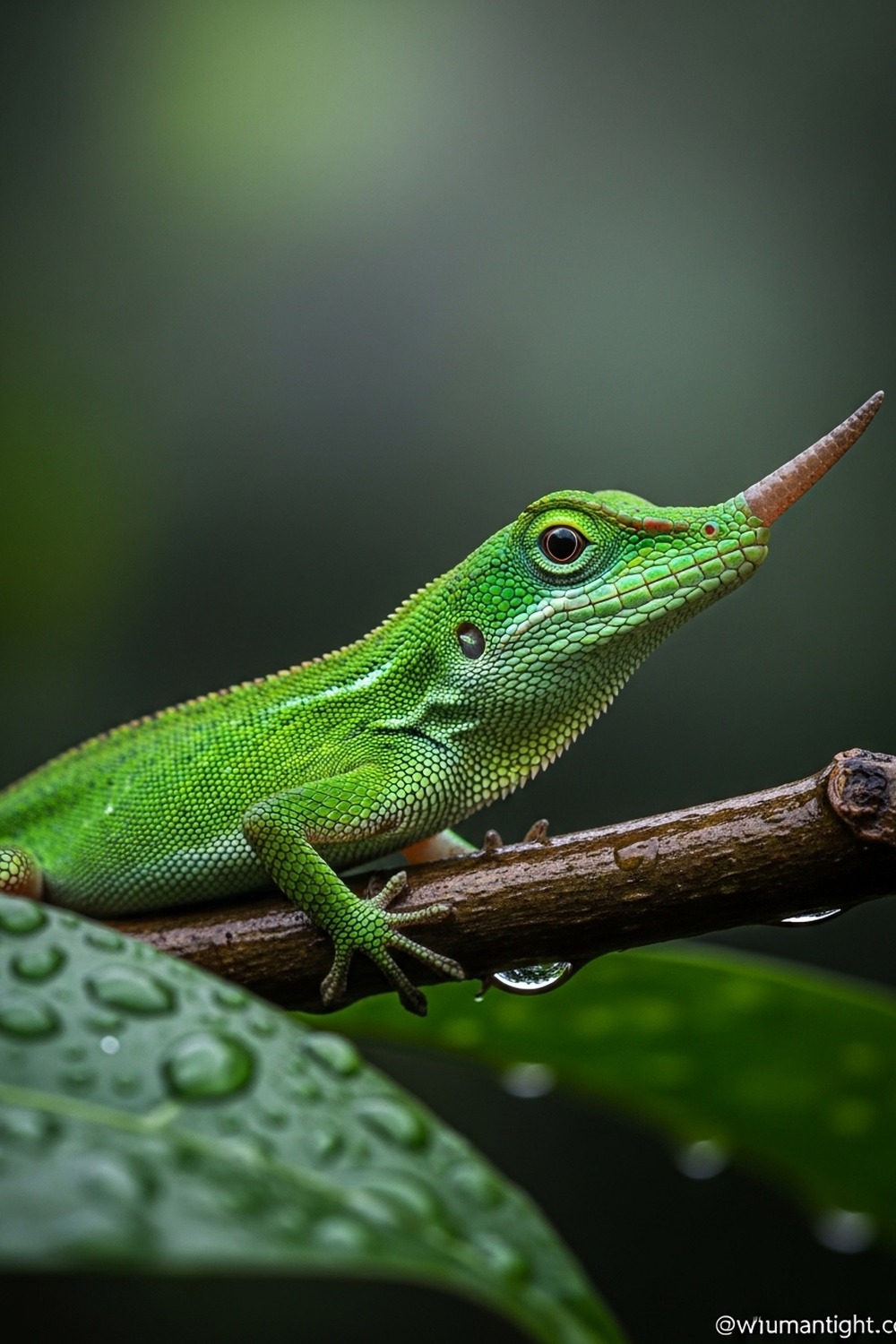
Only the males have the horn. The females are plain-faced — no appendage, no flair, nothing that would make you stop the car. The male’s nasal structure is fleshy and prehensile, meaning it moves on its own. It wobbles. It flexes. It does this, as far as researchers can tell, entirely to impress female Pinocchio anoles, who have apparently been selecting for increasingly elaborate facial architecture for long enough that evolution committed to the bit.
The horn doesn’t help it hunt. Doesn’t make it faster. Offers no obvious defensive advantage whatsoever.
It exists, essentially, to say: I’m here, I’m healthy, look at my face. You can find other examples of nature leaning this hard into impracticality in species profiles at this-amazing-world.com — and honestly, this one isn’t even the weirdest.
What 47 Years of Silence Actually Means
Conservation biologists have a term for this: a “Lazarus species.” An organism that drops out of the scientific record entirely and then resurfaces, seemingly back from the dead. The Pinocchio anole fits the category almost perfectly, with one important caveat — it was never actually gone.
The lizard didn’t vanish. The attention did.
The cloud forests of the Chocó-Andean corridor are technically accessible. People travel through them. Researchers have studied their birds, their plants, their amphibians. But systematic herpetological surveys of this region have historically been thin, patchy, and underfunded. A small, slow-moving lizard that spends most of its time motionless on a branch in a forest where there are approximately ten thousand plant species competing for your attention is, in practical terms, invisible — not because it’s rare, but because nobody’s ledger had a line for it.
That last part kept me reading for another hour. Because the implication is uncomfortable: if this one went unrecorded for 47 years, how many others currently have no line in anyone’s ledger?
The Birdwatchers Who Changed Everything Without Trying
Here’s the thing about the 2005 rediscovery — it wasn’t a methodological triumph. No radio telemetry. No systematic transect surveys. No carefully designed research protocol. A group of birdwatchers drove a road, something crossed it, someone recognized what they were looking at, and suddenly decades of scientific silence collapsed into a single afternoon.
Turns out citizen observation — the kind that still gets quietly dismissed as anecdotal in certain academic circles — has now contributed to some of the most consequential rediscoveries in modern herpetology. This isn’t a quirky one-off. It’s a pattern. Researchers are increasingly acknowledging it, building platforms around it, and in some cases structuring formal surveys around where citizen naturalists have been reporting sightings.
Which raises the obvious question nobody really wants to answer: how many species are we currently “missing” simply because the person with the right eyes isn’t employed by a university?
By the Numbers
- 47 years between last recorded sighting (1953) and the 2005 rediscovery — among the longest disappearance gaps for any vertebrate species in South American herpetology
- 8.4 cm snout-to-tail, making this one of the smallest anole species in Ecuador’s cloud forest
- The Chocó-Andean corridor where Anolis proboscis lives holds an estimated 10,000 plant species and roughly 600 bird species — and remains one of the least herpetologically surveyed ecosystems in the entire region; the birds get the attention, the lizards do not
- Multiple additional populations found since 2005
- All suggesting the near-50-year absence was a documentation failure, not a population one
Field Notes
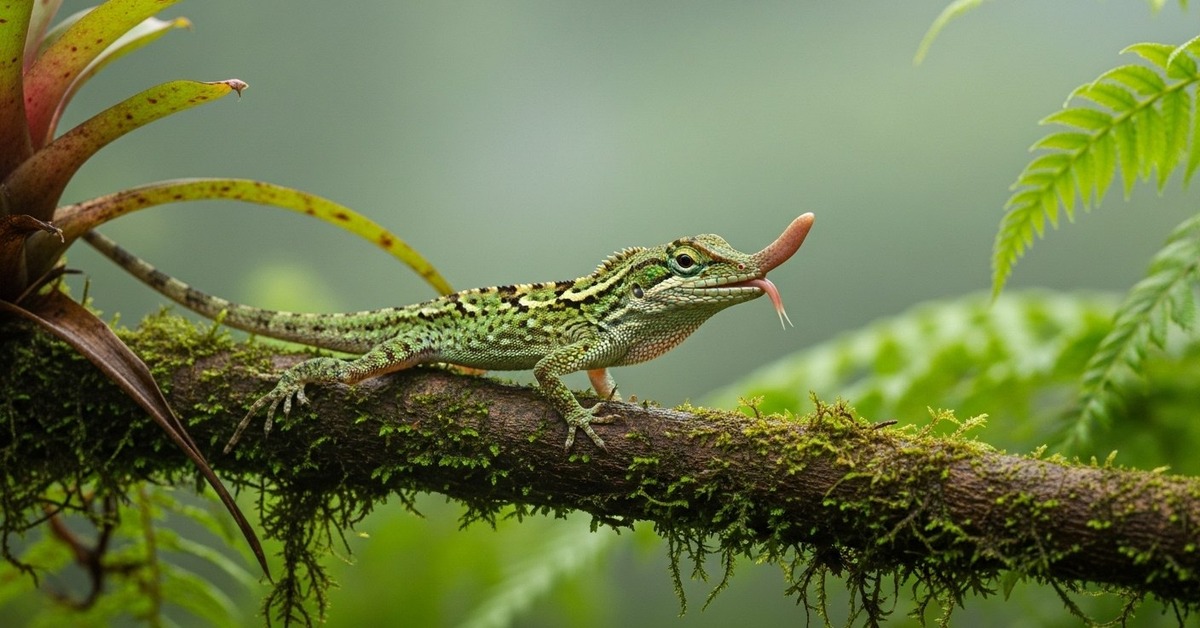
- Moves slowly. Almost deliberately slowly — which researchers think actually works in its favor, since fast movement triggers predator attention and stillness doesn’t.
- Female Anolis proboscis have no nasal horn at all, which meant that in the years immediately following the 2005 rediscovery, field documentation was heavily skewed toward males; females were being systematically undercounted simply because they were harder to identify and nobody was specifically looking for them yet.
- Belongs to a group called “rostral appendage anoles” — a small cluster of South American lizards that independently evolved elaborate nasal structures. Meaning evolution arrived at “fleshy face-horn” as a solution more than once, in the same region, apparently for the same reason.
- That last point is the one that herpetologists find genuinely strange.
Why This Lizard’s Story Still Matters Today
The Pinocchio anole rediscovered by a carful of birdwatchers in 2005 isn’t just a charming footnote. It’s a structural problem wearing a funny hat.
Conservation decisions get made based on what the record says exists. Species without a documented presence don’t receive protection plans. They don’t appear in biodiversity assessments. They don’t factor into land-use decisions that determine whether a particular stretch of cloud forest gets cleared or left alone. A lizard that science has forgotten is, for every practical purpose, a lizard that doesn’t exist — and the cloud forests where this one lives are under serious and escalating pressure from agricultural expansion, logging, and infrastructure development.
A species that spent 47 years off the radar is in a genuinely poor position to survive the kind of threat that requires people to argue for its protection in rooms where nobody has ever heard of it.
What the Pinocchio anole’s story keeps asking is this: how do you protect something you don’t know exists? Every rediscovery is a reminder that the world is fuller than our records suggest — that species go quiet, scientists move on, and in the meantime a small lizard with a wobbling fleshy horn crosses a dirt road in Ecuador and just waits for someone to look down. There’s more at this-amazing-world.com. The next one is stranger.
Frequently Asked Questions
Q: What is the Pinocchio anole and where does it live?
The Pinocchio anole (Anolis proboscis) is a small lizard native to the cloud forests of the Choco-Andean corridor in northwestern Ecuador, one of the most biodiverse regions on the continent. It measures roughly 8.4 cm snout-to-tail. First described in 1953, it is named for the fleshy, prehensile horn that grows from the male’s nose, which females entirely lack.
Q: Why was the Pinocchio anole missing for 47 years?
The Pinocchio anole was not actually gone after its 1953 description, the scientific attention was. Systematic herpetological surveys of the Choco-Andean corridor were historically thin and underfunded. A small, slow-moving lizard that spends most of its time motionless on branches went unrecorded until a group of birdwatchers spotted one crossing a road in 2005, closing a 47-year gap.
Q: What is the male Pinocchio anole’s nose horn for?
The male’s fleshy nasal horn serves no hunting, defensive, or speed advantage. As far as researchers can tell, it exists entirely for display, to impress female Pinocchio anoles, which have been selecting for increasingly elaborate facial architecture over evolutionary time. Females have no horn at all. The structure is prehensile, meaning it moves, wobbles, and flexes on its own.
Q: How was the Pinocchio anole rediscovered in 2005?
It was rediscovered entirely by accident in 2005. A small group of birdwatchers were driving through cloud forest in northwestern Ecuador with no herpetologist in the vehicle and no research protocol. One of them recognized the distinctive horn when the lizard crossed the road, photographs were taken, and decades of scientific silence collapsed into a single afternoon of citizen observation.
Illustrations are AI-generated. Article fact-checked and human-edited. Our editorial standards.