Corn Snake: The Nocturnal Climber Hiding in Plain Sight
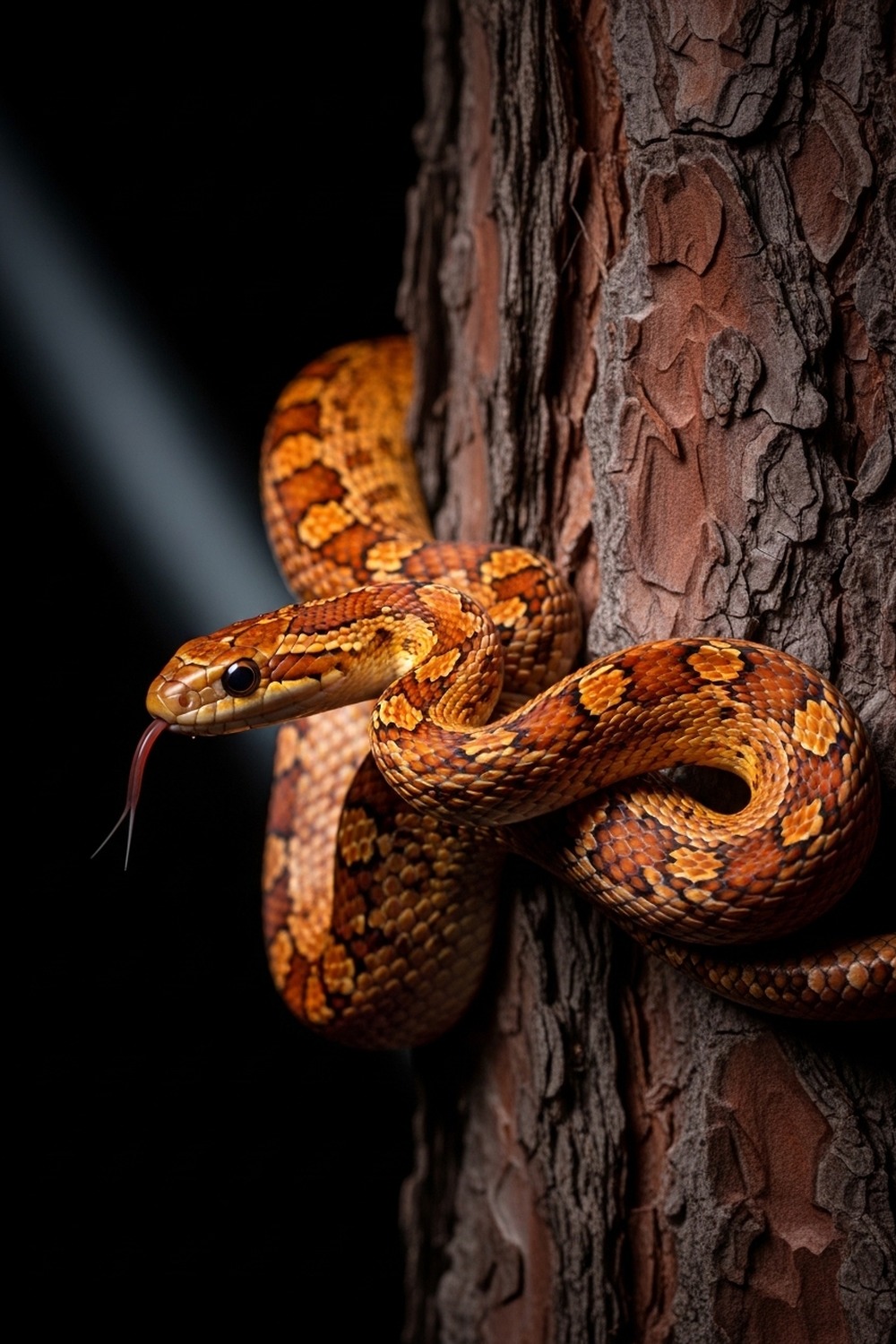
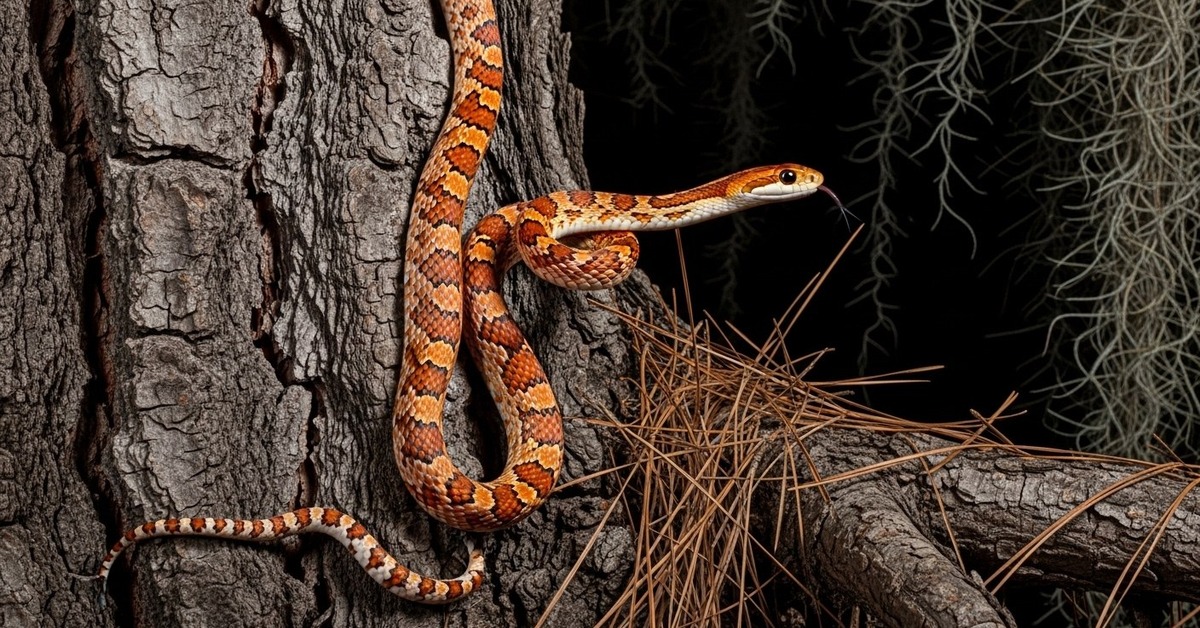
Here’s the thing about corn snakes: most people who live beside them have never seen one. Not because they’re rare — Pantherophis guttatus ranges from New Jersey to the Florida Keys, through pine flatwoods, overgrown farmland, and suburban edges — but because they operate in a vertical world most of us never think to look up into. Warm Georgia night, a longleaf pine, darkness above the canopy: that’s where this burnt-orange hunter is.
Stretching across an almost absurd range of habitats — rocky hillsides, abandoned barns, tropical hammocks, coastal scrub — it’s one of the most successful constrictors in North America. Yet most people outside the reptile-keeping world have never encountered one in the wild. How does a snake this vivid, this widespread, and this actively hunting above our heads stay so thoroughly hidden?
Key Facts
- Corn snakes (Pantherophis guttatus) have been tracked climbing to heights of over six meters, nearly 20 feet, in mature pine and oak forest, and are classified as semi-arboreal.
- Typical adult length ranges from 61 to 182 cm, with females generally reaching greater maximum lengths than males (University of Florida IFAS Extension, 2018).
- Females lay 10 to 30 eggs per clutch, with incubation periods of 58 to 62 days under optimal temperature conditions.
- Radio telemetry recorded home range sizes of 0.5 to 3.5 hectares, roughly 3 times smaller than many large rat snake species.
- The species’ geographic range spans approximately 1,500 km north to south, from New Jersey to the Florida Keys.
In short: The corn snake nocturnal climber demolishes the image of snakes as ground-level animals, ascending over six meters into trees to hunt roosting birds. This non-venomous, semi-arboreal constrictor (Pantherophis guttatus) ranges 1,500 km from New Jersey to the Florida Keys, yet most people who live beside one have never seen it.
The Corn Snake’s Secret Life After Dark
Most people picture snakes as ground-level animals — flat-bellied, low, slow. The corn snake demolishes that assumption the moment it hits a tree trunk. Field research conducted through the University of Florida’s Department of Wildlife Ecology and Conservation, with observations published across the 1990s and early 2000s, began quantifying just how vertically ambitious these animals are — individuals tracked climbing to heights of over six meters, nearly 20 feet, in mature pine and oak forest, navigating bark with overlapping ventral scales that grip like climbing shoes. According to the species’ natural history record, corn snakes are classified as semi-arboreal, a designation that still surprises people encountering the term for the first time.
Nocturnality sharpens that climbing behavior into something purposeful. Between dusk and midnight on summer nights, when temperatures stay above 70°F and humidity rises, corn snakes become intensely active foragers. They navigate almost entirely by scent — flicking their forked tongue to collect airborne chemical particles and deliver them to the Jacobson’s organ on the roof of the mouth (researchers actually call this chemosensory sampling, and it matters more than it sounds). Every flick is a question: what passed here, how recently, which direction? It’s a sensory system tuned so finely that a corn snake can track a mouse across bare concrete.
Roosting birds are a particular prize. A corn snake ascending a tree at 2 a.m. isn’t lost — it’s hunting with a strategy. Small passerines, eggs in unguarded nests, the occasional bat clinging to rough bark: all of it falls within range. The climb is silent. The strike is fast. And then the coils begin.
Constriction, Camouflage, and Cold Survival Math
Why does the corn snake’s coloration matter so much? Because it’s playing a bluff that regularly gets it killed.
There’s a creature in the reptile world that uses vivid coloration as a warning — think coral snakes, whose red-yellow-black bands signal neurotoxic venom to every predator that’s ever made the mistake of ignoring them. The corn snake takes the opposite bet. Those vivid saddle-shaped blotches in burnt orange, red-brown, and copper — running the full length of a body that typically reaches 61 to 182 centimeters — carry no chemical warning whatsoever. In habitats where the similar-looking copperhead does carry hemotoxic venom, the corn snake is simply mimicking danger it doesn’t possess. It’s a form of passive mimicry that researchers at the Smithsonian’s National Zoo have noted in broader discussions of North American colubrid evolution. This color-pattern overlap works well enough that many people kill corn snakes on sight, mistaking them for something dangerous. A species that survives millions of years of predation only to be killed by a misidentification — that particular irony deserves more attention than it gets. Speaking of animals that use deception and disguise as survival tools, the mossy frog of Southeast Asia takes camouflage to a genuinely surreal extreme — but that’s a different story entirely.
Constriction is the corn snake’s actual weapon. It’s not crushing in the way popular imagination suggests — the snake doesn’t break bones. Instead, it wraps its muscular body around prey in tight loops, tightening fractionally with each breath the prey exhales, until the animal can’t fully inhale again. Cardiac arrest follows quickly, often within seconds for a small rodent. A corn snake typically weighs between 900 grams and 1.5 kilograms at adulthood, yet it can subdue prey approaching its own body diameter — possible because the lower jaw is connected by elastic ligaments rather than fused bone, allowing the mouth to open wide enough to swallow a full-grown mouse headfirst.
Cold is a different kind of challenge. Corn snakes are ectothermic — they don’t generate their own body heat. When temperatures drop below roughly 10°C, they enter brumation, a reptilian near-hibernation. In the northern parts of their range, this can last four to five months. Spring emergence means lean, immediately hungry animals, the first warm nights triggering hunting behavior that looks almost frantic compared to their summer patience.
Range, Habitat, and Why Farms Made Them Famous
European settlers in the American Southeast stored dried corn in wooden structures — and where grain stores, rodents follow, and where rodents concentrate, corn snakes appeared in numbers that made an impression. That granary connection is the most widely accepted etymology for the common name, as noted in National Geographic’s species profile. A secondary theory points to the snake’s underside patterning — a checkered arrangement of black and white scales on a cream background that resembles the cross-section of Indian corn. Both explanations may be simultaneously true, reflecting genuine observations from different populations and time periods. Corn snakes are still commonly found in and around agricultural buildings across the Southeast, fulfilling what amounts to free pest control on a regional scale: a single adult can consume dozens of mice and rats per year, keeping grain stores and poultry farms cleaner than any trap system.
And the species’ geographic range is one of the broadest of any North American colubrid. From the Pine Barrens of New Jersey south through Virginia, the Carolinas, Georgia, Alabama, and Mississippi, then down through Florida all the way to the Florida Keys — where a genetically distinct island population exists — the corn snake has colonized ecosystems that vary enormously in temperature, humidity, and vegetation structure. Rocky mountain slopes in Virginia sit at one end of that spectrum. Low-elevation tropical hammocks in Monroe County, Florida, sit at the other. That range spans roughly 1,500 kilometers north to south — an extraordinary tolerance for ecological variation that most large colubrid species simply don’t match.
Abandoned structures are a particular draw. Old farmhouses, collapsed barns, highway culverts, rock walls — anywhere that concentrates warmth, provides hiding spaces, and supports rodent populations becomes potential corn snake habitat. Suburban sprawl, counterintuitively, has created new habitat edges where these snakes persist quietly alongside human activity, mostly unnoticed.
The Corn Snake in Science and in Captivity
By the early 1960s, herpetologists and private breeders had identified that corn snakes bred readily under captive conditions, tolerated handling with minimal stress response, and produced offspring in clutches of 10 to 30 eggs. Selective breeding programs had begun producing color morphs by 1975 — albino animals, snakes with reduced black pigmentation, animals with pastel rather than saturated hues. The reptile breeding industry in the United States now counts corn snake morphs in the hundreds, a genetic diversity generated almost entirely within the past 50 years. Few North American snake species have been more thoroughly studied in captivity, and that’s largely because the corn snake became the reptile hobby’s gateway animal. Research conducted at Louisiana State University’s Museum of Natural Science during the late 1990s used corn snake specimens to refine taxonomic relationships within the genus Pantherophis, helping clarify the distinction between corn snakes and the closely related Great Plains rat snake (Pantherophis emoryi), which had previously been classified as a subspecies.
Radio telemetry changed what researchers knew about wild behavior. Individuals fitted with surgically implanted transmitters revealed home range sizes between 0.5 and 3.5 hectares for adult animals — relatively compact territories compared to many large colubrid species. Snakes didn’t wander randomly but revisited specific hunting sites on what appeared to be learned schedules, suggesting a spatial memory capacity more sophisticated than previously assumed. Temperature and prey availability both influenced movement patterns, with adult males ranging more widely during breeding season in April and May.
Egg incubation studies added another layer of complexity. Female corn snakes deposit eggs in rotting logs, loose soil, or accumulated leaf litter between May and July, then leave entirely — no parental investment beyond site selection. Yet the microhabitat choices females make are remarkably consistent: soil temperatures between 21°C and 29°C, humidity above 60%, and partial cover that reduces desiccation risk. Herpetologists now use these preferences as indicators of local habitat quality when assessing population health in degraded landscapes.
Where to See This
- Okefenokee National Wildlife Refuge, Georgia, USA — one of the most reliable regions for wild corn snake encounters; late spring and early summer evenings along the refuge’s forest edges offer the best chance, particularly after warm rain events when snakes are most active on the surface.
- Florida Museum of Natural History in Gainesville, Florida (floridamuseum.ufl.edu) maintains ongoing herpetological collections and publishes range data useful for anyone trying to locate wild populations or understand regional subspecies variation.
- For a reliable first encounter without field conditions, reputable zoological institutions including Zoo Atlanta and the San Diego Zoo keep corn snakes in naturalistic displays — a useful starting point for understanding scale, patterning, and movement before looking for them in the wild.
By the Numbers
- 61–182 cm: typical adult length range, with females generally reaching greater maximum lengths than males (University of Florida IFAS Extension, 2018)
- 10–30 eggs per clutch, with incubation periods of 58–62 days under optimal temperature conditions
- Hundreds of recognized captive color morphs produced through selective breeding since the 1960s — more than almost any other reptile species in the US pet trade
- Home range sizes of 0.5–3.5 hectares recorded via radio telemetry in Southeast US populations — roughly 3× smaller than many large rat snake species
- Geographic range spans approximately 1,500 km north to south, from New Jersey to the Florida Keys, across more than a dozen distinct ecosystem types
Field Notes
- In a 2003 telemetry study conducted in North Carolina’s Sandhills region, researchers from the North Carolina State Museum of Natural Sciences tracked a single adult female corn snake that ascended and descended the same longleaf pine seven times over a 22-day period — consistent with targeted revisitation of a known bird roost site, not random exploration.
- Corn snake eggs are leathery rather than hard-shelled, and they absorb moisture from surrounding soil throughout incubation — an egg placed in dry conditions can fail even if temperature is ideal, which is why female nest-site selection is so behaviorally specific.
- The Florida Keys population shows measurable genetic divergence from mainland populations — isolated long enough by rising sea levels that some herpetologists argue it warrants subspecies designation, though formal classification remains contested.
- Researchers still can’t fully explain the corn snake’s apparent capacity for spatial memory of hunting sites: whether this represents true episodic-like memory or a simpler chemosensory return-to-signal behavior is an open question that current neuroscience hasn’t resolved for any colubrid species.
Frequently Asked Questions
Q: Is a corn snake dangerous to humans?
No. The corn snake carries no venom and poses no meaningful threat to adult humans or children. If handled roughly or cornered, it may bite — but the teeth are small, the bite is superficial, and no envenomation occurs. Corn snakes are non-aggressive by temperament; most wild individuals freeze, attempt to flee, or vibrate their tail in dry leaves when threatened rather than striking. The species is one of the most commonly kept pet snakes in North America precisely because of this tractable disposition.
Q: Why is a corn snake called a corn snake if it doesn’t eat corn?
The name has nothing to do with the snake’s diet. The most widely accepted explanation connects it to colonial-era granaries — dried corn stored in wooden barns and outbuildings attracted mice and rats, which in turn attracted corn snakes in numbers large enough that settlers began associating the snake with corn storage locations. A secondary theory points to the checkered black-and-white pattern on the snake’s belly, which resembles the cross-section of an ear of Indian corn. Both explanations may reflect genuine observations from different populations and time periods.
Q: Are corn snakes nocturnal or active during the day?
Primarily nocturnal, particularly during the warm summer months — most active between dusk and midnight when temperatures stay above about 70°F. During cooler spring and autumn periods, corn snakes shift toward crepuscular or even diurnal activity, taking advantage of midday warmth to raise body temperature. This flexibility is one reason the species is so broadly distributed: it adjusts activity timing seasonally and regionally rather than holding to a fixed schedule, allowing it to exploit thermal opportunities that more rigid species miss.
Editor’s Take — Alex Morgan
What gets me about the corn snake isn’t the climbing, though that’s the detail that changes how you look at trees at night. It’s the granary history — the idea that this species tracked human agriculture northward across centuries, benefiting from every barn we built and every grain store we stocked, and that in return it quietly controlled the rodent populations that would’ve devastated those same stores. We didn’t plan that relationship. Neither did the snake. It just worked out, in the dark, without anyone noticing.
Somewhere tonight, in the gap between a pine tree’s bark and the darkness above it, a corn snake is moving upward — tongue flickering, sensing a roosting bird it’s visited before. It doesn’t know it’s living inside a human blind spot. It’s simply doing what it’s done for millions of years, in forests that predate our towns, our barns, our granaries, our roads. The question isn’t really about corn snakes. It’s about what else is out there, operating at full capacity, in the hours and the places we never think to look.
Illustrations are AI-generated. Article fact-checked and human-edited. Our editorial standards.