The Ice Is Gone. Now What Does a Polar Bear Do?
A 700-kilogram predator wakes up on a beach with no food, no ice, and no way out. This is happening right now, in real time, across the Arctic.
The ice was supposed to be there. For hundreds of generations, it always was. But late spring in the Beaufort and Chukchi Seas doesn’t look like it used to — and the bears have maybe three, four weeks before the entire spring hunt window closes without them. An adult male needs to pack on 200 kilograms of fat during these weeks. He needs to gorge on ringed seals until his body is a biological savings account built to last until next year. Miss this window, and what comes next is just slow arithmetic.
Key Facts
- An adult male polar bear needs to gain about 200 kilograms of fat during the spring seal-hunting window.
- Polar bears get 70 to 80 percent of their calories from fat, mostly from ringed seals.
- A single adult ringed seal can sustain a large bear for up to two weeks.
- Arctic sea ice is now breaking up three to four weeks earlier than in the 1980s.
- A goose egg clutch delivers about 700 kilocalories versus roughly 100,000 in a ringed seal — a difference of more than 140 to 1.
In short: Polar bears depend on spring sea ice to hunt ringed seals, getting 70–80% of their calories from fat; an adult male must bank about 200 kilograms in a few weeks. But Arctic ice now breaks up three to four weeks earlier than in the 1980s, forcing bears ashore underfed. Land foods like goose eggs can’t compensate — a seal holds 140 times more calories.
How Polar Bear Arctic Survival Actually Works
Here’s the thing about polar bears: 70 to 80 percent of their calories come from fat, not protein. Almost all of it — we’re talking seal fat, specifically from ringed seals hunted on sea ice during spring. A single adult ringed seal can sustain a large bear for up to two weeks. That’s not just dinner. That’s the whole reason spring exists for these animals.
According to research compiled on polar bear ecology, wildlife biologist Steven Amstrup spent decades in the Beaufort Sea studying exactly this window. He calls it the critical window. The one that everything else depends on.
Miss it, everything unravels.
The gorging isn’t casual. A successful spring means a male gains 200 kilograms — a fat deposit so thick it has to carry him through summer starvation and into the next ice season. But that plan only works if the ice cooperates.
The Hunting Method That Only Works on Frozen Sea
To understand why melting ice is so devastating, you have to understand how a polar bear actually catches a seal — because the method is almost entirely dependent on a solid frozen platform. Ringed seals are mammals. They breathe air. To survive winter under a metre or more of sea ice, they gnaw and scratch open breathing holes called aglu, maintaining them all season long. The seal surfaces at the same hole again and again. And that predictable routine is the bear’s entire strategy.
This is “still-hunting”: a bear locates an active breathing hole using a sense of smell that can detect a seal from over a kilometre away and through nearly a metre of snow and ice. Then it simply waits — sometimes motionless for hours, nose to the hole, every muscle still — until the seal exhales and surfaces. One explosive lunge, and the hunt is over. The other technique is stalking seals that have hauled out onto the ice to rest beside their holes; the bear creeps low, freezes when the seal lifts its head, and closes the final distance in a sprint. In spring, bears also dig into snow-covered birth lairs where seal pups are hidden, an especially rich and energy-dense prey.
Every one of these methods requires a stable surface to stand, wait, and stalk on. A polar bear cannot still-hunt from open water. It cannot pin a seal against the air-water boundary when there is no ice ceiling for the seal to surface against. Take away the platform, and you haven’t just made hunting harder — you’ve removed the only stage on which the entire performance is possible. The bear is exquisitely engineered for a hunting method that simply stops functioning the moment the ice is gone.
The Ice Leaves Earlier. The Bears Pay Later.
Arctic sea ice is breaking up three to four weeks earlier than it did in the 1980s.
That sounds administrative. A scheduling problem. It’s not. When the ice retreats before the spring hunt finishes, bears get forced ashore early — underfed, carrying maybe half the reserves they need, facing months with almost nothing to eat. Explore more about how climate is reshaping ocean ecosystems over at this-amazing-world.com, where this story connects to dozens of others just like it.
On land, they improvise. Crowberries. Snow geese. Goose eggs when luck breaks their way. Kelp. It’s not nothing — but the math is brutal. A goose egg clutch delivers about 700 kilocalories. A single ringed seal? 100,000. That’s a difference of more than 140 to 1.
It’s not substitution. It’s not even close.
There’s a second cruelty hidden in the timing. It’s not only that the ice melts earlier in summer — it also forms later in autumn. The ice-free season is being squeezed open from both ends. Each lost week is a week the bear is on land, burning the fat it spent all spring trying to bank, with no way to top up the account. Biologists studying the western Hudson Bay population — one of the most closely monitored on Earth — have watched this play out across decades: as the ice-free period lengthens, average body condition declines, females come into the denning season lighter, and fewer cubs make it through their first year. The mechanism isn’t mysterious. It’s just energy in versus energy out, and the ledger keeps tilting the wrong way.
What Polar Bear Arctic Survival Looks Like on the Ground
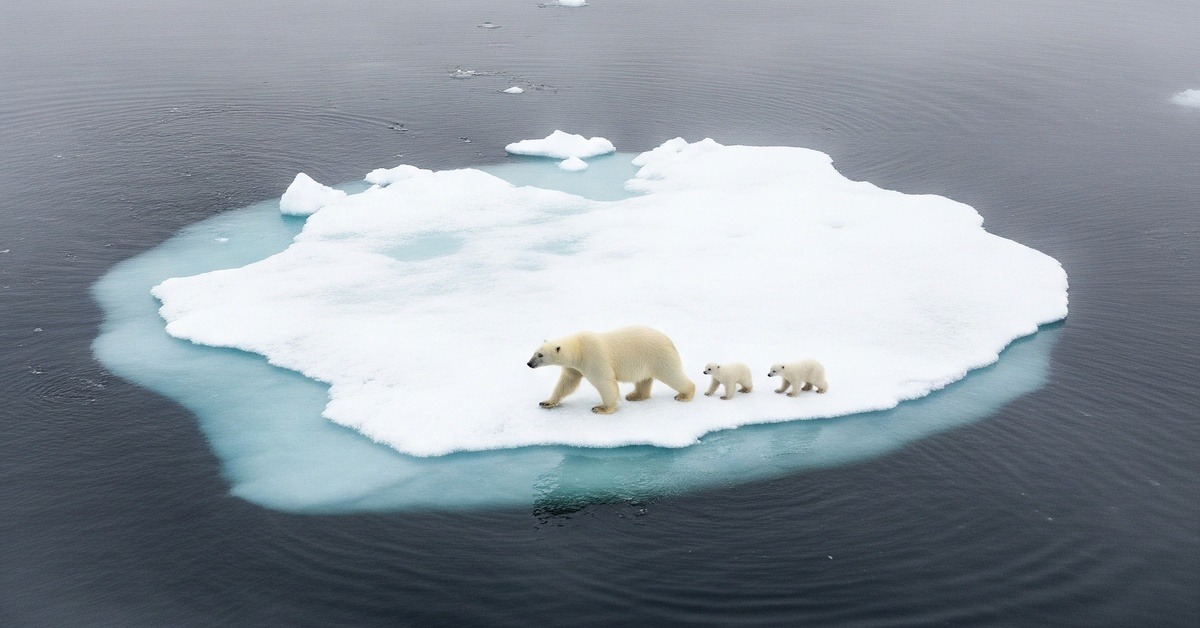
Some bears have started scavenging bowhead whale carcasses left by Indigenous subsistence hunters. Others swim open-water distances that would’ve seemed impossible two decades ago. They’re adaptive. Problem-solvers. Swimming 100 kilometers between shrinking ice floes because there’s no other option. But adaptation has a ceiling, and that ceiling arrives pretty fast when the actual resource disappears.
Nursing mothers hit it first. A lactating female needs enormous caloric input. The milk she produces is fatty — her cubs depend on it. Cubs are born with almost no reserves of their own. That last fact kept me reading for another hour, actually. A mother who comes ashore underweight doesn’t just struggle personally. Her cubs stop gaining weight. Researchers have documented cub survival rates dropping dramatically in populations facing the most severe ice loss.
The denning chapter makes this even more precarious. A pregnant female digs a snow den in late autumn and stays inside through the deep Arctic winter, giving birth to cubs that weigh barely half a kilogram — blind, almost hairless, utterly dependent. She does not eat for months. Everything she gives her cubs through that period comes out of the fat she stored the previous spring and summer. If she entered the den underweight because the ice broke up too soon, there is simply less to give. The den is a fixed-budget operation, and the budget was set on the sea ice she may never have reached.
The Longer Swims Are the Hidden Killer
Nobody talks about the swimming part, and that’s strange because it might be the worst part. As ice floes shrink and drift farther apart, bears get trapped in open-water crossings that stretch 100 kilometers or more. These swims can last days. Polar bears are strong swimmers — their front paws are partially webbed, they sustain about 10 kilometers per hour — but swimming burns fat at a completely different rate than land movement. A long swim followed by a failed hunt becomes a double loss.
The thermodynamics make it worse. A polar bear’s whole body is built to conserve heat: dense fat, oil-shedding guard hairs, a metabolism tuned for the cold. On land or ice, that insulation is an asset. In water, especially as the bear’s fat layer thins from a poor season, it becomes a problem in reverse — the animal is working hard, generating heat, and dumping a portion of it into frigid sea while paddling for survival. Cubs are far more vulnerable here than adults. They are smaller, leaner, and chill faster, with proportionally less reserve to spend on a multi-day crossing. When a mother is forced into a long swim, the cub is the one most likely to be lost to cold, exhaustion, or simply falling behind.
One GPS-tracked female in the Beaufort Sea swam continuously for nine days across 687 kilometers of open water.
She lost 22 percent of her body weight.
Her cub didn’t survive the crossing.
They’ve Survived Before — But Not Like This
Polar bears have been on Earth for somewhere between 130,000 and 350,000 years depending on which genetic analysis you believe. They’ve lived through warm interglacial periods. They’ve seen the climate shift dramatically before. That gets used as comfort a lot — evidence they’re resilient, that they’ll endure. Here’s the problem with that framing though: those past climate shifts happened over thousands of years. This one is happening over decades. Evolution doesn’t work on decades. Polar bear arctic survival adapted to ice over hundreds of generations. It can’t un-adapt in three.
It’s worth being precise about what evolution would even need to do here. A polar bear isn’t just a brown bear that happens to like snow. It diverged from brown bears and accumulated a stack of specialized traits — the white-appearing translucent fur, the elongated skull and body shape for slipping along the ice, the enormous fat-loading metabolism, the dietary chemistry that lets it thrive on almost pure blubber. These are deep adaptations, written across thousands of generations of selection on a frozen hunting ground. To “switch” to a land-based, more omnivorous lifestyle isn’t a behavioural tweak; it would require unwinding much of what makes the species a polar bear at all. Behaviour can flex in a single lifetime — a hungry bear will try berries and eggs and carcasses. But anatomy and physiology change at the pace of generations, and the ice is retreating far faster than that.
Some researchers have wondered if polar bears might shift their diet dramatically — eating more plants, more terrestrial prey, becoming something closer to brown bears. A handful of “grolar bears,” hybrids between polar and grizzly bears, have already been documented in the wild.
But hybridization isn’t adaptation.
It’s a symptom of two ranges colliding under pressure. The ecological job that polar bears do — apex predator of sea ice — doesn’t get replaced by a bear that eats berries.
By the Numbers
- Arctic sea ice extent in September 2023 hit its lowest recorded minimum: 4.23 million square kilometers, down from roughly 7 million in the 1980s (National Snow and Ice Data Center, 2023).
- 26,000 polar bears remain globally. They’re spread across 19 subpopulations — at least 3 already classified as declining by the IUCN.
- One ringed seal delivers approximately 100,000 kilocalories. A typical snow goose egg clutch provides about 700 kilocalories.
- A single GPS-tracked female swam 687 kilometers nonstop over nine days in the Beaufort Sea, losing 22% of her body weight and her only cub.
Field Notes
- Polar bears cover their black noses with their paws while hunting — once thought to be myth, now documented on camera multiple times, possibly to reduce contrast against the ice.
- Their fur isn’t white. It’s transparent and hollow. The whiteness comes from light scattering. Under UV light, polar bear fur appears dark.
- Polar bears have a specialized liver that processes enormous quantities of vitamin A from seal liver. That same liver would be toxic to humans — a single polar bear liver contains enough vitamin A to kill a person.
When the Bears Come to Town
There’s a human side to this story that rarely makes the wildlife documentaries. As bears spend longer stretches on land, hungry and searching, they drift toward the one place that reliably smells of food: human settlements. Coastal Arctic communities have reported more frequent encounters — bears nosing through waste, lingering near homes, occasionally posing genuine danger to people. In some northern towns, the response has become a near-permanent fixture: patrols that haze bears away, communal storage to keep food and refuse out of reach, and holding facilities where repeat visitors are detained and later released far from town.
These conflicts are a direct readout of the same energy crisis playing out on the ice. A well-fed bear with a full fat layer has little reason to risk a confrontation with humans. A starving one has every reason. So the rise in encounters isn’t a sign that bears are becoming bolder by nature — it’s a sign that the calories they need are no longer where they used to be. For the people who share that coastline, it turns an abstract climate statistic into a problem standing at the edge of the village. And for the bears, the town is just one more low-quality, high-risk food source that can never replace what the ice provided for free.
Why This Story Is About More Than One Animal
Polar bear arctic survival is a warning signal. These animals didn’t create the conditions they’re living in — but they’re the most visible indicator of a system changing faster than anything in it can adjust to. The Arctic is warming roughly four times faster than the global average. What’s happening to the bears shows what happens when a specialized species loses its ecosystem before evolution has any time to respond.
And the Arctic doesn’t sit isolated. Its ice regulates ocean currents and weather patterns that reach every continent.
Part of why the Arctic heats so fast is a feedback loop that the bears live at the centre of. Bright sea ice reflects most of the sunlight that hits it back into space. Dark open ocean absorbs it. So as ice melts, more dark water is exposed, more heat is absorbed, and still more ice melts — a self-reinforcing spiral scientists call ice-albedo feedback. The same vanishing ice that strands a polar bear is also accelerating the warming that strands it. The bear isn’t just a victim of the change; it’s standing on the very surface whose disappearance drives the change faster.
This isn’t just a story about one charismatic species becoming rarer. It’s a story about foundational conditions for life in an entire region being altered — and what ripples outward from that shift. The polar bear is just the part we can photograph.
Frequently Asked Questions
Q: Why can’t polar bears just switch to eating land food like berries and birds?
Because the math doesn’t work. A polar bear is built to run on seal fat, and the calories available on land are a fraction of what a single seal provides — a goose egg clutch is around 700 kilocalories against a seal’s roughly 100,000. Bears do scavenge berries, eggs, kelp, and carcasses when stranded, but these are emergency rations, not a viable replacement diet. A 700-kilogram predator cannot meet its energy budget by foraging like a much smaller omnivore.
Q: Haven’t polar bears survived warm periods before, so won’t they adapt again?
They have lived through warmer interglacials, but those shifts unfolded over thousands of years — enough time for behaviour, range, and even physiology to adjust. Today’s change is happening over decades. Evolution operates on generations, not headlines, so the species’ deep specializations for ice-hunting can’t be rewritten quickly enough to keep pace.
Q: How many polar bears are left, and are they all declining?
An estimated 26,000 polar bears remain, split across 19 subpopulations. Not every group is crashing at the same rate — local ice conditions vary — but at least three subpopulations are already classified as declining by the IUCN, and the populations facing the steepest ice loss show the clearest drops in body condition and cub survival.
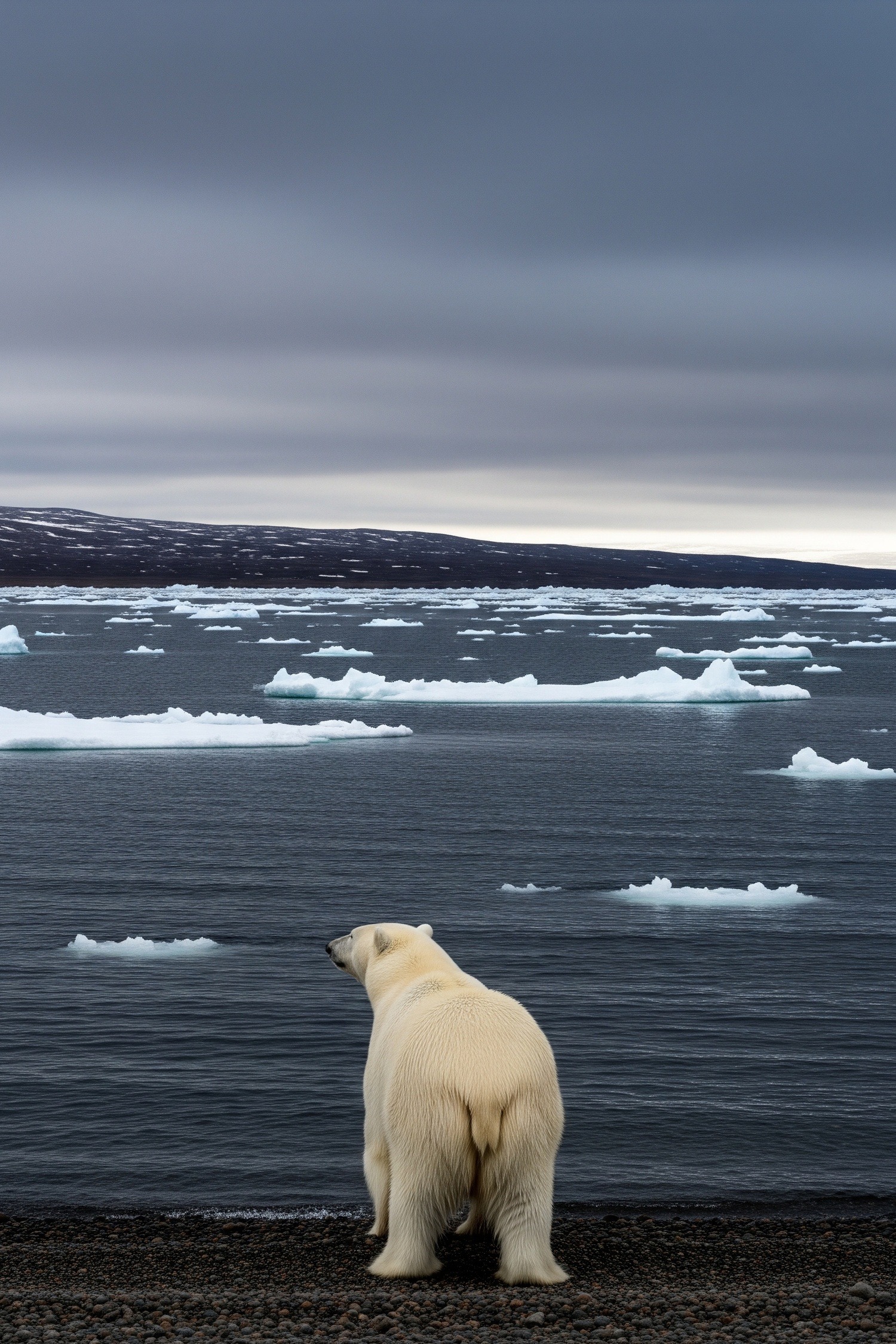
A bear standing at the waterline staring at open ocean isn’t being theatrical. It’s doing exactly what its biology instructs — looking for ice that isn’t coming back on any schedule it was built for. That image stays with you. It should. The Arctic is the planet’s early warning system, and it’s been sending signals for a while now. If this keeps you up at night, there’s more at this-amazing-world.com — and yeah, the next one is even stranger.
Illustrations are AI-generated. Article fact-checked and human-edited.