Saola: the Asian Unicorn Nobody Has Seen Alive
Everyone calls it the saola Asian unicorn, and almost everyone pictures the same thing: one long spiralled horn, parting the mist of a Vietnamese cloud forest. There is no single horn. There are two, they are nearly straight, they grow on females as well as males — and in the thirty-four years since science learned this animal existed, not one biologist has watched a wild saola walk through its own forest. The myth is tidy. The truth is stranger, and a great deal more urgent.
Key Facts
- The saola (Pseudoryx nghetinhensis) has two nearly straight horns, 35 to 50 centimetres long, present on both males and females — not one spiraled horn
- Genetically it belongs to the tribe Bovini (cattle, buffalo, bison), its earliest-diverging member, having split off roughly 10.8 to 16.2 million years ago
- It stands about 84 cm at the shoulder, is about 150 cm long, and weighs 80 to 100 kilograms
- The most recent confirmed photographic record of a living saola was a September 2013 camera-trap image in Quang Nam province, Vietnam
- Searchers have collected more than 25,000 leeches across protected areas in Vietnam and Laos, pooled into over 2,000 samples, to sequence saola DNA from swallowed blood
In short: The saola (Pseudoryx nghetinhensis), nicknamed the “Asian unicorn,” is a rare Annamite forest bovid with two nearly straight horns, not one spiraled horn. No biologist has ever seen a wild saola; the last confirmed photograph came from a 2013 camera trap in Vietnam’s Quang Nam province.
Does it really have one horn?
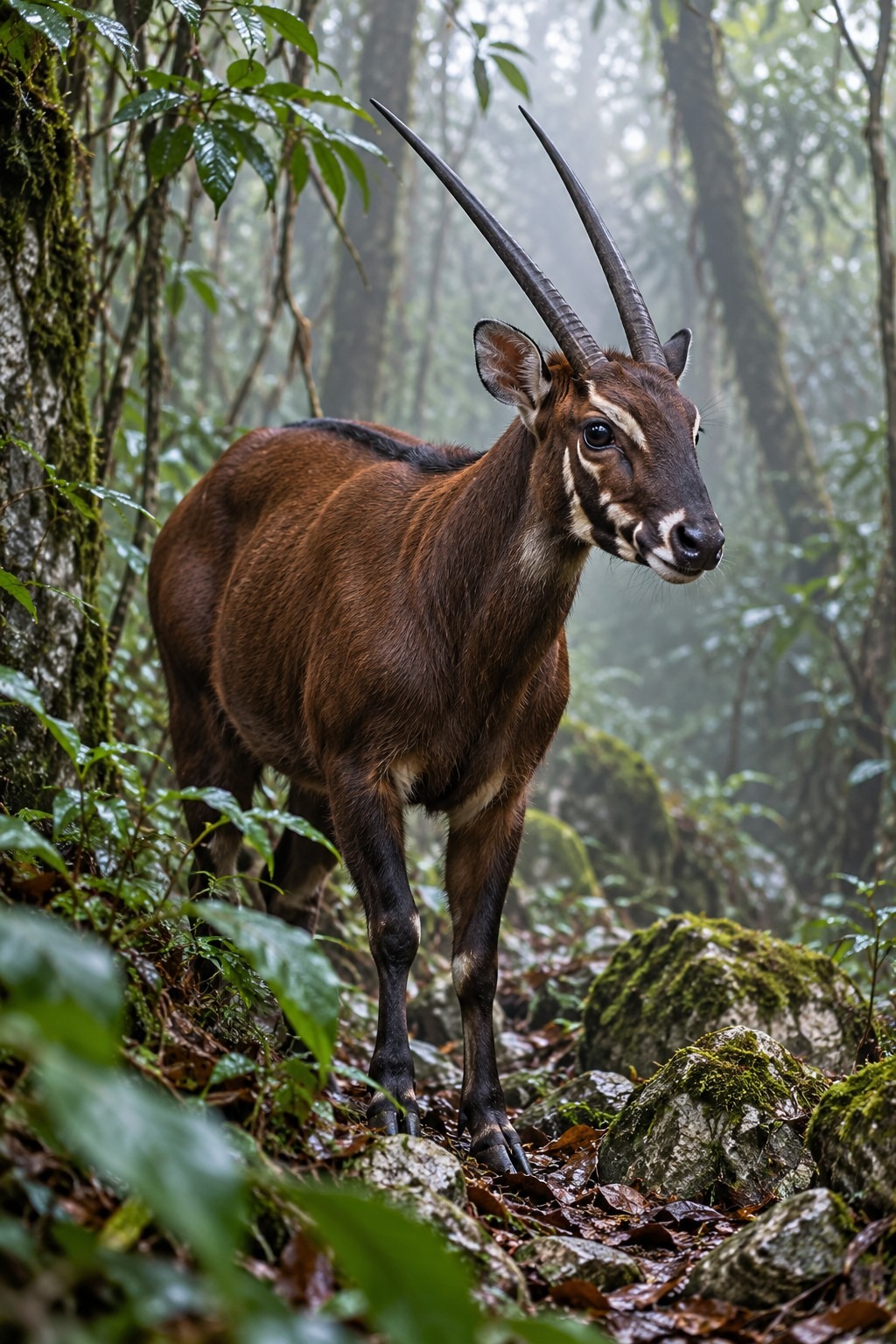
No. A saola carries a matched pair of dark, slightly diverging horns that sweep back over the shoulders, typically 35 to 50 centimetres long, occasionally longer, and present in both sexes. Seen from the side, the two line up into one — the same optical trick that linked the Arabian oryx to unicorn legend for centuries. That resemblance is baked into the animal’s scientific name. Pseudoryx nghetinhensis means, roughly, “false oryx from Nghe An and Ha Tinh,” the two Vietnamese provinces nearest the first specimens.
Local names are more precise than the press nickname. In a Tai language of Vietnam, and in Lao, saola refers to the paired posts of a spinning wheel — hence the species’ other English name, spindlehorn. You will also find a romantic translation circulating on wildlife sites, something like “priceless as the moon and the stars.” It is lovely, and it is not the reading given in the reference literature on the species, which consistently points to the spinning-wheel post. Hmong communities in Laos call it saht-supahp: the polite animal.
So where did “unicorn” come from? Not from anatomy. It came from scarcity — from an animal so rarely encountered that calling it mythical felt less like hyperbole than shorthand.
Is it an antelope? The DNA says no
You will read, in otherwise careful places, that the saola is the world’s rarest antelope. It isn’t, strictly speaking, and the correction matters. Genetic work places Pseudoryx inside the tribe Bovini — the cattle, buffalo and bison lineage — as its earliest-diverging member, having split from the ancestors of the rest between roughly 10.8 and 16.2 million years ago. Its nearest living relatives are wild cattle. “Antelope” is a body shape, not a branch of the family tree; bovids that aren’t cows, sheep, goats, buffalo or bison tend to get filed there by default.
Why does a taxonomic quibble deserve space in an article about an animal nobody can find? Because it explains one of conservation’s hardest problems here: there is no close cousin to practise on. Captive husbandry for a species is usually built by borrowing from relatives, and the saola’s relatives diverged before the Pleistocene. Nobody knows, in detail, what a saola needs to eat.
Physically it is a compact forest bovid: around 84 centimetres at the shoulder, about 150 centimetres long, 80 to 100 kilograms, chestnut-brown with a black stripe down the spine and startling white flashes on the face — brows, cheeks, muzzle — like chalk marks on wet bark. Enormous maxillary glands sit under flaps on its muzzle, the largest of any living mammal.
{IMAGE_2}
Has anyone ever seen a saola Asian unicorn alive?
Scientists have seen living saola perhaps a handful of times, and every single time the animal was already in human hands. In 1996, villagers near Lak Xao in Bolikhamxay province, Laos, caught a pregnant female. William Robichaud, later coordinator of the IUCN Species Survival Commission’s Saola Working Group, spent roughly three weeks with her in a village menagerie — the most detailed behavioural observations ever made of the species, and still the backbone of what we think we know about its temperament. She was calm around people and nervous around dogs. She died within weeks; an adequate diet was never worked out.
Fourteen years later, in 2010, Hmong villagers in the same province caught an adult male. He was photographed, and he died within days, before a technical team could reach the village. In between, remote cameras in Laos photographed a saola in 1999. Then, in September 2013, a camera trap set by WWF and the Vietnamese government in Quang Nam province caught a single animal stepping past the lens — the most recent confirmed record of a living saola anywhere on Earth.
That is the whole visual archive: a few captives already doomed, and a scatter of camera-trap frames.
Why a 90-kilogram animal can hide for 13 years
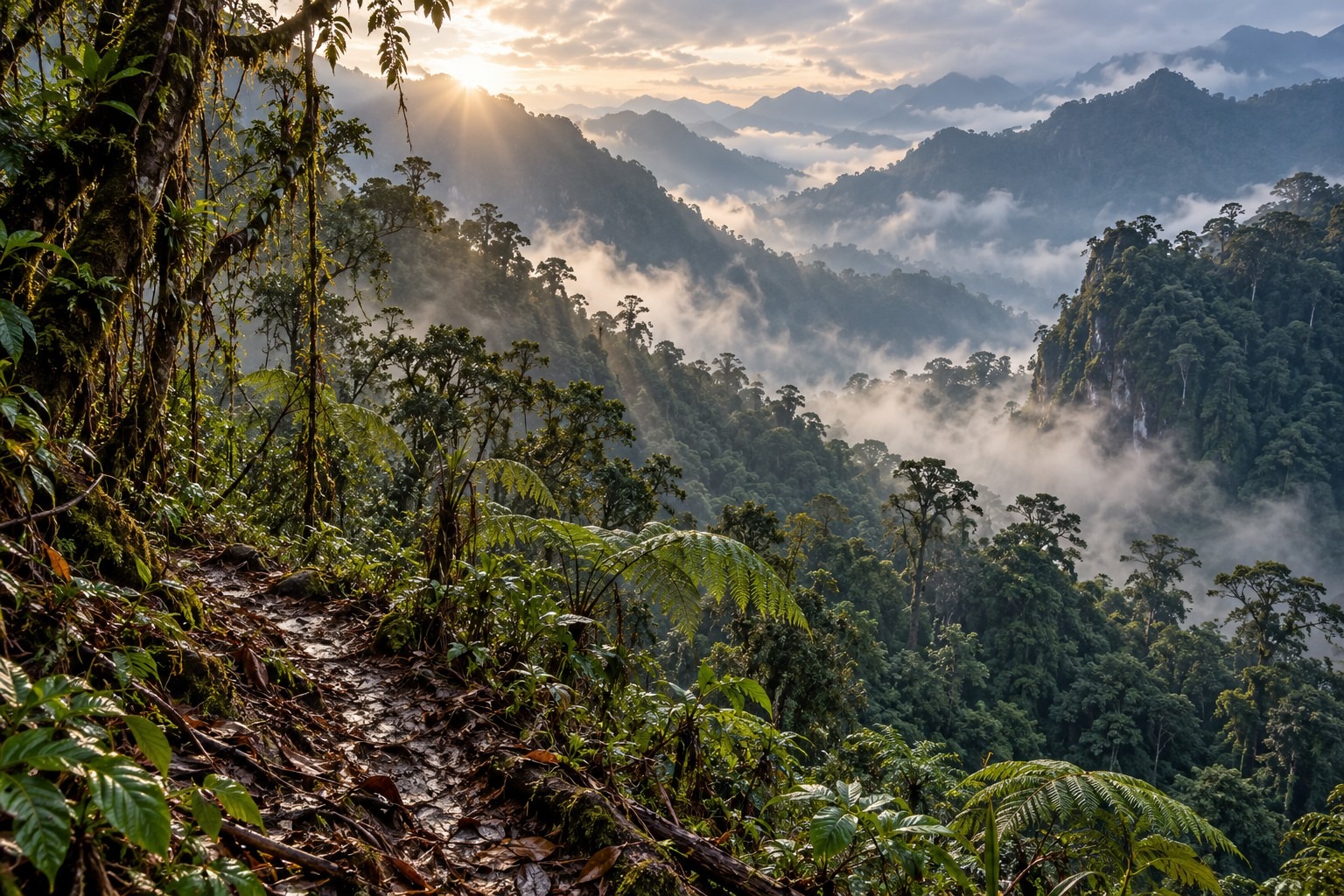
Start with the forest. The Annamite range, running along the Vietnam–Laos border, is steep, soaked, and biologically absurd — Mongabay’s reporting notes it covers under 0.2 percent of the planet’s land surface while holding more than 3 percent of its land vertebrate species. Then add density. Working estimates cited in that same 2026 reporting on the Laos search put the saola at something like one animal per 300 square kilometres. You are not looking for a needle in a haystack; you are looking for a needle in a province.
Worse, the saola leaves almost nothing a surveyor can trust. Its tracks are easily confused with those of serow and muntjac, and it has no distinctive dung, call or scrape. Which is why searchers turned to blood — other animals’ blood. Forest guards and scientists have collected more than 25,000 terrestrial leeches across saola protected areas in Hue and Quang Nam in Vietnam and eastern Xe Sap in Laos, pooling them into over 2,000 geographically discrete samples and sequencing whatever mammal DNA the leeches had swallowed. The method works: it has pulled up other Annamite endemics, including the elusive Annamite striped rabbit. It has not pulled up a saola.
Today’s effort, run by the Saola Foundation for the Conservation of the Annamite Mountains, has been combing roughly 300 square kilometres of Bolikhamxay province in Laos since 2025 with expert local trackers, sniffer dogs supplied by Working Dogs for Conservation, and field DNA equipment that can separate saola from serow within hours. Why bother with dogs when you already have cameras? Because a camera waits where you put it, and a dog goes where the animal went.
The real reason the saola is disappearing
Here’s the thing: nobody is hunting the saola. Not really. It has no significant market value — no trophy trade, no established role in traditional medicine (unlike the pangolins and bears that share its forest). What is killing it is bycatch — wire nooses, set in lines by the thousand, intended for wild pig, sambar and muntjac destined for the urban wild-meat trade. A snare does not check what walked into it. Published tallies from saola habitat put the number of snares pulled out of these forests at more than 26,000, and that is only what teams reached.
Hunting dogs compound it, flushing and cornering an animal that by every account panics at them. Add a low reproductive rate, add populations already thinned to the point where finding a mate is a matter of luck, and the arithmetic turns brutal without anyone ever deciding to hunt a saola.
Habitat loss plays a part — roads, logging, fragmentation along the old Ho Chi Minh Trail corridor — but the forest, in many of these areas, is still standing. It is simply empty.
Is it extinct? What the evidence actually shows
Honestly: nobody knows, and the people closest to the question disagree in public. The IUCN still lists the saola as Critically Endangered, not extinct; no authority has declared it gone. Population estimates have slid steadily — 50 to 300 individuals in a 2015 assessment, “fewer than 100” in most recent summaries, and fewer than 50 in October 2026 reporting on the Laos search.
Barney Long, senior director at Re:wild, put his position plainly to Mongabay: “Unfortunately, I personally think we have lost the saola. It has not been seen for 13 years.” Lorraine Scotson, chief executive of the Saola Foundation, is equally plain in the other direction: “We see no sound scientific reason to conclude the saola is extinct.” And Nguyen Quoc Dung of Vietnam’s Forest Inventory and Planning Institute has given what may be the only fully defensible answer: the existence of live saola “can neither be proven nor disproven.” A WWF-Vietnam-led search from 2022 to 2024 produced no detections. Absence of evidence, in a forest this big, is not quite evidence of absence.
What’s fragile now is the search itself. Scotson told Mongabay that her team leaves the forest each July for the wet season, and that a sharp contraction in funding meant she could not confirm they would go back in October 2026; the money that sent them in came from zoo donations, and the months after that are unconfirmed. If the saola is lost, it will not be because the world decided to let it go — it will be because the search for it was funded three months at a time.
Could the genome bring it back?
In May 2025, a team led from the University of Copenhagen published the saola’s genome in Cell, under the title “Genomes of critically endangered saola are shaped by population structure and purging.” They had no living animals to work with. Instead they extracted DNA from bone and horn fragments kept in hunters’ households across the Annamites, and assembled 26 complete genomes.
Two findings turned out to matter enormously. The saola is not one population but two, genetically distinct, split somewhere between 5,000 and 20,000 years ago — a structure nobody had suspected. And the genetic diversity each population lost is not the same diversity the other lost. As lead author Genís Garcia-Erill described it, “the genetic variation lost in each population complements the other. So, if you mix them, they could compensate for what the other is missing.” The same analyses suggest the species was never abundant: its total numbers appear not to have exceeded about 5,000 animals in the last 10,000 years, with both populations declining since the end of the last Ice Age.
That points to a concrete, modest-sounding target. “If we can bring together at least a dozen saolas — ideally a mix from both populations — to form the foundation of a future population, our models show the species would have a decent chance of long-term survival,” said Rasmus Heller, the Copenhagen associate professor who led the work. Read that carefully, because it is not de-extinction and it is not cloning. There are no saola in captivity, no breeding stock, no cell lines. Every path through the genetics begins with somebody physically finding living animals in the Annamites. Heller’s own assessment was candid: “I’m not overly optimistic, I have to admit — but I really hope the saola is still out there.”
Belief vs evidence
Four claims you will meet in almost any article about this animal, set against what the record actually supports.
| Common belief | What the evidence shows |
|---|---|
| It’s called a unicorn because of its horn. | It has two horns, in both sexes. The nickname comes from its rarity and the old oryx–unicorn association, not its anatomy. |
| It’s the world’s rarest antelope. | Genetically it is the earliest-diverging member of the cattle tribe Bovini. Its closest relatives are wild cattle and buffalo, not antelope. |
| It’s hunted for its horns. | It has no significant market value. Deaths are overwhelmingly incidental — wire snares set for pigs, deer and muntjac. |
| It’s extinct. | Not declared extinct, and not confirmed alive since 2013. Experts openly disagree; the defensible position is that it can neither be proven nor disproven. |
The short answer: the saola is a two-horned forest relative of wild cattle, unique enough to sit alone in its own genus, and it has never once been observed by a scientist in the wild — only in captivity, in photographs, and in fragments of DNA. Whether any are still alive in the Annamites is genuinely unknown, and the only way to find out is to keep looking.
Sources and notes
- Garcia-Erill, Heller et al., “Genomes of critically endangered saola are shaped by population structure and purging,” Cell (2025), with the University of Copenhagen’s accompanying research announcement
- Mongabay — reporting on the Laos saola search (2025) and on the search’s funding shortfall (October 2026), including interviews with Lorraine Scotson and Barney Long
- Saola Foundation for the Conservation of the Annamite Mountains — species and status pages
- WWF — saola species profile and the 2013 Quang Nam camera-trap record
- IUCN Species Survival Commission Saola Working Group, and the 1993 species description published in Nature
Thirty-four years ago, a skull with two long horns came out of a hunter’s house in Vu Quang and told biologists that a large mammal had been living beside people, unrecorded, the whole time. The animal it belonged to has never been seen alive in the wild by anyone trained to describe it. That is the part worth sitting with: not that the saola might vanish, but that it may vanish still essentially unknown — and that in a forest the size of the Annamites, the difference between gone and merely unfound is measured in whether anyone can afford to go back in.
Frequently Asked Questions
Q: Does the saola really have just one horn, like a unicorn?
No. The saola carries a matched pair of dark, slightly diverging horns, typically 35 to 50 centimetres long, present on both males and females — not a single spiraled horn. Seen from the side, the two horns can line up to look like one, the same optical illusion that linked the Arabian oryx to unicorn legend for centuries. The nickname “Asian unicorn” comes from the animal’s extreme rarity, not from its actual anatomy.
Q: Is the saola an antelope?
Not strictly. Although it is often called the world’s rarest antelope, genetic analysis places the saola (Pseudoryx nghetinhensis) within the tribe Bovini — the cattle, buffalo, and bison lineage — as its earliest-diverging member, having split off roughly 10.8 to 16.2 million years ago. Its closest living relatives are wild cattle, not antelopes. “Antelope” simply describes a body shape, which is why bovids that aren’t cows, sheep, goats, buffalo, or bison often get filed there by default.
Q: Has anyone ever actually seen a living saola?
Only a handful of times, and always an animal already captured by villagers. In 1996, Laotian villagers caught a pregnant female that researcher William Robichaud observed for about three weeks before she died. In 2010, Hmong villagers caught an adult male that died within days. The only confirmed sighting of a free-ranging saola came from a camera trap set by WWF and the Vietnamese government in Quang Nam province in September 2013.
Q: Why is the saola so hard to find in the wild?
The Annamite mountains it inhabits are steep and biologically dense, covering under 0.2 percent of Earth’s land surface yet holding over 3 percent of its land vertebrate species. Estimates put saola density at roughly one animal per 300 square kilometres, and its tracks are easily confused with those of serow and muntjac. Searchers have collected over 25,000 leeches across protected areas in Vietnam and Laos, sequencing swallowed blood for saola DNA, but the species still hasn’t turned up.
Illustrations are AI-generated. Article fact-checked and human-edited. Our editorial standards.