The Silbo Gomero Whistled Language of La Gomera
A man stands on a ridge above a ravine on La Gomera, cups two fingers into his mouth, and fires off a note so sharp it seems to slice the air — the silbo gomero whistled language, mid-sentence. On the far slope, across a gorge too wide for a shout, a woman pegging laundry to a line stops, turns her head, and whistles back. What just passed between them was not a signal. Not a code of hoots meaning come here or danger. It was Spanish — vowels, consonants, word order, a question and its answer — carried on a single tone.
Key Facts
- UNESCO inscribed silbo gomero on its Representative List of the Intangible Cultural Heritage of Humanity in 2009
- Whistled messages can travel up to about five kilometres across La Gomera’s ravines
- La Gomera covers about 370 square kilometres and rises to 1,487 metres at Alto de Garajonay
- Ramón Trujillo of the University of La Laguna published the first full linguistic analysis of silbo in 1978
- Castilian conquest of the Canary Islands lasted from 1402 to 1496, after which the Indigenous Guanche languages disappeared but the whistling practice survived
In short: Silbo gomero is whistled Spanish from La Gomera in the Canary Islands, not a separate language — whistlers encode the same vocabulary and grammar as spoken Spanish using pitch. UNESCO listed it as Intangible Cultural Heritage in 2009. Whistles carry roughly five kilometres across the island’s ravines, far farther than shouting, inherited from the pre-conquest Guanche inhabitants.
What the silbo gomero whistled language actually is
First, the correction that almost every travel article gets wrong: silbo is not a language of its own. It is Spanish, re-encoded. Linguists call this a surrogate or whistled register — the same vocabulary, the same grammar, a different carrier signal, in the way that writing and speech are two formats for one language. A Gomeran whistler is not translating. They are whistling the sentence directly.
Production is physical and unglamorous. One or two fingers go into the mouth to form a tiny resonating chamber; the other hand often cups in front of the lips as a crude megaphone, aiming the sound down a valley. UNESCO, which inscribed the practice on its Representative List of the Intangible Cultural Heritage of Humanity in 2009, describes messages travelling up to about five kilometres. Shepherds used it for the ordinary business of a hard island: a goat is loose, bring the mule, the boat has come in, someone has died.
And here is the thing that makes it genuinely strange rather than merely picturesque — it is, in principle, open-ended. Anything you can say, you can whistle. In practice whistlers lean heavily on context and a shared stock of phrases, because the whistled channel throws away a great deal of acoustic information. Which raises the obvious question of how it works at all.
Why a whistle travels where a shout dies
{IMAGE_2}
Speech is a messy, broadband sound. Its information is spread across many frequencies at once, and distance punishes it brutally: high frequencies fade first, echoes smear the consonants, wind and foliage fill in the gaps with noise. Shout across a valley and what arrives is mush — you can tell someone is shouting, not what they said.
A whistle does the opposite. It dumps nearly all its energy into a single narrow tone, typically somewhere in the one-to-four-kilohertz band, which happens to sit close to where human hearing is at its most sensitive and where the low rumble of wind interferes least. Julien Meyer, a researcher with the CNRS at GIPSA-lab, Université Grenoble Alpes, who has spent years cataloguing whistled speech worldwide, has reported that whistled sentences stay intelligible at roughly ten times the distance of shouted ones.
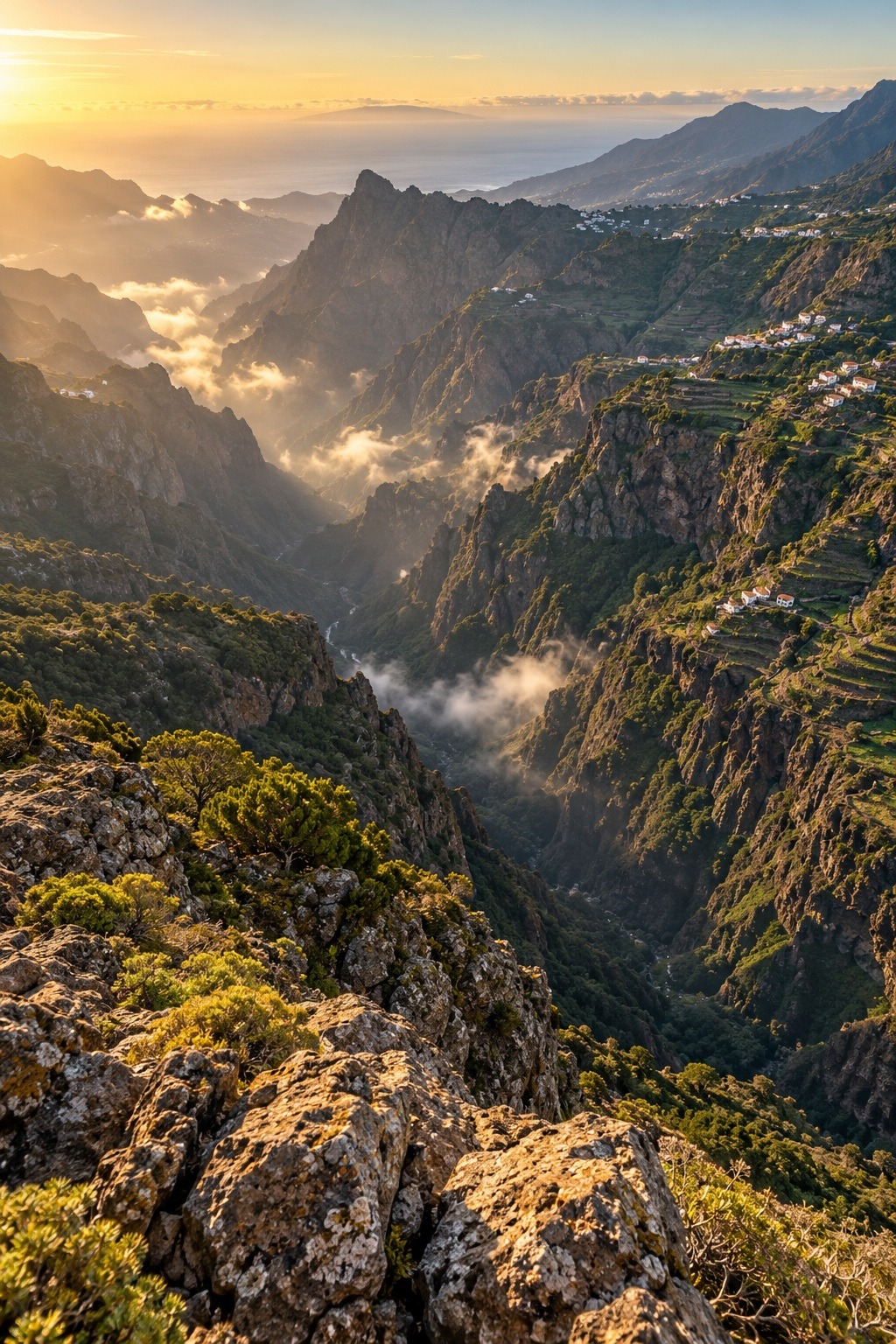
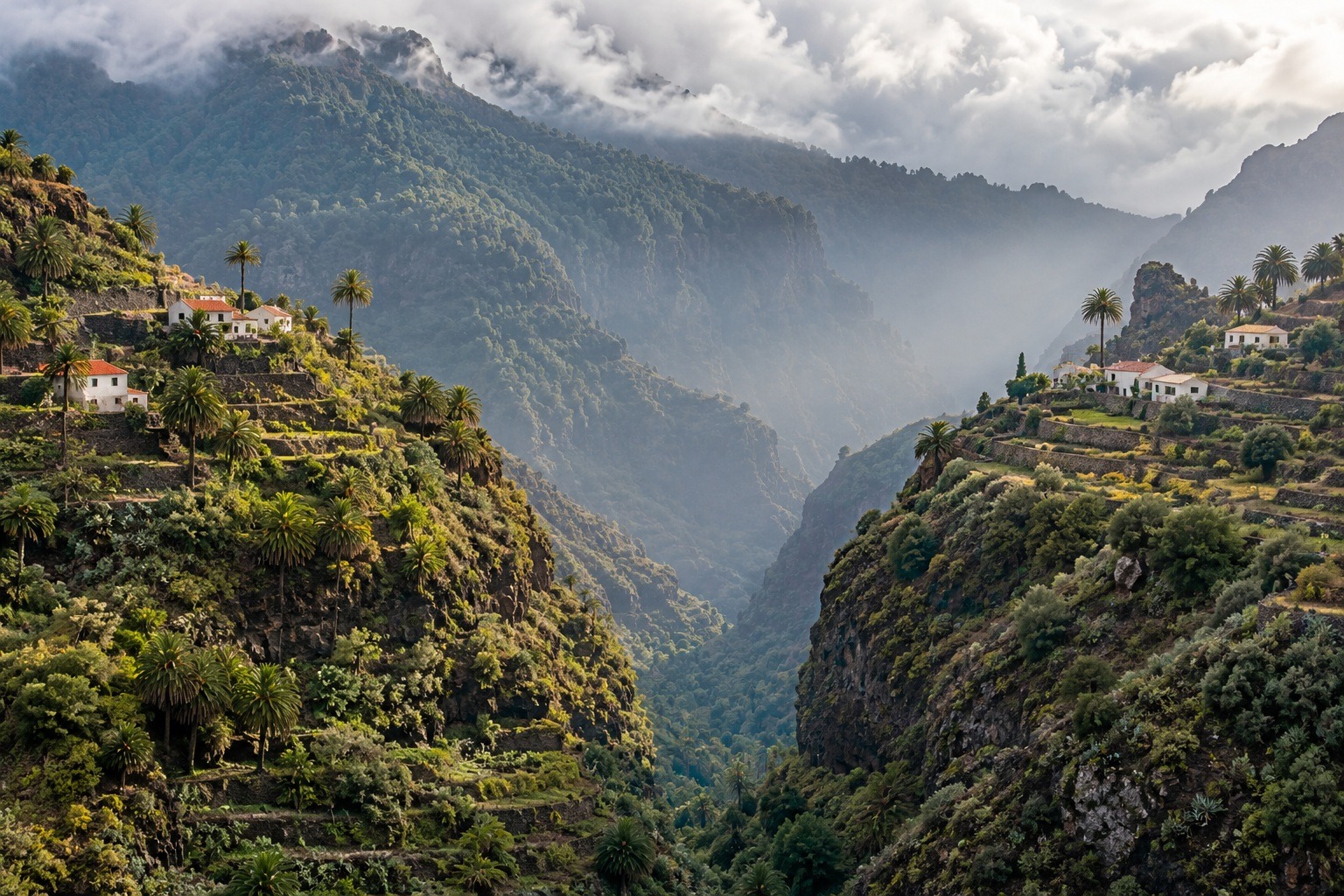
Geography did the rest. La Gomera is a small, almost circular island of about 370 square kilometres, rising to 1,487 metres at Alto de Garajonay, with deep ravines — barrancos — radiating out from the centre like spokes. Those ravines are terrible for walking and excellent for sound. Two hamlets an hour apart on foot can be a few seconds apart by whistle.
Two vowels, or five? The count nobody agrees on
Open five articles about silbo and you will read the same sentence five times: two whistles for the five Spanish vowels, four whistles for the consonants. It comes straight from UNESCO’s own description, and it is the single most repeated claim about the language. It is also, at best, a simplification — and the disagreement hiding behind it is far more interesting than the tidy number.
Ramón Trujillo of the University of La Laguna published the first full linguistic analysis of silbo in 1978, and ever since, specialists have landed on different inventories depending on how they look. Phonologists counting the contrasts that reliably separate words get one answer; acousticians measuring the actual pitch trajectories of recorded whistles get another; engineers asking what a machine needs in order to decode real speech get a third. Annie Rialland, the French phonetician, placed Silbo in her 2005 survey of whistled phonology among the systems that preserve more vowel detail than the two-level picture implies — and Meyer’s comparative measurements point the same way, because Spanish vowels differ mainly along the acoustic dimension that maps most directly onto whistled pitch. There is more room in the signal than “high or low” suggests.
- UNESCO’s description, and most popular accounts: 2 vowels, 4 consonants — six whistled units in total.
- Mid-twentieth-century descriptions: the five Spanish vowels collapsed onto two pitch levels, high and low.
- Later acoustic and perceptual work (Rialland, Meyer and others): around four distinguishable vowels, with a contested fifth, and considerably more consonant categories than four.
- A 2023 machine-recognition study presented at Interspeech: modelled on five whistled vowels and roughly twenty consonantal categories.
No single figure is simply “right”. What you get depends on whether you are counting contrasts, measuring frequencies, or asking what a decoder needs — which is exactly why published counts run from six units to twenty-five.
Nobody here is being careless. Whistled Spanish is a lossy channel, and listeners do a great deal of repair work in their heads, filling in distinctions the signal never carried. That makes “how many phonemes does silbo have” a slightly ill-posed question, and honest sources say so rather than picking a number and moving on.
A Guanche inheritance, re-tuned to Spanish
Before Castile arrived, La Gomera belonged to the Guanches — Indigenous islanders of North African Berber descent — and early European chroniclers describe them whistling across the same ravines. Castilian conquest of the Canary archipelago stretched from 1402 to 1496, and the islands’ Indigenous languages did not survive it. The whistle did.
What was inherited, almost certainly, was the technique rather than the content. No recording of the Guanche whistle exists and no text preserves it, so the re-encoding — a whistling method lifted off one language and fitted onto Castilian Spanish — is an inference from history and geography rather than something anyone can demonstrate directly. Worth saying plainly: the pre-conquest stage of silbo is reconstructed, not documented.
La Gomera was also not alone. Whistled speech was reported on other Canary Islands, and on neighbouring El Hierro the practice had all but disappeared by the 1970s. Only one island’s whistle made it into the twenty-first century as a living, community-wide system.
What happens inside a whistler’s brain
In 2005, a short paper in Nature turned silbo into a neuroscience story. Manuel Carreiras, then at the University of La Laguna in Tenerife, with co-authors including the neuroscientist David Corina, scanned fluent whistlers and non-whistlers while both groups listened to Silbo Gomero. In the whistlers, classic left-hemisphere language regions lit up. In the non-whistlers — hearing, physically, the identical sound — they did not. Experience had recruited the language network to a signal it was never built for.
Ten years later the picture got more complicated, and most articles about silbo simply never mention it. Onur Güntürkün and colleagues at Ruhr University Bochum tested 31 people fluent in both spoken and whistled Turkish — the “bird language” of the Black Sea mountains — and reported in Current Biology in 2015 that whistled syllables drew a markedly more balanced contribution from the two hemispheres than spoken ones, with the right hemisphere taking on more of the work.
So which is it, left or both? Probably both, and the two results are less contradictory than they look: they used different methods (brain imaging versus a behavioural listening test), different languages, and asked subtly different questions — one about whether the language network engages at all, the other about how the load is shared. A whistle is simultaneously linguistic and a pitch contour, and pitch is the right hemisphere’s specialty. Reading the two studies side by side, the most economical interpretation is that the language network does the linguistic work while the right hemisphere’s acoustic machinery handles the carrier — but that synthesis is ours, not a published consensus, and it has not been tested directly on Silbo Gomero.
The generation that stopped whistling — and the timetable that brought it back
Silbo nearly died, and not for mysterious reasons. From the 1950s onward, roads reached the hamlets, telephones reached the houses, young Gomerans emigrated to Tenerife and Venezuela, and whistling picked up the smell of rural poverty — something your grandfather did with goats. Islanders born roughly between 1950 and 1980 are the hole in the chain: many understand silbo perfectly well and cannot produce it.
Rescue came through the dullest instrument available: the school timetable. Canarian authorities moved in the late 1990s, and UNESCO records silbo as taught in the island’s schools since 1999, where it is a compulsory subject in primary education. Classroom time is modest — accounts from the island’s education programme put it at around half an hour a week — and in 2007 a dedicated island school was launched to train accredited silbo instructors. Children from the first mandatory cohort are adults now.
If La Gomera’s experience teaches anything, it is unglamorous: whistled languages are not rescued by heritage certificates, they are rescued by timetables.
Compare the survivors and the pattern is hard to miss. Silbo is the only whistled system in the world embedded in a compulsory curriculum — and the only one with tens of thousands of users rather than dozens.
| Whistled system | Where / language encoded | Scale of use | Status |
|---|---|---|---|
| Silbo Gomero | La Gomera, Canary Islands — Spanish | UNESCO cites an island of more than 22,000 inhabitants where it is widely understood | UNESCO Representative List, 2009; compulsory school subject since 1999 |
| Kuşköy “bird language” | Giresun province, Black Sea Turkey — Turkish | Reported in the order of 10,000 people, and falling | UNESCO Urgent Safeguarding list, 2017 |
| Sfyria | Antia, southern Evia, Greece — Greek | Reported at around six whistlers in a village of a few dozen residents | Critically endangered; not UNESCO-listed |
| Whistled Béarnese | Aas, French Pyrenees — Béarnese Occitan | Effectively none | Died out over the twentieth century |
| Chinantec and Mazatec whistling | Oaxaca, Mexico — tonal Indigenous languages | Village-scale, varies by community | Surviving locally; whistles carry lexical tone |
Meyer’s worldwide survey, published by Springer in 2015, located on the order of seventy to eighty populations with some form of whistled speech — nearly all of them in steep mountains or dense forest, nearly all of them shrinking. Out of roughly seven thousand human languages, that is a rounding error.
Teaching a machine to hear a whistle
Something new has started happening to silbo, and it is the part of the story the travel features have not caught up with. At Interspeech 2023 — the field’s main international speech-technology conference — a team presented a “whistle-to-text” system: an attempt to build automatic speech recognition for Silbo Gomero, modelled on five whistled vowels and roughly twenty consonantal categories.
Their central obstacle was not the algorithm. It was data. Modern speech recognition is built on thousands of hours of transcribed audio, and silbo has nothing remotely like that — a small speaker community, almost no annotated corpus, and a dwindling number of elders whose whistling predates the school programme. Turns out the bottleneck in digitising an endangered language is almost never the machine learning.
Keep it in proportion, though. A recogniser that can transcribe whistles is a documentation tool, not a speaker, and no model preserves a language that children stop learning. What it can do is make an archive searchable — and give linguists a way to settle, at scale, how many vowels silbo really distinguishes.
Questions Readers Ask
Is Silbo Gomero a real language or just a signalling code?
Both labels miss slightly. It is a whistled register of Spanish — real language, carried in an unusual medium. Unlike a signal code with a fixed list of meanings, it encodes Spanish sound by sound, so brand-new sentences are possible.
How far can it actually be heard?
UNESCO’s description cites distances of up to about five kilometres. Real range depends heavily on terrain, wind and whether the ravine helps or hurts; larger figures circulate but are hard to verify.
Can an outsider learn to whistle it?
The technique itself is learnable with practice, and visitors to La Gomera are routinely taught a phrase or two. Fluency is another matter: it means knowing Spanish well enough to reconstruct heavily degraded sentences from context, which is precisely why the school programme starts with children who already speak the language.
Is Silbo Gomero still used in daily life?
Rarely as a practical tool — mobile phones won that argument decades ago. It survives as a taught subject, an identity marker and a performance for visitors, which is a real change in function rather than a straightforward revival. Whether a language kept alive mainly in classrooms stays flexible enough to coin new expressions is genuinely open, and islanders themselves disagree about it.
Sources and Notes
- UNESCO Intangible Cultural Heritage — Whistled language of the island of La Gomera (Silbo Gomero), inscribed 2009; Whistled language of Kuşköy, Urgent Safeguarding list, 2017
- Nature — Carreiras, Lopez, Rivero and Corina, “Neural processing of a whistled language”, 2005
- Current Biology — Güntürkün, Güntürkün and Hahn, “Whistled Turkish alters language asymmetries”, 2015
- Julien Meyer, Whistled Languages: A Worldwide Inquiry on Human Whistled Speech (Springer, 2015), and his typology of whistled languages in the Annual Review of Linguistics
- Proceedings of Interspeech 2023 — automatic recognition (“whistle-to-text”) of Silbo Gomero
- Ramón Trujillo, El silbo gomero: análisis lingüístico (1978); Annie Rialland’s 2005 work on the phonology and phonetics of whistled languages
Stand in a barranco on La Gomera at dusk and you may still hear it: a thin, hard note crossing a kilometre of empty air, carrying a sentence in a language that had every reason to vanish and didn’t. Technology made silbo obsolete, and then a classroom made it permanent — which is, in the end, a quietly hopeful thing to know about how human beings decide what to keep.
Frequently Asked Questions
Q: Is silbo gomero a separate language from Spanish?
No. Despite being called a “whistled language,” silbo gomero is Spanish itself, re-encoded onto a whistled carrier signal — linguists classify it as a surrogate or whistled register. It uses the same vocabulary, grammar, and word order as spoken Spanish; whistlers are not translating sentences into a code, they are whistling the Spanish sentence directly, with pitch changes standing in for vowels and consonants.
Q: How far can a whistled message travel on La Gomera?
UNESCO’s inscription of silbo gomero as Intangible Cultural Heritage in 2009 describes messages travelling up to about five kilometres. Researcher Julien Meyer of CNRS/GIPSA-lab has reported that whistled sentences stay intelligible at roughly ten times the distance of shouted speech, because a whistle concentrates nearly all its energy into one narrow tone instead of spreading it across many frequencies that fade and echo over distance.
Q: Why does whistling carry farther than shouting across La Gomera’s valleys?
Shouted speech spreads energy across many frequencies, and distance degrades it quickly as high frequencies fade, echoes smear consonants, and wind adds noise. A whistle instead concentrates almost all its sound energy into a single narrow tone, typically one to four kilohertz, close to where human hearing is most sensitive and least disturbed by wind. La Gomera’s deep ravines, or barrancos, carry that tone efficiently between hamlets separated by an hour’s walk.
Q: How many distinct sounds does silbo gomero actually use?
Sources disagree. UNESCO and popular accounts cite two whistled vowel levels and four consonants — six units total. Mid-twentieth-century descriptions collapsed the five Spanish vowels onto two pitch levels, while later acoustic work by Annie Rialland and Julien Meyer found around four distinguishable vowels. A 2023 Interspeech machine-recognition study modelled five whistled vowels and roughly twenty consonant categories, showing the count depends on measurement method.
Illustrations are AI-generated. Article fact-checked and human-edited. Our editorial standards.