The $6 Dog Who Changed History From a Foxhole
In 1944, a soldier in New Guinea paid $6.44 for a dog nobody wanted. Six years later, she’d accidentally invent an entire field of medicine. Nobody — not even the Army — saw it coming.
Corporal William Wynne found her in an abandoned foxhole. A four-pound Yorkshire Terrier, alone in the dirt, with no explanation for how she got there. He named her Smoky. What he didn’t know was that he’d just purchased the first therapy dog in documented history — though that word, “therapy,” wouldn’t exist in medical vocabulary for another fifteen years.
Key Facts
- In 1944 Corporal William Wynne paid $6.44 for a four-pound Yorkshire Terrier he named Smoky in New Guinea.
- Smoky completed 12 combat missions and earned 8 battle stars despite having no official military status.
- At Lingayen Gulf in 1945 she pulled telegraph wire through an 8-inch-wide, 70-foot-long pipe under an airstrip.
- She is credited as the first documented therapy dog, decades before Boris Levinson formalized animal-assisted therapy in the 1960s.
- Animal-assisted therapy is now used in over 50,000 facilities globally, according to the American Kennel Club.
In short: Smoky was a four-pound Yorkshire Terrier bought for $6.44 in New Guinea in 1944 by Corporal William Wynne. She completed 12 combat missions, earned 8 battle stars, and threaded wire through a 70-foot pipe at Lingayen Gulf. Credited as the first documented therapy dog, she predated the formal field of animal-assisted therapy by decades.
A Dog That Wasn’t Supposed to Exist
The strangest part? The U.S. Army never officially acknowledged her. No rank. No rations. No designation. Smoky wasn’t a service dog because that category didn’t exist yet. She was just… there. A small warm thing that followed Wynne through combat missions, hospital visits, and a war that turned men into shells of themselves.
She performed tricks between firefights. Walking a tightrope. Weaving through obstacles. Responding to commands in multiple languages Wynne had taught her in spare moments. The men in those hospital beds — the ones who hadn’t laughed in months, maybe longer — they’d watch her do these small things and something would shift inside them. Historians now credit her as the first documented therapy dog in recorded history. Her Wikipedia entry runs several thousand words. But the clinical language misses the point entirely.
She just showed up and made people feel less alone.
That last fact kept me reading for another hour.
Twelve Combat Missions. Zero Official Record.
Here’s where the story gets genuinely strange. Smoky flew on air and sea rescue missions across the Pacific theater. She survived multiple air raids. Soldiers reported that she’d alert them to incoming danger before any human in the unit noticed anything wrong — a sensitivity to sound or vibration that nobody could quite explain. Wynne carried her in his pack during missions. When shrapnel scattered during bombardments, she’d press herself against him, and somehow that small pressure was grounding.
- Twelve combat missions completed
- 8 battle stars awarded — an extraordinary record for an animal with no official military status whatsoever
- She weighed approximately 4 pounds and stood 7 inches tall
- She ate whatever Wynne ate, slept where he slept, and when he was hospitalized with scrub typhus, the nurses brought her to his bedside because they could see what she was doing to him — something that looked like recovery
The Seventy-Foot Pipe That Changed Everything
It is 1945. Engineers need to run telegraph wire beneath an airstrip at Lingayen Gulf in the Philippines. The proper way means digging up the runway, grounding aircraft for three days, leaving personnel exposed.
Someone suggests the impossible.
An eight-inch-wide pipe runs under the airstrip. Seventy feet long. Dark. They thread the wire through Smoky’s collar and have Wynne call to her from the other end. She crawls through.
She doesn’t hesitate. She doesn’t get stuck. She comes out the other side.
No runway grounded. No personnel exposed. The first therapy dog in history also solved an engineering problem that would’ve taken three days and endangered hundreds of people. Stories like this surface when you dig deep enough — of animals who slip through the cracks of official history and change it anyway.

After the War Ended, the Work Didn’t
Wynne brought Smoky back to the United States in 1945. She kept visiting veterans. Hospital rooms. Rehabilitation centers. Public programs. Television appearances. She was there when men who’d come home changed were still coming home, still sitting in rooms that felt very far from anywhere anyone cared about them.
The formal field of animal-assisted therapy wouldn’t emerge until the 1960s, when psychologist Boris Levinson began documenting the therapeutic effects of animal companionship. But Smoky had been doing the work for two decades already. The science was just catching up to what she already knew.
What’s remarkable is this: nobody called it therapy when she was doing it.
- The pipe at Lingayen Gulf was 8 inches in diameter, 70 feet long
- Her wartime service included 12 combat missions and earned her 8 battle stars
- Animal-assisted therapy is now used in over 50,000 facilities globally, according to the American Kennel Club — a field that traces its documented origins back to a dog who cost $6.44
- She could understand commands in both English and hand signals Wynne developed specifically for loud or dangerous environments — an entire language system built in the field, for wartime, for survival
Field Notes
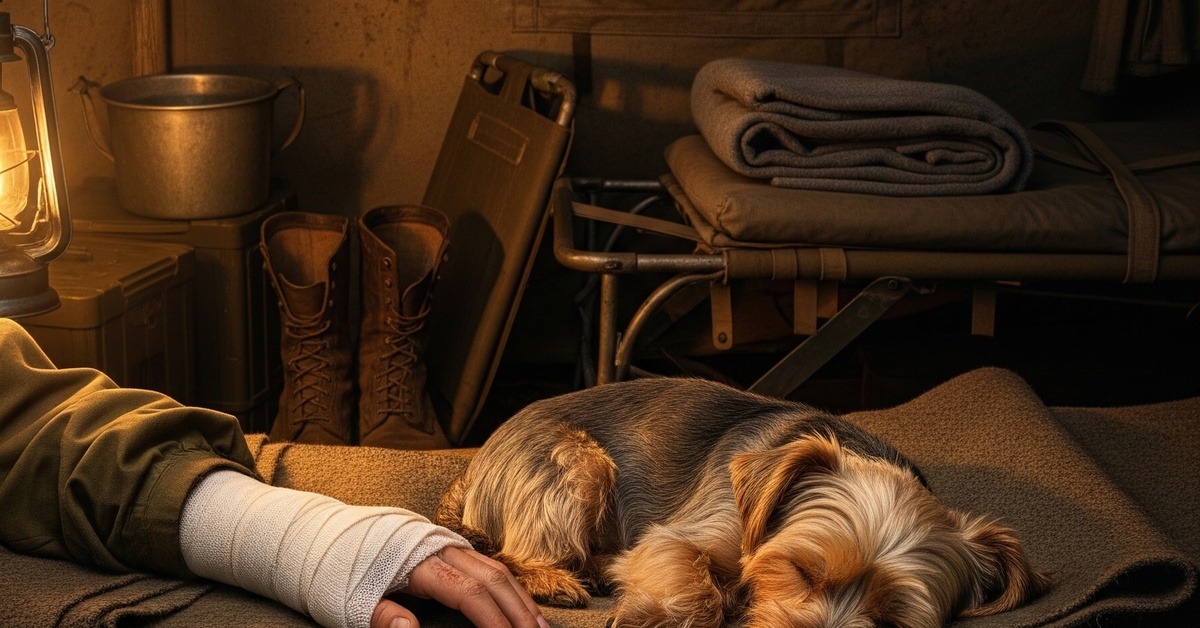
- When Wynne contracted scrub typhus and lay hospitalized, doctors allowed Smoky to sleep on his pillow each night. His recovery was faster than expected. The nurses credited the dog, and the records show it.
- A life-sized bronze memorial statue stands in Cleveland’s Lakewood Park, overlooking Lake Erie — Wynne’s favorite view. It was placed there in 2005, nearly 60 years after her service ended.
- She could reportedly understand multiple languages. Whether that was true or whether it was just what people needed to believe about her is, at this point, indistinguishable.
What a Four-Pound Dog Proved Without Trying
Healing doesn’t always look like medicine. Presence matters. Something small and warm moving through a room full of men in pain was doing measurable good — even when no one had the language to measure it yet.
The entire modern field of animal-assisted therapy runs a line straight back to a foxhole in New Guinea and a soldier who spent six dollars on a hunch. Smoky was never given a rank. Never officially recognized. And yet she changed what we understand about service, about healing, about what it means to show up for someone when they’re broken.
That’s not a footnote. That’s a foundation.
Smoky died in 1957. Wynne buried her with full honors. The work she started — showing up, staying close, making people feel less alone — is still happening today in hospitals and recovery rooms everywhere, performed by animals trained in a field she accidentally invented. Small things. Quiet revolutions. There’s more at this-amazing-world.com — and honestly, the next one is even stranger.
Frequently Asked Questions
Q: Who was Smoky the war dog?
Smoky was a four-pound Yorkshire Terrier found in an abandoned foxhole in New Guinea in 1944 and bought for $6.44 by Corporal William Wynne. The U.S. Army never officially recognized her — no rank, rations or designation — yet she followed Wynne through combat missions and hospital visits, performing tricks that lifted wounded soldiers. Historians now credit her as the first documented therapy dog in recorded history.
Q: What did Smoky do during World War II?
She completed 12 combat missions across the Pacific theater and earned 8 battle stars, an extraordinary record for an animal with no official military status. She survived multiple air raids and reportedly alerted soldiers to danger. Her most famous feat came at Lingayen Gulf in 1945, where she pulled telegraph wire through an 8-inch-wide, 70-foot-long pipe beneath an airstrip — sparing engineers three days of digging and keeping aircraft and personnel out of harm’s way.
Q: Why is Smoky called the first therapy dog?
Because she did the work of a therapy dog decades before the term existed. She visited hospital beds and made men who hadn’t laughed in months feel less alone. When Wynne was hospitalized with scrub typhus, nurses brought her to his bedside because they could see her effect on his recovery. The formal field of animal-assisted therapy only emerged in the 1960s with psychologist Boris Levinson, long after Smoky had already been doing it.
Q: Is there a memorial to Smoky?
Yes. A life-sized bronze memorial statue stands in Cleveland’s Lakewood Park, overlooking Lake Erie — Wynne’s favorite view. It was placed there in 2005, nearly 60 years after her wartime service ended. The statue honors a dog who was never given a rank or official recognition, yet helped lay the foundation for animal-assisted therapy, a field now used in over 50,000 facilities worldwide according to the American Kennel Club.
Illustrations are AI-generated. Article fact-checked and human-edited.