Three Bobcats on Ice: Why This Photo Breaks Every Rule
There’s a photo of three bobcats on ice that nobody can fully explain, and it’s been bothering wildlife researchers ever since it surfaced. Bobcats aren’t supposed to do this.
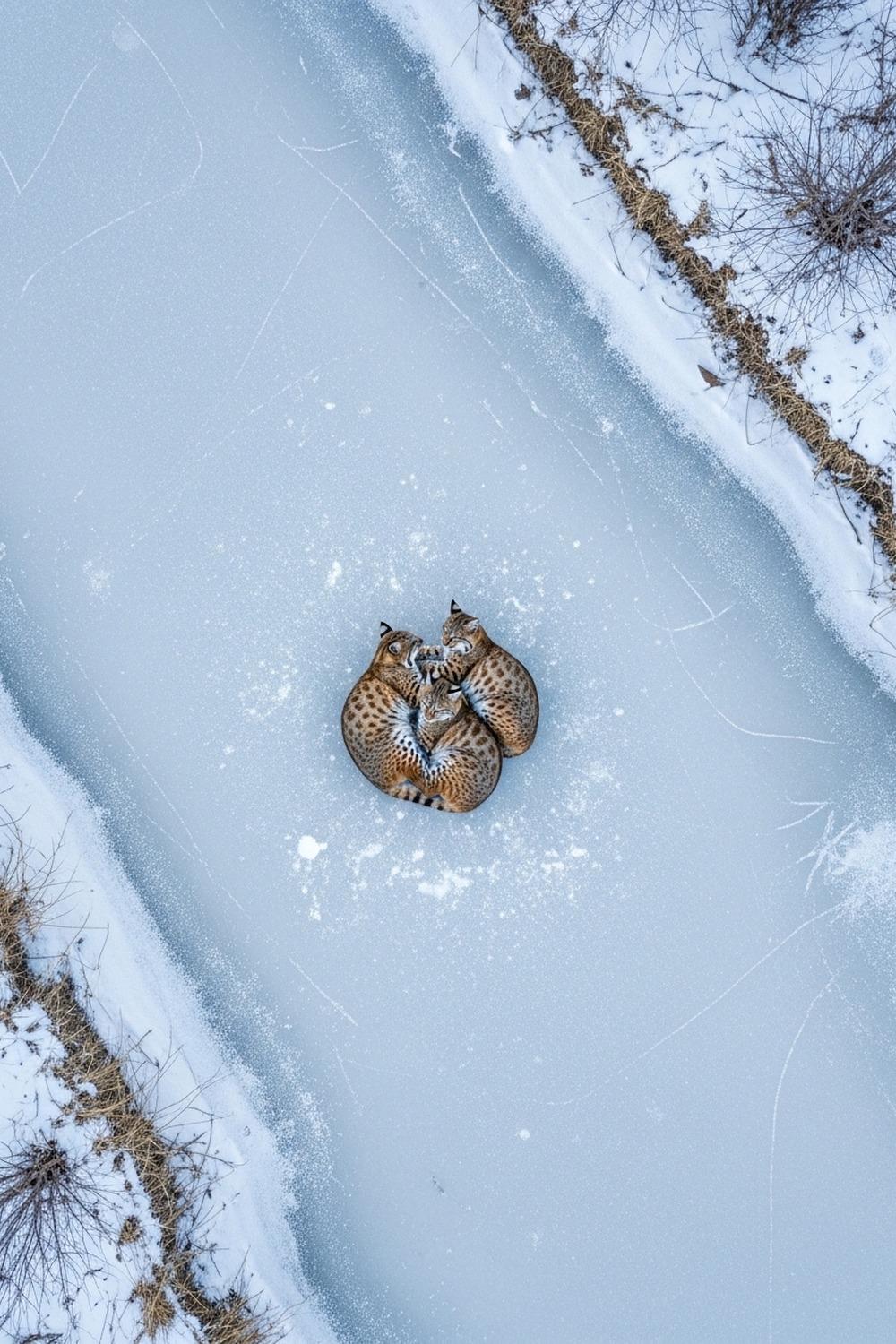
Drone photographer Mike Mayou was flying over a frozen river somewhere in the American West when his camera caught something that made biologists stop and stare. Three bobcats. Same stretch of ice. Completely at ease. Not fighting, not fleeing, not pretending the others didn’t exist — just lying there like it was the most natural thing in the world. The photo went viral because it *shouldn’t* exist. Everything we know about how bobcats live says this moment is impossible.
Key Facts
- Drone photographer Mike Mayou captured three wild bobcats resting together on a frozen river in the American West, behavior that contradicts known bobcat ecology
- Bobcat (Lynx rufus) territories span anywhere from 10 to 40 square miles, with males claiming larger ranges than females, per USDA wildlife surveys through 2022
- The North American bobcat population is estimated at between 2.3 and 3.5 million individuals, making them the most abundant wild cat on the continent
- Bobcat kittens stay with their mother for nine to twelve months before dispersing into solitary life
- A bobcat’s home range overlaps with roughly 3 to 8 other individuals on average, yet groups of three appear in fewer than a handful of peer-reviewed field studies
In short: A viral drone photo by Mike Mayou shows three wild bobcats resting peacefully on a frozen river, contradicting known bobcat solitary behavior. Bobcats hold territories of 10 to 40 square miles and avoid other adults outside mating season, so three co-present cats, especially one likely stranger, defies every documented model.
Why Bobcat Solitary Behavior Makes This So Completely Strange
Bobcats (Lynx rufus) are hardwired loners. We’re talking obsessively territorial — territories span anywhere from 10 to 40 square miles, and each adult marks their borders with urine, feces, scratch posts, and loud vocalizations that basically amount to “stay out.” According to Wikipedia’s overview of bobcat ecology, they’ll go out of their way to avoid other adults except during mating season, which lasts maybe a few days a year. Researcher Roger Powell spent decades documenting felid territoriality and found that adult bobcats will travel significant distances just to dodge each other.
So what happened on that ice?
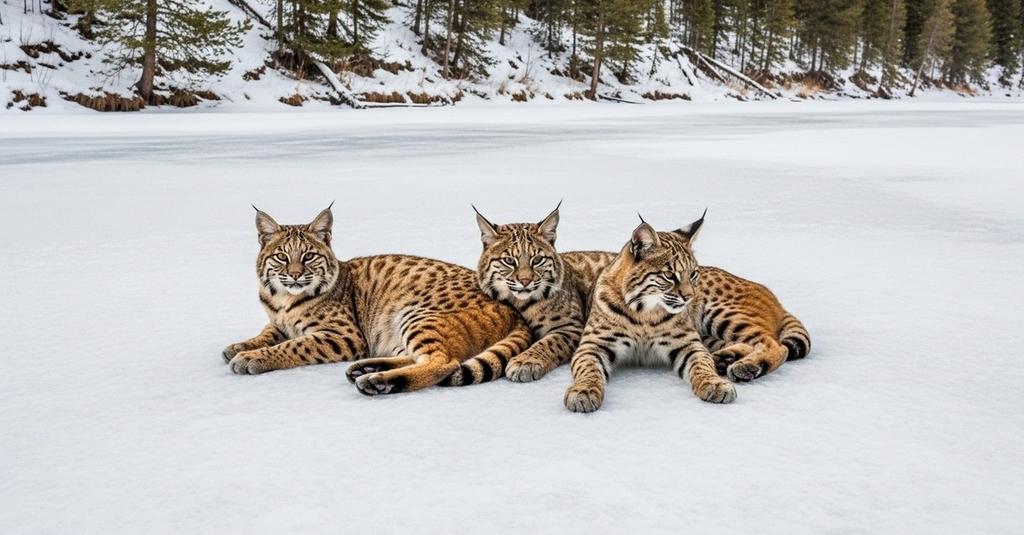
These weren’t passing through. They were sprawled out. Resting. That last fact kept me reading for another hour — because a resting bobcat is a vulnerable bobcat, and vulnerable bobcats don’t choose to share space with strangers.
The Photo Itself
There’s something almost painterly about it. Their tawny, spotted coats spread across pale frost like someone arranged them intentionally. The composition is almost too perfect — three apex predators, each one capable of taking down a deer alone, positioned across the ice as if they were part of a gallery piece. Mayou shot from above, which strips away scale and turns the whole thing abstract. You can explore other moments where nature produces images that look almost designed over at this-amazing-world.com.
What makes it stick in your mind is that Mayou didn’t just document rare behavior. He documented rare behavior that *also* happened to be visually stunning. Those two things almost never happen together.
Were These Cats Related?
The leading theory (though nobody’s confirmed it) is that at least two of them probably knew each other. Bobcat kittens stay with their mother for nine to twelve months before dispersing into solitary life. In that window, they’re together constantly. A mother with a near-grown youngster, or siblings from the same litter who haven’t fully split, would actually explain the tolerance. Bobcat solitary behavior kicks in hard by the end of year one, but that window exists.
The third cat though?
That’s where the theory falls apart. A stranger showing up and just… staying? Lying down? With two other bobcats nearby? That doesn’t fit any documented model. Either the cold rewrote something fundamental about how these animals operate, or there’s a piece of the puzzle we’re still missing.
Winter Changes Everything
Cold reshuffles survival math. When temperatures drop and prey becomes scarce, animals start making calculations they’d normally reject. Defending territory burns calories a hungry bobcat might not be able to spare. Researchers watching coyote behavior in brutal winters have documented temporary “truces” in territories that are otherwise absolutely fiercely guarded year-round. The same logic probably applies here. Bobcat solitary behavior isn’t irrational — it’s adaptive. But adaptation works both directions. Sometimes surviving the cold means setting the rulebook down for a single afternoon.
Three apex predators.
One frozen river.
No conflict. No movement. Just stillness, and then a drone appearing overhead, and they didn’t scatter.
What It Takes to Get This Shot
Drone wildlife photography has changed everything about what we can document. Traditional ground-based wildlife photography requires proximity that almost always spooks the subject. Drones maintain altitude and, at the right height, produce almost no behavioral disruption in mammals. The cats registered the drone as ambient noise rather than a threat — which is part of why Mayou got the shot. This wasn’t luck. It was technically earned.
But here’s the thing about that photo — it documents a moment, not the beginning of one. Whatever brought those three cats to the same patch of ice started long before the drone arrived. Mayou caught the middle of a story. We’ll probably never know how it started.
By the Numbers
- Bobcat territory size ranges from 10 to 40 square miles for adults, with males claiming larger ranges than females — a pattern that USDA wildlife surveys have documented consistently through 2022.
- The bobcat population across North America is estimated at between 2.3 and 3.5 million individuals, making them the most abundant wild cat on the continent. Yet genuinely communal sightings remain rare enough that most field researchers never witness one in a career.
- Motionless for hours. Bobcats can remain completely still while resting or conserving energy in winter.
- A bobcat’s home range overlaps with roughly 3 to 8 other individuals on average, meaning territorial neighbors are always nearby — but physical co-presence, especially in groups of three, appears in fewer than a handful of peer-reviewed field studies worldwide.
Field Notes
- Bobcats communicate territory almost entirely through scent — urine, feces, glandular secretions deposited at specific landmarks along their range boundaries. The absence of any visible conflict in Mayou’s photo suggests all three cats may have been operating on scent information that pre-negotiated something before they ever arrived at the same spot.
- Despite their reputation for solitude, bobcats are occasionally documented sharing kill sites, particularly in winter when prey like rabbits and squirrels cluster near limited food sources. Shared resources create temporary overlap zones that are less defended than core territories.
- The ice itself may have functioned as neutral ground. In felid behavior research, open exposed surfaces like rocks, snowfields, and frozen water are sometimes avoided as ambush points — meaning no cat would typically choose to launch an attack from one. Ice as peacekeeping infrastructure that nobody planned, but it might have worked anyway.
What One Photo Reveals
The real story isn’t just about three cats. It’s about what we *still* don’t know about animals we’ve studied for decades. Bobcat solitary behavior has been documented, mapped, modeled — and then this photo arrived and quietly dismantled the assumption that we have the full picture. Wildlife biology is full of these moments: field observations that don’t fit the literature, behaviors that emerge in conditions nobody thought to study. The frozen river wasn’t a controlled environment. It was just real life, happening outside the margins of what research designs normally capture.
Somewhere out there, in places no camera has reached yet, animals are doing things that would rewrite entire chapters of what we think we know about them.
Three bobcats on ice. No explanation, no follow-up sighting, no researcher on the ground to document what happened next. Just a drone, a frozen river, and a photograph that keeps asking a question nobody’s answered yet. The wild doesn’t wait for us to be ready to document it. If this kind of story keeps you up at night, there’s more at this-amazing-world.com — and the next one is even stranger.
“
Frequently Asked Questions
Q: Why is the photo of three bobcats together so unusual?
The photo is unusual because bobcat solitary behavior makes such a gathering nearly impossible to explain. Bobcats (Lynx rufus) are obsessively territorial, holding ranges of 10 to 40 square miles and marking borders with urine, feces, scratch posts, and vocalizations. They go out of their way to avoid other adults except during a brief mating season. The three cats in Mike Mayou’s drone photo were not passing through but resting together at ease, and a resting bobcat is a vulnerable one that does not normally share space with strangers.
Q: How large are bobcat territories?
Bobcat territories span anywhere from 10 to 40 square miles for adults, with males claiming larger ranges than females, a pattern USDA wildlife surveys have documented consistently through 2022. Each adult marks its borders with scent and vocalizations to keep others out. A bobcat’s home range overlaps with roughly 3 to 8 other individuals on average, meaning neighbors are always nearby, but physical co-presence, especially in groups of three, is extremely rare in the field literature.
Q: Could the three bobcats have been related?
The leading theory, though unconfirmed, is that at least two of the bobcats probably knew each other. Bobcat kittens stay with their mother for nine to twelve months before dispersing into solitary life, and during that window they are together constantly. A mother with a near-grown youngster, or siblings from the same litter who had not fully split, would explain the tolerance. The third cat is where the theory falls apart, since a stranger staying calmly near two others fits no documented model.
Q: How does winter affect bobcat behavior?
Cold weather reshuffles survival math for bobcats. When temperatures drop and prey becomes scarce, defending territory burns calories a hungry bobcat may not be able to spare. Researchers watching coyotes in brutal winters have documented temporary truces in territories otherwise fiercely guarded year-round, and similar logic likely applies to bobcats. Their solitary behavior is adaptive rather than fixed, so surviving the cold can occasionally mean setting the usual rules aside for a single afternoon.
Illustrations are AI-generated. Article fact-checked and human-edited. Our editorial standards.