Two Heads, One Body: How Bicephalic Animals Survive
Nobody set out to study them. The two-headed animals just kept showing up — in fishing nets, in captive breeding programs, in museum tanks — and at some point, researchers had to admit this wasn’t as rare as everyone assumed.
Most don’t make it past the first week. The ones that do are essentially running two operating systems on hardware built for one. Two brains. One circulatory system. No arbitration process for when those brains disagree — and they disagree constantly.
Key Facts
- Bicephaly originates as failed twinning during embryonic development, leaving two heads sharing one circulatory system, one digestive tract, and often one set of lungs.
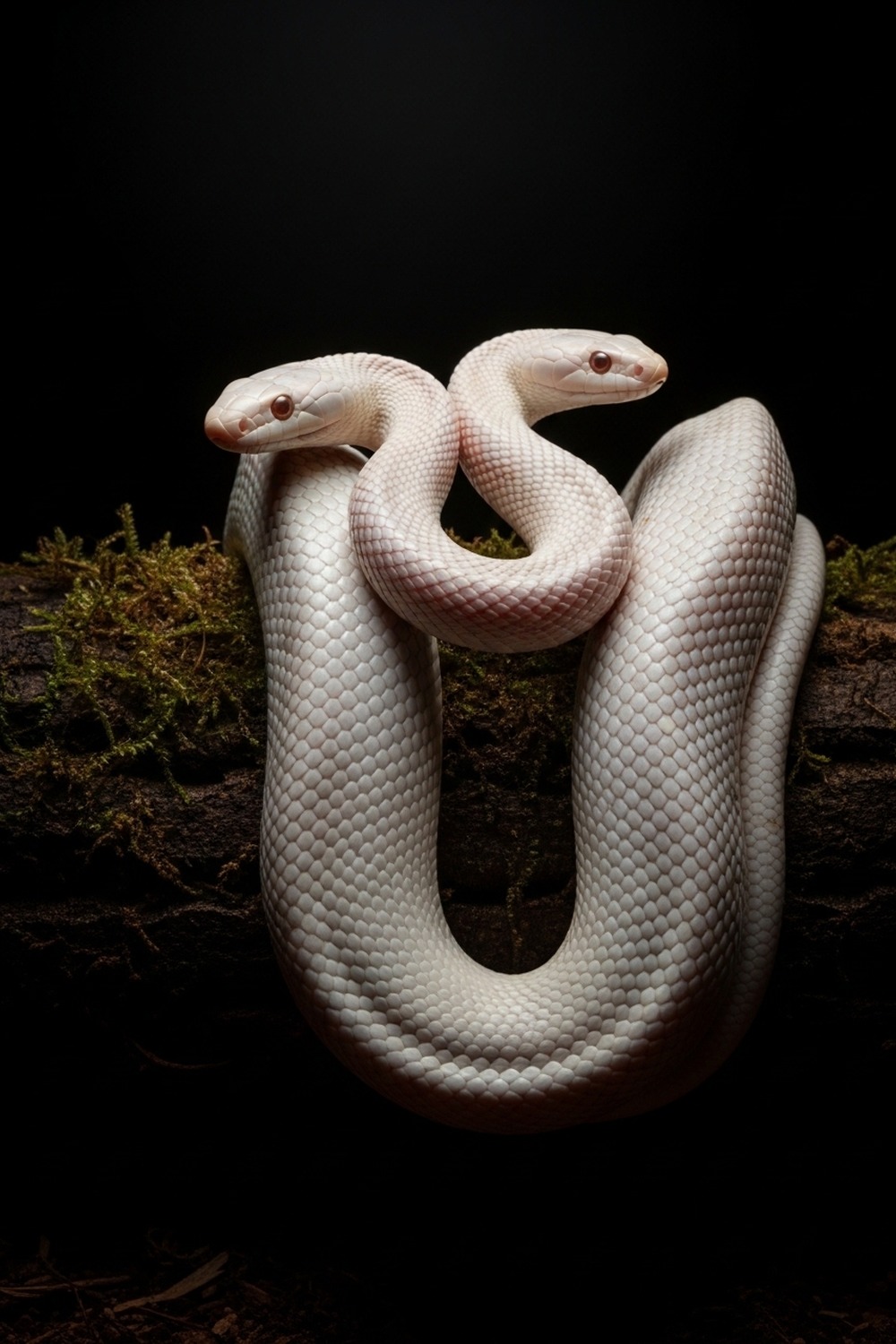
- Medusa, a two-headed albino rat snake, survived over 15 years in captivity.
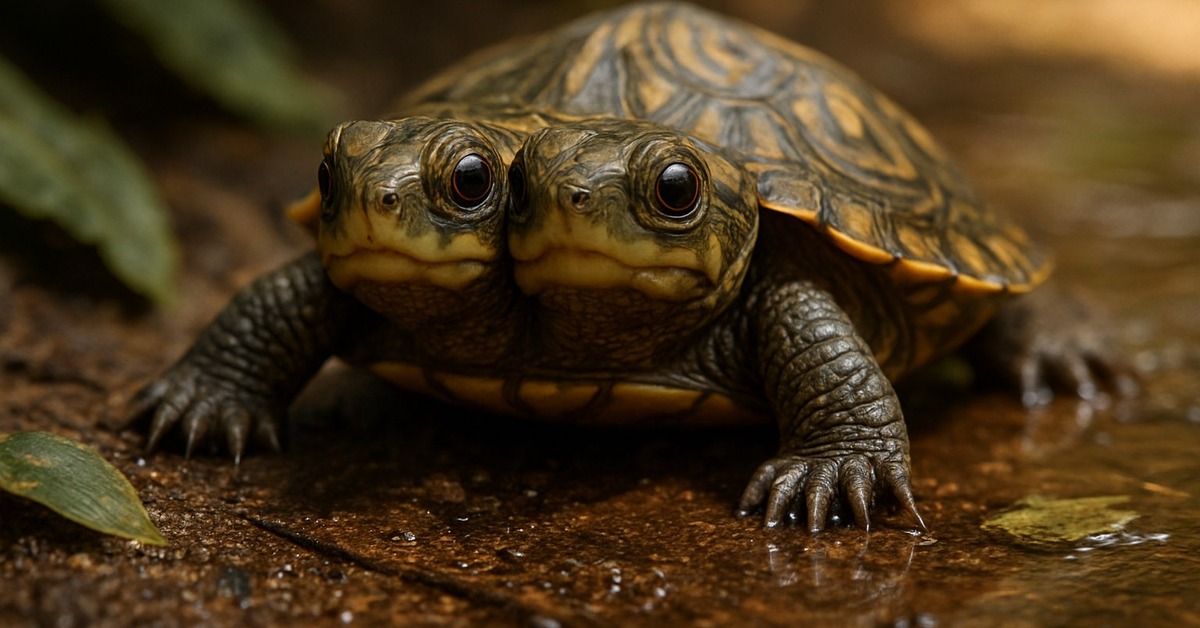
- Janus, a two-headed tortoise born at the Natural History Museum of Geneva in 1997, has survived more than 25 years — the longest verified lifespan on record for any bicephalic reptile.
- In 2011, a recreational fisherman in the Gulf of Mexico pulled up a two-headed bull shark embryo, later described in the Journal of Fish Biology.
- Bicephaly occurs in roughly one in 100,000 births in captive reptile breeding populations.
In short: Bicephalic animals — two heads sharing one body — result from failed twinning. Most wild cases die quickly. Captive examples include Medusa (15+ years), the king snake We at a San Diego center, and Janus the tortoise at Geneva’s Natural History Museum (born 1997, 25+ years). A two-headed bull shark embryo was documented in 2011.
What Bicephaly in Two-Headed Animals Actually Means
It starts as twinning. The embryo begins to split the way identical twins split, but something stalls the process partway through. What’s left is two heads sharing one body — one circulatory system, one digestive tract, often one set of lungs. Documented cases span snakes, turtles, sharks, and cattle, with snakes appearing most frequently, probably because they’re bred in captivity at scale and the anomalies get noticed. It’s not random mutation. It’s a failure of twinning — which somehow makes it feel stranger, not less so.
The nervous system is where it gets genuinely weird. Each head has its own brain. Each brain fires its own signals. The body below has to receive both simultaneously, and it has no mechanism — none — for deciding which one wins.
Two Brains Mean Two Survival Instincts Competing
In the wild, a two-headed snake isn’t just dealing with predators. It’s dealing with itself. One head picks up a chemical trail and lunges toward prey. The other head, wired to respond to sudden movement, interprets that lunge as a threat. Captive keepers of two-headed king snakes learned this the hard way — they now feed each head separately, using a physical divider during meals to stop one head from attempting to eat the other. Which sounds like a dark punchline until you realize it’s just basic care at that point. You can find more on strange animal survival adaptations at this-amazing-world.com.
Movement is its own catastrophe. Each head controls the muscles on its side of the body. One wants left, one wants right. The animal doesn’t split the difference. It stalls, thrashes, and burns energy it genuinely cannot afford to lose.
That last detail kept me reading for another hour.
How These Animals Actually Survive — and Who Helps
In the wild, they almost never do. A two-headed turtle can’t retract both heads into its shell at the same time. A two-headed bull shark embryo found in the Gulf of Mexico in 2011 — later written up in the Journal of Fish Biology — almost certainly didn’t reach adulthood. The Mediterranean two-headed shark documented off Spain that same year probably didn’t either. Nature has very little patience for inefficiency, and bicephaly is inefficiency made flesh.
Captivity changes the calculation entirely.
Remove the predators, stabilize the temperature, hand-deliver the food — and suddenly the animal’s only job is to not die. Some of them turn out to be remarkably good at that.
The Animals That Defied Every Expectation
A two-headed albino rat snake named Medusa lived for over fifteen years in captivity. That’s an extraordinary lifespan for a healthy single-headed rat snake, let alone this. A two-headed king snake named “We” spent years at a San Diego wildlife center and became something of a local fixture. Both required meticulous daily management — patient hand-feeding, careful positioning at mealtimes, constant temperature monitoring. The keepers who cared for them weren’t following any established protocol. They were figuring it out as they went.
Here’s the thing that surprised me most: the heads had distinct personalities. Not metaphorically. One head would be calm while the other was defensive. One would eat readily while the other refused for days. Keepers describe the experience as reading two animals simultaneously, which — neurologically — is exactly what was happening.
And then, in some cases, the heads started to coordinate. Slowly. Imperfectly. But enough to function.
What Two Heads Reveal About How Brains Work
Bicephalic animals aren’t just oddities. They’re accidental neuroscience experiments — ones nobody would have been allowed to design deliberately. Two brains sharing a single body create a situation that’s nearly impossible to study any other way: what happens when competing neural commands hit the same muscles at the same time? How does movement get negotiated, or does it? Research on split-brain patients in humans touches the edges of this territory, but bicephalic animals represent a far more complete division than surgery can produce.
Some two-headed snakes develop what keepers call a “dominant” head over time — one that seems to win more of the arguments with the shared body. Whether that’s structural, learned, or something else isn’t fully understood. But it suggests neural adaptability operating in conditions it was never remotely built for.
By the Numbers
- Medusa, the two-headed albino rat snake, survived over 15 years in captivity. Most wild bicephalic animals don’t last their first month.
- In 2011, a recreational fisherman in the Gulf of Mexico pulled up a two-headed bull shark embryo. It was later described in a peer-reviewed paper in the Journal of Fish Biology — one of only a handful of confirmed shark bicephaly cases ever documented.
- Roughly one in 100,000 births in captive reptile breeding populations.
- Janus, a two-headed tortoise born at the Natural History Museum of Geneva in 1997, has now survived more than 25 years — the longest verified lifespan on record for any bicephalic reptile, by a significant margin. No one projected anything close to this when he hatched.
Field Notes
- Janus in Geneva has two genuinely distinct personalities — the right head is curious and active, the left more cautious and hesitant. Staff have watched the tortoise freeze mid-step while the heads appear to work out a disagreement about direction.
- Two-headed animals can starve with food right in front of them. If both heads refuse simultaneously, or if one head’s feeding triggers a stress response in the other, the animal may go days without eating despite the food being available. Experienced keepers use barriers and precise timing to get around this.
- Not just reptiles — two-headed calves appear throughout agricultural records going back centuries.
- Bicephaly has now been confirmed in at least seven shark species, which suggests this isn’t a reptile-specific glitch but something baked into the basic mechanics of vertebrate embryonic development.
Why Bicephaly Forces Us to Rethink Survival Itself
Every biological system we study — immune response, motor control, thermoregulation — is built around the assumption of a single command center. One brain, one body, one set of instructions. Two-headed animals bicephaly cases exist entirely outside that assumption. They’re not designed to work. They work anyway, sometimes, under specific conditions, with a lot of help.
Turns out “not designed for this” isn’t always a death sentence. It’s sometimes just a harder starting position.
Janus has been improvising for over two decades. The people who care for animals like him aren’t primarily motivated by research — they’re motivated by the fact that the animal is alive, and alive things have a claim on our attention that’s hard to argue with. That’s not science. That’s just what happens when you spend enough time with something that shouldn’t exist and does anyway.
Biology occasionally produces things it has no roadmap for. Two-headed animals are proof of that — proof that survival doesn’t always come down to being built correctly. Sometimes it’s about a lucky environment. Sometimes it’s about a caretaker who figures it out as they go. Sometimes it’s about a second brain that simply refuses to stop sending signals. There’s more of this kind of thing at this-amazing-world.com — and the next one is stranger.
Frequently Asked Questions
Q: How does a two-headed animal develop?
Bicephaly originates as failed twinning during embryonic development. The embryo begins to split the way identical twins split, but something stalls the process partway through. What’s left is two heads sharing one body — one circulatory system, one digestive tract, and often one set of lungs. Documented cases span snakes, turtles, sharks, and cattle, with snakes appearing most frequently — probably because they are bred in captivity at scale and anomalies get noticed. The condition occurs in roughly one in 100,000 captive reptile births.
Q: Why do the two heads conflict with each other?
Each head has its own brain. Each brain fires its own signals. The body below receives both simultaneously and has no mechanism for deciding which one wins. One head picks up a chemical trail and lunges toward prey; the other, wired to respond to sudden movement, interprets that lunge as a threat. Captive keepers of two-headed king snakes learned to feed each head separately, using a physical divider during meals to stop one head from attempting to eat the other.
Q: Which two-headed animals lived the longest?
Medusa, a two-headed albino rat snake, survived over 15 years in captivity — an extraordinary lifespan even for a healthy single-headed rat snake. A two-headed king snake known as We spent years at a San Diego wildlife center, becoming a local fixture. Janus, a two-headed tortoise born at the Natural History Museum of Geneva in 1997, has now survived more than 25 years — the longest verified lifespan on record for any bicephalic reptile, by a significant margin. None of this was projected at hatching.
Q: Have two-headed sharks ever been documented?
Yes. In 2011, a recreational fisherman in the Gulf of Mexico pulled up a two-headed bull shark embryo, later described in a peer-reviewed paper in the Journal of Fish Biology — one of only a handful of confirmed shark bicephaly cases ever documented. A Mediterranean two-headed shark off the coast of Spain was also reported that same year. Neither animal almost certainly reached adulthood; nature has very little patience for the inefficiency of two competing nervous systems sharing one body.
Illustrations are AI-generated. Article fact-checked and human-edited. Our editorial standards.