What Happens to Your Brain in the Seconds Before Death
The soldier’s name was Er. He died on a battlefield, came back, and described what he’d seen with enough specificity that Plato wrote it down. That was 380 BCE. Scientists are still trying to explain it.
Not the myth part. The structure of it. The tunnel. The light. The feeling of watching your own body from somewhere above it. Plato’s account and a cardiac arrest patient’s account from São Paulo in 2019 share details that shouldn’t overlap if these were just random hallucinations misfiring in a dying brain. Dr. Sam Parnia, a resuscitation specialist at NYU Langone, has spent years cataloging these accounts and argues they represent something far more consistent across cultures than random hallucination would predict.
The accounts don’t just rhyme. They practically quote each other across centuries.
Key Facts
- Plato’s account of Er in The Republic dates to roughly 380 BCE, making the documented phenomenon at least 2,400 years old in Western literature
- A 2023 University of Michigan study recorded intense gamma wave surges in two of four patients dying after cardiac arrest
- Gamma waves fire at 30 to 100 cycles per second and the dying brain’s activity measurably exceeded normal waking consciousness (PNAS, 2023)
- Roughly 1 in 5 cardiac arrest survivors reported a near-death experience (Pim van Lommel, 2011 Lancet study)
- Over 80% of near-death experience survivors report a lasting reduction in fear of death (IANDS)
In short: What the near-death experience brain does in its final seconds defies current models. A 2023 University of Michigan study found gamma wave surges exceeding normal waking consciousness in dying patients, echoing accounts of tunnels and light that Plato recorded around 380 BCE. With 1 in 5 survivors reporting one, the timing alone keeps researchers awake.
Near-Death Experiences Are Older Than You Think
A medieval monk in 12th-century England. A child in rural Japan who nearly drowned. A cardiac arrest patient pulled back from clinical death in a São Paulo hospital. Tunnels. Light. Watching your own body from above. The ancient Egyptians wrote about journeys through an afterlife with the same structural elements researchers document today — the sense of leaving the body, moving through a threshold, encountering something luminous on the other side.
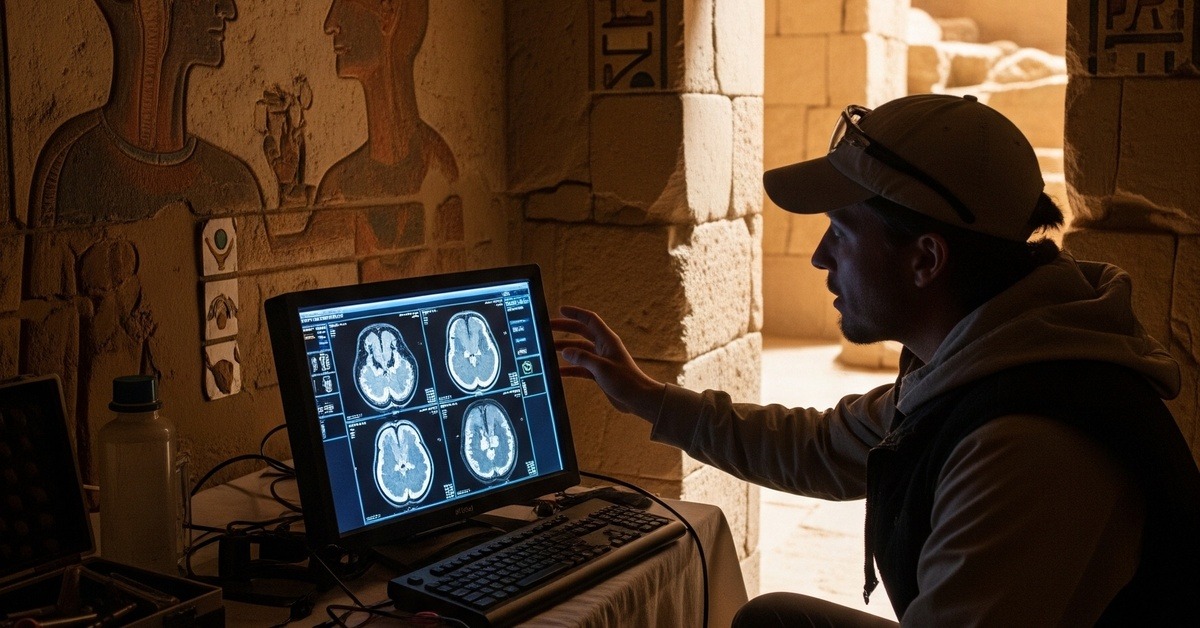
The overlap is either deeply meaningful or deeply strange.
Possibly both. And it’s been documented for at least 2,400 years in recorded Western literature alone, which raises the obvious question — why did it take this long for mainstream science to take it seriously?
What the Dying Brain Actually Does
In 2023, researchers at the University of Michigan published findings that rattled the neuroscience world considerably. They recorded the brain activity of four patients dying after cardiac arrest — patients whose ventilators had been removed. In the moments after the heart stopped, two of them showed intense surges of gamma wave activity. Gamma waves are the high-frequency signals your brain uses during heightened awareness, vivid dreaming, and what researchers technically call “conscious perception.” The brain wasn’t shutting down quietly.
It was lighting up.
Gamma waves fire at 30 to 100 cycles per second — the frequencies your brain runs when it’s doing its most intense processing, binding sensory information, creating coherent experience, making meaning out of noise. The fact that they surge at the moment of death rather than taper off is the detail that keeps researchers awake. You can read more about how consciousness shifts in extreme states at this-amazing-world.com, where the science gets considerably more layered.
The People Who Come Back Are Different
It is 2004. A woman in Ohio wakes in a cardiac care unit. Her family thinks the hard part is over. She knows something has shifted that she can’t explain to them yet.
Studies consistently show that people who’ve had a clinically documented near-death experience report dramatic and lasting shifts in personality and values. Fear of death drops sharply — sometimes vanishes entirely. Materialism fades. Relationships feel suddenly more urgent than they did three days ago. A sense of purpose, often overwhelming, takes hold. Family members notice. Therapists document it. In some cases, the transformation is disorienting enough that survivors genuinely struggle to reintegrate into their old lives.
Some describe returning to a world that suddenly seems thinner than where they’d just been. Like walking back into a black-and-white room after seeing color for the first time.
Not everyone finds that easy to live with.
The Science Can’t Explain the Timing
Here’s the particular problem. Many of the most vivid, coherent near-death experiences are reported during periods when the brain shouldn’t have the capacity to generate them at all. Cardiac arrest cuts blood flow to the brain within seconds. The cerebral cortex — the part responsible for complex thought and sequential experience — typically flatlines within 20 to 30 seconds of the heart stopping.
And yet survivors describe detailed, emotionally rich, narratively ordered experiences. That last part matters. They don’t describe chaos. They describe sequence.
That doesn’t fit oxygen-deprived hallucination. Hypoxia produces fragmented, often terrifying experiences — not orderly ones. Near-death experiences reported during verified flatline periods represent one of the most persistent anomalies in modern consciousness research, and the standard explanations — REM intrusion, endorphin flooding, hypoxia — simply don’t hold if the experience is occurring after measurable brain activity has ceased.
Something is happening that the current models weren’t built to explain.

What the Gamma Wave Surge Actually Means
The 2023 University of Michigan study wasn’t the first time anyone found this. A 2013 study from the same institution, led by Dr. Jimo Borjigin, recorded similar surges in dying rats. The gamma activity in the moments after cardiac arrest was actually higher than during normal waking consciousness. That last fact kept me reading for another hour — not a misprint, not an artifact, just the raw finding sitting there: the dying brain, in measurable electrical terms, was more active than the living one.
The 2023 human study extended those findings with an additional detail. The surges weren’t scattered. They were concentrated in the brain’s “hot zone” — the region most directly associated with conscious visual experience. Think of it like the brain’s final processing running not on backup power, but on a surge.
Death isn’t the lights going out. For some, it might be the moment the lights burn brightest.
What that means for what survives it — if anything — is a question science hasn’t answered. And may not currently be equipped to ask correctly.
By the Numbers
- Roughly 1 in 5 cardiac arrest survivors reported a near-death experience — from Dr. Pim van Lommel’s 2011 Lancet study of patients who were clinically dead and successfully resuscitated.
- Gamma wave activity in dying patients surged to frequencies measurably exceeding normal waking consciousness, per findings published in PNAS in 2023.
- Plato’s account of Er in The Republic (c. 380 BCE) — making the documented phenomenon at least 2,400 years old in Western literature.
- Over 80% of near-death experience survivors report a significant and lasting reduction in fear of death, according to research compiled by the International Association for Near-Death Studies (IANDS). Not a small shift. Family members describe it as meeting a different person.
Field Notes
- Congenitally blind people who have near-death experiences often report being able to see during them — describing colors, faces, and spatial environments they have no prior visual reference for. Researchers Kenneth Ring and Sharon Cooper documented 31 such cases in their 1999 study Mindsight. That one tends to stop people cold.
- Children as young as three report the same core elements as adults.
- The “life review” — in which a person experiences their entire life in rapid sequential detail — is reported not as a chaotic blur but as an orderly, emotionally complete narrative. That doesn’t fit the profile of memory dysfunction caused by oxygen deprivation. It fits something else, and nobody’s agreed on what yet.
- No cultural coaching required. Children describe it before they have language for it.
Why This Question Won’t Stop Mattering
It is not a fringe topic anymore. Near-death experiences sit at the intersection of the two things humans find hardest to examine honestly — death and consciousness — and neither, it turns out, behaves the way anyone assumed. The gamma wave findings don’t prove an afterlife. They don’t confirm the spiritual accounts. But they do confirm that something measurable, intense, and not yet explained is happening in those final moments.
The people who pass through that window and return are, statistically and anecdotally, changed by it. Durably changed. Not in a vague, inspirational sense — in ways that researchers can track, that therapists document, that families notice across years.
What’s actually at stake is the question of what consciousness is. Whether it’s strictly biological. What it means to live a life knowing that its ending might be its most vivid moment.
That changes how you look at things. It’s supposed to.
A surge of gamma waves. A floating perspective above a hospital bed. A 2,400-year-old soldier’s account that maps almost exactly onto what a cardiologist in Rotterdam started writing down in 1988. Thousands of accounts across thousands of years, all pointing somewhere that science hasn’t fully charted yet. Death, it turns out, is considerably more interesting than it looks from the outside. There’s more at this-amazing-world.com — and the next one is stranger still.
Frequently Asked Questions
Q: What does the brain actually do in the seconds before death?
In a 2023 University of Michigan study, researchers recorded the brain activity of four patients dying after cardiac arrest. In the moments after the heart stopped, two showed intense surges of gamma wave activity, the high-frequency signals tied to heightened awareness and conscious perception. Gamma waves fire at 30 to 100 cycles per second, and per findings published in PNAS in 2023, the dying brain’s activity measurably exceeded normal waking consciousness rather than tapering off.
Q: How old is the documented near-death experience?
At least 2,400 years old in recorded Western literature. Plato’s account of the soldier Er in The Republic dates to roughly 380 BCE and describes a tunnel, light, and the feeling of watching one’s own body from above. Ancient Egyptians wrote about afterlife journeys with the same structural elements researchers document today, and accounts from a medieval English monk to a 2019 Sao Paulo cardiac patient share details that random hallucination would not predict.
Q: Why can’t science explain the timing of these experiences?
Cardiac arrest cuts blood flow to the brain within seconds, and the cerebral cortex typically flatlines within 20 to 30 seconds of the heart stopping. Yet survivors describe detailed, emotionally rich, narratively ordered experiences during periods when the brain shouldn’t have the capacity to generate them. Standard explanations like hypoxia produce fragmented, terrifying experiences, not orderly sequences, so near-death experiences during verified flatline periods remain a persistent anomaly in consciousness research.
Q: Are people changed after a near-death experience?
Durably, and in measurable ways. Studies show survivors report dramatic, lasting shifts in personality and values: fear of death drops sharply, materialism fades, and a sense of purpose takes hold. Over 80% of near-death experience survivors report a significant and lasting reduction in fear of death, according to research compiled by IANDS. Roughly 1 in 5 cardiac arrest survivors report an experience at all, per Pim van Lommel’s 2011 Lancet study, and families often describe meeting a different person.
Illustrations are AI-generated. Article fact-checked and human-edited. Our editorial standards.