Lab-Grown Spinal Cord Reverses ‘Irreversible’ Nerve Damage
Can a lab grown spinal cord reverse nerve damage that doctors have long filed under “permanent”? In a dish, yes — a Cambridge team wired two human organoids together and switched nerve regrowth back on in cells that had lost the ability, the first human-tissue evidence that this kind of damage may not be a one-way street. But it happened in a lab model, not a person — so here is exactly what changed, why a contraceptive pill is suddenly part of the story, and what it honestly means for spinal-cord injury.
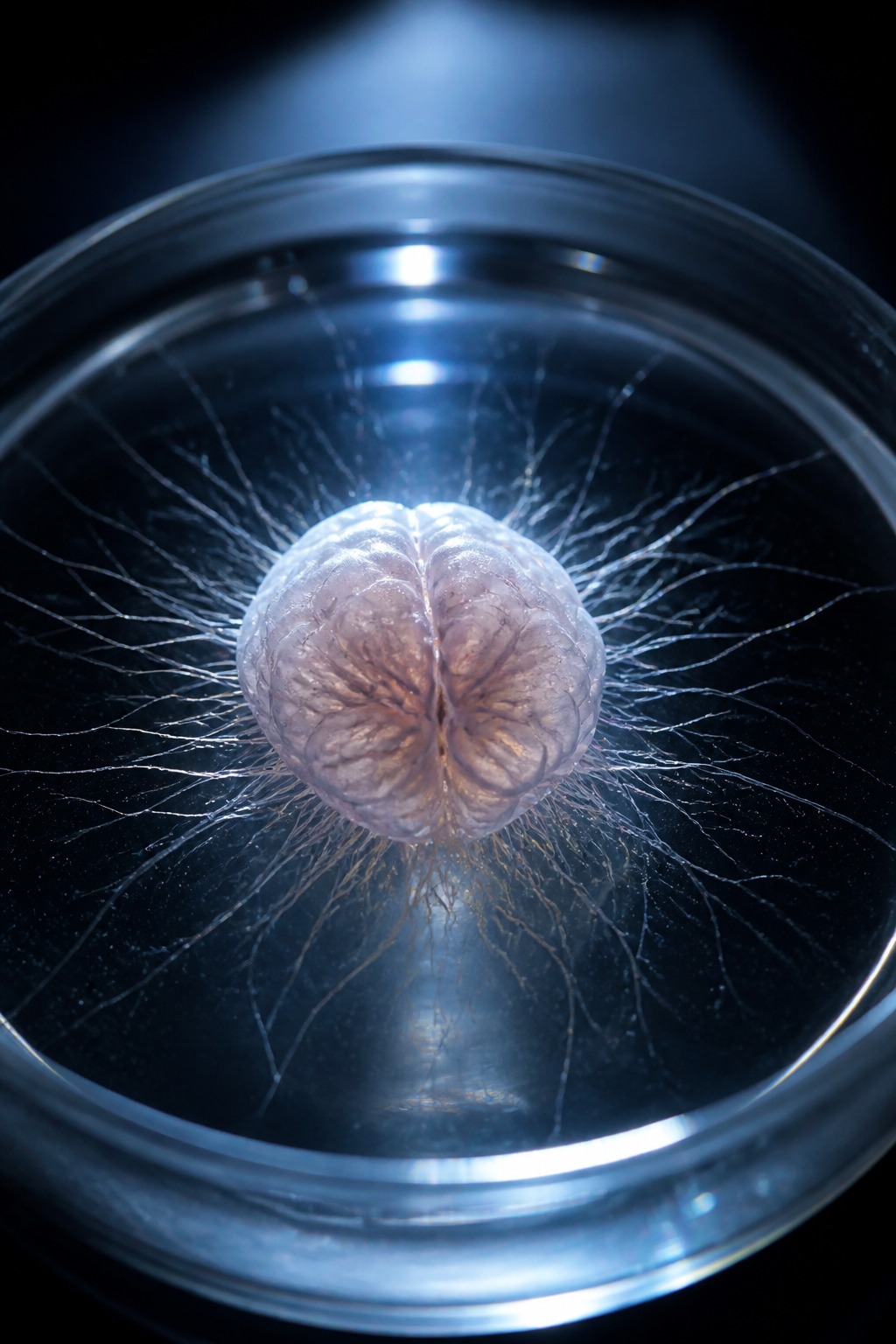
- The model: a pea-sized human brain (cortex) organoid and a separate spinal-cord organoid, kept apart, wired together by nerve fibres that grew across the gap — and hooked to tiny muscle clusters.
- The proof: signals sent from the brain organoid travelled down the circuit and made those muscle clusters twitch — a working corticomotor circuit built from human cells.
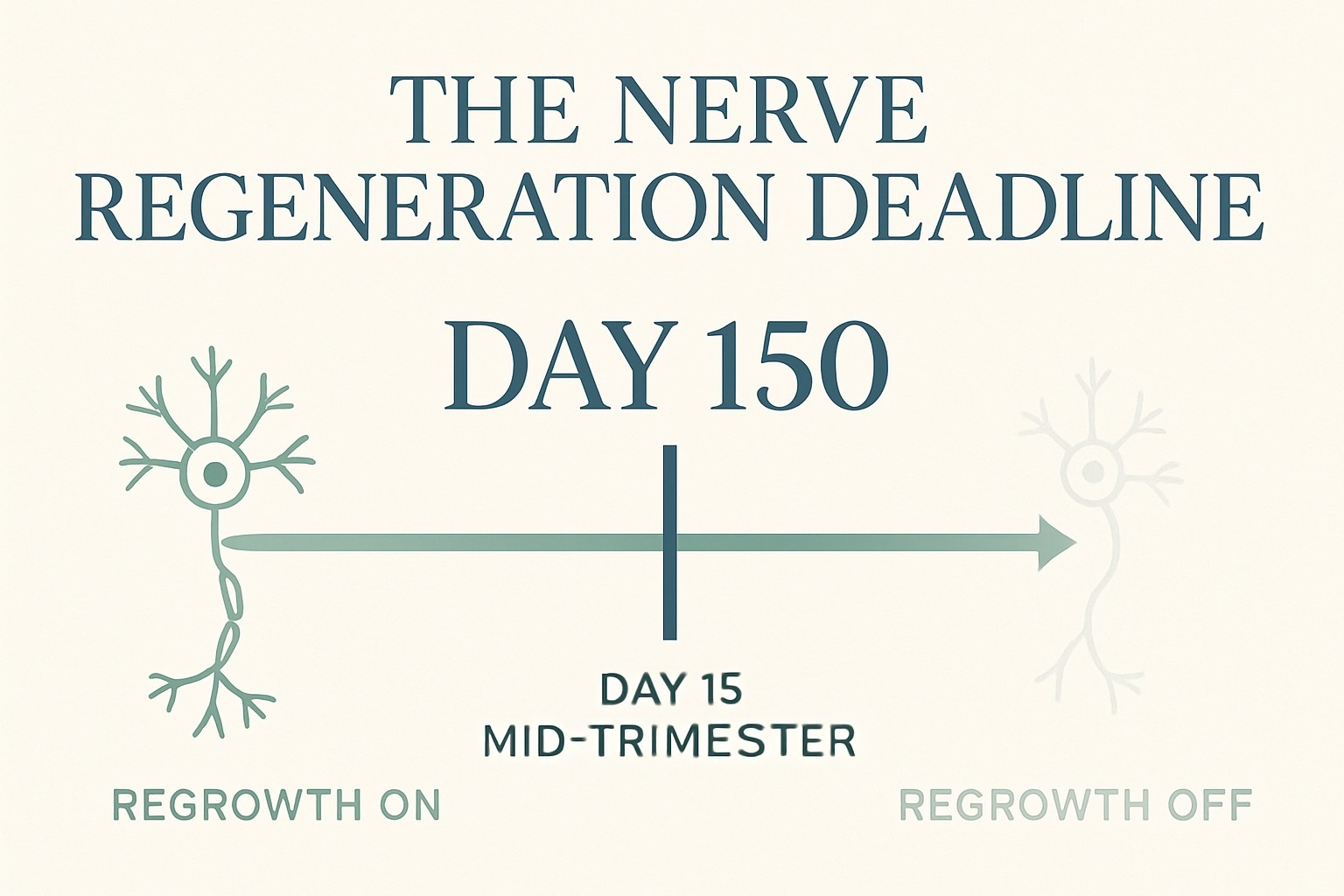
- The deadline: injured axons regrew until about day 150 of development (the mid-trimester of pregnancy); after that, regrowth collapsed.
- The mechanism: a network of genes acts like a switch that shuts axon regrowth off as neurons mature — blocking it flipped regrowth back on.
- The team: Dr András Lakatos’s lab, first author George Gibbons, Department of Clinical Neurosciences, University of Cambridge — published in Cell Reports, May 2026, funded by the MRC and the charity Spinal Research.
Key Facts
- A Cambridge team wired a human cortex organoid to a spinal-cord organoid, building a working corticomotor circuit from human cells that made muscle clusters twitch.
- Injured axons regrew until about day 150 of development (the mid-trimester of pregnancy), after which regrowth collapsed.
- A network of genes acts as a switch that shuts off axon regrowth as neurons mature; blocking it restored regrowth.
- Screening existing drugs identified lynestrenol — a hormone drug used as a contraceptive — which boosted axon regrowth.
- The work, from Dr Andras Lakatos’s lab with first author George Gibbons, was published in Cell Reports in May 2026.
In short: A Cambridge team wired two human organoids — brain and spinal cord — into a working circuit and switched nerve regrowth back on in mature human cells that had lost it. They found regrowth collapses around day 150 of development via a genetic off-switch, which the contraceptive drug lynestrenol helped reverse. It happened in a lab model, not a patient.
A working brain-to-spinal-cord circuit, grown in a dish
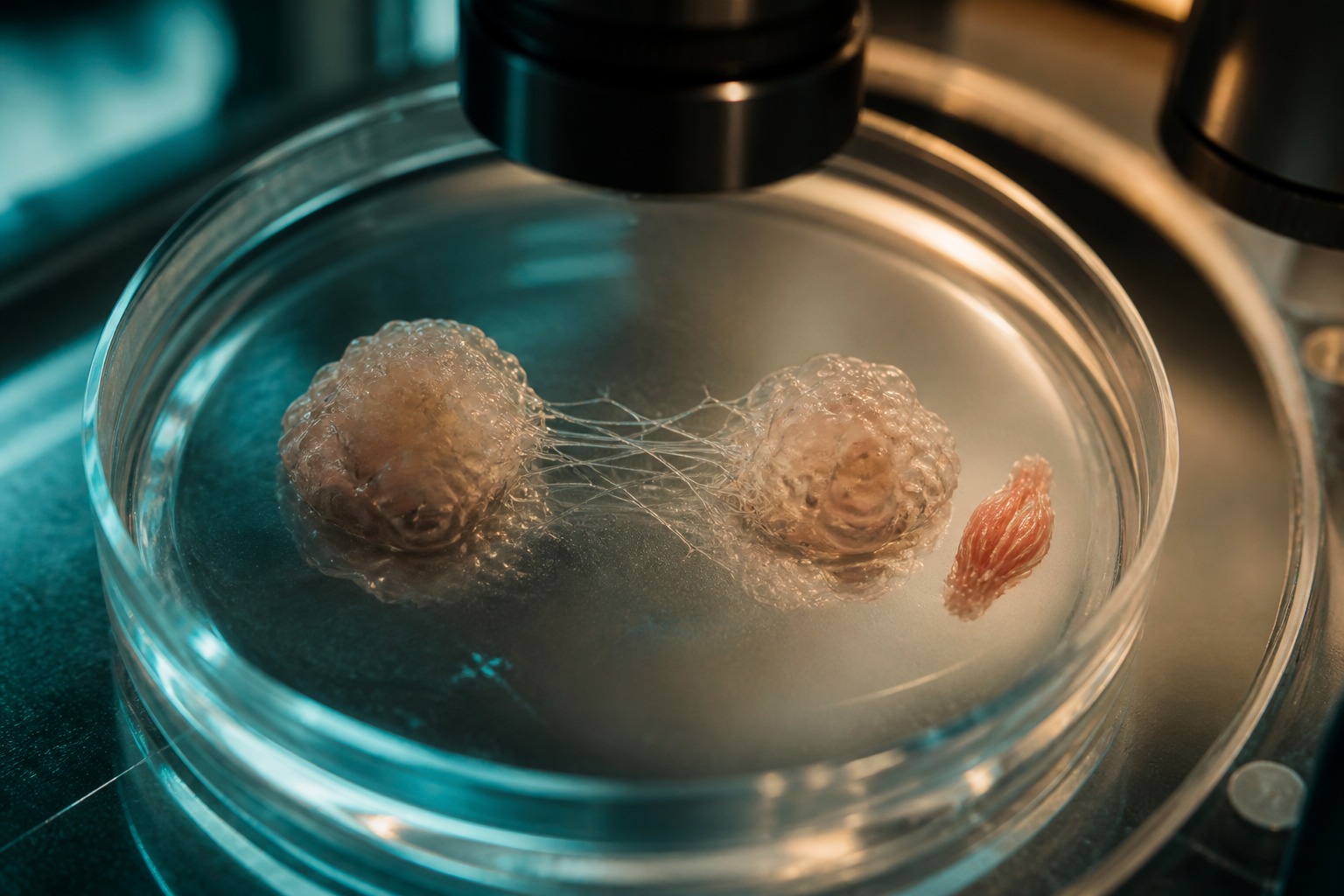
Start with the part that sounds like science fiction and isn’t. Gibbons and his colleagues grew two blobs of living human tissue from stem cells — one that behaves like the cerebral cortex, the “command” end of movement, and one that behaves like the spinal cord, the relay that carries those commands to muscle. They placed them a short distance apart and let biology do the wiring.
Nerve fibres crept out of the brain organoid, crossed the gap, and plugged into the spinal-cord tissue. Then the team added clusters of muscle cells at the far end. When they stimulated the brain organoid, the signal ran the length of the circuit and the muscle clusters contracted. A thought-like pulse in, a twitch out — the whole chain of human movement, in miniature.
Why does that matter beyond the “wow”? Because most of what we know about nerve regrowth comes from mice and rats, whose neurons do not behave like ours. A human-derived circuit closes that gap. As Lakatos put it, these organoid models “help bridge the knowledge gap from animal models to what we see in patients.” For once, the tissue being tested is actually human.
{IMAGE_2}
The deadline written into your nerves — why ~day 150 changes everything
Here is the finding that reframes the whole story, and the one every headline buried. Your nerves had an expiry date before you were born.
When the researchers injured neurons taken from younger organoids, the axons — the long cables that carry electrical signals — grew back. When they injured neurons from older organoids, the same cells barely regrew at all. The cut-off sat at roughly day 150 of development, which lines up with the mid-trimester of human pregnancy. Before that window, repair; after it, silence.
The clock, it turns out, starts before you are born.
Gibbons stated it plainly: “Neurons taken from less mature organoids regrew long fibres after injury, but those from more mature organoids showed a sharp drop in their ability to regrow. In other words, poor regeneration is built into human neurons as they mature in the central nervous system.” So why can’t your nerves simply regrow after a spinal injury? Because they were never built to. The loss of that ability isn’t damage from the injury — it’s a feature the body switches on during development, and one you have been living without since the womb.
The genetic off-switch — and how a contraceptive pill flipped it back
If maturity kills regeneration, the obvious question is: what pulls the trigger? By reading which genes were active in the brain-to-spine neurons, the Cambridge team found not a single gene but a network of them behaving like a master switch — one that steadily restricts axon growth as neurons settle down and form their connections. Think of it as a circuit breaker the body flips once the wiring is finished, so mature nerves stop sprawling and stay put.
The elegant part came next. When the researchers blocked key regulators of that network, the switch flipped back the other way, and the ability to grow axons switched back on. The block, in other words, is not a wall. It’s a setting — and settings can be changed.
To find something that could change it, they screened a library of existing drug compounds and landed on an unlikely name: lynestrenol, a hormone drug already licensed to manage certain menstrual disorders and as a contraceptive. Applied to damaged human neurons, it significantly boosted axon regrowth. If you strip away the excitement, the real news here isn’t lynestrenol at all — it’s the proof that the off-switch can be picked in the first place. A drug already sitting in pharmacies happened to nudge a genetic program nobody designed it to touch, which tells you the target is real and druggable.
Can a lab grown spinal cord reverse nerve damage in a patient? What this does and doesn’t mean
No. Not yet, and not the way the internet is implying. This is the section every other write-up skipped, so let’s be honest about the gap between a twitching dish and a person walking again.
What happened is genuinely a first: human central-nervous-system neurons, the kind that give up regrowing after the mid-trimester, were coaxed into regrowing again in a controlled human model. What did not happen is a treatment. Lakatos himself cautioned that “Lynestrenol itself may not be the answer to spinal cord repair,” while adding that the work shows it should be possible to directly target human neurons and regenerate their axons — with more work still needed to re-establish the right connections between brain and spinal-cord cells. Regrowing a fibre is not the same as re-wiring a functioning circuit inside a living body.
| What the study shows | What it does not show (yet) |
|---|---|
| Human CNS neurons can be pushed to regrow axons after injury | A person with paralysis can be treated today |
| The block on regrowth is genetic and can be reopened | Lynestrenol is the drug that will do it in people |
| It works in human-derived tissue, closing the animal-to-human gap | It works inside a living human spinal cord |
| Regrowth returns when the maturation switch is blocked | The regrown fibres reconnect into useful, controlled movement |
A realistic timeline? Think years of further lab work — testing whether regrown axons find the right targets, whether the effect holds in more complex tissue, and whether any drug can do this safely in a living nervous system — before anything resembling a human trial. This is a foundation, not a finish line, and it is worth being clear about that so hope stays honest.
But what stage of a human is this tissue, really?
This trips people up, so it’s worth untangling. A brain organoid is not a tiny brain, and a spinal organoid is not a tiny spinal cord. They are simplified, self-organising clumps of the right cell types that recreate some features of early development — useful models, not miniature people.
The “day 150” figure describes a developmental stage the neurons reach as they mature in the dish, roughly matching the mid-trimester of pregnancy — that’s the point where the regeneration window closes. It is not a claim that the organoid is a whole fetus of a given age, and you’ll see other coverage online blur this together with older, different organoid work. The clean takeaway: the tissue models the maturation of specific brain-to-spine nerve cells, and the crucial variable is how “old” those cells have become, not how big or complete the blob is.
Is it alive? The ethics of lab-grown human neural circuits
A lab-grown lump of human brain and spinal tissue that fires signals and twitches muscle raises the obvious, uncomfortable question — and dodging it would be a disservice. Can it think? Can it feel?
On the current science, there is no evidence that these organoids are conscious or can experience anything. They lack the scale, the organised sensory inputs, the blood supply, and the vast integrated architecture a functioning human brain uses to generate awareness. A muscle twitch driven by an electrical pulse is a reflex-like circuit, not a mind, and no researcher in this field is claiming otherwise.
That said, the honest position is that this is exactly the kind of research the scientific community keeps under active ethical review precisely because the tissue is human and the models keep getting more sophisticated. Bodies such as national ethics committees and institutional oversight boards exist to draw and re-draw those lines as capability grows. Asking the question early isn’t alarmism — it’s the responsible part of doing the work.
What scientists are trying next
The immediate goals are practical. Can regrown axons be guided to reconnect with the correct partners, so signals arrive where they’re meant to rather than sprawling uselessly? Does the switch-flipping effect survive in more complex, more mature tissue? And is there a compound — lynestrenol or, more likely, something refined from what it taught them — that could act on human neurons safely?
There’s also the model itself. A human corticomotor circuit that runs from “brain” to muscle is a testing ground for spinal-cord injury, motor neuron disease, and other conditions where these connections fail — a place to try ideas on human tissue before ever approaching a patient. That, quietly, may be the study’s longest-lasting gift: not one drug, but a human system for finding the next hundred.
Questions readers ask
Can lab-grown organoids reverse paralysis?
Not in people — not yet. The Cambridge work reversed a loss of nerve regrowth in a human-tissue model in the lab. It is early-stage evidence that the underlying block can be reopened, not a treatment for spinal-cord injury or paralysis.
What is a brain–spinal cord organoid?
It’s two lab-grown clumps of human cells — one resembling the cerebral cortex, one resembling the spinal cord — grown from stem cells and allowed to wire together with nerve fibres. Attached muscle clusters let researchers test whether the circuit actually works.
Is lynestrenol a cure for nerve damage?
No. Lynestrenol is a licensed hormone drug that, in this experiment, boosted axon regrowth in damaged human neurons in a dish. The lead researcher explicitly said it “may not be the answer” — it points to a target, it isn’t a proven therapy.
Can a brain organoid feel anything?
There is no evidence that it can. These organoids lack the size, sensory connections, and integrated structure thought to be necessary for consciousness. A muscle twitch is a signal passing through a circuit, not a sign of awareness.
Sources and notes
- University of Cambridge research news — “Lab-grown brain-spinal cord model shows ‘irreversible’ nerve damage may be reversed” (May 2026)
- Gibbons, G. et al., “A human corticospinal organoid-slice connectoid model informs enhancer strategies for post-injury axon regrowth,” Cell Reports (2026)
- Department of Clinical Neurosciences, University of Cambridge — lab of Dr András Lakatos
- ScienceDaily — coverage of the Cambridge organoid axon-regeneration study (May 2026)
- Funders: UK Research and Innovation Medical Research Council (MRC); the charity Spinal Research
The lasting takeaway isn’t a miracle drug — it’s a shift in what “permanent” means. For the first time in human tissue, a damage that biology seemed to lock shut was pried back open, and the lock turned out to be a genetic setting rather than a wall. Keep your hopes measured and your curiosity high: the road from a twitching dish to a walking patient is long, but this is a real, honest step onto it.
Frequently Asked Questions
Q: Can a lab-grown spinal cord reverse nerve damage in a patient?
Not yet. The Cambridge work is a genuine first — human central-nervous-system neurons that normally stop regrowing after the mid-trimester were coaxed into regrowing again — but it happened in a controlled lab model, not a person. Lead researcher Andras Lakatos cautioned that lynestrenol itself may not be the answer, while noting the work shows human neurons can be targeted to regenerate axons. Much more work is needed.
Q: What did the Cambridge team actually build?
They grew two blobs of human tissue from stem cells — one behaving like the cerebral cortex, the movement command centre, and one like the spinal cord — and placed them a short distance apart. Nerve fibres grew across the gap and plugged into the spinal-cord tissue, and clusters of muscle cells were added at the far end. Stimulating the brain organoid sent a signal down the circuit that made the muscle clusters contract.
Q: Why can’t human nerves normally regrow after spinal injury?
Because they were never built to. When researchers injured neurons from younger organoids, the axons regrew; from older organoids, they barely regrew at all. The cut-off sat at roughly day 150 of development — the mid-trimester of pregnancy. Poor regeneration is built into human neurons as they mature, driven by a network of genes acting like a master switch that restricts axon growth once the wiring is finished.
Q: How does a contraceptive pill fit into the story?
After finding that blocking the genetic off-switch flipped axon regrowth back on, the team screened a library of existing drugs and landed on lynestrenol — a hormone drug already licensed for menstrual disorders and contraception. Applied to damaged human neurons, it significantly boosted axon regrowth. The real news is not lynestrenol itself but proof that the off-switch can be picked, showing the target is real and druggable.
Illustrations are AI-generated. Article fact-checked and human-edited. Our editorial standards.