How Long Are Blood Vessels in the Human Body? Real Answer
How long are blood vessels in the human body? You’ve almost certainly heard the answer: 60,000 miles. 100,000 kilometers. Enough to wrap the Earth two and a half times. It’s a great stat. It’s also wrong — and the real story, traced back to a 1922 Danish physiology book, is more interesting than the myth.
Key Facts
- The viral “100,000 km / 60,000 miles” figure originated with Danish Nobel laureate August Krogh in his 1922 book The Anatomy and Physiology of Capillaries. His extrapolation was scaled up from assumptions about a hypothetical, unusually muscular adult — not an average person.
- Modern peer-reviewed work by David Poole and colleagues, published in the Journal of Physiology, suggests the realistic total for an average adult is closer to about 40,000 km — almost exactly one loop around Earth’s equator (40,075 km), not 2.5.
- Capillaries account for the great majority of total vessel length — by most estimates, well over 90%. The arteries and veins you can see on an anatomy chart together amount to only a few hundred kilometers.
- Every living cell in your body sits within about 50 micrometers of a capillary — half the diameter of a human hair.
- The number isn’t fixed for life. Endurance training grows new capillaries through angiogenesis, and a newborn starts with only about 6,000 km of vessels.
In short: The number most people quote (60,000 miles) comes from a 1922 estimate based on a hypothetical oversized adult. Modern physiology suggests an average human carries closer to 40,000 km of blood vessels — once around Earth’s equator, not 2.5 times. Most of that length is capillaries you cannot see.
Key Facts
- The viral 100,000 km / 60,000 miles figure originated with Danish Nobel laureate August Krogh in his 1922 book The Anatomy and Physiology of Capillaries.
- Krogh’s extrapolation was scaled up from assumptions about a hypothetical, unusually muscular adult, not an average person.
- Modern work by David Poole and colleagues in the Journal of Physiology suggests the realistic total for an average adult is closer to about 40,000 km – almost exactly one loop around Earth’s equator (40,075 km).
- Capillaries account for well over 90% of total vessel length, while all visible arteries and veins together amount to only a few hundred kilometers.
- Every living cell sits within about 50 micrometers of a capillary, and a newborn starts with only about 6,000 km of vessels.
In short: The familiar 60,000-mile (100,000 km) figure comes from a 1922 estimate by August Krogh that was scaled up from a hypothetical oversized adult. Modern physiology, drawing on work by David Poole in the Journal of Physiology, suggests an average human actually carries closer to 40,000 km of blood vessels – once around Earth’s equator, not two and a half times. Most of that length is capillaries you cannot see.
The Number You’ve Heard: 60,000 Miles. Is It Real?
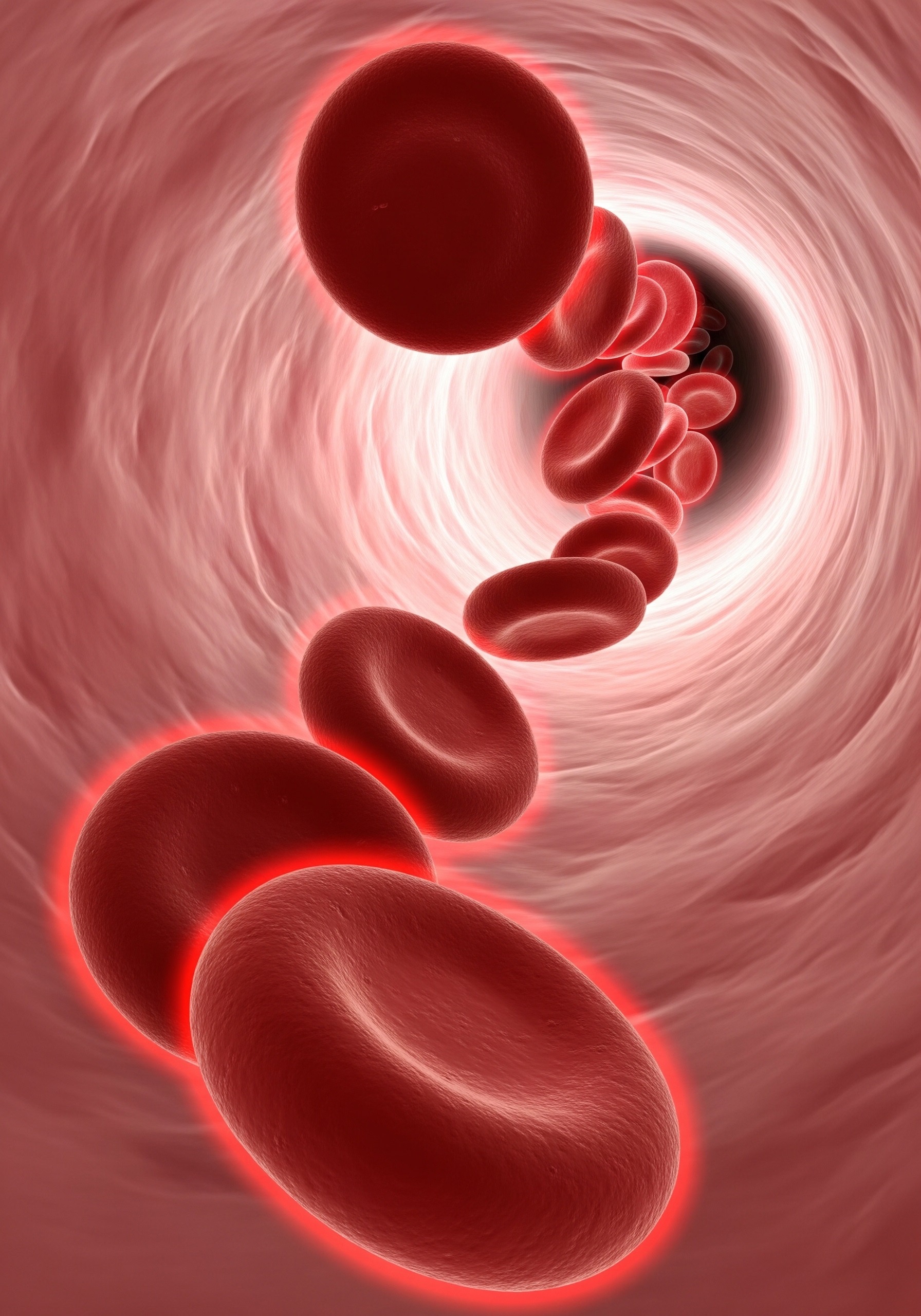
Walk into a high-school biology class and you will meet the figure. Open a TED-Ed video, a viral Short, a PBS explainer, a UNILAD article. The same number, every time. 60,000 miles. 100,000 kilometers. Two and a half trips around the planet, coiled inside one person.
It is one of the most repeated statistics in human biology. It is also, almost certainly, far too big.
The short version: that figure is a century old, it was never measured directly, and it was scaled up from assumptions about a hypothetical adult that modern physiologists describe as far from typical. A realistic number for an average person appears to be closer to 40,000 km — which is its own jaw-dropping fact, because that is the circumference of Earth at the equator. Almost exactly once around the planet, packed inside you.
So how did the inflated version conquer textbooks for a hundred years? It’s the usual story: a careful scientific estimate, written for a specific assumption, gets stripped of its footnotes by popular writers, repeated, repeated, and eventually becomes “common knowledge.” Once a number is everywhere, nobody bothers to check the math.
Let’s check the math.
Where the 100,000 km Figure Actually Came From (Krogh, 1922)
The trail leads back to a single book: The Anatomy and Physiology of Capillaries, published in 1922 by Danish physiologist August Krogh. Two years earlier, Krogh had won the Nobel Prize in Physiology or Medicine for his discovery of how capillaries open and close to deliver oxygen on demand — foundational work on capillary physiology to this day.
His book contained the original whole-body estimate. Krogh counted capillaries in small samples of muscle tissue under a microscope, measured their density, and then scaled the number up. Here is the trap. To produce a whole-body figure, he had to assume a “standard” body — how much muscle, how much fat, how big the organs. Modern physiologists who have revisited the calculation note that his hypothetical human was unusually heavy and unusually muscular — closer to a competition bodybuilder than to an average adult.
Multiply a per-gram capillary count by an oversized hypothetical body, and you get an oversized number. That is exactly what happened.
From there, the figure was carried into the wider world by popular-science writers. Steven Vogel’s Vital Circuits (Oxford University Press, 1992) repeated a version of it. David Suzuki’s Looking at the Body (1991) cited a 96,000-km variant. Textbook authors kept it because it was vivid. By the time the internet arrived, the “100,000 km” claim was a cultural fact — the kind of number nobody questions because everybody says it.
Krogh’s underlying biology was right. He won a Nobel Prize for good reason. But the headline number was always conditional on a body that does not exist.
By the Numbers: Vessel Length, Myth vs Measurement
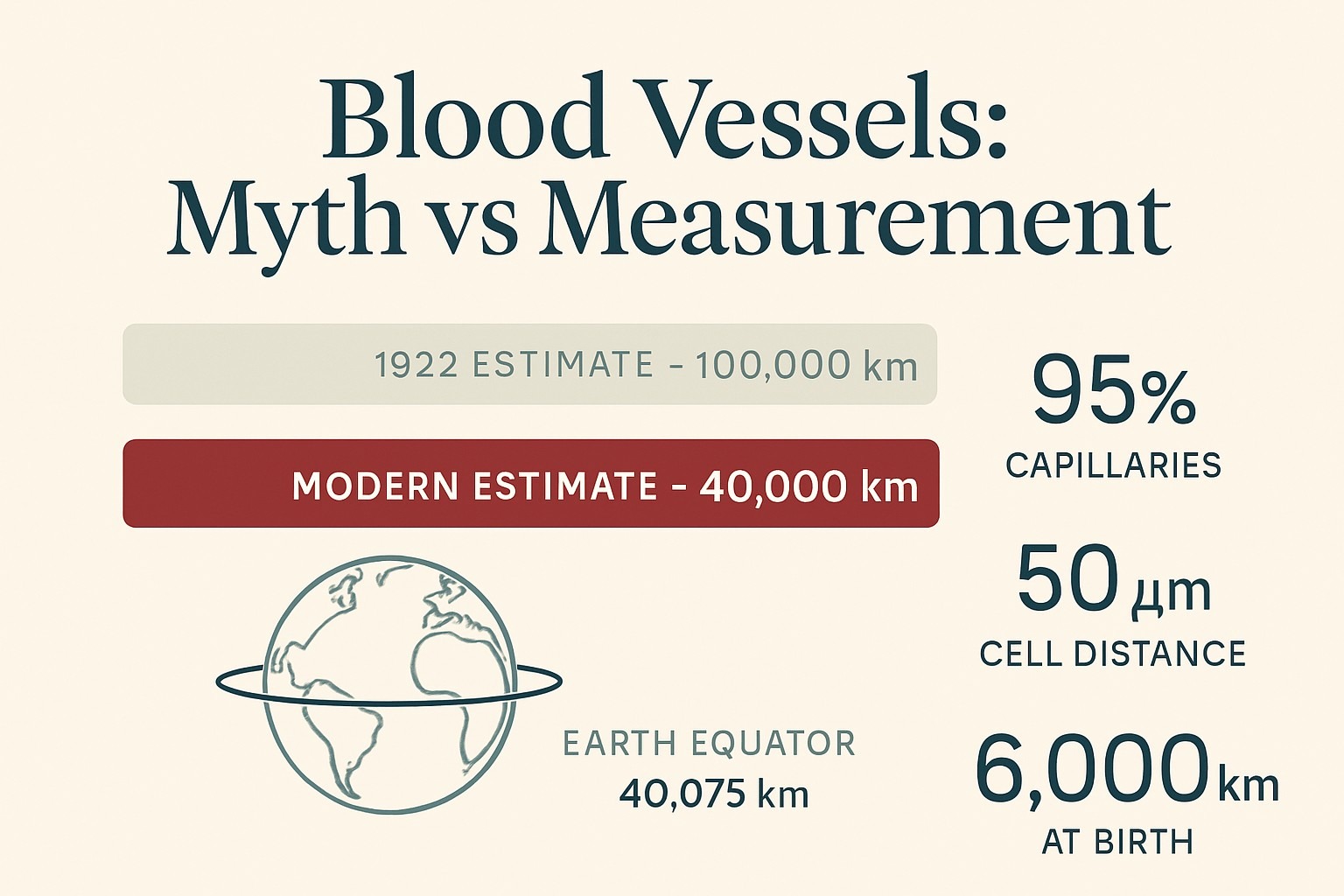
- ~100,000 km — Krogh’s 1922 estimate, scaled to an oversized hypothetical body. Still in most textbooks.
- ~40,000 km — modern estimate for an average adult (synthesis of Poole et al., Journal of Physiology, and related muscle-capillary studies).
- 40,075 km — Earth’s circumference at the equator.
- >90% — share of total vessel length made up of capillaries.
- ~6,000 km — approximate total vessel length at birth.
- 5-10 μm — diameter of a typical capillary (a red blood cell, ~7 μm, just fits).
{IMAGE_2}
What Modern Research Says: ~40,000 km, Not 100,000
Modern measurements tell a different story. Exercise physiologist David Poole at Kansas State University has spent decades quantifying capillary length and density in skeletal muscle, with results published in the Journal of Physiology. When his lab’s direct measurements of capillary density are carefully scaled to average human body composition, total capillary length in skeletal muscle lands in the range of roughly 10,000 to 20,000 km — far below Krogh’s extrapolation.
Add the rest: capillary beds in the lungs, the liver, the kidneys, the brain, the skin and every other tissue. Add the macrocirculation — every artery, vein, arteriole and venule. Sum the whole network, and the realistic total for an average adult lands somewhere around 40,000 km. Capillaries are most of it. The visible arteries and veins are a rounding error. The whole network coils into a length close to a single loop of the planet.
Here’s the thing: 40,000 km is not a deflation of the original story. It is still the most extraordinary plumbing in nature. It is just an honest version. Several independent approaches — direct microscopy on muscle, MRI-based vascular reconstruction, indirect estimates from oxygen-diffusion modeling — converge on the same order of magnitude. Krogh’s 100,000 km figure does not.
That textbook number should have been retired thirty years ago.
The Capillary Secret: 95% of Your Plumbing You Can’t See
Here is the part nobody puts on the chart: when biologists talk about the length of the circulatory system, they are mostly talking about a structure you cannot see and have never met.
Arteries and veins on your anatomy poster — the aorta, the femoral, the jugular — are large highways, but in total length, they are trivial. The entire macrovasculature of an adult body amounts to only a few hundred kilometers, generously. The other >90% of the length lives at a scale invisible to the naked eye. Capillaries are 5 to 10 micrometers wide — narrow enough that red blood cells squeeze through one at a time, deforming as they go. There are roughly 10 billion of them in the average adult, woven through every muscle, every organ, every gram of tissue except a handful of avascular structures (the lens of the eye, the cornea, the inside of cartilage).
Geometry is the point. To keep every cell alive, the body has to put a capillary within reach of every cell — and “within reach” means within about 50 micrometers, half the width of a human hair. The only way to satisfy that geometric constraint is to make the network unimaginably dense. Length is the unavoidable consequence.
Arteries vs Veins vs Capillaries — A Length Breakdown
A useful way to picture the system: a single branching delivery network where the trunks are large and few, the branches medium and many, and the leaves microscopic and effectively endless. Length scales inversely with diameter.
This synthesis is approximate — direct, whole-body measurement is impossible — but the ratios it captures are well established in the physiology literature.
| Vessel type | Diameter | Share of total length | What it does |
|---|---|---|---|
| Arteries & arterioles | ~25 mm (aorta) → 30 μm | A few hundred km (~1-2%) | High-pressure delivery from heart to tissues |
| Capillaries | 5-10 μm | Great majority (~95%, tens of thousands of km) | Gas, nutrient and waste exchange with cells |
| Veins & venules | ~30 μm → 30 mm (vena cava) | A few hundred km (~1-2%) | Low-pressure return to heart |
What you can name from a textbook — every named vessel on an anatomy chart — is the headline. The capillary bed is the whole rest of the book.
Why Your Number Isn’t Fixed: Training, Age, and Body Size
One reason the 100,000-km figure persisted is that biology textbooks like a single round answer. Real bodies don’t oblige. Your vasculature length is set by how much tissue you have to feed, and the tissues themselves can build new vessels when they need them.
A newborn carries about 6,000 km of vessels — large for a small body, but a fraction of the adult network. As tissues grow, the vasculature grows with them. By adulthood the total has multiplied roughly six- or seven-fold.
And it does not stop there. In a foundational 1988 paper in News in Physiological Sciences, Swiss physiologists Hans Hoppeler (University of Bern) and S. R. Kayar showed that endurance training drives genuine angiogenesis — the muscle literally builds new capillaries to feed the higher oxygen demand. Later work by Nikolaus Wick and colleagues at the Medical University of Vienna (2004) confirmed the effect in trained humans: marathon runners and cyclists carry measurably denser capillary networks in working muscle than sedentary controls. Run for months and you grow new plumbing.
Lose muscle to disuse or age, and the network thins. (This is one of the under-told reasons physical training is protective into old age.) The number is biography, not constant.
Why This Length Is Why Blood Pressure Is So Dangerous
There is a reason cardiologists treat high blood pressure as a whole-body disease, and the reason is the length you just read about.
Every minute, your heart pushes roughly five liters of blood through tens of thousands of kilometers of vessel. The vast majority of that distance is microscopic tubing — capillaries the width of a single red blood cell. Now raise the pressure inside that network and hold it there for decades. Capillary walls, which are a single cell thick, take the brunt of it. Damage them in the kidneys, and kidney function declines. Damage them in the retina, and vision fades. Damage them in the brain, and you get small-vessel disease and stroke risk.
This is not a metaphor; it is geometry. Hypertension is dangerous because the system it pressurizes is enormous, fragile, and irreplaceable. The same length that lets oxygen reach every cell is exactly what makes a small chronic pressure problem into a systemic one. The cardiovascular system has no “outside” of itself.
Same logic explains why diabetes damages the microvasculature first: it is simply the largest surface area in the body, and it is where the disease has the most to touch.
The Bottom Line: Once Around the Equator, Inside One Person
So: how long are blood vessels in the human body? The most honest answer modern physiology can give is about 40,000 kilometers — one trip around Earth’s equator, give or take, with the great majority of that length in capillaries thinner than a human hair. Not 100,000 km. Not 2.5 trips around the planet. One trip is enough.
That is still extraordinary. It says that inside every adult body there is, in a real and measurable sense, an entire planet’s worth of microscopic plumbing — enough that no living cell is more than half a hair’s breadth from a fresh delivery of oxygen. (For an even stranger circulatory system, consider the octopus, with three hearts and copper-based blue blood.) The myth was bigger. The truth is more accurate, and frankly more satisfying.
Frequently Asked Questions
Q: Are there really 100,000 km of blood vessels in the human body?
A: Almost certainly not, for an average adult. The 100,000 km figure traces to August Krogh’s 1922 book and was scaled up from assumptions about a hypothetical adult that modern physiologists describe as far from typical. Modern peer-reviewed estimates put the realistic total closer to 40,000 km.
Q: How many times do blood vessels wrap around the Earth?
A: The popular claim is 2.5 times. The honest modern answer is closer to once. Earth’s equator is 40,075 km long; an average adult’s total vessel length appears to be roughly the same order of magnitude.
Q: What percentage of blood vessels are capillaries?
A: Well over 90%, by most estimates around 95%. The named arteries and veins on an anatomy chart together amount to only a few hundred kilometers; everything else is the microscopic capillary bed that feeds individual cells.
Q: Can you grow more blood vessels by exercising?
A: Yes. The process is called angiogenesis. Endurance training stimulates the body to build new capillaries in working muscle to meet higher oxygen demand — documented in foundational work by Hoppeler and Kayar (1988) and confirmed in trained humans by later researchers. A trained endurance athlete genuinely carries more vessel length than a sedentary adult.
Sources
- August Krogh, The Anatomy and Physiology of Capillaries (Yale University Press, 1922). Original whole-body estimate. Nobel Prize in Physiology or Medicine, 1920.
- David C. Poole and colleagues, Journal of Physiology. Modern measurements of capillary length and density in human skeletal muscle, Kansas State University.
- Hans Hoppeler and S. R. Kayar, “Capillarity and oxidative capacity of muscles,” News in Physiological Sciences (1988).
- Nikolaus Wick et al., Medical University of Vienna (2004), on capillary networks in trained vs untrained muscle.
- Steven Vogel, Vital Circuits (Oxford University Press, 1992).
Next time someone tells you that you carry 60,000 miles of blood vessels, you can do the small, honest thing: tell them the real number is closer to once around the equator, and that the rest is a hundred-year-old textbook ghost. A truer story is not a smaller one.
Illustrations are AI-generated. Article fact-checked and human-edited. Our editorial standards.