Is the Ocean Cleanup Actually Working? The Honest Math
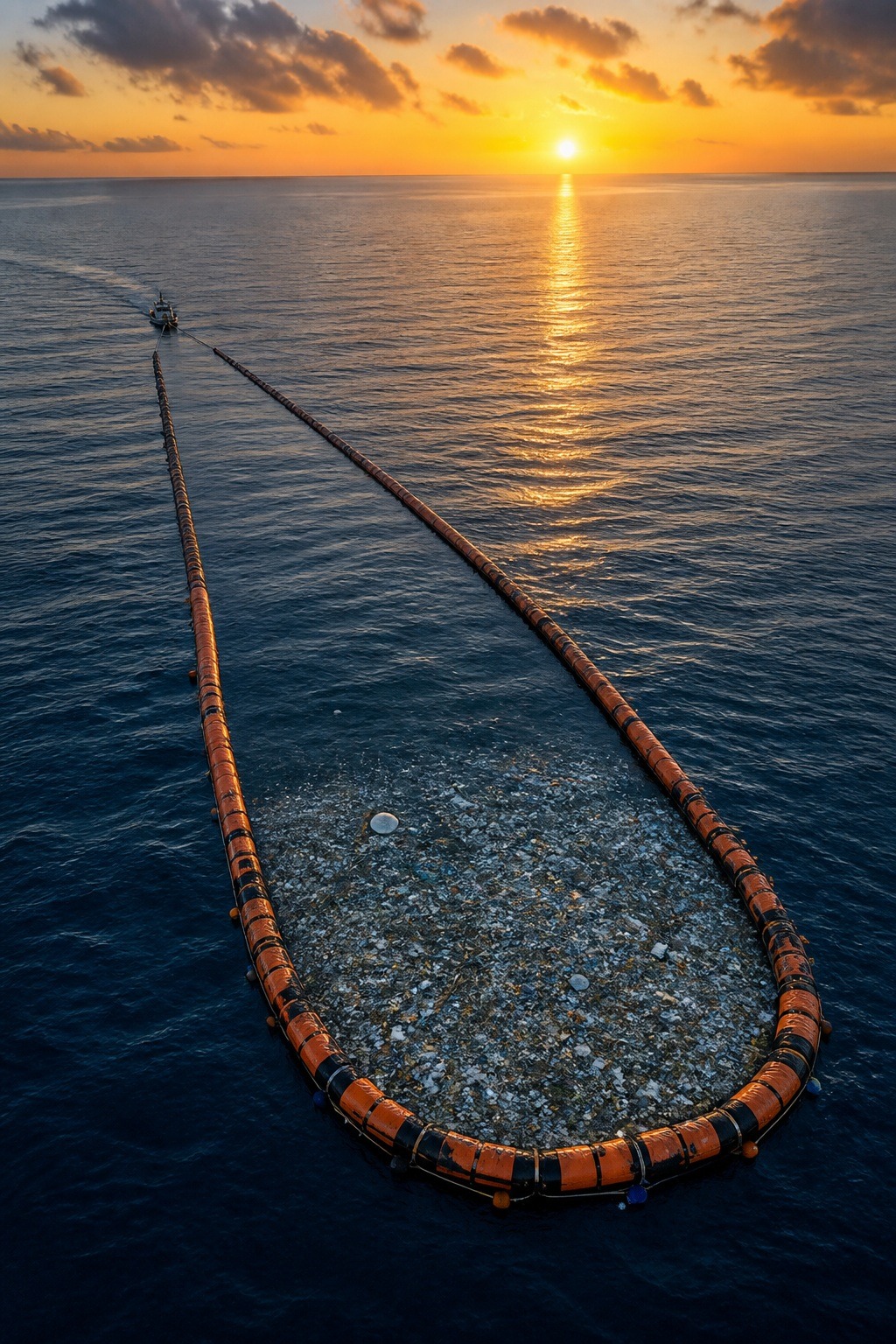
The single biggest question about the world’s most famous plastic-fishing project — is the ocean cleanup actually working — got its loudest answer on 10 August 2023, when one U-shaped array dragged roughly 11 tonnes of trash (about 25,000 pounds) out of the Great Pacific Garbage Patch in a single extraction. It was the largest one-off haul the organisation had ever recorded, part of nearly 50 tonnes pulled from the water over four weeks. A record. A genuinely good day. And, on its own, almost nothing.
Bottom line: Yes, The Ocean Cleanup really does remove real plastic from the real ocean — millions of kilograms of it — but the patch is refilling faster than any fleet of its current size can empty it, so “working” depends entirely on what you’re asking the machine to do.
- ~11.3 tonnes (25,000 lb) — largest single extraction, 10 Aug 2023
- ~79,000 tonnes / 1.8 trillion pieces — plastic floating in the Great Pacific Garbage Patch (Lebreton et al., 2018)
- ~1.6 million km² — the patch’s area, roughly three times the size of France
- 0.8–2.7 million tonnes a year — plastic rivers alone carry to sea (Meijer et al., 2021) — on the order of 3,000 kg every minute
- 45+ million kg — total removed by The Ocean Cleanup across all operations by the end of 2025; the 50-million-kg mark fell in March 2026
Key Facts
- The largest single extraction was about 11.3 tonnes (25,000 lb) on 10 August 2023 by System 02, nicknamed Jenny.
- The Great Pacific Garbage Patch holds roughly 79,000 tonnes / 1.8 trillion pieces over about 1.6 million sq km (Lebreton et al., 2018).
- Rivers alone deliver 0.8-2.7 million tonnes of plastic a year, around 3,000 kg every minute (Meijer et al., 2021).
- The Ocean Cleanup, founded by Boyan Slat in 2013, had removed over 45 million kg by the end of 2025, passing 50 million kg in March 2026.
- System 03’s barrier is around 2.2 km, about three times the size of Jenny.
In short: The Ocean Cleanup genuinely removes plastic, a record 11 tonnes in one 2023 haul and over 45 million kg total by the end of 2025. But rivers add roughly 3,000 kg of plastic to the sea every minute, so the current fleet cannot empty the Great Pacific Garbage Patch faster than it refills.
11 Tons in One Haul: Is the Ocean Cleanup Actually Working?
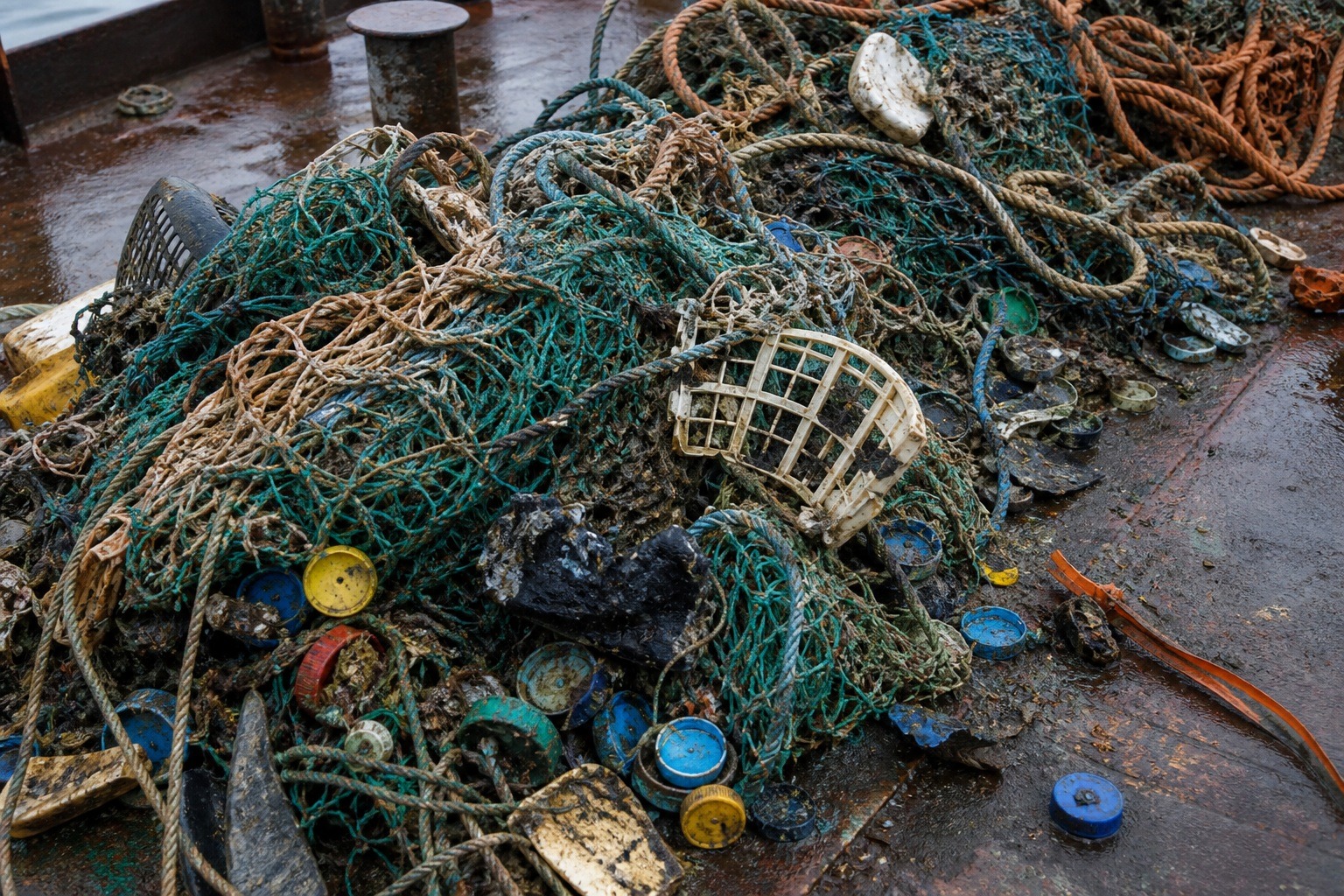
Start with what is not in dispute. On that August day, the system known as “Jenny” surfaced with about 25,000 pounds of plastic in one closing of its net — bottle caps, crates, fragments, and a great tangle of rope. Alex Tobin, then the organisation’s head of PR, told ABC News something you rarely hear from a company: “Our goal is to kind of put ourselves out of business.” The plastic was real. The tonnage was measured, not modelled.
So the honest reply to “is the ocean cleanup actually working” is not a simple yes or no. As a machine that physically extracts plastic, it works — it has done so, repeatedly, for years. Whether it is winning is a different question, and the answer to that one is buried in arithmetic most cheering headlines skip.
Founded by Dutch inventor Boyan Slat in 2013, The Ocean Cleanup set out to do the thing every oceanographer said was impractical: sweep the open sea. That it has hauled tonnes of plastic ashore at all is, by the standards of 2013, a small miracle. What that miracle amounts to against the scale of the problem is where the story gets uncomfortable.
1.8 Trillion Pieces: The Patch Is a Soup, Not an Island
First, kill the mental image. The Great Pacific Garbage Patch is not a floating landfill you could walk across. A 2018 survey led by oceanographer Laurent Lebreton and colleagues at The Ocean Cleanup, published in Scientific Reports, put it at roughly 79,000 tonnes of buoyant plastic — around 1.8 trillion individual pieces — smeared across some 1.6 million square kilometres of the North Pacific between Hawaii and California.
Three times the area of France, and yet mostly invisible. Average the mass across that expanse and you get roughly 50 kilograms of plastic per square kilometre — a dilute, sun-shattered “plastic soup,” heavy on microplastics you could sail straight through without noticing. The NOAA Marine Debris Program describes it as the largest of five gyres where currents concentrate floating waste.
That geometry matters, because it’s what makes cleanup so hard. You are not scooping a pile. You are filtering a swimming-pool-thin scatter of plastic out of an ocean the size of a continent, one slow pass at a time.
{IMAGE_2}
A Football Field Every Five Seconds: How the Array Works
The engineering is elegantly lazy, and that’s the point. Instead of chasing plastic with engines, two vessels tow a long, U-shaped floating barrier — a curtain hanging about three metres beneath the surface — in a wide, slow arc. Wind and current push the top layer of water (and its plastic) toward the mouth of the U. Debris funnels into a retention zone at the far end, which is hauled up and emptied when full. The system skims only the top few metres, where buoyant plastic rides, and is steered toward the densest hotspots using satellite and modelling data.
The record haul came from System 02, nicknamed “Jenny,” an array of roughly 800 metres. Its successor, System 03, is the reason 2024 became a record year: a barrier around 2.2 kilometres end to end — nearly three times Jenny’s size — capable, the organisation says, of sweeping an area equal to a football field every five seconds. Here is how the two generations compare.
| Feature | System 02 “Jenny” | System 03 |
|---|---|---|
| Barrier length | ~800 m | ~2.2 km |
| Relative size | baseline | ~3× larger |
| Service window | 2021–2023 | 2024 onward (workhorse) |
| Plastic removed from GPGP | ~283,000 kg over ~2 years | drove 112 extractions in 2024 |
3,000 Kilograms a Minute: The Uncomfortable Math
Now the part the celebratory videos leave out. Rivers alone deliver an estimated 0.8 to 2.7 million tonnes of plastic to the ocean every year — a figure from a 2021 study, again led by researchers at The Ocean Cleanup and published in Science Advances, which found that more than 1,000 rivers account for about 80% of it. Take the middle of that range, roughly 1.7 million tonnes annually, and it works out to something near 3,000 kilograms entering the sea every single minute. And that’s rivers only; total inputs from all sources run higher still.
Hold that against the record. The biggest single haul in the organisation’s history — 11 tonnes — is matched by fresh riverine inflow in under four minutes. Judged as a machine meant to empty the patch faster than the world fills it, the current fleet is losing badly; judged as proof that ocean-scale cleanup is physically possible at all, it has already won. Both statements are true, and holding them at once is the only honest way to answer the question.
This is exactly why critics push back. Dr. Melanie Bergmann of Germany’s Alfred Wegener Institute has become the best-known scientific voice for the “turn off the tap” camp, arguing with a now-famous analogy: if the bathtub is overflowing, you shut off the faucet before you start mopping the floor. Her point is not that removal is worthless — it’s that every euro spent skimming the surface is a euro not spent stopping plastic at the river mouth, where it is cheaper to catch.
75% From Fishing Gear: Where the Plastic Really Comes From
Here’s the detail that reframes the whole “turn off the tap” argument, and almost nobody puts it next to the cleanup story. When Lebreton’s team weighed the large debris in the patch, household waste was not the main culprit. By mass, roughly 46% of it was fishing nets and ropes, and between 75% and 86% of the large floating pieces — anything bigger than five centimetres — traced back to abandoned, lost, or discarded fishing gear. Lebreton himself called the 46% figure “unexpectedly high,” having expected something closer to 20%.
The origins cluster tightly. Japan and China each contributed about a third of the identifiable debris, South Korea around 15%, the United States roughly 5%, and Taiwan about 3%. So the patch, at least at the visible end, is less a monument to plastic straws than to industrial fishing — “ghost gear” that keeps drowning wildlife long after it’s cut loose.
That changes what “the tap” even means. Turning it off isn’t only about riverside waste plants in Southeast Asia; it’s also about the fisheries losing nets in the open Pacific, a source no riverbarrier will ever intercept.
From Dock to Sunglasses: What Happens to the Plastic
So the boat comes in. Then what? Once landed, the catch is sorted, cleaned, and — the parts that can be — recycled. The Ocean Cleanup has turned some of its verified Great Pacific Garbage Patch plastic into branded products, most visibly a run of sunglasses, using the proceeds to help fund operations. It’s a neat loop on paper: trash becomes a desirable object becomes money for more cleanup.
The honest caveat is that ocean plastic is miserable feedstock. Years of sun, salt, and mechanical grinding leave it brittle, contaminated, and mixed — far harder to recycle than clean factory scrap, and only a fraction closes into genuinely circular products. Much of what’s recovered is degraded enough that “recycling ocean plastic” means downcycling or careful disposal, not an endless bottle-to-bottle loop. The branded goods are better understood as a fundraising and awareness tool than as proof the material fully returns to use.
The 2040 Goal and the $7.5 Billion Question
The organisation’s stated ambition is enormous: remove 90% of floating ocean plastic by 2040. For the patch specifically, it has argued the Great Pacific Garbage Patch could be cleared in roughly ten years for about $7.5 billion, or faster — around five years — for closer to $4 billion, if the money and the scaled-up fleet arrive.
Whether that’s a forecast or a hope depends on funding, on how System 03 and its successors scale, and on whether the fishing-gear tap and the river tap can be closed in parallel. For perspective, the running total across all The Ocean Cleanup operations — oceans and river “Interceptors” combined — passed 45 million kilograms by the end of 2025 and crossed 50 million in March 2026. Impressive. Also a reminder that only a slice of that came from the patch itself, whose 79,000 tonnes still dwarf what any single record haul removes. (A slower, stranger form of help may already be underway out there, too: researchers have documented marine fungi beginning to colonise and break down floating plastic — a natural process explored in our piece on the fungus quietly eating the Great Pacific Garbage Patch.)
Quick Answers
How much plastic has The Ocean Cleanup removed? Across all operations — ocean systems plus river Interceptors — more than 45 million kilograms by the end of 2025, passing 50 million in March 2026. Only part of that came from the Great Pacific Garbage Patch itself.
Does the ocean cleanup actually work? Yes as a removal machine — it demonstrably pulls tonnes of real plastic from the sea. But new plastic enters the ocean far faster than the current fleet removes it, so it is not yet “winning” against inflow.
Where does the collected plastic go? It’s sorted and, where possible, recycled — some verified patch plastic has been made into branded products like sunglasses. Much of it is too degraded for true circular recycling.
What is most of the Great Pacific Garbage Patch made of? By mass, largely fishing gear: about 46% nets and ropes, with 75–86% of large debris from abandoned or lost fishing equipment.
Sources
- Lebreton et al. (2018), “Evidence that the Great Pacific Garbage Patch is rapidly accumulating plastic,” Scientific Reports
- Meijer et al. (2021), “More than 1,000 rivers account for 80% of global riverine plastic emissions into the ocean,” Science Advances
- The Ocean Cleanup — official operations data, milestones, and System 02/03 specifications
- ABC News (August 2023) — report on the record 25,000-pound extraction, with comments from Alex Tobin
- Dr. Melanie Bergmann, Alfred Wegener Institute — scientific critique of surface removal versus source reduction
- NOAA Marine Debris Program — background on the Great Pacific Garbage Patch and ocean gyres
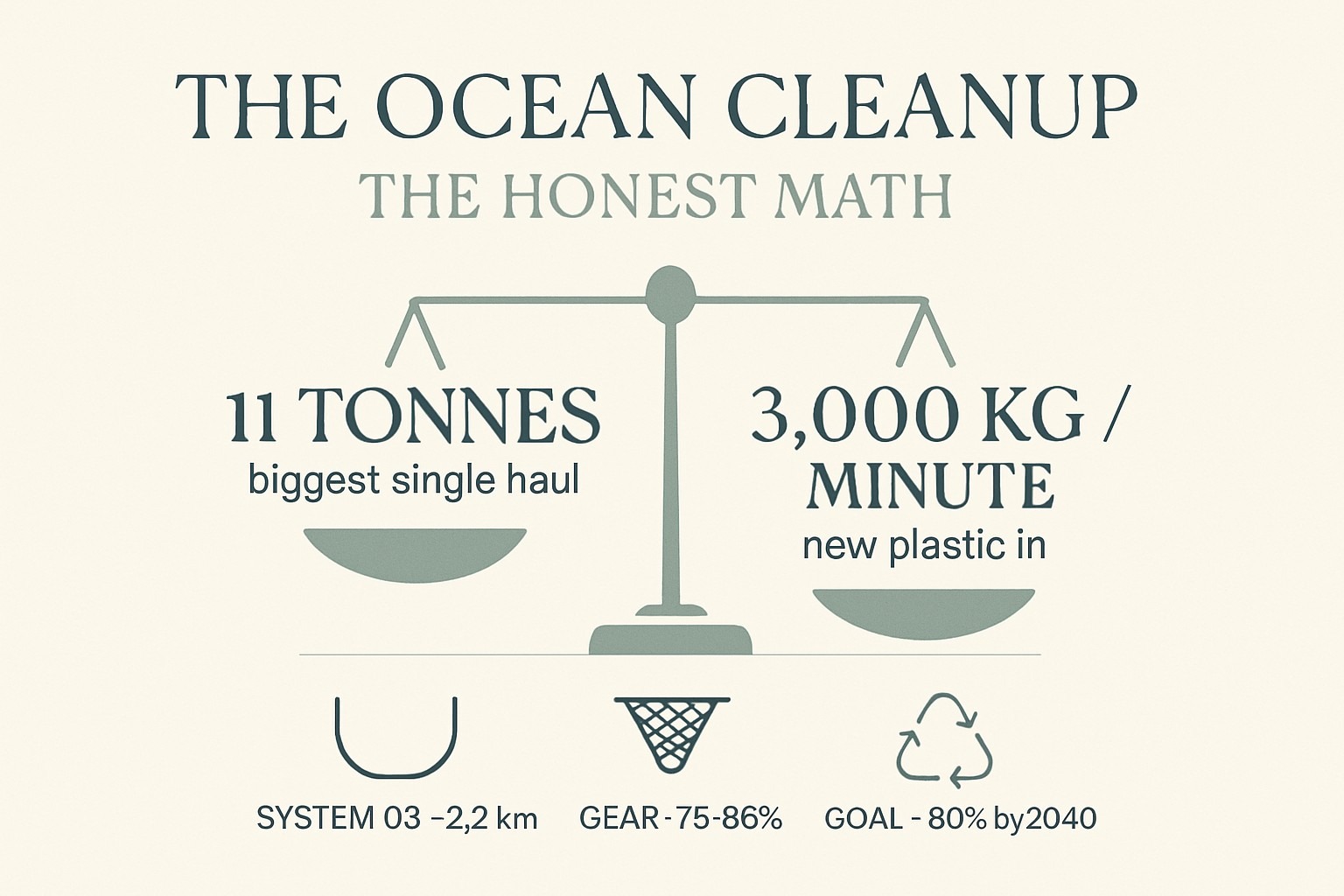
The most useful way to watch The Ocean Cleanup from here is to stop asking whether it will “clean the ocean” and start asking whether it can scale faster than the tap runs — while that tap, from rivers to lost fishing nets, actually gets turned down. The 11-tonne haul proved the hard part is possible. The next decade will decide whether possible ever becomes enough.
Frequently Asked Questions
Q: Is the Ocean Cleanup actually working?
It depends what you ask of it. As a machine that physically extracts plastic, yes, it has hauled tonnes ashore repeatedly, over 45 million kg by the end of 2025. But judged against the scale of the problem, the patch refills faster than the current fleet can empty it, so it is best seen as proof that ocean-scale cleanup is physically possible rather than a solution on its own.
Q: What is the Great Pacific Garbage Patch?
Not a solid island but a dilute plastic soup. A 2018 survey led by Laurent Lebreton put it at roughly 79,000 tonnes of buoyant plastic, about 1.8 trillion pieces, smeared across some 1.6 million square kilometres, three times the area of France. Averaged out, that is only about 50 kilograms per square kilometre, mostly sun-shattered microplastics you could sail through unnoticed.
Q: How does the cleanup system work?
Two vessels tow a long U-shaped floating barrier, a curtain hanging about three metres deep, in a slow arc. Wind and current push surface plastic toward the mouth of the U, where it funnels into a retention zone that is emptied when full. The record haul came from the roughly 800 m System 02, Jenny; System 03’s barrier is around 2.2 km, about three times larger.
Q: Why can’t the Ocean Cleanup keep up?
Arithmetic. A 2021 study led by Ocean Cleanup researchers found rivers alone deliver 0.8 to 2.7 million tonnes of plastic to the sea each year, around 3,000 kilograms every minute. The organisation’s biggest single haul of 11 tonnes is matched by fresh riverine inflow in under four minutes, so the current fleet is losing the race even as it removes real plastic.
Illustrations are AI-generated. Article fact-checked and human-edited. Our editorial standards.